



Is Your AC Keeping Up? Undersized AC Unit Signs and Problems in a South Jersey Home
If you've noticed undersized AC unit signs and problems in a South Jersey home, you're not alone. South Jersey summers hit hard — high humidity, coastal heat, and temperatures that regularly climb into the 90s put enormous demand on home cooling systems. When your AC isn't sized right for your home, it simply can't keep up, and the effects are impossible to ignore.
Here's a quick look at the most common signs your AC unit is undersized:
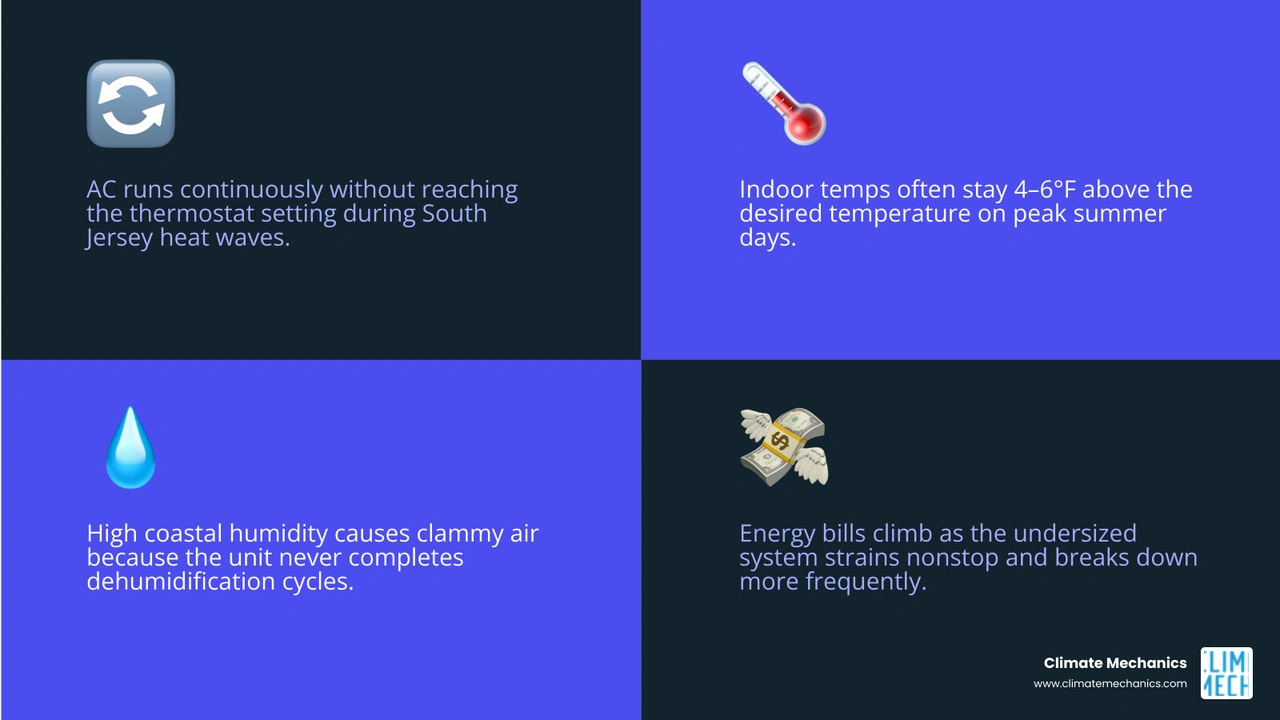
1. AC runs constantly without ever reaching the temperature you set
2. Indoor temperatures stay 4–6°F above the thermostat setting on hot days
3. Certain rooms stay stuffy and hot no matter how low you set the thermostat
4. Indoor humidity feels high and clammy even while the system is running
5. Energy bills keep climbing despite no real improvement in comfort
6. The system breaks down more often than it should
7. Cooling gets noticeably worse during peak afternoon heat
These aren't just comfort complaints — they're warning signs that your system is working far beyond its capacity, wearing itself out, and costing you more money every month.
South Jersey's coastal climate makes this problem especially serious. Atlantic and Cape May Counties regularly see relative humidity above 60–70% in summer. A properly sized AC doesn't just cool the air — it removes moisture too. When the unit is too small, it runs nonstop without ever completing a proper dehumidification cycle, leaving your home feeling muggy and uncomfortable even on days when the system never shuts off.
The good news? Once you know what to look for, the problem is diagnosable — and fixable.
Undersized ac unit signs and problems in a south jersey home terms at a glance:
• ac never reaches set temperature during a south jersey heat wave what is wrong
• ac running constantly in new jersey summer heat
• how high humidity in the delaware valley makes your ac work harder than dry climates
Key Undersized AC Unit Signs and Problems in a South Jersey Home
When you live in communities like Haddonfield, Cherry Hill, or Marlton, your home is your sanctuary from the intense mid-Atlantic summer heat. However, if your cooling system lacks the necessary capacity, that sanctuary can quickly feel like a sauna. Identifying an undersized air conditioner early can save you from months of discomfort and high utility bills.
Continuous Operation Without Relief
One of the most obvious signs of a capacity issue is an air conditioner that runs all day without stopping. In normal conditions, a properly sized system operates in cycles of 15 to 30 minutes, turning off once it satisfies the thermostat.
When a system is too small, it has to work continuously to combat the heat entering your home. If you notice your unit running from sunrise to well past sunset without a break, you are likely experiencing the classic symptoms detailed in our guide on Why Does My AC Run All Day Without Stopping in a South Jersey Summer.
The Thermostat Gap
If you set your thermostat to a comfortable 72°F, but the indoor display stubbornly hovers at 77°F or 78°F all afternoon, your system is struggling. This gap between your desired temperature and the actual indoor temperature is a clear sign of AC Not Responding to Temperature Adjustments. An undersized unit lacks the British Thermal Unit (BTU) capacity to offset the heat load penetrating your walls, roof, and windows during peak hours.
Persistent Hot Spots and Uneven Cooling
Do you have a second story in your Collingswood home that feels like an attic, or a sunroom in Willingboro that never cools down? While poor ductwork or inadequate insulation can play a role, an undersized system worsens these issues.
Because the air conditioner cannot generate enough cool air volume, the rooms furthest from the indoor blower unit remain warm, stuffy, and uncomfortable. The system satisfies the immediate area around the thermostat but fails to push adequate cooling to the rest of the house.
Comparing Sizing Discrepancies
To help you understand if your comfort issues stem from an undersized unit or a completely different sizing error, look at how the symptoms compare:
• Cycle Length — Undersized AC System: Runs continuously for hours without stopping. — Oversized AC System: Short-cycles (turns on and off every 5–10 minutes).
• Thermostat Accuracy — Undersized AC System: Struggles to reach the set temperature. — Oversized AC System: Reaches the set temperature too quickly, then shuts off.
• Humidity Control — Undersized AC System: Poor; runs constantly but cannot lower humidity effectively. — Oversized AC System: Very poor; shuts off before it can remove moisture, leaving air clammy.
• Energy Bills — Undersized AC System: Extremely high due to nonstop electrical consumption. — Oversized AC System: High due to frequent power spikes during constant startups.
• Wear and Tear — Undersized AC System: Accelerated wear on the compressor and fan motors from long runtimes. — Oversized AC System: High stress on starting components (ignitors, contactors, compressors).
• Temperature Distribution — Undersized AC System: Persistent hot spots in distant or upper-level rooms. — Oversized AC System: Drastic temperature swings and cold blasts of air.
How Coastal Humidity and Climate Exacerbate Sizing Issues
South Jersey’s geography plays a massive role in how our heating and cooling systems perform. Positioned between the Delaware River and the Atlantic Ocean, towns like Pennsauken, Audubon, and Burlington experience high levels of humidity. When the air is thick with moisture, your air conditioner has to work twice as hard.
An air conditioner has two primary jobs: lowering the air temperature (sensible cooling) and removing moisture from the air (latent cooling).
When warm, humid air passes over the cold evaporator coils of your AC, the moisture condenses onto the coils and drains away. This process is essential because high humidity makes the air feel much hotter than it actually is.
If you have an undersized unit, it is constantly overwhelmed by the sheer volume of moisture in the air. Because the system is running at its absolute limit just trying to lower the temperature, it cannot keep up with the heavy moisture load.
This leads to a situation where your AC Running Constantly in New Jersey Summer Heat still leaves your home feeling muggy, sticky, and clammy.
Furthermore, when indoor relative humidity levels consistently stay above 50%, it creates an ideal breeding ground for mold, mildew, and dust mites. This can negatively impact your indoor air quality and trigger respiratory issues for your family. Proper system sizing is your first line of defense against these humid coastal climate challenges.
Long-Term Consequences of Ignoring an Undersized AC
It can be tempting to ignore a struggling air conditioner, especially if it manages to keep the house "tolerable" on milder days. However, forcing an undersized system to run throughout the summer can lead to serious mechanical and financial consequences.
Frozen Evaporator Coils
It sounds counterintuitive, but an air conditioner that is too small can actually freeze up. Because the system runs continuously without a break, the temperature of the evaporator coil can drop below freezing.
When humid indoor air comes into contact with this freezing coil, the moisture turns to ice. As ice builds up, it blocks airflow entirely, causing the system to blow warm air or shut down completely. If you notice ice on your indoor or outdoor lines, read our guide on AC Freezing Up - What to Know to prevent permanent system damage.
Frequent and Expensive Breakdowns
Operating under constant strain accelerates wear and tear on vital components. The compressor — the heart of your air conditioning system — is not designed to run 24 hours a day.
Continuous operation leads to overheating, electrical failures, and mechanical breakdown. If you find yourself frequently searching for Signs You Need Expert AC Repair, your system’s capacity may be the root cause.
Premature System Lifespan
A standard, well-maintained central air conditioner in South Jersey should last between 12 and 15 years. However, an undersized unit that is constantly overworked may fail much sooner.
When faced with a major component failure on an aging, struggling system, homeowners must ask themselves: Is a 12 to 15 Year Old AC Worth Fixing in a South Jersey Home? In most cases, replacing the unit with a properly sized system is the more practical and cost-effective choice.
Skyrocketing Utility Bills
Running an air conditioner non-stop consumes an incredible amount of electricity. An undersized unit can easily increase your monthly energy bills by 20% to 30% because it never reaches its cycle completion point. You are paying premium rates for a system that isn't even keeping you comfortable.
Sizing It Right: The Science of Manual J Load Calculations
How do you avoid the trap of buying an improperly sized air conditioner? The answer lies in professional, data-driven calculations rather than outdated "rules of thumb."
Many inexperienced contractors still use simple square-footage estimates to size AC units (such as assuming 1 ton of cooling for every 500 square feet). This approach often leads to improperly sized equipment. It completely ignores the unique construction features of your home.
The industry standard for correct HVAC sizing is the ACCA Manual J Load Calculation. This scientific assessment evaluates several critical factors to determine the precise BTU capacity your home requires:
• Insulation Levels: The quality and R-value of the insulation in your attic, walls, and crawlspaces.
• Window Type and Orientation: The number of windows, their efficiency ratings, and which direction they face (south-facing windows introduce significantly more heat).
• Ceiling Heights: High or vaulted ceilings increase the volume of air that needs to be cooled.
• Home Occupancy: The number of people living in the home (human bodies naturally generate heat).
• Heat-Generating Appliances: The location and types of appliances used in the living space.
• Local Climate Data: Specific outdoor design temperatures for South Jersey (such as typical peak summer highs in Maple Shade or Camden).
Once we complete a Manual J calculation, we can confidently select a system that matches your home's exact cooling load.
Before making a purchase, it is also highly beneficial to understand efficiency metrics. You can learn more about how to evaluate these numbers in our guide on How to Compare AC Unit Efficiency Ratings Before Buying in South Jersey, which explains SEER2 ratings and how they impact your long-term comfort and operating costs.
Frequently Asked Questions About AC Sizing
How can I identify undersized ac unit signs and problems in a south jersey home versus other system issues?
It can be tricky to tell the difference between an undersized unit and a system that is simply malfunctioning. For example, a clogged air filter or a duct leak can restrict airflow, making your home feel warm.
Similarly, low refrigerant levels due to a leak can cause your system to blow lukewarm air. If your system is blowing warm air, check out our guide on Why is My AC Blowing Warm Air.
To help narrow down the cause, look for other Spot Signs Air Conditioning Trouble like unusual noises, short-cycling, or frozen lines. If your system is clean, well-maintained, and still running 24/7 without cooling your home, the issue is likely improper sizing.
What are the most common undersized ac unit signs and problems in a south jersey home during peak summer?
During peak July and August heat waves, an undersized AC unit will run continuously without ever cycling off. You will notice that while the system works fine on mild 75°F days, it completely fails to maintain comfort once outdoor temperatures climb past 88°F.
Unlike a healthy system that runs in balanced 20-to-30-minute cycles, an undersized unit will stay on for hours, causing high energy bills and uneven temperatures between floors. To learn more about common operational failures, explore our overview of Common Problems with AC Units.
Can zoning or ductless mini-splits resolve these sizing issues?
If your central air conditioner is significantly undersized, zoning your existing ductwork won't solve the problem. Zoning helps distribute air more efficiently, but it cannot create more cooling capacity than your system is capable of producing.
However, installing a ductless mini-split system can be an excellent way to supplement an undersized system. Mini-splits allow you to cool specific problem areas — like a finished attic, a new home addition, or a hot second-story bedroom — without replacing your entire central AC.
If your central unit is near the end of its lifespan, it may be time to evaluate your options. Read our guide on When to Consider an AC Replacement to find the best path forward.
Conclusion
Living with an undersized air conditioner is a recipe for high energy bills, frequent repair calls, and a clammy, uncomfortable home. In South Jersey's humid climate, having a system that is precisely matched to your home's unique layout and insulation levels is essential.
At Climate Mechanics, we bring over 38 years of NATE and NCI-certified expertise to every home we serve. Whether you are in Maple Shade, Willingboro, Marlton, or Camden, our experienced team can perform a comprehensive Manual J load calculation to determine exactly what your home needs.
If it's time for an upgrade, we'll help you select a system that delivers reliable comfort and outstanding efficiency. To see how a modern, properly sized system pays for itself over time, read our article on How Energy Savings from a New AC Offset Replacement in South Jersey.
Don't spend another summer dealing with high humidity and uneven cooling. Schedule a professional AC evaluation with Climate Mechanics today, and let us restore comfort and peace of mind to your South Jersey home.
