



Why Your AC Runs All Day Without Stopping in a South Jersey Summer
If you've ever wondered why does my AC run all day without stopping in a South Jersey summer, you're not alone — and the short answer is: it's often completely normal, but not always.
Quick Answer: Common Reasons Your AC Runs Non-Stop in South Jersey
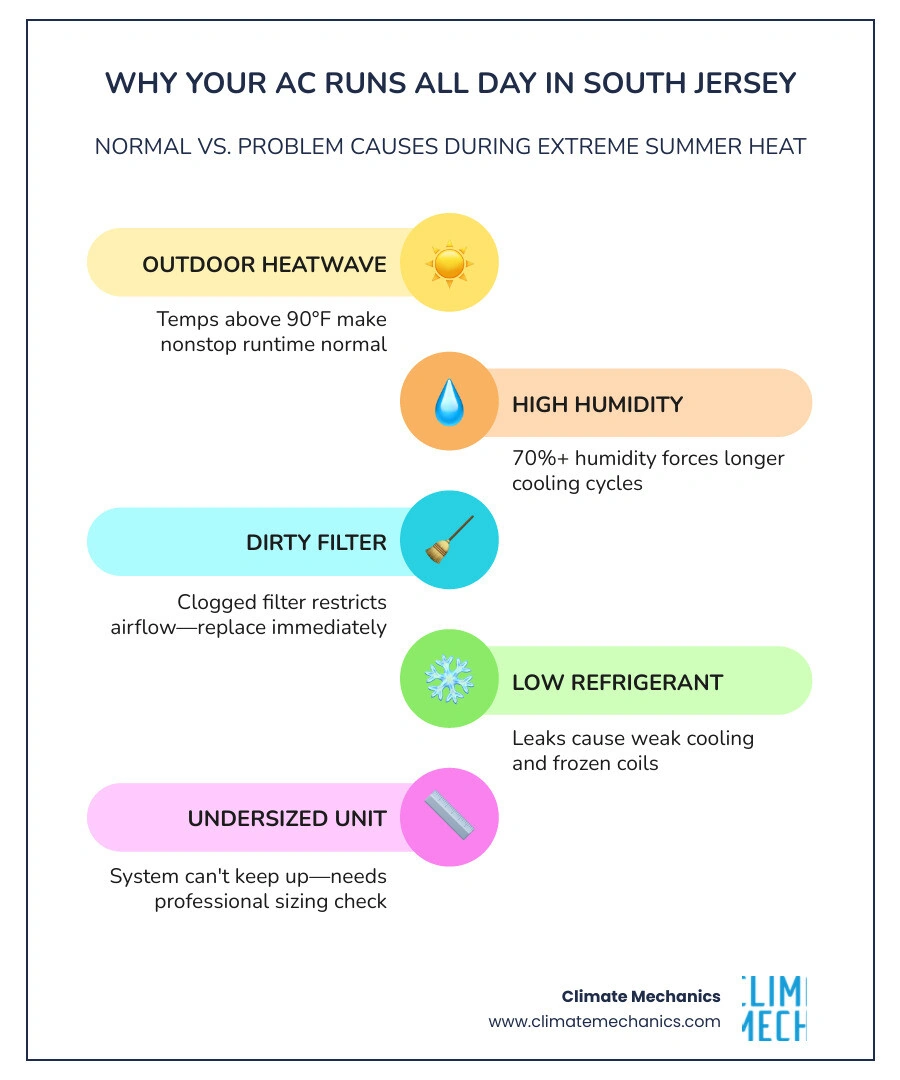
• Outdoor temps above 90°F during a heat wave — Normal or a Problem?: Normal
• High humidity making the air feel hotter — Normal or a Problem?: Normal
• Dirty or clogged air filter — Normal or a Problem?: Problem — fix it now
• Low refrigerant or a leak — Normal or a Problem?: Problem — call a pro
• Frozen evaporator coil — Normal or a Problem?: Problem — turn system off
• Thermostat set too low or malfunctioning — Normal or a Problem?: Problem — check settings
• AC unit is undersized for your home — Normal or a Problem?: Problem — needs evaluation
• Blocked vents or poor airflow — Normal or a Problem?: Problem — check registers
South Jersey summers are no joke. July and August regularly bring temperatures above 90°F, combined with humidity levels that can exceed 70%. That combination puts your cooling system under serious stress — and your AC has to work much harder just to keep your home comfortable.
Here's the thing: a well-maintained system running all day during a heat wave is often doing exactly what it was designed to do. But if your AC is running constantly and your home still feels warm and sticky, something else is going on — and ignoring it can lead to higher energy bills, bigger repairs, or a full system breakdown right when you need it most.
This guide walks you through everything you need to know, from understanding how your system handles extreme heat to spotting the warning signs of a real problem.
Understanding HVAC Design Conditions and the 20-Degree Rule
To understand why your air conditioner seems to run forever, it helps to know a little bit about how HVAC systems are engineered. Many homeowners in places like Marlton and Haddonfield expect their air conditioners to keep their homes at a crisp 68°F even when it is 98°F outside. However, standard residential systems are not designed for those extreme scenarios.
HVAC systems are sized using regional "design conditions." In South Jersey, systems are typically designed based on an outdoor temperature of around 91°F to 92°F to maintain an indoor temperature of 75°F.
There is a physical limit to what your air conditioner can achieve, often referred to as the "20-Degree Rule" or "Delta T." A healthy, properly functioning AC system is designed to lower the temperature of the air by about 16 to 22 degrees as it passes through the cooling coils.
If it is 95°F outside in Collingswood or Audubon, and your thermostat is set to 72°F, your system is pushing past its standard design limit. To keep up, it will run continuously.
Additionally, your air conditioner has two jobs:
1. Sensible Cooling: Lowering the actual temperature you see on the thermometer.
2. Latent Cooling: Removing moisture (humidity) from the air.
In South Jersey's mixed-humid climate (Climate Zone 4A), high humidity means your system has to work incredibly hard to pull gallons of water out of your indoor air before you even begin to feel a temperature drop. If your system is busy fighting high humidity, it has to run much longer to achieve the same cooling effect. If you want to keep your utility bills from skyrocketing during these intense periods, check out these 4 Ways to Lower Your AC Costs This Summer.
Why Does My AC Run All Day Without Stopping in a South Jersey Summer?
When your air conditioner runs continuously, it is trying to keep up with the thermal load of your home. While a properly maintained system can run around the clock without shutting off during a major heat wave, continuous running on milder days (like a comfortable 82°F afternoon) is a clear warning sign.
Constant operation puts immense strain on your compressor, blower motor, and outdoor fan. Over time, this wear and tear can lead to premature system failure, electrical issues, or a frozen system. Understanding the difference between normal heavy-duty summer operation and a mechanical issue is key to preventing system breakdowns. For a broader look at what might be going wrong, explore these Common Problems with AC Units.
Let's break down the environmental and mechanical factors that keep your air conditioner running without a break.
Environmental Factors: Why Does My AC Run All Day Without Stopping in a South Jersey Summer?
Sometimes, the issue isn't inside your air conditioner at all — it's the environment around your home.
• Extreme South Jersey Humidity: Because we live in a coastal-influenced region, humidity levels in towns like Pennsauken and Maple Shade can make a 90-degree day feel like 100 degrees. Your AC has to condense and drain up to 15 gallons of water per day from your indoor air. If the air is thick with moisture, the cooling cycle takes much longer.
• Solar Heat Gain: If your home has large, unshaded windows — particularly west-facing ones — the sun acts like a giant radiator. Rooms with heavy sun exposure can become 5 to 10 degrees warmer than the rest of the house, forcing your AC to run nonstop to balance the temperature.
• Attic Heat Transfer: On a sunny, 90-degree afternoon, your attic space can easily climb above 130°F. If your attic is poorly insulated, or if your ductwork runs through the attic and has compromised insulation, that intense heat will radiate down into your living space and warm up the cool air inside your ducts before it even reaches your vents.
Mechanical Issues: Why Does My AC Run All Day Without Stopping in a South Jersey Summer?
If the weather is mild but your system is still running constantly, you are likely dealing with one of these common mechanical issues:
• Dirty Air Filters: A clogged filter restricts the volume of air flowing through your system. When air can't move freely, the system has to run much longer to distribute enough cool air to satisfy the thermostat.
• Low Refrigerant Levels (Leaks): Your AC does not "consume" refrigerant; it circulates it in a closed loop. If your system is low on refrigerant, it means there is a leak. Low refrigerant prevents the system from absorbing heat efficiently, causing the compressor to run nonstop as it struggles to lower the temperature.
• Frozen Evaporator Coils: When airflow is restricted (by a dirty filter or blocked vents) or refrigerant is low, the temperature of your indoor evaporator coil can drop below freezing. Condensation on the coil turns to ice, completely blocking heat transfer. If you suspect this is happening, read more about AC Freezing Up What to Know.
• Failing Compressor or Electrical Components: A weak capacitor or a failing compressor can prevent your system from reaching its full cooling capacity, leading to weak airflow and warm air coming from your registers. If your system is blowing but not cooling, check out Why Is My AC Blowing Warm Air.
Troubleshooting Steps for Homeowners Before Calling a Professional
Before you pick up the phone to schedule an emergency service call, there are several simple DIY checks you can perform. Sometimes, a constantly running AC is caused by a simple oversight that you can resolve in minutes.
Immediate DIY Checks for Homeowners
To narrow down the cause of your nonstop AC runtime, go through this quick checklist:
• Check the Thermostat Batteries and Settings: Make sure your thermostat isn't set to "On" instead of "Auto." The "On" setting keeps the indoor fan blowing constantly, even when the outdoor compressor is resting, which can make it feel like the system never stops. Also, replace low batteries to prevent "ghost readings" that trick your system.
• Inspect and Replace the Air Filter: If you can't remember the last time you changed your filter, do it now. During peak summer, you should check your filter every 30 days. To find the right fit for your home, read our guide on Choosing the Right Air Filter for Your Home and learn How Often Should You Change Your Air Filter.
• Clear Blocked Registers and Return Vents: Ensure that furniture, drapes, or toys are not blocking your supply registers or return vents. Closing vents in unused rooms is a common mistake; it actually increases duct pressure and can cause your system to work harder or freeze up.
• Clear the Outdoor Condenser Unit: Your outdoor unit needs to "breathe" to release the heat it gathered from inside your home. Clear away tall grass, weeds, leaves, and trash to maintain at least a two-foot clearance zone around the unit. If the metal fins are caked with pollen or dirt, gently rinse them down with a low-pressure garden hose.
When to Schedule Professional AC Repair or Replacement
If you've cleaned your filter, cleared your outdoor unit, and verified your thermostat settings, but your AC still runs 24/7 without cooling your home, it's time to bring in the experts.
As of June 2026, the HVAC industry is navigating major changes, including the ongoing phase-out of R-410A refrigerant. If you have an older system that relies on R-410A and it develops a major refrigerant leak, repairing it can be costly due to dwindling refrigerant supplies.
When deciding whether to repair or replace your constantly running system, we recommend using the 50% Rule: if the cost of the repair exceeds 50% of the value of the system, and the unit is more than 10 to 12 years old, investing in a modern, high-efficiency replacement is usually the smarter long-term financial choice.
Keep an eye out for these critical warning signs that require professional attention:
• Squealing, grinding, or loud clanging noises from the outdoor unit.
• Frequent electrical breakers tripping when the AC starts up.
• Ice forming on the copper refrigerant lines or the outdoor unit.
• A sudden, unexplained spike in your monthly electric bill.
For more details on spotting these issues early, check out Signs You Need Expert AC Repair, read about other Signs AC Unit Needs Professional Attention, and learn how to identify AC Compressor Problems Warning Signs.
Frequently Asked Questions About Constant AC Operation
Is it safe for my AC to run continuously during a heatwave?
Yes, it is generally safe. Modern air conditioning systems are engineered to operate continuously during extreme heat waves to keep up with high thermal loads. In fact, letting your system run in a long, steady cycle is often more energy-efficient and causes less mechanical wear than "short-cycling" (turning on and off every few minutes).
However, this is only true if your system is well-maintained. If your system has dirty coils or low refrigerant, running constantly will eventually overheat the compressor and cause a major breakdown. Learn how to keep your system safe with these 4 Ways to Keep Your A.C Running Properly.
Why is my AC running but the house isn't getting cooler?
If your system is running nonstop but the temperature inside keeps rising, your system is likely experiencing a loss of cooling capacity. This can be caused by a failed outdoor capacitor (meaning the indoor fan is blowing, but the outdoor compressor isn't running to cool the air), a severe refrigerant leak, or heavily leaking ductwork that is dumping cold air into your crawlspace or attic. If your system isn't reacting to your thermostat adjustments, take a look at our guide on AC Not Responding to Temperature Adjustments.
How does a dirty filter affect my cooling system's runtime?
A dirty filter acts like a wall to your HVAC system. When airflow is choked off, your system has to work twice as hard and run much longer to circulate the same amount of cool air. This restricted airflow also causes the temperature of your indoor evaporator coil to plummet, which can lead to a frozen coil and a complete system shutdown. To understand how airflow restrictions impact your entire system, read How Dirty Filter Affects Forced Air Heaters.
Conclusion
A constantly running air conditioner during a scorching South Jersey summer can be stressful, but understanding the difference between normal heavy-duty operation and a mechanical cry for help keeps you in control of your home comfort.
At Climate Mechanics, we bring 40 years of NATE and NCI-certified expertise to every home we service. We proudly serve our neighbors throughout South Jersey, including Marlton, Maple Shade, Camden, Collingswood, Haddonfield, Audubon, Pennsauken, Willingboro, and Burlington.
Whether you need a quick system tune-up to stop your AC from running excessively or a complete system replacement, our team is dedicated to providing personalized, reliable service. Don't wait for your system to break down in the middle of a July heat wave. Protect your home comfort today by exploring our HVAC System Preventative Maintenance plans or scheduling our professional Air Conditioning Services.
