


Preparing for Winter: Navigating Upgrades and Legal Requirements
Are you starting to wonder if your aging furnace will survive another freezing season, making options comparisons for homeowners a sudden priority before the weather turns? As the leaves change and temperatures begin to drop, the urgency of replacing an outdated heating system becomes impossible to ignore. Mid-fall is the last reliable window to secure a new system before freezing weather makes a failing unit a true emergency. However, selecting the right hardware is only half the battle.
For many property owners, the central dilemma lies in choosing between modern heat pumps and high-efficiency gas furnaces. Both technologies offer incredible comfort and energy savings, but they operate very differently. Beyond the mechanical choices, navigating municipal permit requirements is equally critical to a successful project. Installing heating systems without the proper legal documentation can lead to severe consequences down the road.
With the extreme temperature swings of South Jersey—where humid summers quickly give way to bitter, freezing winters—a mid-fall heating startup is the perfect time to evaluate your equipment. In our years of serving the local community, we've found that this guide will walk you through objective comparisons of your heating options, explain exactly why New Jersey requires permits for these upgrades, and outline the steps our team takes for a safe, legally compliant installation.
Why Mid-Fall is the Ideal Window for a Heating System Upgrade
Scheduling a major home improvement project requires careful timing. Waiting for a mid-winter breakdown often limits your choices and forces rushed decisions. Taking action in October provides significant logistical and comfort-based advantages.
1. Avoiding the Emergency Freeze: Proactive replacements prevent dangerous outages during the first major freeze of the year. When temperatures plummet, our local technicians are flooded with no-heat emergency calls. Replacing your system during the shoulder season ensures you are not left waiting for parts in a freezing house.
2. Favorable Supply Chain and Scheduling: Before the peak winter rush hits, supply chain availability is generally much stronger. We have access to a wider variety of models and efficiency tiers, making it easier to select the perfect unit rather than settling for whatever is currently sitting in a local warehouse. Furthermore, securing a convenient installation date with our crew is significantly easier in the fall.
3. Predictable Permit Turnaround Times: Municipal permit offices experience their own seasonal rushes. During the mid-fall shoulder season, we typically see that local construction offices have more predictable turnaround times for reviewing applications and scheduling inspections. This keeps your project moving smoothly from start to finish.
4. Complete Peace of Mind: Testing a brand-new system during mild autumn weather allows our technicians to calibrate the airflow, check the thermostat response, and ensure perfect operation. The ultimate peace of mind comes from knowing your home is protected by a fully tested, legally permitted system long before the snow begins to fall. If you are considering a furnace replacement in Cinnaminson, acting now guarantees a stress-free winter.
The Short Answer: Do You Need a Permit for HVAC Replacement in NJ?
The definitive answer is yes—New Jersey strictly requires permits for replacing major HVAC components. Whether you are swapping out an old gas furnace or installing a brand-new heat pump system, the state mandates that the work be documented, reviewed, and inspected. Permits are not just bureaucratic red tape; they are essential safeguards that ensure your new system meets all current safety, electrical, and energy efficiency codes.
At Climate Mechanics, our team intimately understands Burlington County and Cinnaminson permit requirements. Unlike big-box corporate services that might overlook regional nuances, our local experts ensure a hassle-free, compliant process from application to final inspection. You can also read more about the specific permit requirements to replace your AC in New Jersey to understand how cooling systems share similar regulatory steps.
State vs. Municipal Requirements in Burlington County
The New Jersey Uniform Construction Code (UCC) sets the baseline safety requirements for the entire state. However, the actual enforcement, application processing, and physical inspections are handled at the municipal level. This means that the specific paperwork and processing timelines in Cinnaminson NJ may differ slightly from a neighboring township. Timelines vary heavily depending on the local municipal office's current workload, which is another reason why we highly recommend starting the process in mid-fall.
What the Permit Process Actually Looks Like
When you work with us, our licensed contractors handle the entire permit application process on your behalf. First, we submit detailed technical specifications, load calculations, and equipment models to the local construction office. Once the township reviews and approves the application, the permit is issued, and the installation of the new system can begin. Finally, after the equipment is running, we schedule a final inspection with a municipal official. The inspector verifies that all gas lines, electrical connections, and venting meet safety codes before officially closing out the permit.
The Hidden Dangers of Unpermitted Installation Work
Attempting to bypass the legal permit process to save a little time or money is one of the most dangerous mistakes a property owner can make. The risks extend far beyond a simple slap on the wrist. Unpermitted work compromises your safety, your finances, and your property value.
• Municipal Fines and Stop-Work Orders: If a local code enforcement officer discovers unpermitted work occurring on your property, they can issue an immediate stop-work order. You may face steep municipal fines, and you will still be required to pay for the permits—often at a penalty rate—before the project can resume.
• Voided Homeowner's Insurance: This is perhaps the most significant financial risk. If an unpermitted gas furnace causes a fire, or an uninspected electrical connection on a heat pump shorts out, your homeowner's insurance policy may refuse to cover the damages. Insurance companies require proof that major home systems were installed legally and inspected by municipal authorities.
• Complicated Real Estate Transactions: When it comes time to sell your home in Cinnaminson NJ, unpermitted work almost always surfaces. Buyers' home inspectors are trained to look for updated equipment and will request the corresponding permit records. If the town has no record of the installation, the buyer may demand that you retroactively pull permits, pay for exhaustive inspections, or lower the asking price significantly.
• Severe Safety Hazards: Beyond the financial and legal headaches, skipping permits puts your family at physical risk. High-voltage electrical connections require precise gauge wiring and proper breaker sizing. Gas lines must be perfectly sealed and vented to prevent carbon monoxide leaks. A municipal inspection acts as a critical second set of eyes to ensure the installation is completely safe. This applies to heating as well as any future AC replacement you might plan for the summer.
Weighing Your Options: Heat Pumps vs. High-Efficiency Gas Furnaces
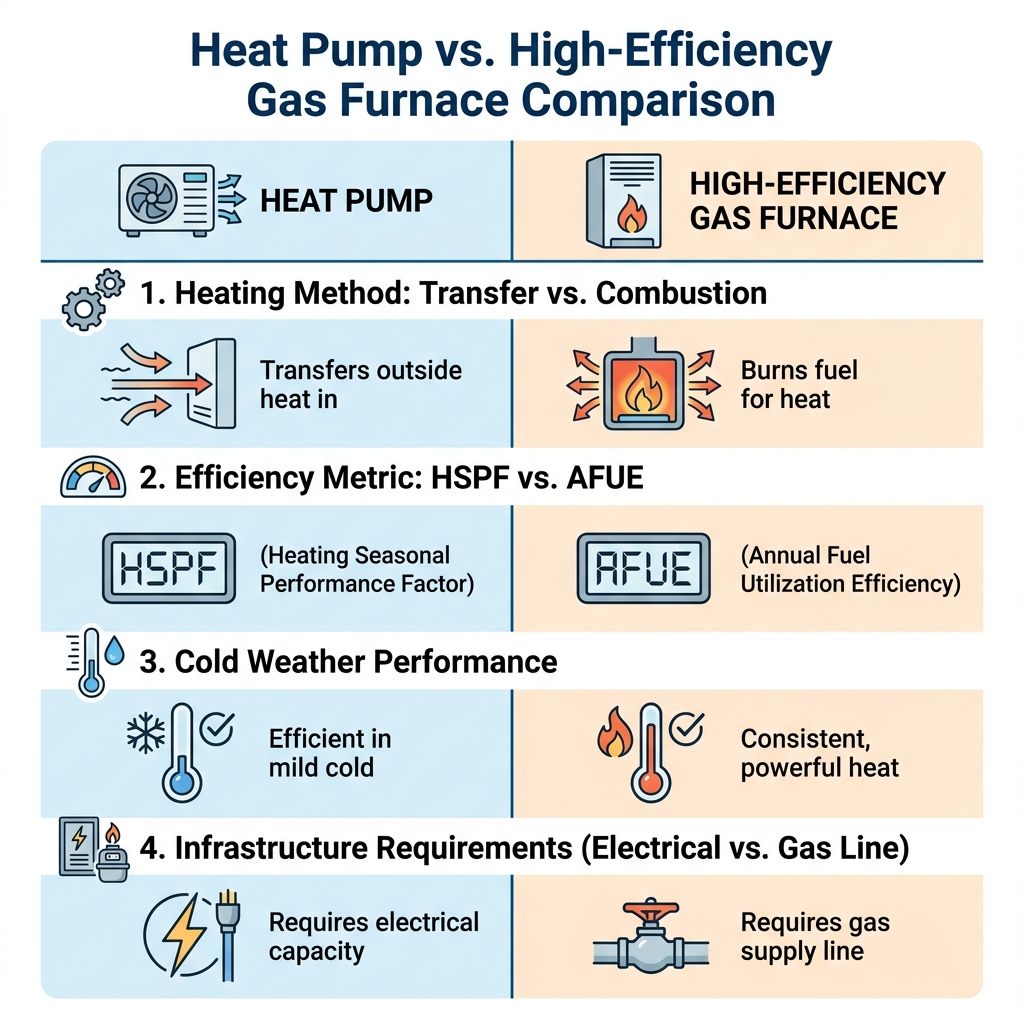
Once you understand the legal landscape, the next step is choosing the right technology for your home. The two primary contenders for modern heating upgrades are heat pumps and high-efficiency gas furnaces. While both are exceptional at keeping homes warm, they achieve that goal using entirely different mechanical processes. A heat pump transfers ambient heat from the outside air into your home, while a gas furnace generates heat through the controlled combustion of fossil fuels.
To make the best decision for your mid-fall heating startup, it helps to see the differences laid out clearly.
• Heating Method — Modern Heat Pump: Transfers heat from the outside air indoors. — High-Efficiency Gas Furnace: Generates heat via combustion of natural gas or propane.
• Efficiency Metric — Modern Heat Pump: HSPF (Heating Seasonal Performance Factor). — High-Efficiency Gas Furnace: AFUE (Annual Fuel Utilization Efficiency).
• Cold Weather Performance — Modern Heat Pump: Highly efficient, but may run longer cycles in extreme cold. — High-Efficiency Gas Furnace: Produces rapid, intense heat regardless of outdoor temperatures.
• Infrastructure Needed — Modern Heat Pump: Requires dedicated high-voltage electrical circuits (often 200-amp service). — High-Efficiency Gas Furnace: Requires active gas lines and proper exhaust venting (flues).
• Maintenance Needs — Modern Heat Pump: Bi-annual checks (operates year-round for heating and cooling). — High-Efficiency Gas Furnace: Annual safety checks focusing on combustion and carbon monoxide risks.
Customer service and careful selection apply to any major system replacement. For instance, last fall, a local homeowner reached out to our team during an early cold snap when their aging furnace suddenly failed. We helped them select a new unit that could handle the extreme winter weather ahead and explained the replacement process in detail. The new unit was quickly and professionally installed to keep the family comfortable. That same careful, consultative approach is exactly what we provide when helping you compare heating options before winter.
Assessing Energy Efficiency and Climate Suitability
Historically, homeowners in colder climates hesitated to install heat pumps, fearing they would freeze up when temperatures dropped. However, technology has advanced dramatically. Current Department of Energy guidelines regarding heat pump efficiency in freezing temperatures validate them as a highly viable option for New Jersey winters. Modern cold-climate heat pumps can extract heat from the air even when it is well below freezing outside. Conversely, high-efficiency gas furnaces remain a powerhouse for rapid, intense heating, making them ideal for homes that experience deep, sustained freezes and already have robust gas infrastructure.
Long-Term Maintenance and Lifespan Expectations
Because a heat pump serves as both your air conditioner in the summer and your heater in the winter, it runs year-round. This constant operation requires diligent bi-annual maintenance by our technicians to keep the coils clean and the refrigerant levels optimized. Gas furnaces, on the other hand, sit dormant for half the year. However, their pre-winter maintenance requires strict safety checks to ensure the heat exchanger is intact and there are no carbon monoxide risks from the combustion process.

How Electrification Changes the Installation and Approval Process
The Problem: Many property owners want to switch from an older fossil fuel system to a modern, electric heat pump to improve energy efficiency, but they underestimate the infrastructure changes required to support the new hardware.
The Cause: Replacing a gas furnace with a heat pump is rarely a simple one-to-one swap. A traditional gas furnace uses a relatively small amount of electricity just to run the blower motor. A whole-home heat pump relies entirely on electricity to power the compressor and the air handler. Older homes with 100-amp electrical panels often lack the capacity to support this increased electrical load. Additionally, the existing gas lines must be addressed safely.
The Solution: Electrification frequently requires structural or electrical panel upgrades to safely accommodate the new system. These electrical upgrades trigger additional permit requirements and specific municipal inspections by the township's electrical sub-code official. Furthermore, if a home fully electrifies its heating system, a licensed professional must safely cap and decommission the old gas lines.
Because these projects involve multiple trades, a professional assessment is vital. Recently, another customer reached out to us needing a quote and ideas for a complicated full-house HVAC install job utilizing multi-zone heat pumps. One of our lead technicians came out on time to provide a detailed quote and consultation, delivering a prompt plan for the complex installation. Having our experienced professionals evaluate your home's infrastructure before committing to a system type ensures you understand the full scope of the project, including all necessary permits.
Navigating Efficiency Standards and Generic Tax Incentives
Upgrading to a new heating system is a significant investment, but making smart efficiency choices can positively impact your wallet over time. Beyond the monthly utility savings, choosing the right equipment often qualifies homeowners for various incentives.
When evaluating options for your mid-fall heating startup, use ENERGY STAR criteria as your primary benchmark. Systems that meet or exceed ENERGY STAR ratings are verified to consume significantly less energy than standard models. Upgrading to these high-efficiency gas furnaces and heat pumps often qualifies homeowners for federal tax credits aimed at reducing residential energy consumption.
Furthermore, New Jersey has broader state guidelines and clean energy programs that actively encourage electrification and heat pump adoption. While these programs change frequently, they are designed to make high-efficiency upgrades more accessible to the average homeowner. Because individual tax situations and local utility rebate programs vary widely, we strongly advise readers to consult with their tax professional or utility provider to verify current incentive programs and eligibility requirements before finalizing their equipment choice.
Frequently Asked Questions About NJ HVAC Upgrades and Permits
Navigating the transition to a new heating system involves balancing technology choices, local regulations, and safety standards. Whether you are planning a winter furnace upgrade or a future AC installation in Cherry Hill, having clear answers is the best way to prepare. Here are the most common questions property owners ask our team during the process.
Is it better to install a heat pump or a gas furnace in New Jersey?
The best choice depends entirely on your home's existing infrastructure and your specific comfort preferences. Modern heat pumps are incredibly efficient and handle New Jersey winters exceptionally well, offering both heating and cooling in one unit. However, if your home already has robust gas lines and you prefer the rapid, intense heat of combustion, a high-efficiency gas furnace remains an outstanding, reliable choice.
Do you need a permit for HVAC replacement in NJ?
Yes, replacing major HVAC equipment requires a permit under the New Jersey Uniform Construction Code. This legal requirement ensures that all new electrical wiring, gas piping, and ventilation systems are installed safely and meet current efficiency standards. Our licensed contractors will typically handle the application and schedule the municipal inspections on your behalf.
What are the new efficiency standards for furnaces?
Efficiency standards are continually updated to reduce energy consumption and lower utility costs. Modern high-efficiency gas furnaces are measured by their AFUE (Annual Fuel Utilization Efficiency) rating, with top-tier models converting nearly all their fuel directly into usable heat. Looking for the ENERGY STAR label is the easiest way to ensure a new furnace meets the latest federal efficiency criteria.
Does replacing a gas furnace with a heat pump require electrical upgrades?
In many older homes, transitioning from gas to electric heating does require an electrical panel upgrade. Because a whole-home heat pump relies entirely on electricity to run its compressor and air handler, a standard 100-amp service panel may not have the necessary capacity. A professional assessment by our team will determine if you need to upgrade to a 200-amp panel to safely support the new system.
Will unpermitted HVAC work void my homeowner's insurance?
It is highly likely that unpermitted work can compromise your insurance coverage. If a fire, electrical short, or gas leak occurs and traces back to an HVAC system that was installed without municipal permits and inspections, the insurance company may deny the claim. Maintaining valid permits proves that the work was performed legally and verified by a local code official.
How long does the municipal permit process take in South Jersey?
Permit processing times vary significantly by municipality and the time of year. In our experience working in Cinnaminson NJ and surrounding Burlington County townships, the shoulder seasons (like mid-fall or mid-spring) often see more predictable turnaround times. While the paperwork might take anywhere from a few days to a few weeks to be approved, the actual installation can usually commence as soon as the permit is officially issued.
Take the Next Step Toward a Warm, Compliant Home
Whether you ultimately decide that a modern heat pump or a high-efficiency gas furnace is the right fit for your property, one fact remains constant: a legally permitted installation is non-negotiable. Ensuring your system is documented and inspected protects your family's safety, secures your homeowner's insurance, and preserves your property value.
Mid-fall is the absolute optimal time to finalize these options comparisons for homeowners before the bitter cold sets in. Do not wait for a mid-winter breakdown to force your hand. Reach out to our expert team at Climate Mechanics in Cinnaminson NJ. We will evaluate your home's unique infrastructure, recommend the most efficient hardware, and handle the local permit paperwork seamlessly from start to finish.
