



Do You Need a Permit to Replace AC in New Jersey? Here's What the Law Says
Do you need a permit to replace AC in New Jersey? Yes — in almost every case, you do. Under the New Jersey Uniform Construction Code (UCC), replacing an AC unit is classified as "minor work," which requires at minimum a construction permit and prior notice to your local code enforcement agency before work begins.
Quick Answer:
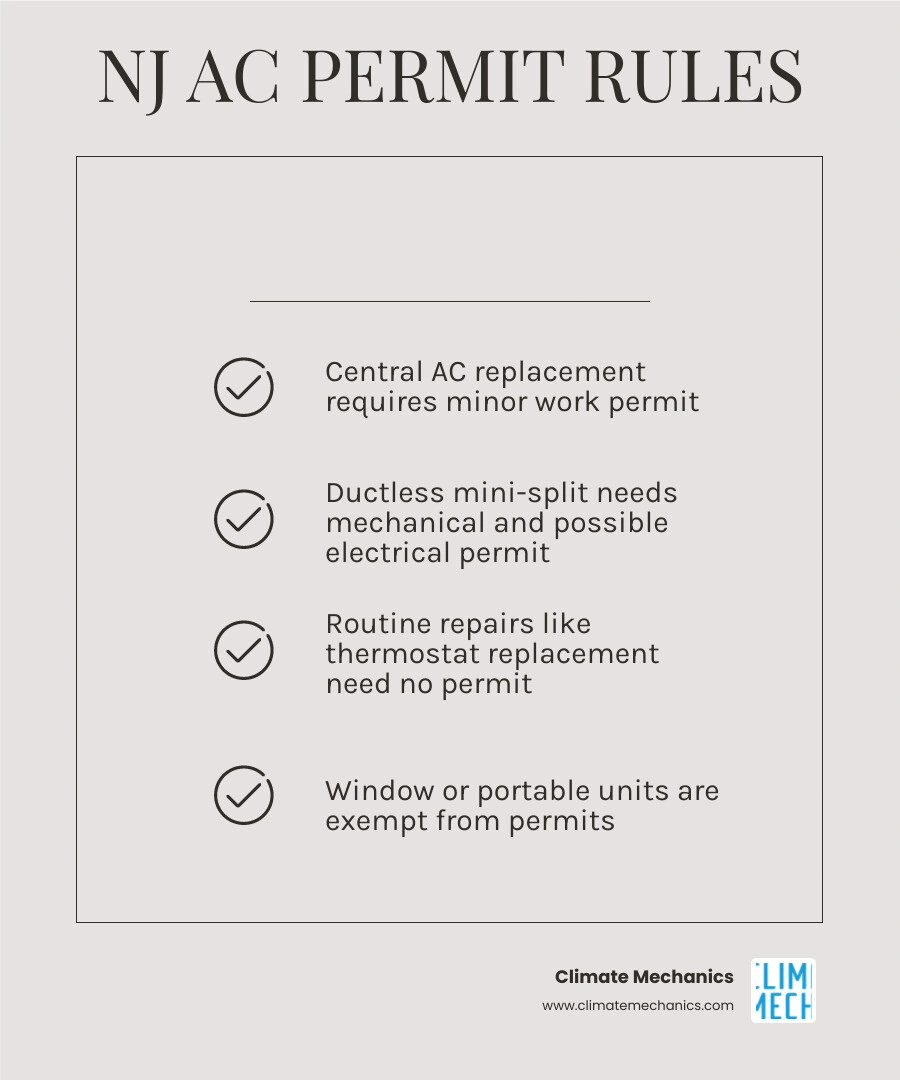
• Replacing central AC (like-for-like) — Permit Required?: Yes — minor work permit
• Installing a new ductless mini-split — Permit Required?: Yes — mechanical + possible electrical permit
• Repairing AC components (capacitor, thermostat) — Permit Required?: No — routine maintenance
• Installing a window or portable unit — Permit Required?: No — exempt
• Upgrading to a larger capacity system — Permit Required?: Yes — full permit + plan review
Many South Jersey homeowners are surprised to learn that even a straightforward swap of an existing unit requires paperwork. It's not just red tape — improper HVAC installations are linked to more than 25% of home fires in the United States. The permit process exists to make sure the work is done safely and up to current code standards.
Skipping this step can lead to serious problems down the road — from failed home inspections during a sale to voided insurance coverage. The good news is that the process is more straightforward than most people expect, especially when you work with a licensed HVAC contractor.
Do You Need a Permit to Replace AC in New Jersey?
To understand the regulations in New Jersey as of June 2026, we have to look at how the state defines different types of home improvement projects. The New Jersey Uniform Construction Code (UCC) divides home services into three main categories: ordinary maintenance, minor work, and major alterations.

Routine tasks like replacing a dirty filter, cleaning the outdoor coils, or swapping out a broken thermostat fall under ordinary maintenance. For these simple fixes, you do not need to contact your local building department or obtain any permits.
However, replacing an entire air conditioning condensing unit or installing a completely new split system is classified as minor work. Under New Jersey law, minor work still requires a permit. The primary benefit of the "minor work" classification is that it allows the installation to begin before the physical permit is officially issued, provided that we give proper oral or written notice to your local municipal enforcement agency first.
If you are wondering When to Consider an AC Replacement, it is vital to factor this permitting step into your timeline. Whether you live in Marlton, Haddonfield, or Collingswood, your local township’s building department enforces these state-level codes to ensure that any new mechanical equipment is safely integrated into your home.
Why do you need a permit to replace ac in new jersey for central systems?
Replacing a central air conditioning system is not as simple as unplugging an old appliance and plugging in a new one. Central systems are complex, high-voltage mechanical systems that connect directly to your home’s electrical panel, ductwork, and drainage infrastructure.
When we replace a central AC system, we must comply with both the Mechanical Subcode and the Electrical Subcode of the New Jersey UCC. The permitting process ensures that:
• The electrical wiring, overcurrent protection (breakers), and outdoor disconnect switches are properly sized to handle the electrical load of the new condenser.
• The refrigerant lines are properly sealed and pressurized to prevent harmful environmental leaks.
• The condensate drain lines are routed correctly to prevent water damage or mold growth inside your home.
This level of oversight is why Why Updating Your HVAC System Is So Important. It guarantees that your investment is safe, operates at peak efficiency, and complies with modern safety standards designed to protect your household from electrical fires and system failures.
Do you need a permit to replace ac in new jersey when installing ductless mini-splits?
Yes, ductless mini-split installations also require permits. While they do not rely on centralized ductwork, they still involve high-voltage electrical connections and the handling of refrigerant lines.
Furthermore, ductless mini-splits often introduce unique layout challenges. Because the outdoor condenser unit must be placed on a pad outside your home, local zoning boards frequently get involved. In many South Jersey communities—such as Audubon, Pennsauken, and Willingboro—zoning ordinances dictate exactly where an outdoor unit can be placed.
These are known as setback requirements, which measure the minimum allowable distance between your outdoor equipment and your neighbor's property line. When applying for a permit to install a mini-split, we often have to submit a copy of your property survey showing the exact proposed location of the condenser to ensure it complies with local zoning laws. To learn more about how these systems are structured, you can read our AC Installation Ultimate Guide.
Understanding the NJ HVAC Permit Requirements
The state of New Jersey bases its mechanical codes on national standards, including the International Mechanical Code (IMC) and the National Electrical Code (NEC). When replacing an AC unit, the system must meet strict energy efficiency and load calculation guidelines.
In New Jersey, we are required to follow specific design standards to make sure your system is sized perfectly for your home:
• Manual J Calculations: This is a comprehensive calculation used to determine the exact heating and cooling load of your home based on square footage, insulation levels, window placement, and local climate data.
• Manual S Sizing: Once we know the load, Manual S guidelines are used to select an air conditioner that matches those exact capacity requirements. Sizing is critical; an oversized unit will short-cycle and waste energy, while an undersized unit will run constantly without cooling your home.
• Manual D Ductwork: If we are modifying or replacing your ductwork during the installation, we use Manual D to ensure proper airflow distribution throughout your living spaces.
Taking these New AC Pre-Installation Steps ensures that your home remains comfortable and that your municipal inspector will sign off on the work without any issues.
Required Documents and Forms
When applying for an AC replacement permit in South Jersey, the paperwork must be filled out precisely. The standard packet submitted to your local construction office includes:
1. The Construction Permit Application Folder: The cover sheet for the entire project.
2. Mechanical Subcode Technical Section: Outlines the specifications of the outdoor condenser and indoor evaporator coil.
3. Electrical Subcode Technical Section: Details the electrical connections, wire sizes, and disconnect switches.
4. Equipment Specifications: Manufacturer "cut sheets" showing the model numbers, efficiency ratings, and electrical requirements of the new units.
5. Zoning Permit Application: Required in many municipalities (like Haddonfield or Burlington) to approve the physical location of the outdoor condenser on your property.
6. Chimney Verification Form: If the AC replacement is done alongside a furnace replacement, this form ensures that the existing chimney venting system is safe and properly sized for the new equipment.
Homeowner vs. Contractor Responsibility
As a property owner in New Jersey, you are ultimately responsible for ensuring that all work performed on your home is legal and permitted. However, the actual process of pulling the permit is highly technical.
While New Jersey law does allow homeowners of single-family, owner-occupied residences to pull their own permits, we highly recommend letting your licensed HVAC contractor handle it.
When you hire us to manage the permit process, we ensure that all forms are filled out correctly, the technical subcode sheets are signed and sealed by a licensed professional, and the system design complies with local codes. Choosing a qualified professional is the most critical step in this process; you can read more about what to look for in our guide on Choosing an HVAC Technician.
Step-by-Step Guide to the AC Permit Process in New Jersey
Navigating the local building department doesn't have to be stressful. Here is exactly how the process unfolds when we replace your air conditioning system:
• 1. Site Assessment & Sizing — Action Required: Perform Manual J load calculations to determine the correct unit size. — Who Handles It?: Contractor — Timeline: Before contract signing
• 2. Document Preparation — Action Required: Fill out the Mechanical, Electrical, and Zoning applications. — Who Handles It?: Contractor — Timeline: 1–3 days
• 3. Municipal Notice — Action Required: Notify the local building department of "minor work" replacement. — Who Handles It?: Contractor — Timeline: Day of installation
• 4. Installation — Action Required: Remove old equipment, install new system to code standards. — Who Handles It?: Contractor — Timeline: 1–2 days
• 5. Permit Submission — Action Required: Formally submit the full permit application and pay municipal fees. — Who Handles It?: Contractor / Homeowner — Timeline: Within 5 days of starting
• 6. Inspection Scheduling — Action Required: Call the local township office to schedule mechanical and electrical inspections. — Who Handles It?: Homeowner / Contractor — Timeline: Within 30 days of completion
• 7. Final Approval — Action Required: Inspector signs off, and the township issues a Certificate of Approval. — Who Handles It?: Municipal Inspector — Timeline: Day of inspection
By utilizing the "minor work" clause, we can get your cooling restored immediately without waiting weeks for the local building department to review the paperwork. This is a lifesaver during hot New Jersey summers! Knowing what to expect during this process can help ease any anxiety; read more about Professional AC Installation Expectations.
Required Post-Installation Inspections
Once your new air conditioning system is up and running, the permit process is not complete until it passes its final inspections. You must coordinate with your local municipality (such as Maple Shade, Camden, or Willingboro) to have their licensed inspectors visit your home.
Typically, two separate inspections are performed:
• The Mechanical Inspection: The inspector will verify that the condenser is securely mounted, has proper clearances from walls and fences, that the condensate drain is properly routed, and that the refrigerant lines are insulated.
• The Electrical Inspection: The inspector will check the outdoor disconnect box, ensure the wiring is housed in protective conduit, and verify that the correct fuse or breaker size is installed in your main electrical panel.
Once both inspectors sign off on their respective technical sections, your local construction official will issue a Certificate of Approval, officially closing out your permit.
Consequences of Replacing an AC Without a Permit in NJ
Some homeowners are tempted to skip the permit process to save time or avoid administrative steps. However, installing a new air conditioning system without a permit carries significant risks.
If your local municipal building department discovers unpermitted work in progress, they can issue an immediate Stop-Work Order. This halts all installation activities on your property.
Furthermore, if the installation is already complete, the township can issue municipal fines for non-compliance. In New Jersey, continuing violations of the Uniform Construction Code can result in civil penalties for each day the violation remains unresolved.
To resolve the issue, you will be forced to apply for a retroactive permit. This process is often much more difficult and stressful. An inspector may require us to open up walls, remove drywall, or dismantle parts of the newly installed system so they can inspect the hidden electrical wiring or refrigerant lines.
Beyond municipal fines, unpermitted work can cause major headaches down the road:
• Home Resale Complications: When you sell your home, the buyer's home inspector or title company will check municipal records to ensure all major renovations and equipment replacements were properly permitted. If they find an unpermitted AC replacement, it can delay or completely derail the sale of your home until retroactive permits are filed and approved.
• Insurance Denials: If an unpermitted electrical connection fails and causes a fire or water damage, your homeowner's insurance company may deny your claim, leaving you financially responsible for the damages.
• Safety Hazards: An improperly installed system can lead to carbon monoxide issues (if paired with a furnace), electrical shocks, refrigerant leaks, or premature equipment failure. If you suspect your system was installed incorrectly in the past, it may be time to look into whether You Need New Air Conditioner installed the right way.
Frequently Asked Questions About NJ AC Permits
Are there any exceptions where an AC replacement permit is not required in NJ?
Yes, there are a few exceptions. You do not need a permit to install individual, plug-in window air conditioning units or portable, rolling AC units.
Additionally, routine maintenance and component-level repairs do not require permits. For example, if we are replacing a bad capacitor, swapping out a fan motor, or installing a new thermostat on your existing system, no permit is necessary. Permits are only triggered when you replace the major equipment units themselves (the indoor evaporator coil, the outdoor condenser, or the furnace/air handler).
How long does it take to get an HVAC permit approved in New Jersey?
Under New Jersey state law, municipal building departments have up to 20 working days to review and approve or deny a standard construction permit application.
However, because replacing an existing AC unit is classified as "minor work," you do not have to wait those 20 days to start the project. As long as we provide verbal or written notice to your local construction office before we begin, we can perform the installation immediately. We then submit the formal paperwork and fee payments within five business days of starting the work.
Can a homeowner pull their own AC replacement permit in NJ?
Yes, if you own and reside in a single-family home, New Jersey law allows you to act as your own contractor and pull your own permits.
However, you must personally perform the work or be present to supervise it, and the work must still meet all UCC code requirements. If you live in a multi-family building, a condo, or a rental property, you are not permitted to pull your own permits—the work must be performed and permitted by a licensed New Jersey HVAC contractor.
Even for single-family homeowners, navigating the complexities of the Electrical and Mechanical Subcodes can be overwhelming. Letting a professional handle the paperwork ensures that everything is done safely and correctly the first time.
Conclusion
Replacing your air conditioning system is a major home improvement project that enhances your comfort and protects your property's value. While navigating New Jersey's permitting laws might seem daunting at first, it is a crucial safety measure designed to protect your family and your home.
By working with an experienced, local team, you don't have to worry about the paperwork, the zoning boards, or the local inspectors. We handle the entire process from start to finish, ensuring your new system is perfectly sized, safely installed, and fully compliant with all local South Jersey codes.
We proudly serve homeowners throughout Burlington County, Camden County, and the surrounding South Jersey areas, including Maple Shade, Pennsauken, Audubon, Willingboro, Collingswood, Haddonfield, Burlington, Marlton, and Camden.
Ready to upgrade your home's comfort safely and legally? Schedule your professional AC replacement in Cherry Hill, NJ with our NATE-certified experts today!
