



Addressing the Burning Smell on the First Cold Day
When the temperature finally drops and you turn on your thermostat, one of the most common homeowner questions answered by our technicians at Climate Mechanics is why the vents suddenly blast a concerning, burning odor throughout the house. You expect a wave of cozy warmth, but instead, you are greeted by a smell that immediately triggers alarm bells. In our years of servicing Cinnaminson homes, we've found that experiencing a burning dust smell during a mid-fall heating startup is incredibly common, but it forces every homeowner to make an immediate, high-stakes decision: is this a normal seasonal occurrence, or is the house in danger?
Just as proper Air Conditioning maintenance and Central Air Conditioning Installation are prioritized in the sweltering summer months, heating safety becomes the critical focus the moment the weather turns cold. The transition between cooling and heating seasons requires your HVAC equipment to engage components that have sat dormant for months.
Establishing the core decision point between harmless dust burn-off and a dangerous mechanical failure is essential. Safety must always come first when dealing with combustion appliances or high-voltage heating equipment. You should never have to guess whether your family is safe, which is why understanding the strict boundaries of normal system operation is the first step in responsible homeownership.
The Shift from Cooling to Heating
When you switch your thermostat from cool to heat, a complex sequence of electrical and mechanical events takes place inside your furnace. Gas valves open, igniters glow, and blower motors ramp up to push air over a heat exchanger that rapidly climbs to hundreds of degrees. Because this process involves intense heat and raw energy, any foreign material resting on those internal components will instantly react. Knowing what to expect during this mid-fall heating startup prevents unnecessary panic while keeping you alert to genuine warning signs.
Why Dust Accumulates Inside Idle Heating Systems
To understand why your furnace smells like it is burning, you have to look at what happens to the equipment during the off-season. For more than half the year, the heating components of your HVAC system sit completely idle. While the blower motor may run to circulate air for your cooling system, the heat exchanger and burner assembly remain cold, dark, and inactive.
During this extended downtime, airborne particles continuously circulate through your ductwork. Even with high-quality air filters in place, microscopic debris inevitably makes its way into the furnace cabinet. Pet dander, lint, dead skin cells, and household dust gradually settle across the surface of the heat exchanger, the burners, and the surrounding electrical housings.
The Impact of Regional Climate on Dust Buildup
Our team at Climate Mechanics sees this pattern every autumn. The specific climate in New Jersey plays a massive role in how severe this mid-fall heating startup odor will be. Our region is known for highly humid summers. As warm, moisture-heavy air moves through your home and interacts with the cooler metal surfaces inside your HVAC cabinet, condensation can form. This ambient moisture acts like a mild adhesive. Instead of loose dust that might simply blow away when the fan kicks on, the humidity causes the dust and dander to cake onto the idle furnace components.
When the first cold snap arrives and you trigger the heat, that caked-on layer of organic material is suddenly subjected to intense temperatures. The physical process of this accumulated debris incinerating is exactly what produces the dry, dusty, burning smell. It is a standard part of seasonal transitions, but because the dust has essentially baked onto the metal over a humid summer, the odor can be surprisingly strong when it finally flashes off.
The Strict Safety Boundary for Odor Dissipation
While a burning dust smell is a normal physiological reaction of your furnace waking up, it is not something that should linger indefinitely. There is a definitive, expert timeframe for how long this process should take, and adhering to this boundary is non-negotiable for your home's safety.
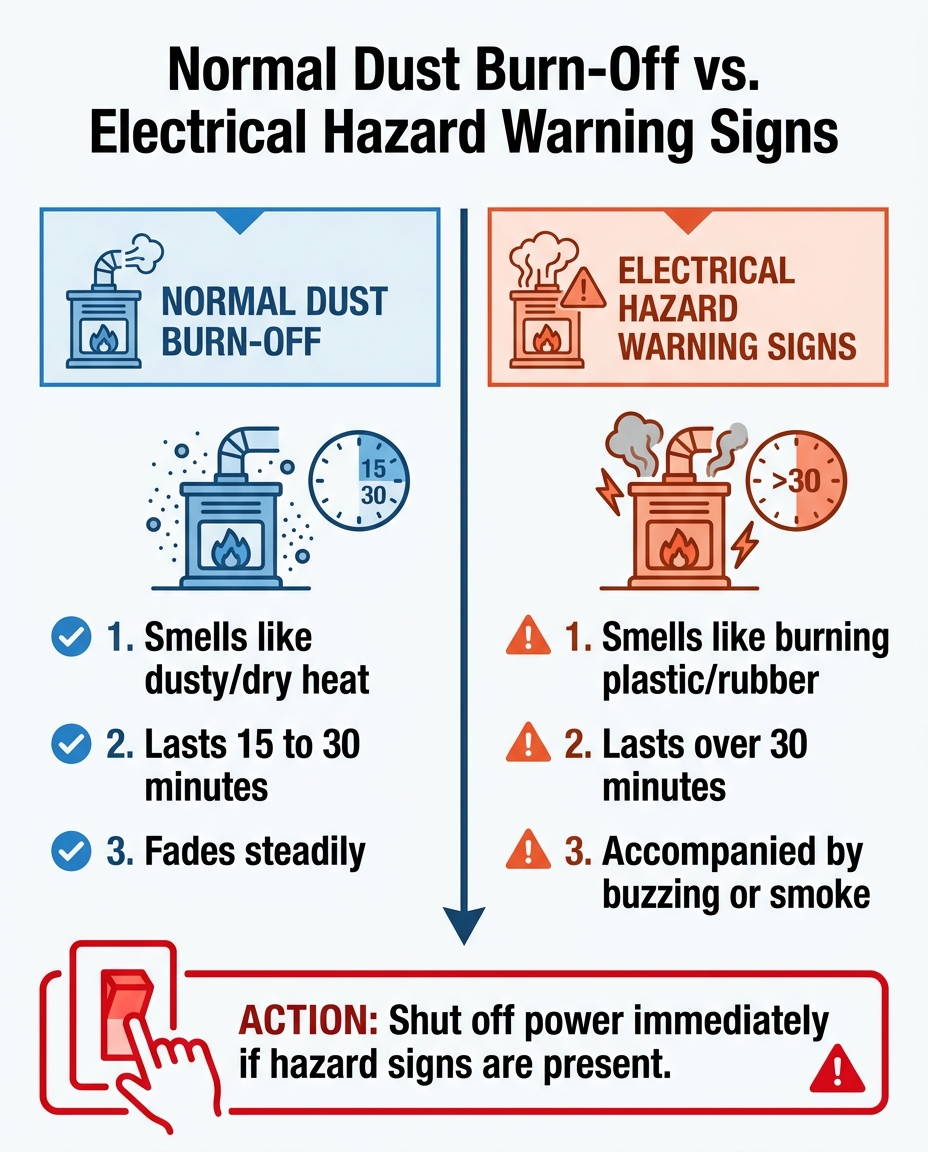
Normal dust burn-off should dissipate completely within a specific window of 15 to 30 minutes of odor duration. If the smell persists beyond this timeframe, it crosses the line from a harmless nuisance to a potential hazard. To safely navigate this initial startup, follow these numbered steps:
1. Prepare the environment: Before turning the heat on for the first time, open a few windows to ensure proper ventilation. This allows the harmless dust odors to escape rather than lingering in your living space.
2. Engage the thermostat: Set the temperature a few degrees above the current room temperature to trigger a continuous heating cycle.
3. Start the clock: Note the exact time the furnace ignites. You are strictly monitoring for 15 to 30 minutes of odor duration.
4. Assess the smell: The odor should peak within the first five minutes and steadily fade as the cycle continues.
5. Enforce the boundary: If the smell has not completely cleared after half an hour, or if it grows stronger, shut the system down immediately at the thermostat.
Why the Timeframe Matters
A prolonged odor indicates continuous burning rather than a temporary flash-off of surface dust. If a furnace continues to produce a burning smell after thirty minutes, it means a component is actively overheating, melting, or combusting. Homeowners must treat this 15 to 30-minute window as a hard limit. Ignoring a persistent smell because you assume it is "just dust" is a dangerous gamble with your home's integrity.
Warning Signs of an Electrical or Mechanical Hazard
Differentiating between harmless, dry dust and a dangerous mechanical failure is critical. Dust burn-off has a very distinct, dry, almost earthy smell—similar to the scent of a space heater that has just been plugged in. However, if your system is experiencing a genuine failure, the odors will be sharp, acrid, and highly synthetic.
Specific danger odors include the smell of burning plastic, melting rubber, or a sharp electrical scent similar to ozone or overheating wires. These smells indicate that wire insulation is melting, a capacitor is failing, or the blower motor is seizing up and overheating its internal components. According to National Fire Protection Association (NFPA) statistics, heating equipment is a leading cause of home fires in the United States, emphasizing exactly why abnormal smells must be taken seriously.
When to Shut Down Your System
If you experience any of the following warning signs during your startup, do not wait for the 15 to 30 minutes of odor duration to expire. Cut power to the unit at the thermostat and switch off the dedicated breaker immediately:
• Harsh chemical odors: Any smell resembling burning plastic, melted wire casings, or hot rubber.
• Audible distress: Loud buzzing, humming, electrical arcing sounds, or rhythmic popping noises accompanying the smell.
• Visible smoke: Any trace of visible smoke emerging from the supply vents or the furnace cabinet itself.
• Intensifying smells: An odor that grows thicker and more overpowering as the system runs, rather than steadily fading away.
We must provide explicit safety warnings against homeowners attempting internal furnace diagnostics. If you smell melting plastic or electrical burning, do not open the furnace cabinet. Do not attempt DIY electrical repairs, and do not touch internal wiring. Modern furnaces utilize high-voltage components and combustible gas lines that require a licensed professional to safely inspect and repair.
• Type of Smell — Normal Dust Burn-Off: Dry, earthy, similar to a hot space heater — Electrical / Mechanical Hazard: Acrid, sharp, melting plastic, rubber, or ozone
• Duration — Normal Dust Burn-Off: Fades entirely within 15 to 30 minutes — Electrical / Mechanical Hazard: Persists, intensifies, or lasts beyond 30 minutes
• Accompanying Sounds — Normal Dust Burn-Off: Normal blower fan and burner ignition sounds — Electrical / Mechanical Hazard: Loud buzzing, grinding, popping, or electrical arcing
• Required Action — Normal Dust Burn-Off: Ventilate the home and allow it to run its cycle — Electrical / Mechanical Hazard: Shut off power at the breaker and call a professional

Navigating System Failures: Do You Need a Permit for HVAC Replacement?
When a professional inspects a persistent burning smell and discovers severe electrical damage or a cracked heat exchanger, the unit is often condemned for safety reasons. A cracked heat exchanger allows deadly carbon monoxide to leak into the home, while melted electrical harnesses present an immediate fire risk. In these catastrophic failure scenarios, a full system replacement is the only safe option moving forward.
This reality brings up a critical compliance question for homeowners: do you need a permit for hvac replacement? The short answer is yes. Local municipalities require permits for heating replacements to ensure strict fire safety standards and electrical code compliance are met. A permitted installation guarantees that the new system is properly sized, safely wired, and correctly vented to the outside.
Some homeowners worry that the permitting process will delay their comfort, but efficient, multi-unit replacements can be done seamlessly when handled by experienced professionals. For example, one local Cinnaminson homeowner faced a total system failure last spring, requiring a new central air, heater, and water heater. Because the replacement was managed by our expert team at Climate Mechanics, the multi-unit installation was completed ahead of schedule, fully permitted, and entirely up to code. Navigating HVAC Permit Requirements doesn't have to be a roadblock; it is a necessary safeguard that protects your home's structural integrity and resale value. A mid-fall heating startup failure is stressful enough without adding regulatory headaches to the mix.
Protecting Your Home's Value
When you eventually sell your home, inspectors will look for closed permits on major mechanical upgrades. An unpermitted furnace replacement can stall a home sale, force you to pay retroactive fines, or require you to tear out the work and start over. Doing it right the first time ensures your home remains a safe, valuable asset.
The Dangers of Unpermitted Work and DIY Diagnostics
The temptation to cut corners when faced with a sudden heating failure is high, but the risks of skipping permits or attempting DIY fixes are severe. Unpermitted electrical work on heavy-duty heating equipment is a massive liability. If a homeowner attempts to bypass municipal codes to save time, they bypass the very safety checks designed to keep their house from catching fire.
Exceeding the safe 15 to 30 minutes of odor duration requires a licensed professional to diagnose the root cause, not a DIY internet tutorial. Opening a furnace cabinet to poke around complex circuit boards, gas valves, and blower capacitors exposes you to high voltage and the risk of creating a gas leak.
Furthermore, bypassing municipal codes and attempting unpermitted repairs can instantly void manufacturer warranties. Heating manufacturers stipulate that their equipment must be installed and serviced by licensed professionals according to local building codes. If a fire or severe water damage occurs due to an illegal installation, homeowner insurance companies will frequently deny the claim, leaving the resident entirely responsible for the catastrophic costs.
The Importance of Load Calculations
A proper Furnace Installation involves much more than just swapping out a metal box. Licensed professionals perform detailed load calculations to ensure the new unit matches the exact cubic volume and insulation levels of your home. An oversized unit will short-cycle, constantly turning on and off, which burns out electrical components prematurely. An undersized unit will run continuously, driving up utility bills and eventually overheating. Proper, permitted installations guarantee these safety checks are performed.
How Certified Technicians Ensure Code-Compliant Comfort
Navigating the transition into the heating season should not involve a crash course in municipal building codes or electrical diagnostics. Reputable contractors take the entire burden off the homeowner by managing all municipal paperwork, permit pulling, and final inspection scheduling.
As local Cinnaminson HVAC experts, our team at Climate Mechanics handles all the permitting and local municipal paperwork for our customers, ensuring a seamless, up-to-code installation every single time. This approach provides the ultimate peace of mind. You sleep better knowing your system is legally installed, rigorously safety-tested, and fully compliant with state and local fire codes.
Establishing a relationship with a trusted local team does more than just solve today's burning smell. It prepares your home for future needs. Whether you require routine heating maintenance to prevent next year's mid-fall heating startup odors, or you are planning ahead for an AC Replacement Cinnaminson NJ next season, having a reliable contractor ensures your home's mechanical systems are always operating safely and efficiently.
The Value of Turnkey Permitting and Installation
A turnkey installation means the contractor handles the project from the initial safety diagnostic to the final municipal sign-off. You won't be left standing in line at the local township building trying to decipher mechanical drawings. Professional teams submit the specifications, secure the approvals, perform the installation to exact manufacturer standards, and stand by during the municipal inspector's final walkthrough.
Rely on Local Experts for Safe Heating Solutions
While brief dust odors are a normal part of waking your system up for the winter, persistent smells are a hard boundary requiring expert care. If your system exceeds the 15 to 30 minutes of odor duration, or if you detect the sharp scent of melting plastic or electrical burning, it is time to act immediately.
Do not guess with your family's safety, and do not attempt to diagnose complex electrical systems on your own. If you have concerns about your system's performance or need a professional set of eyes to ensure your equipment is safe to run this season, schedule a comprehensive inspection today. Peace of mind is just a phone call away.
Frequently Asked Questions
How long should a furnace smell like burning dust?
A normal burning dust smell should completely dissipate within 15 to 30 minutes of continuous operation. If the odor lasts longer than this timeframe, it indicates a potential mechanical or electrical problem rather than simple dust burn-off. You should shut the system down and contact a professional if the smell persists.
What does an electrical fire in a furnace smell like?
An electrical fire or failing component produces a sharp, acrid odor that resembles melting plastic, burning rubber, or hot wires. Unlike the dry, earthy smell of dust, these synthetic odors are harsh and will often intensify the longer the system runs. This is a severe safety hazard that requires immediate shutdown.
When should I shut off my furnace due to a burning smell?
You should turn off your furnace immediately if the burning smell is accompanied by visible smoke, loud buzzing or popping noises, or if the odor smells like melting plastic. Additionally, if a standard dusty smell lasts longer than 30 minutes without fading, cut the power at the thermostat and breaker to prevent further damage.
Is it normal for a heater to smell like burning?
Yes, it is completely normal for a heater to emit a burning dust smell during its first cycle of the season. Over the summer, dust and airborne particles settle on the internal heat exchanger, and this debris incinerates when the system heats up. The key is that this normal odor should be brief and fade quickly.
Can a dusty furnace cause a fire if left unchecked?
While light surface dust normally burns off safely, severe neglect can lead to dangerous conditions. Heavy accumulations of debris, pet hair, and restricted airflow from clogged filters can cause the furnace to overheat, potentially damaging internal components or creating a fire hazard. Annual professional maintenance prevents this dangerous buildup.
Who is responsible for pulling the permit if my furnace needs to be replaced?
A reputable, licensed HVAC contractor will handle all the necessary permitting and municipal paperwork for a furnace replacement. They submit the documentation to the local township to ensure the installation meets all building and fire codes. Homeowners should never be forced to pull their own permits for complex mechanical work.
