



The Chill of an October Heating-Startup Gone Wrong
The first freezing night is only weeks away, making home maintenance tips and troubleshooting essential before you flip the switch on your dormant furnace. When that initial October heating-startup arrives, you expect a rush of cozy warmth to fill your rooms. Instead, you hear the blower kick on, you feel air coming from the vents, but it is completely cold. That sudden blast of unheated air brings immediate anxiety. In our years keeping Cinnaminson homes comfortable, our team at Climate Mechanics sees this exact scenario play out every fall. You are left wondering if this is a minor hiccup or a major mechanical failure right at the start of the season.
Knowing when a strange odor or a cold breeze is a temporary startup quirk versus a safety hazard requires a bit of foundational knowledge. The good news is that several safe, simple homeowner checks can be performed before you ever need to pick up the phone. If you are already experiencing startup issues and need a professional eye, our team's comprehensive heating services are designed to get your system back on track safely.
How Humid New Jersey Summers Impact Dormant Furnaces
Your furnace sits completely dormant for months while your home's cooling system handles the heavy lifting. During this long off-season, the equipment is not just resting; it is exposed to the local environment. With summer temperatures regularly bringing high humidity to the Cinnaminson NJ area, the air inside your utility room or basement becomes heavy with moisture. A pattern we see often during our fall maintenance visits is that this high ambient humidity allows airborne dust, pet dander, and household debris to settle and cake onto sensitive internal furnace components.
When you finally call for heat in the fall, that sticky layer of summer dust reacts to the sudden temperature change. Sometimes it creates a brief, alarming smell. Other times, it interferes with electrical connections or sensors, causing the system to blow cold air instead of igniting properly. Proactive fall maintenance prevents these dormant-season issues from becoming mid-winter emergencies, which is why scheduling a furnace repair in Cinnaminson before the first freeze is always a smart move.
The Difference Between Dust Burn-Off and Mechanical Failure
It is crucial to differentiate between a furnace that is just waking up and one that is actively failing. Here is what our mechanics recommend watching for during your initial startup:
• Brief burning smell, but blowing hot air — Likely Cause: Normal seasonal dust burn-off — Action Required: Monitor for 15-30 minutes; smell should fade.
• Continuous blowing of room-temperature air — Likely Cause: Component failure or thermostat error — Action Required: Begin basic troubleshooting steps.
• Short-cycling (turning on and off rapidly) — Likely Cause: Sensor issue or severe airflow restriction — Action Required: Check filter, then call a professional.
Check the Thermostat: The 'ON' vs. 'AUTO' Mistake
Before you assume the worst about your October heating-startup, start with the most common, safest, and easiest homeowner troubleshooting step: checking the thermostat. We recommend this check over anything else because the fan setting on your thermostat dictates exactly how your furnace blower operates, and a simple accidental bump can change how your entire system feels.
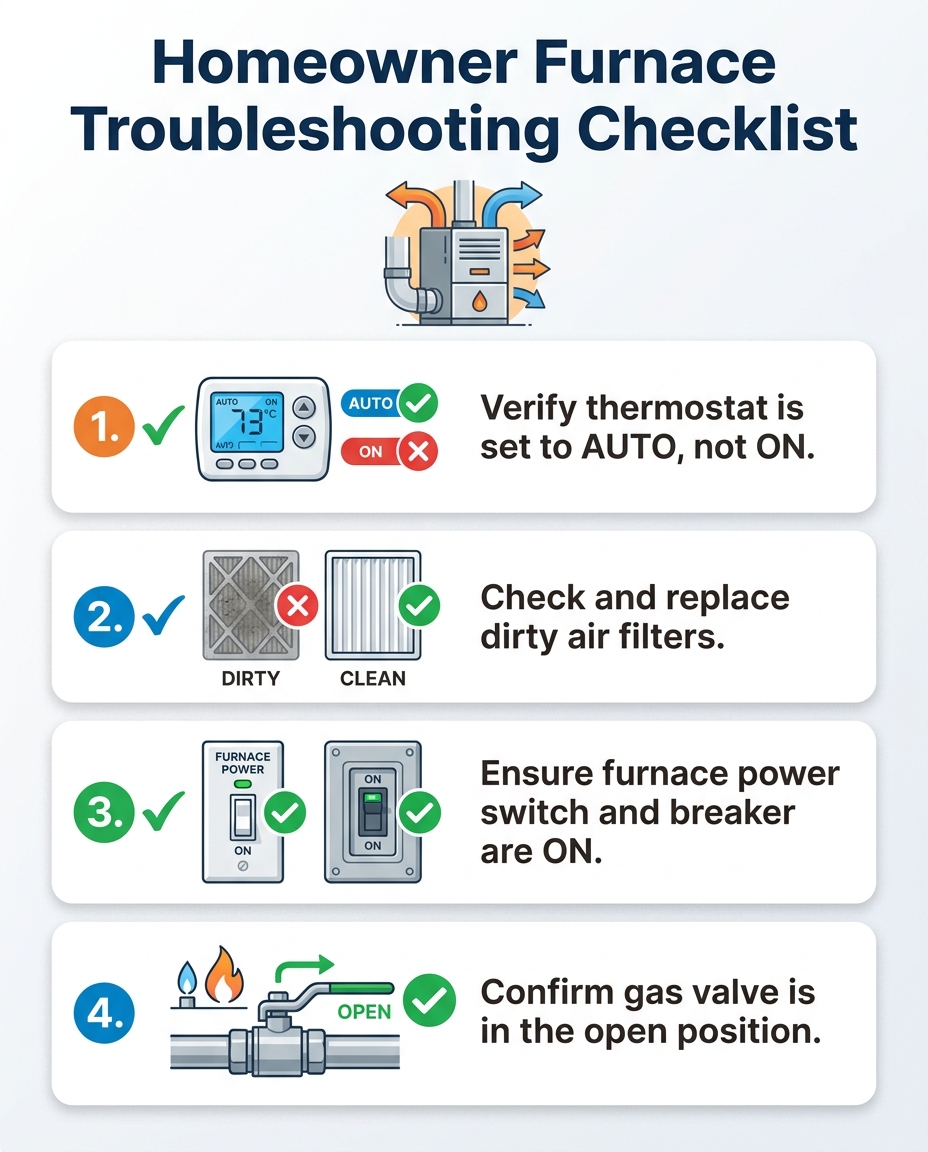
1. Locate the fan switch: Look at your thermostat interface for a switch or button labeled "Fan."
2. Verify the setting: Ensure the switch is set to "AUTO" rather than "ON."
3. Understand the difference: When set to "ON," the blower fan runs continuously, 24 hours a day, regardless of whether the burners are actively heating the air. When the heating cycle ends, the fan just circulates room-temperature air, which feels cold coming out of the vents.
4. Check the batteries: If you have a digital thermostat with a blank screen or a fading display, swap in fresh batteries. Low power can cause erratic communication between the thermostat and the furnace control board.
If you find the switch was set to "ON," switch it back to "AUTO" and wait for the next heating cycle to see if the problem resolves itself.

Clogged Air Filters and Overheating Limit Switches
According to data from the U.S. Department of Energy, a dirty air filter is one of the most common reasons for HVAC system inefficiency and failure. Our technicians frequently respond to "no heat" calls only to discover a completely blocked filter. The mechanism behind this failure is a simple chain reaction. Your furnace relies on a steady, unrestricted flow of return air to keep its internal heat exchanger cool. When a clogged filter restricts that airflow, the heat generated by the burners has nowhere to go, trapping intense heat inside the furnace cabinet.
This is where your system's safety features step in. The "limit switch" acts as a critical safety device. If the internal temperature gets too high, the limit switch immediately shuts off the gas burners to prevent a fire hazard. However, it leaves the blower fan running to cool the overheated system down. The result? Your Cinnaminson NJ home receives a steady stream of cold air from the vents while the furnace desperately tries to cool its internal components. Staying on top of routine furnace maintenance prevents this dangerous overheating cycle.
How to Safely Check Your Furnace Filter
Checking and changing your filter is the most impactful maintenance task you can perform yourself. Follow these steps:
• Kill the power: Turn off power to the unit at the nearby wall switch or the main electrical breaker panel before opening any access doors.
• Perform the light test: Remove the filter and hold it up to a bright light source. If light cannot easily pass through the pleated material, the filter is clogged and must be replaced.
• Check the airflow direction: When inserting the new filter, ensure the printed arrow on the cardboard frame points directly toward the furnace blower motor.
Dirty Flame Sensors and Short-Cycling Symptoms
If your thermostat is set correctly and your filter is spotless, you may be dealing with a slightly more complex issue that requires professional intervention. The flame sensor is a delicate, critical safety mechanism located inside the combustion chamber. Its sole job is to detect whether the gas has actually ignited. If the sensor does not feel a flame within a few seconds of the gas valve opening, it immediately shuts the system down to prevent raw gas from flooding your home.
During an October heating-startup, this sensor is highly vulnerable. If it became coated in summer dust or developed light oxidation while sitting dormant, it will fail to read the flame. The resulting symptom is highly recognizable: you will hear the system start, the burners will ignite briefly, and then they will shut down just seconds later, all while the blower continues to push cold air into your rooms.
Working with true local mechanics means you get a technician who focuses on diagnosing the root cause—like a dirty flame sensor—rather than just treating symptoms or pushing for unnecessary equipment upgrades. Because cleaning a flame sensor requires opening the sealed combustion chamber and handling highly delicate rods, our team at Climate Mechanics always stresses that this task must be left to a licensed professional to ensure safe, proper operation.
Assessing Pilot Lights and Gas Supply Limitations
Fuel-related issues are another common culprit when a furnace runs but fails to produce heat. Older furnace models still rely on a standing pilot light—a small, continuous flame that ignites the main burners. Over the summer, drafts or minor gas fluctuations in your Cinnaminson NJ home may have extinguished this pilot light. If the pilot is out, the burners cannot ignite, and the blower will simply circulate cold air.
Modern high-efficiency furnaces do not have standing pilot lights; instead, they use electronic ignition systems like hot surface igniters. However, these modern systems can also fail to spark if there is a disruption in the gas supply or a failing igniter component. As a homeowner, you can safely verify that the main gas valve leading to the furnace is parallel to the pipe, which indicates it is in the open position. You can also check other gas appliances in your home, like a stove or water heater, to ensure your property is receiving gas.
A strict warning: You should never attempt to manually light a modern sealed-combustion furnace with a match or lighter, and you should never tamper with gas lines or valves if you are unsure of their function. Gas appliances require licensed expertise to service safely.
Making the Call: Repair, Replace, or Professional Maintenance
If you have walked through the basic homeowner checks—verifying the thermostat is on AUTO, confirming the air filter is clean, and ensuring the power is on—and your October heating-startup is still blowing cold air, you have reached the limit of safe DIY troubleshooting. At this point, the issue is mechanical and requires a licensed professional to diagnose and resolve.
Recurring cold-air issues, frequent breakdowns, or strange noises on older systems might prompt a larger decision about your equipment's longevity. If you find yourself constantly paying for repairs, it may be time to consider a furnace replacement. Deciding whether it is worth fixing an older HVAC system depends on its age, efficiency, and safety. Keep in mind that generic energy rebates or tax credits may be available for qualifying high-efficiency upgrades; be sure to verify current programs with your utility provider or a tax professional to see what incentives apply to your situation.
When to Stop Troubleshooting
Some symptoms require immediate action. Stop troubleshooting and call for help if you notice any of the following:
• Gas odors: If you smell a strong odor of gas or rotten eggs, leave the house immediately and call your utility company from a safe distance.
• Electrical tripping: If the system repeatedly trips your home's circuit breaker when it tries to start, do not keep resetting it.
• Severe noises: If you hear loud grinding, scraping, or banging noises accompanying the cold air, turn the system off to prevent further mechanical damage.
Restoring Reliable Comfort for the Winter Ahead
A furnace blowing cold air is a common, highly solvable fall startup issue for homeowners in Cinnaminson NJ. By understanding what is normal and what requires a mechanic's touch, you can protect your equipment and your peace of mind. Proactive care and timely professional maintenance now will ensure your heating system delivers safe, efficient, and reliable comfort all winter long.
Frequently Asked Questions
Why is my furnace running but blowing cold air?
The most common reason a furnace runs but blows cold air is that the thermostat fan setting is switched to "ON" instead of "AUTO." This causes the blower to run continuously, even when the heating cycle is off. Other common causes include a clogged air filter causing the system to overheat, or a dirty flame sensor shutting down the burners.
Can a dirty filter cause a furnace to blow cold air?
Yes, a dirty filter severely restricts airflow, which traps heat inside the furnace cabinet. This causes the internal limit switch to trip as a safety precaution, shutting off the gas burners while leaving the fan running to cool the system down. The result is unheated air blowing from your vents.
How do I reset my furnace after it blows cold air?
You can reset your furnace by turning off the power at the main electrical panel or the wall switch next to the unit, waiting a few minutes, and turning it back on. However, if the system was blowing cold air due to an overheating limit switch or a dirty flame sensor, resetting the power will not fix the underlying mechanical issue, and the symptom will likely return.
Why does my furnace blow cold air sometimes but hot air other times?
Intermittent cold air often points to a thermostat issue, a failing flame sensor, or an oversized furnace that is short-cycling. If the flame sensor is dirty, it may successfully read the flame on some cycles but fail on others, leading to inconsistent heating performance throughout the day.
Is it dangerous if my furnace is blowing cold air?
Blowing cold air itself is not inherently dangerous, as it often means the system's safety mechanisms (like the limit switch or flame sensor) are doing their job by shutting down the gas supply. However, if the cold air is accompanied by the smell of gas, frequent breaker trips, or loud grinding noises, it indicates a serious hazard that requires immediate professional attention.
How long should a furnace blow cold air before heating up?
When a furnace first starts its cycle, it is normal to feel cool air for about 30 to 60 seconds as the blower pushes the resting room-temperature air out of the ductwork. If the air remains cold after two to three minutes, the burners have likely failed to ignite, indicating a problem that needs troubleshooting.
