


Is a 12 to 15 Year Old AC Worth Fixing in a South Jersey Home?
Is a 12 to 15 year old AC worth fixing in a South Jersey home? In most cases, the answer depends on a few key factors: how often it has broken down, what type of repair is needed, and whether it still uses older refrigerant. If your system is at or past the 12-year mark and showing signs of trouble, you may be spending more to keep it running than it would cost to replace it.
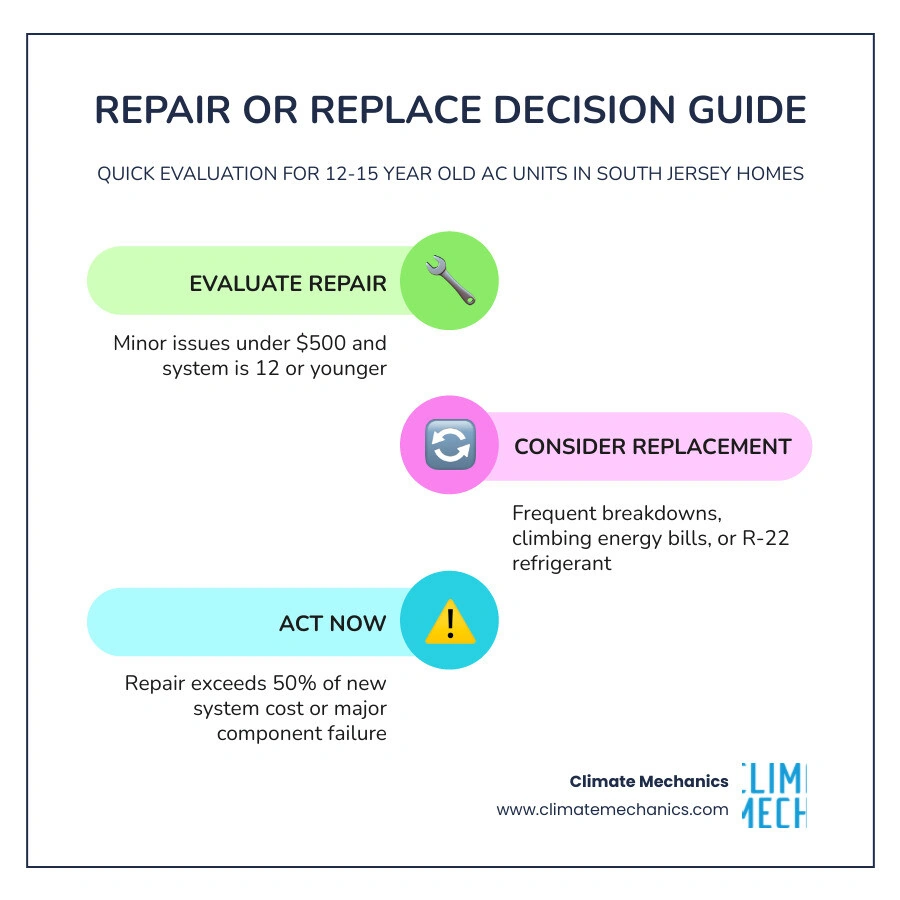
Here is a quick breakdown to help you decide:
• Repair is likely worth it if the system is 12 years old or younger, the repair is minor, and breakdowns have been rare
• Replacement is often the smarter move if the system is 13 to 15 years old, repairs are becoming frequent or expensive, or energy bills keep climbing without a clear reason
• Replacement is almost always recommended if the system uses R-22 refrigerant, a major component like the compressor has failed, or the repair cost exceeds 50% of what a new system would cost
South Jersey summers are no joke. The heat kicks in fast, humidity levels push your AC to work harder than systems in drier climates, and a unit that was already limping through last season may not survive another. Central air conditioners typically last 12 to 15 years with reasonable maintenance — and when yours lands squarely in that window, every repair decision carries real financial weight.
This guide walks you through exactly how to evaluate your situation, what warning signs matter most, and when it makes more sense to invest in a new system rather than keep patching an old one.
Evaluating System Lifespan: Is a 12 to 15 Year Old AC Worth Fixing in a South Jersey Home?
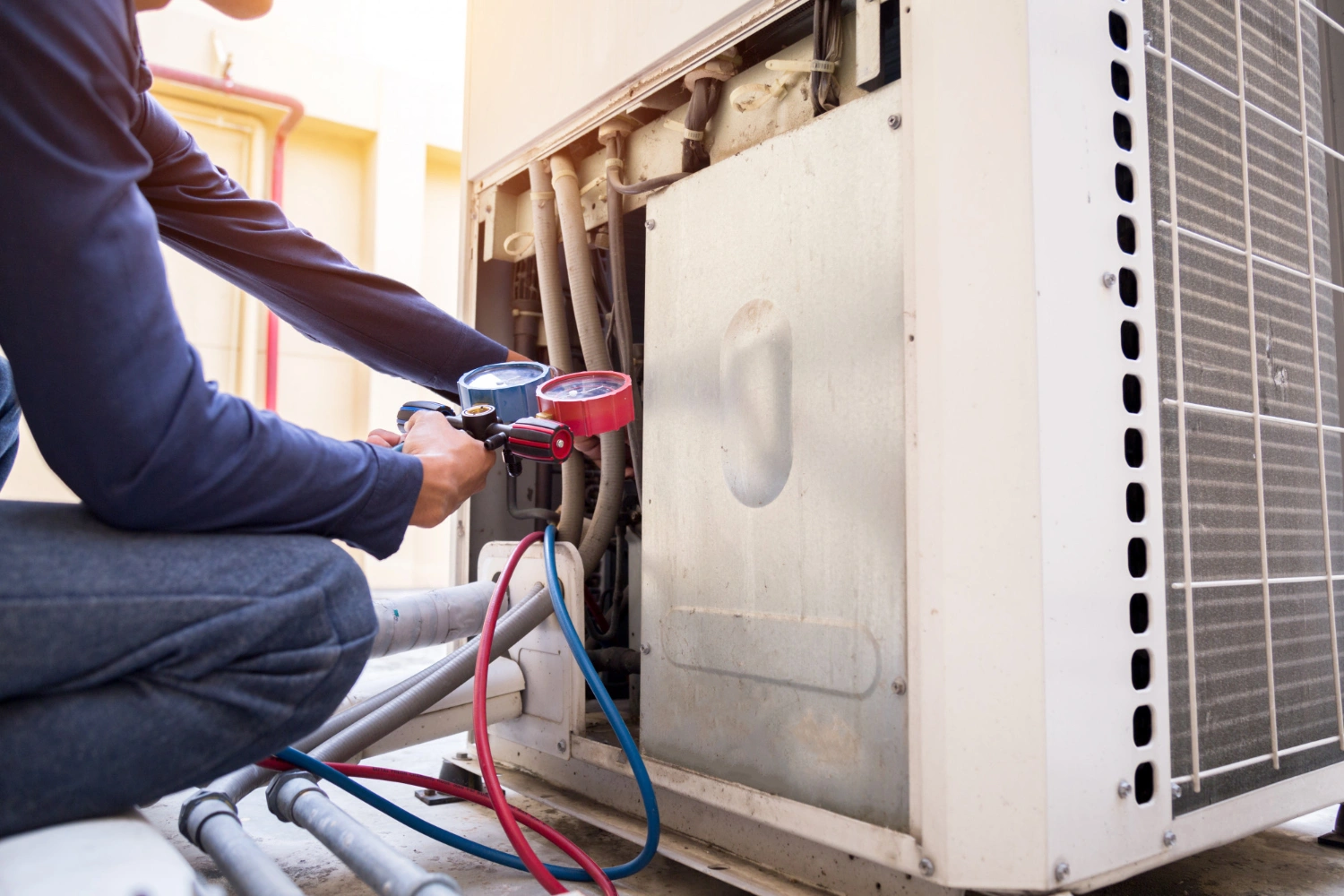
When an air conditioner reaches the 12-to-15-year mark, it enters its twilight years. While a well-installed, well-maintained air conditioner should last you 15 years or more, achieving this milestone depends heavily on how hard the system has had to work. In South Jersey communities like Pennsauken, Audubon, and Willingboro, our systems face intense seasonal demands.
The typical lifespan of a central air conditioner in our region is heavily influenced by local environmental factors:
• High Humidity Stress: Our proximity to the Delaware River and the Atlantic coast means summers are incredibly muggy. Your AC doesn't just cool the air; it also acts as a dehumidifier. High humidity forces the system to run longer cycles, accelerating wear and tear on the compressor and fan motor.
• Corrosive Coastal Air: For homes closer to coastal breezes, airborne moisture can speed up the corrosion of delicate outdoor aluminum fins and copper coils.
• Extreme Temperature Swings: Going from freezing winters to scorching, humid summers means your home's overall HVAC infrastructure expands and contracts, stressing connected components.
As your system ages, its efficiency naturally declines. Over a decade of operation, dirt accumulation, minor motor wear, and microscopic refrigerant leaks slowly degrade performance. A system that started its life with a solid SEER (Seasonal Energy Efficiency Ratio) rating will no longer operate at that manufactured efficiency level. Upgrading to a modern, high-efficiency system can deliver better long-term value than pouring money into repeated repairs on a unit that is actively costing you more on your monthly utility bills.
Determining If a 12 to 15 Year Old AC Worth Fixing in a South Jersey Home is the Best Choice
Deciding whether is a 12 to 15 year old ac worth fixing in a south jersey home often comes down to the type of refrigerant running through its copper lines.
If your air conditioner was manufactured before 2010, there is a very high probability it uses R-22 refrigerant (commonly known as Freon). The U.S. Environmental Protection Agency (EPA) fully phased out the production and import of R-22. Because only reclaimed or recycled R-22 is available, the cost of sourcing this refrigerant has skyrocketed. If an older system develops a refrigerant leak, simply patching the leak and recharging the system can cost as much as a major component replacement.
Furthermore, the industry is currently transitioning away from R-410A (the refrigerant that replaced R-22) toward newer, more eco-friendly alternatives like R-454B. This means that even systems on the younger end of the 12-to-15-year range may soon face parts availability issues and rising service costs for refrigerant-related repairs.
When you are facing a leak in an old coil, continuing to patch the system is often a temporary, expensive band-aid. Understanding When to Consider an AC Replacement can help you avoid throwing good money after bad.
Key Signs Your Aging Air Conditioner Needs Professional Attention
It is rarely a mystery when an aging air conditioner is on its last legs. The system will usually send clear warning signals before it suffers a catastrophic failure. If you live in Haddonfield, Collingswood, or Burlington and notice any of the following red flags, your system needs immediate professional evaluation:
• Frequent Breakdowns: If your air conditioner is getting older and breaking down more than two or three times per season, it is telling you that its components are failing in a chain reaction.
• Uneven Cooling and Hot Spots: Do you find that your upstairs rooms feel like a sauna while your downstairs is freezing? An aging compressor or a failing blower motor often struggles to distribute air evenly.
• Weak Airflow: If the air coming out of your registers feels like a gentle whisper rather than a strong breeze, your system's fan motor or compressor may be failing.
• Strange Noises: Squealing, grinding, or loud rattling noises are clear indicators of mechanical wear.
• Rising Utility Bills: If your energy bills keep climbing even though your cooling habits haven't changed, your system is losing its efficiency.
If you are experiencing these performance issues, you can read more about the Signs AC Unit Needs Professional Attention to help diagnose the issue. If your system is running but failing to lower the temperature, find out Why Is My AC Blowing Warm Air before calling for service.
When to Opt for Professional Repairs in South Jersey
While replacement is often the most sensible long-term choice for a 12-to-15-year-old system, there are times when a repair is still the most practical option. If your system is otherwise reliable and the issue is minor, fixing it can buy you a few more years of comfort.
Minor electrical issues are excellent candidates for repair, even on older systems. For example, replacing a failed capacitor, a worn contactor, or a faulty thermostat is a quick, straightforward process. These parts act as the electrical gatekeepers of your system; when they fail, the AC won't turn on, but replacing them does not require opening the refrigerant loop or replacing heavy mechanical machinery.
If you are located in the local area and need a fast, honest diagnostic check, our team provides expert AC Repair Cherry Hill NJ to help you understand the exact state of your equipment. For more context on what constitutes a minor versus a major fix, check out these Signs You Need Expert AC Repair.
The Repair-vs-Replace Decision Framework for South Jersey Homeowners
To make an unbiased, financially sound decision, it helps to use a structured framework. Below is a comparison table outlining how key factors stack up when evaluating an aging air conditioner:
• System Age — Opt for AC Repair: Under 10–12 years old — Opt for AC Replacement: 12 to 15+ years old
• Repair Frequency — Opt for AC Repair: Rare, isolated incident — Opt for AC Replacement: Multiple breakdowns per season
• Refrigerant Type — Opt for AC Repair: Modern refrigerant (R-410A) — Opt for AC Replacement: Phased-out R-22 (Freon)
• Operating Efficiency — Opt for AC Repair: Energy bills remain stable — Opt for AC Replacement: Utility bills are steadily rising
• Warranty Status — Opt for AC Repair: Parts are still covered — Opt for AC Replacement: Warranty has fully expired
• Overall Comfort — Opt for AC Repair: Consistent, even cooling — Opt for AC Replacement: Uneven temperatures and high humidity
A good rule of thumb used by HVAC professionals is the 50% rule: if the cost of a single repair approaches 30% to 50% of the cost of a brand-new system, replacement is almost always the smarter financial move. Investing a significant amount of money into a 14-year-old system with an expired warranty does not guarantee that another major component won't fail next month.
To help you decide if your system has crossed the line, review these 4 Signs It's Time for a New AC Unit.
Applying the Multiplier Rule: Is a 12 to 15 Year Old AC Worth Fixing in a South Jersey Home?
Another practical tool is the Multiplier Rule (sometimes called the $5,000 rule). To apply this rule, you multiply the age of your air conditioner by the estimated cost of the repair.
If the resulting number exceeds a predetermined threshold (traditionally represented by a factor of 5,000 in industry calculations), replacement is recommended. For example:
• A minor electrical repair on a 12-year-old system results in a low multiplier, indicating that repairing the unit is a reasonable, low-risk decision.
• A major component failure (such as a compressor or evaporator coil replacement) on that same 12-year-old system results in a very high multiplier, signaling that the money would be far better spent on an upgrade.
Upgrading to a modern system ensures you benefit from advanced technology, quieter operation, and a brand-new manufacturer's warranty. If you decide to take this route, our AC Installation Ultimate Guide covers everything you need to know, and you can learn what to look for in our guide on Professional AC Installation Expectations.
Considering Combined Furnace and AC Replacement
If you decide to replace your aging air conditioner, it is highly beneficial to evaluate your furnace at the same time. In many South Jersey homes in Marlton, Maple Shade, and Camden, the furnace and air conditioner share the same blower motor and ductwork system.
Replacing both units together offers several distinct advantages:
1. Matched System Efficiency: Modern AC units require specific airflow rates to achieve their rated efficiency. An old, single-stage furnace blower may not be compatible with a high-efficiency, multi-stage AC, preventing you from getting the full energy-saving benefits of your investment.
2. Labor Savings: Installing both systems at the same time is far more labor-efficient than installing them years apart. The installation team only has to modify your plenum, gas lines, and electrical connections once.
3. Preventing Future Headaches: If your furnace is also approaching the 12-to-15-year mark, replacing it alongside the AC prevents you from having to deal with another major home disruption in the middle of winter.
Timing your replacement can also save you stress. Planning your upgrade during the milder autumn months is highly advantageous; read more about Why Replace AC This Fall to see why the shoulder seasons are the best time for an installation.
Frequently Asked Questions About Aging AC Units
How long do central air conditioners typically last in South Jersey?
On average, a central air conditioner in South Jersey lasts between 12 and 15 years. While systems in milder climates might push past 15 years, our hot, humid summers and freezing winters place significant mechanical stress on HVAC equipment. Regular, professional maintenance is the single most important factor in helping your system reach the upper end of this lifespan.
How does the R-22 phase-out affect my 12-to-15-year-old system?
Because the EPA banned the production and import of R-22 Freon, servicing these older systems has become incredibly expensive. If your 12-to-15-year-old AC has a refrigerant leak, the cost of sourcing reclaimed R-22 to recharge the system is often hard to justify. In almost all cases, a refrigerant leak in an R-22 system is a definitive sign that you should replace the unit. If you are wondering about the parts of your system that hold this refrigerant, you can learn more in AC FAQ: What Are Coils.
Are there New Jersey incentives or rebates for upgrading to a high-efficiency AC?
Yes! New Jersey homeowners have access to several excellent incentives that make upgrading to a high-efficiency system highly attractive. The New Jersey Clean Energy Program, along with local utility programs, offers rebates for qualifying high-efficiency air conditioners and heat pumps. Additionally, federal tax credits under the Energy Efficient Home Improvement Credit can help offset the cost of qualifying installations. Flexible financing options are also widely available to help fit a new system comfortably into your household budget.
Conclusion
Deciding whether is a 12 to 15 year old ac worth fixing in a south jersey home doesn't have to be a stressful guessing game. By looking at the system's age, its repair history, its refrigerant type, and its overall efficiency, you can make an informed, practical decision that protects your home's comfort and your wallet.
At Climate Mechanics, we bring over 38 years of NATE and NCI-certified expertise to every home we serve in Maple Shade, Pennsauken, Audubon, Willingboro, Collingswood, Haddonfield, Burlington, Marlton, and Camden. We pride ourselves on providing honest, personalized guidance. We won't push you into a replacement if a simple, reliable repair is all you need, but we will always give you a straight answer when continuing to patch an old system is no longer in your best interest.
If your aging air conditioner is struggling to keep up with the South Jersey heat, let our family take care of yours. If you are located near Delran, you can also easily schedule an expert diagnostic assessment with our team for AC Repair Delran NJ. Contact us today to secure your home's comfort for this summer and many more to come!
