



Are Your Fall Heating Startup Issues Normal, or Is It Time for an Upgrade?
Here at Climate Mechanics, we know that when searching for home maintenance tips and troubleshooting strategies this season, one of the most pressing questions is whether that strange smell coming from your vents is normal, or a sign of impending failure. As the unpredictable autumn temperatures begin to drop, transitioning your thermostat from cooling to heating is a critical moment for your home's infrastructure. Every October heating-startup brings a moment of suspense: will the furnace roar to life seamlessly, or will it struggle after months of sitting idle?
Understanding the difference between harmless seasonal quirks and serious mechanical red flags is the key to maintaining a safe, comfortable home before deep winter sets in. When a system fails or struggles to meet the demands of the changing weather, evaluating your options requires a comprehensive approach. A thorough assessment of your air conditioning services and heating infrastructure will determine whether a simple tune-up is sufficient, or if moving forward with a central AC installation and heating replacement is the safest, most cost-effective path for your property.
Understanding Summer Dormancy: Normal Dust Burn-Off vs. Mechanical Red Flags
To make informed decisions about your HVAC system, it is essential to understand the physical mechanics of what happens when a furnace or heat pump sits dormant for months. Throughout the long cooling season, the internal heating components remain inactive. This prolonged dormancy allows environmental elements to settle within the cabinet, creating the conditions for the most common fall startup symptoms.
The Anatomy of a Dormant HVAC System
While your air conditioner runs continuously throughout the summer, the heat exchanger, burners, and heating sensors inside your furnace sit unused. Over these months, airborne particles bypass standard filters and settle directly onto these sensitive metal components. In our experience servicing homes throughout Cinnaminson NJ, our team typically sees that the intensely humid summers in the Delaware Valley can trap moisture inside dormant heating components. This trapped humidity can potentially accelerate rust on cast-iron heat exchangers or cause oxidation on vital electrical contacts, increasing the risk of startup failures for local homeowners.
The Problem: When the thermostat finally calls for heat, the system ignites, and the sudden extreme temperatures incinerate the accumulated dust and debris on the heat exchanger.
The Cause: This is a standard physical reaction to seasonal dormancy, exacerbated by humidity and standard household dust.
The Solution: A brief burning dust smell—often described as a dusty, slightly smoky odor—is a completely normal part of the seasonal startup. This scent should dissipate entirely within 15 to 30 minutes of continuous operation. Opening a few windows during this initial cycle is usually all that is required.
When to Step Back: The Limits of DIY
While a brief dust odor is harmless, persistent electrical odors, grinding noises, or a smell akin to burning plastic indicate severe mechanical or electrical failure. A safety-first approach is mandatory when dealing with combustion appliances and high-voltage systems. Basic homeowner troubleshooting should remain strictly limited to the exterior of the unit.
• Thermostat checks: Verify that the thermostat is set to "heat" and has fresh batteries installed.
• Air filter replacement: Ensure a clean, unrestrictive air filter is in place to promote proper airflow.
• Vent inspection: Confirm that all return and supply registers are open and unobstructed by furniture or rugs.
Once these basic checks are complete, we strongly advise that the boundary for DIY intervention is firmly drawn. If the system continues to produce unusual odors, leaks water, or makes metallic scraping sounds, a licensed professional must take over. Opening the sealed combustion chamber or attempting to clean delicate internal sensors without proper training poses significant safety risks and can instantly void manufacturer warranties.
Identifying Critical Heating and Cooling Failures Before Deep Winter
Recognizing the early warning signs of a failing system can prevent total breakdowns during the coldest nights of the year. An October heating-startup is the ideal time to monitor your equipment for these critical red flags. If your system exhibits any of the following symptoms, our team recommends immediate professional diagnostics.
• Rapid Short-Cycling: If the heating system turns on, runs for only a few minutes, and abruptly shuts off before reaching the target temperature, it is short-cycling. This is often a protective measure triggered by the internal limit switch. It indicates that the heat exchanger is overheating, usually due to a failing blower motor or a severely restricted airflow issue.
• Lukewarm Air in Heating Mode: A heat pump or furnace that runs continuously but only delivers tepid air is failing to transfer heat effectively. In heat pumps, this often points to a refrigerant leak or a malfunctioning reversing valve. In gas furnaces, it may indicate a weak ignition sequence or a failing gas valve.
• Loud Grinding or Squealing Noises: HVAC systems are designed to operate with a consistent, smooth hum. High-pitched squeals typically indicate failing bearings in the blower motor, while loud banging or rattling can point to a cracked heat exchanger or loose internal mounts.
• Frequent Tripped Breakers: If turning on the heat consistently trips your electrical panel's circuit breaker, the system is drawing excessive amperage. This is a severe electrical safety hazard that points to a grounding issue or a seized compressor motor.
Ignoring these signs during the unpredictable autumn weeks forces an aging, inefficient unit to work exponentially harder. This not only drives up monthly energy consumption but also accelerates the final mechanical failure, leading directly to the inevitable conversation about system lifespan and replacement.
Repair vs. Replace: Evaluating Your Aging HVAC System
When a professional diagnostic reveals significant mechanical failure, homeowners face a critical decision: invest in a costly repair to patch an old system, or invest in a complete, high-efficiency replacement. Navigating this choice requires evaluating the overall health, age, and operational history of your existing equipment.
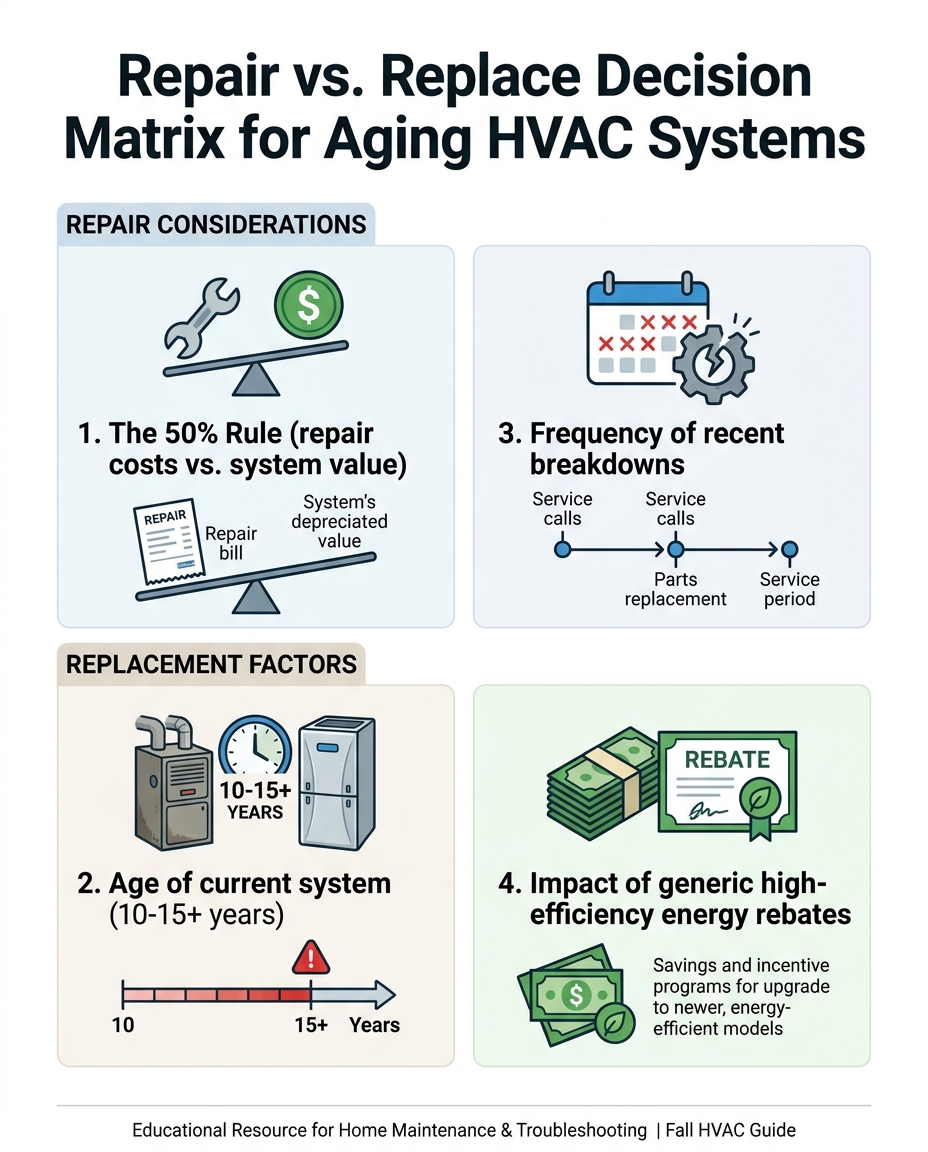
At Climate Mechanics, our technicians frequently rely on the "50% rule" to guide homeowners through this decision. If the cost of the required repair approaches or exceeds half the remaining value of the system, replacement is generally the wiser financial choice. This rule is especially relevant for units that have exceeded a decade of heavy use. Nursing an aging unit through another harsh season often involves hidden costs, including elevated utility bills due to degraded efficiency, the likelihood of secondary component failures, and the stress of unreliable climate control.
A pattern we see often on our service calls highlights the benefits of making a proactive choice. For example, we recently helped one local family who had moved into a new home and discovered their aging central air simply couldn't keep up with the hot and humid summer. After evaluating the extensive repair needs of the outdated equipment, they opted to replace the entire unit. The result was a quick, professional installation that immediately secured their comfort and prepared their home for the seasons ahead.
Replacing both the central air and heating components simultaneously offers distinct advantages. Matched systems operate with peak efficiency, communicating seamlessly to balance humidity and temperature. Furthermore, obtaining a prompt, competitively priced estimate from a licensed contractor in Cinnaminson NJ often reveals that a full replacement is more viable than expected, providing long-term peace of mind and comprehensive warranty coverage.

Comparing Replacement Options: Central AC vs. Heat Pump Systems
If replacement is the right choice for your home, the next step is selecting the appropriate technology. Modern advancements offer highly efficient alternatives to traditional setups. Providing a side-by-side comparison of these replacement technologies ensures you choose the right fit for your specific property layout and your upcoming October heating-startup needs.
Traditional Forced Air Systems
The standard pairing of a gas furnace and a central air conditioner remains a reliable, powerful choice for many properties. These systems utilize a single set of ductwork to distribute treated air throughout the home. They are particularly effective in homes that already possess extensive, well-sealed duct infrastructure and require robust heating capacity for extreme winter lows.
Modern Heat Pump Efficiency
Alternatively, a modern heat pump installation offers a highly efficient, two-in-one solution. Heat pumps provide robust cooling in the summer and reverse their operation to extract ambient heat from the outside air during the winter. Because they move heat rather than generating it through combustion, they offer exceptional energy efficiency. For homes without existing ductwork, or for properties requiring targeted zone control, ductless AC systems utilizing heat pump technology provide year-round comfort with minimal invasive installation.
• Heating Method — Traditional Furnace & Central AC: Combusts fuel (gas/oil) to generate heat. — Modern Heat Pump System: Transfers ambient heat from outdoors inside.
• Energy Efficiency — Traditional Furnace & Central AC: High efficiency, but consumes fossil fuels. — Modern Heat Pump System: Extremely high electrical efficiency year-round.
• Infrastructure Needed — Traditional Furnace & Central AC: Requires extensive, sealed ductwork. — Modern Heat Pump System: Available in both ducted and ductless configurations.
• Climate Suitability — Traditional Furnace & Central AC: Excellent for extreme, sub-zero winters. — Modern Heat Pump System: Ideal for the moderate regional climate of the Mid-Atlantic.
The Logistics of Upgrading: What to Expect During a Professional Installation
Many homeowners hesitate to upgrade their failing systems out of fear that the installation process will leave them without climate control for days. However, professional logistics have advanced significantly, ensuring that replacing a system minimizes disruption to your daily life. Local expertise ensures rapid, streamlined processes, meaning families do not have to suffer through unpredictable temperature swings while waiting for their new equipment.
1. Comprehensive Load Calculation: Before any equipment is ordered, technicians perform a Manual J load calculation. This strictly measures the home's square footage, insulation levels, and window placements to ensure the new system is perfectly sized for effective dehumidification and heating.
2. Safe Decommissioning and Removal: The existing system is safely disconnected. Refrigerant is recovered according to environmental regulations, and the old equipment is hauled away for proper recycling.
3. Infrastructure Preparation: The installation team prepares the site, leveling equipment pads, upgrading electrical disconnects, and modifying the sheet metal plenum to ensure a perfect, airtight fit with the new air handler or furnace.
4. Setting and Securing the New Equipment: The new units are carefully maneuvered into place, secured, and connected to the electrical, ductwork, and refrigerant lines.
5. Final Testing and Walk-Through: The most crucial step is the commissioning phase. Technicians test the sequence of operations, measure airflow, verify refrigerant charges, and walk the homeowner through the new thermostat controls to guarantee the system is fully winter-ready.
Whether our team is responding to an urgent need—much like a recent call where we helped a local homeowner whose system failed on a Sunday evening, restoring their comfort within an hour—or scheduling a planned upgrade, efficiency is paramount. The process of installing a complete HVAC system in a single afternoon is a standard reality for experienced teams in Cinnaminson NJ, ensuring your home remains protected from the elements.
Maximizing Efficiency with Tax Credits and Energy Rebates
Upgrading a failing system is a significant investment, but modern high-efficiency units often qualify for various financial incentives that make the transition more accessible. When planning an October heating-startup replacement, it is highly beneficial to explore available programs that reward energy conservation.
Federal Tax Credits: Upgrading to qualifying high-efficiency heat pumps and advanced central AC installations may make homeowners eligible for federal tax credits under current energy initiatives. These programs are designed to offset the initial investment of transitioning to greener technology.
Local Utility Rebates: Furthermore, local utility providers frequently offer generous incentive programs for reducing overall energy consumption on the grid. Installing equipment that meets stringent SEER2 and HSPF2 efficiency ratings often triggers these rebates.
Because program availability, qualifying equipment lists, and application requirements change frequently, it is strongly advised that homeowners consult directly with their installation professional and a qualified tax advisor to verify the current, applicable programs for their specific upgrade.
Frequently Asked Questions About Fall HVAC Maintenance and Replacement
Is a burning smell normal when I turn on my heater for the first time?
Yes, a brief burning dust smell is entirely normal during the first seasonal startup. This occurs because dust that settled on the heat exchanger during the summer dormancy is incinerated when the burners ignite. The odor should completely dissipate within 15 to 30 minutes of continuous operation. If the smell persists or smells like melting plastic, shut the system down and call a professional.
Why is my furnace short-cycling during the fall startup?
Short-cycling is usually a protective response triggered by an overheating system. When a furnace turns on and off rapidly, it often means the internal limit switch has detected dangerous temperatures inside the cabinet. This is most commonly caused by a severely clogged air filter restricting airflow, or a failing blower motor that cannot push the heat into the ductwork.
What maintenance should be checked before turning on the heat for winter?
Before initiating your first heating cycle, always start by replacing the air filter with a clean, high-quality option. Ensure that all supply and return vents throughout the house are open and unblocked by furniture. Finally, check that the thermostat has fresh batteries and is set correctly to the heating mode before testing the system.
When should I call a professional for unusual furnace noises?
You should contact a licensed technician immediately if your system produces loud grinding, squealing, or rhythmic banging noises. High-pitched squeals typically indicate failing motor bearings, while loud bangs can signal delayed ignition or a cracked heat exchanger. These are serious mechanical issues that require professional diagnostics to prevent total system failure.
Can I replace my central AC and heating system at the same time?
Yes, replacing both the heating and cooling components simultaneously is highly recommended. Installing a matched system ensures that the indoor air handler and outdoor condenser communicate perfectly, maximizing energy efficiency and performance. It is also generally more cost-effective in terms of labor than replacing the units years apart.
How long does a complete HVAC installation typically take?
A standard residential HVAC replacement can usually be completed in a single day. Professional teams in Cinnaminson NJ are equipped to handle the safe removal of old equipment and the precise installation of the new system rapidly, minimizing any disruption to your home's comfort and daily routine.
Secure Your Home's Comfort Before the Winter Freeze
Addressing an October heating-startup issue immediately is the best way to protect your home from the stress of a mid-winter breakdown. Whether your system requires a thorough professional tune-up to clear away the effects of summer dormancy, or it is time to evaluate a high-efficiency replacement, taking proactive steps today ensures reliable performance tomorrow. The peace of mind that comes from a professionally installed, correctly sized system is invaluable when the temperatures plummet. If you are experiencing unusual symptoms or want to explore your upgrade options, contact our team at Climate Mechanics to schedule a comprehensive inspection or request a detailed replacement estimate today.
