



Is a Single-Afternoon HVAC Installation Actually Possible?
Are you staring at a malfunctioning thermostat and asking yourself, can you install a complete HVAC system in a single afternoon? When a sudden equipment failure strikes during the late August end-of-season cooling period, the last thing you want is a drawn-out construction project. The back-to-school transition is already hectic enough without enduring days of a hot, uncomfortable house while technicians dismantle your utility room. Many homeowners naturally question whether a rapid 4-to-8 hour turnaround is a sign of an incredibly efficient team or a glaring red flag for cut corners and rushed workmanship.
The reality is that a single-afternoon timeline is entirely realistic, provided the project is handled by a highly coordinated local team. By utilizing specific logistical strategies, pre-staged inventory, and divided labor, professional technicians can execute a safe, thorough ac installation without turning your home into a multi-day work zone. Understanding how this timeline is achieved helps you set accurate expectations and ensures you never compromise on safety or system performance just to get the cold air flowing again.
Ready to upgrade your home's comfort? Learn more about our central air conditioning installation process, or reach out to schedule your AC installation in Cinnaminson today.
Breaking Down the 4-to-8 Hour Timeline: From Removal to Testing
To understand how a massive mechanical upgrade happens so quickly, you have to look at the structured phases of the project. A typical pattern we see with Cinnaminson NJ homeowners is initial skepticism over these rapid timelines. However, as demonstrated in a recent local project where a homeowner was concerned about the logistics of a full system swap, the team showed up exactly on time, followed a strict protocol, and actually finished sooner than the estimated afternoon window. The homeowners were extremely pleased to have their new equipment running before dinner.
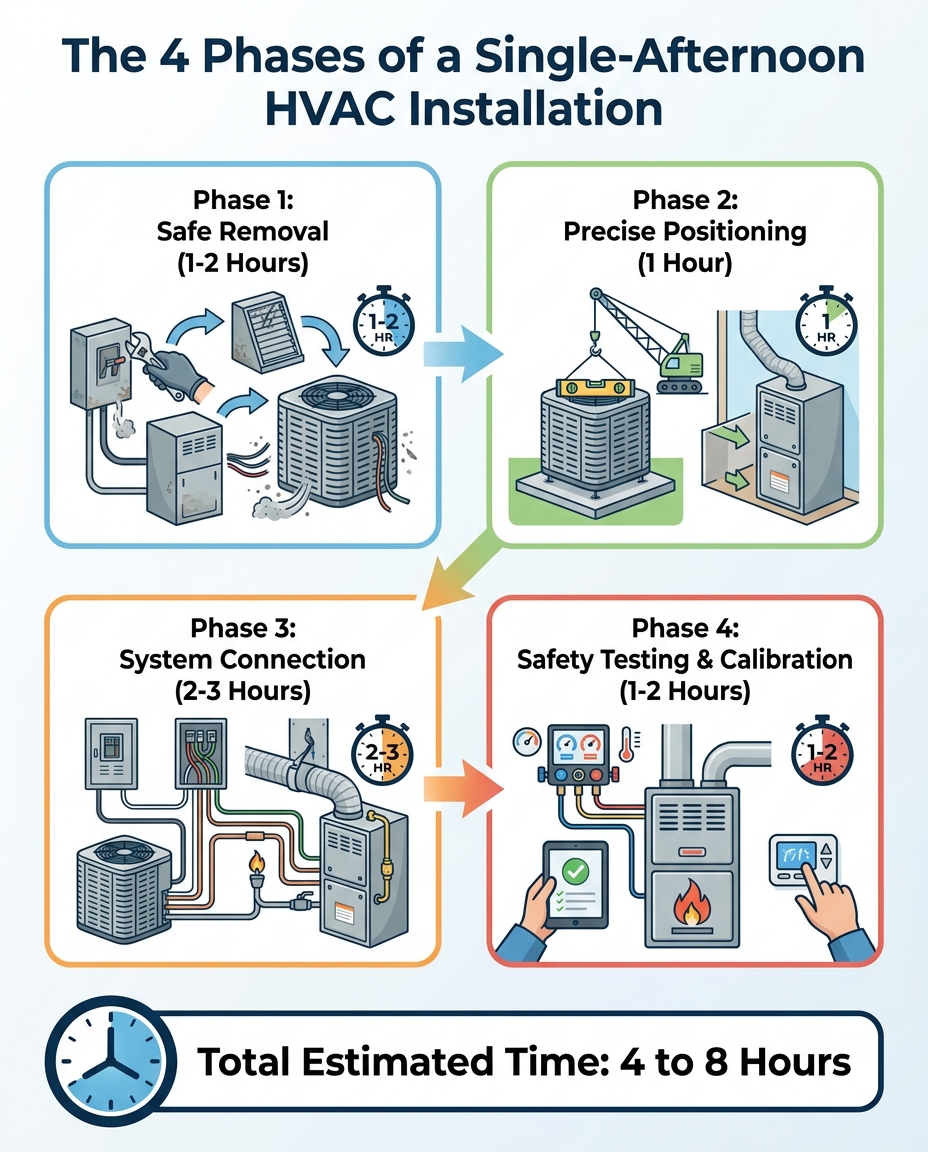
Here is exactly how a professional team compresses days of work into a single afternoon without skipping a single safety check:
1. Phase 1: Safe removal and disposal (1 to 2 hours). The team begins by safely recovering the old refrigerant using specialized EPA-approved extraction vacuums. Once the lines are empty, the electrical connections are severed at the disconnect box, and the failing equipment is hauled out of the house.
2. Phase 2: Precise positioning and securing (1 to 1.5 hours). The new outdoor condenser pad is leveled, and the indoor air handler or furnace is carefully maneuvered into place. Technicians use anti-vibration pads and secure the housing to prevent future rattling or shifting.
3. Phase 3: Connecting the vital lines (2 to 3 hours). This is the most technical phase. The team brazes the copper refrigerant lines, connects the high-voltage and low-voltage wiring, and seals the sheet metal ductwork transitions. A nitrogen sweep is often used during brazing to keep the inside of the pipes perfectly clean.
4. Phase 4: Rigorous safety testing and calibration (1 to 1.5 hours). Before turning the system on, a deep vacuum is pulled on the refrigerant lines to remove microscopic moisture. The team then releases the refrigerant, powers up the unit, measures superheat and subcooling levels, and balances the airflow across your vents.
• Removal — Primary Actions Taken: Refrigerant recovery, electrical disconnect, equipment haul-away — Estimated Time Allocation: 1 - 2 Hours
• Positioning — Primary Actions Taken: Pad leveling, unit placement, vibration dampening — Estimated Time Allocation: 1 - 1.5 Hours
• Connection — Primary Actions Taken: Copper brazing, electrical wiring, duct sealing — Estimated Time Allocation: 2 - 3 Hours
• Testing — Primary Actions Taken: Vacuum testing, charge calibration, airflow balancing — Estimated Time Allocation: 1 - 1.5 Hours

Why Pre-Staging Equipment Prevents Multi-Day Delays
The secret to a single-afternoon timeline does not happen in your driveway; it happens at the warehouse hours before the trucks even arrive. Pre-staging is the logistical backbone of rapid system replacements. Instead of a technician arriving at your home, looking at the old unit, and then driving to a supply house to buy parts, everything is organized and loaded well in advance.
When dealing with late August end-of-season cooling failures, every minute counts. Pre-staging means that the exact condenser model, the correctly sized evaporator coil, the required lengths of copper line set, the disconnect boxes, the electrical whips, and every ounce of sheet metal mastic are verified and loaded onto the truck before the morning dispatch. This eliminates mid-day supply runs, which are the number one cause of project delays in the trades.
Working with Climate Mechanics means you benefit from a well-coordinated, efficient local team that executes these rapid system swaps through precise pre-staging protocols. The dispatch team ensures that the technicians arriving at your door have the exact tools and inventory needed to keep the project moving forward without interruption. Furthermore, handling administrative hurdles in advance keeps the on-site technicians focused purely on the technical swap. By proactively navigating HVAC permits for rush installations, the administrative team ensures that local compliance is handled smoothly behind the scenes, preventing unexpected work stoppages.
Balancing Speed and Precision During Your System Upgrade
A common concern among homeowners is the fear that a fast installation equates to sloppy workmanship. It is incredibly important to understand the difference between a project that is rushed and a project that is highly efficient. Speed should always be a byproduct of expertise, preparation, and having enough trained hands on deck—never the result of cutting corners.
For example, when Cinnaminson NJ homeowners need entirely new heating and cooling systems installed, a prepared crew can complete the job in a single afternoon while still maintaining a clean, respectful work environment. The outcome is a professionally installed system that runs perfectly, precisely because the team follows a standardized, well-practiced routine.
• Skips the deep vacuum test to save an hour of waiting time. — Efficient Installation (Best Practices): Uses dual-port digital micron gauges to verify vacuum while setting up other components.
• Reuses old, degraded electrical disconnects and wiring whips. — Efficient Installation (Best Practices): Installs brand new, code-compliant electrical safety disconnects.
• Leaves the work area messy and covered in sheet metal scraps. — Efficient Installation (Best Practices): Lays down drop cloths and sweeps the utility room before leaving.
• Guesses the refrigerant charge based on line temperature. — Efficient Installation (Best Practices): Calculates exact superheat and subcooling measurements digitally.
Industry benchmarks, including standard ACCA guidelines, fully support a 4-to-8 hour window for direct equipment changeouts performed by experienced professionals. When an AC replacement is executed efficiently, the technicians use specialized tools to perform multiple tasks simultaneously. While one technician is brazing the outdoor copper lines, another is sealing the indoor ductwork transitions. This simultaneous workflow is what safely compresses the timeline.
Coordinating a Simultaneous Furnace and AC Upgrade
Many homeowners wonder if replacing both the heating and cooling units at the same time will push the project into a multi-day ordeal. Surprisingly, performing a dual-system replacement is often the most labor-efficient approach you can take. Because the indoor evaporator coil sits directly on top of, or adjacent to, the furnace blower, accessing one component usually requires dismantling the other anyway.
When facing a late August end-of-season cooling failure, replacing the entire ecosystem ensures that your new air conditioner is paired with a modern, variable-speed blower motor inside the furnace. This guarantees optimal airflow and efficiency. Doing both at once saves total labor hours compared to paying a crew to open up your ductwork in the summer for the AC, and then paying them to do it all over again in the winter for a furnace installation.
Dividing the Labor for Maximum Efficiency
To accomplish a simultaneous upgrade in one afternoon, a professional team strategically divides the labor. Here is how they manage the workload:
• Simultaneous indoor and outdoor work: The lead technician typically manages the indoor air handler or furnace, modifying the sheet metal and connecting the gas lines, while a second technician levels the outdoor pad and sets the condenser.
• Shared ductwork and electrical modifications: Because both systems share the same return and supply plenums, modifying the sheet metal once for a matched system is significantly faster than trying to retrofit a new AC coil onto a twenty-year-old furnace.
• Unified testing phase: At the end of the afternoon, the entire HVAC ecosystem is tested as a single, cohesive unit. The thermostat is calibrated to communicate seamlessly with both the heating and cooling stages, ensuring perfect synchronization before the team leaves your driveway.
Factors That Could Extend Your HVAC Project Timeline
While a single-afternoon completion is the standard for direct replacements, it is equally important to set realistic expectations regarding edge cases. Certain structural and technical factors can legitimately push an installation past the 8-hour mark. A professional contractor will always identify these factors during the initial estimate, ensuring you are never surprised mid-job.
One major factor is complex ductwork modification. If your existing return air drops are severely undersized, or if custom sheet metal fabrication is required to adapt a new high-efficiency unit to a very old duct system, the fabrication process will naturally extend the timeline. System accessibility is another common hurdle. If your air handler is located in a tight crawlspace with limited clearance, or tucked away in a finished attic with narrow pull-down stairs, the physical removal and positioning phases will simply take longer.
Furthermore, upgrading from an outdated technology to a modern system might require electrical modifications. If your home is still running on an older 60-amp or 100-amp electrical panel, you may need a dedicated circuit upgrade to safely power a new heat pump or high-efficiency condenser.
During the peak of summer, when one family moved into a new Cinnaminson NJ home with an aging system, the technical team was able to assess these exact layout challenges during the estimate. They explained the process in detail and executed the installation swiftly. This upfront assessment is critical in our region; lingering late-summer humidity makes it absolutely necessary to identify potential delays early, so the home isn't left exposed to uncomfortable, damaging indoor moisture levels overnight.
Frequently Asked Questions About HVAC Installation Timelines
How long does it take to install a new HVAC system?
A standard direct replacement typically takes 4 to 8 hours to complete. When an experienced team arrives with pre-staged equipment and divided labor, the removal, positioning, connection, and testing phases fit comfortably within a single afternoon. However, complex installations requiring extensive ductwork repairs or electrical panel upgrades can take 1 to 2 days.
Can an AC and furnace be installed in one day?
Yes, a coordinated team can replace both units simultaneously within a single day. Because the indoor coil and the furnace share the same ductwork and blower assembly, replacing them together is often the most labor-efficient method. Technicians divide the work between the indoor and outdoor units to compress the timeline safely.
How many hours does an AC installation take?
Replacing just the AC condenser and the indoor evaporator coil usually takes 4 to 6 hours. Pre-staged inventory keeps this timeline tightly controlled by eliminating the need for mid-day supply runs. The bulk of this time is dedicated to safely brazing the copper lines and performing the mandatory vacuum pressure tests.
Do I need to leave my house during an HVAC installation?
It is generally not necessary to leave the home while the technicians work. Professional teams maintain clean workspaces, use drop cloths, and minimize noise and disruptions as much as possible. You can remain comfortably in another part of the house while the utility room and outdoor areas are being serviced.
Does rain or extreme weather affect the installation timeline?
Light rain rarely stops an installation, but severe storms or lightning will pause outdoor electrical work for safety reasons. If heavy weather rolls in during a late August end-of-season cooling replacement, the indoor furnace or air handler work can usually continue uninterrupted while the team waits for the outdoor conditions to clear.
Schedule Your Single-Afternoon System Upgrade Today
A one-day installation is completely realistic when your project is handled by a prepared, expert team. By relying on pre-staged inventory, divided labor, and strict adherence to safety protocols, you can bypass days of construction disruption without ever sacrificing the quality of the workmanship. If your system is failing and you need a swift, professional resolution, reaching out to a local expert is the best way to evaluate your specific home layout and timeline. Contact our team to schedule your AC installation in Cinnaminson today and restore your home's comfort in a single afternoon.
