



When Your AC Fails During a Late-Summer Heatwave
Your air conditioner is running constantly, but the indoor temperature keeps climbing, leaving you facing a catastrophic system failure right in the middle of an August late-summer heatwave. As families gear up for the back-to-school transition, a sweltering house is the last thing anyone needs. Suddenly, you find yourself navigating HVAC permit requirements for rush installations in Burlington County just to get your house livable again. At Climate Mechanics, we field these panicked calls daily. The immediate panic is rarely just about the stifling heat; it is about the timeline. Most homeowners assume that replacing a major mechanical system requires waiting weeks for local municipal offices to approve paperwork before a single wrench can be turned.
If you need immediate help with air conditioning services or a complete AC replacement in Cinnaminson, our team utilizes emergency protocols to restore your comfort without breaking local laws.
The extreme conditions of the Delaware Valley: In this region, late summer brings a brutal combination of peak high temperatures and severe humidity. When the outdoor heat index pushes past safe levels, a broken air conditioning system elevates from a simple inconvenience to a genuine health and safety hazard. The air inside a sealed home can quickly become dangerous, especially for vulnerable family members and pets. You cannot afford to wait weeks for bureaucratic red tape to clear when your indoor environment is actively working against you.
The municipal permit myth: A common misconception our technicians encounter is that the township must stamp an approval on a physical piece of paper before a contractor can remove your dead unit. While it is true that all HVAC replacements require a permit, the law recognizes that emergencies happen. You do not have to endure a sweltering house while waiting for a township clerk to process an application. A qualified, licensed HVAC contractor handling municipal permits knows exactly how to utilize legal provisions to prioritize your health and safety immediately, allowing the installation to happen right away while the administrative work is handled in the background.
Understanding the New Jersey UCC Emergency Provision
The state of New Jersey understands that critical home infrastructure does not always fail during convenient business hours. To protect homeowners from unsafe living conditions, the New Jersey Uniform Construction Code (UCC) includes a specific emergency work provision. This legal mechanism allows licensed contractors to bypass the standard preliminary waiting period and begin work immediately when life safety or severe property damage is at risk.
Defining an emergency: Extreme indoor temperatures during an August heatwave absolutely qualify under these guidelines. If your cooling system suffers a catastrophic breakdown and your home is becoming dangerously hot, our team can legally install a new system right then and there. The primary goal of this provision is to ensure that residents are not left vulnerable to the elements due to administrative bottlenecks.
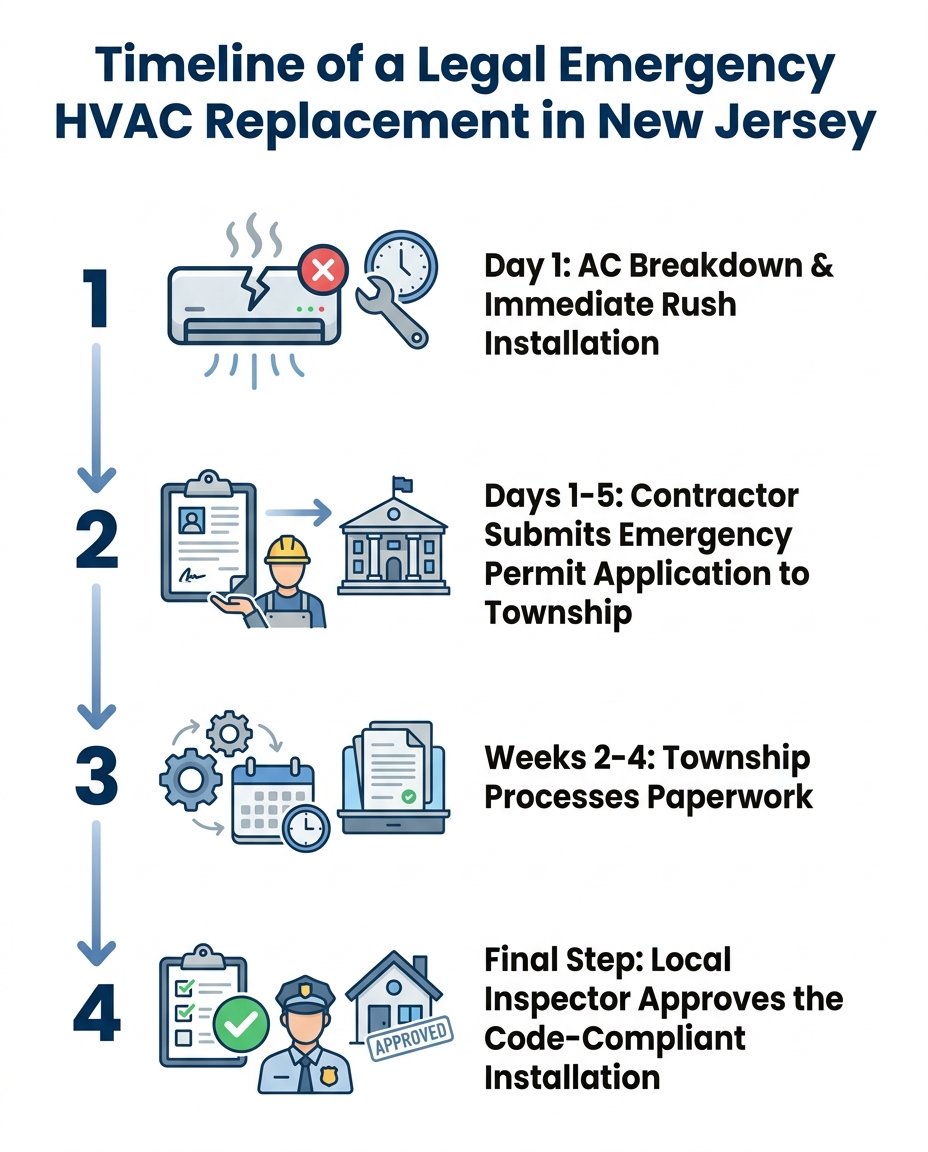
The strict compliance window: It is crucial to understand that the emergency provision does not waive the requirement for a permit; it simply shifts the timeline. Once the emergency installation is complete and your home is cooling again, the clock starts ticking. The contractor must submit the formal permit application to the local municipality within a set timeframe—typically five business days following the installation. This ensures that the township is notified and that the work will eventually be inspected for safety and code compliance.
The value of local expertise: Working with a team like Climate Mechanics that has deep local expertise in these specific municipal codes allows us to fast-track emergency replacements legally without cutting regulatory corners. A licensed professional knows exactly what documentation is required to satisfy the UCC emergency guidelines. We take on the burden of filing the paperwork accurately and promptly, ensuring that your immediate relief does not turn into a legal headache down the road.

How Local Townships Handle Rush Installations
Navigating the permit landscape in this region requires highly specific geographical knowledge. Burlington County townships (including Cinnaminson) do not operate under a single, unified administrative office. Instead, the county consists of 40 separate municipalities, each running its own construction and code enforcement department. This fragmentation means that the exact process, required paperwork, and processing speeds can vary wildly from one town border to the next.
Administrative variances: What takes two days to process in one municipality might sit on a desk for two weeks in another. Furthermore, the technical documentation required for a rush installation differs. Some townships demand highly detailed Manual J load calculations and strict proof of energy code compliance submitted alongside the emergency permit application, while others have more streamlined requirements for identical equipment.
The importance of established relationships: This is where our local footprint becomes invaluable. The team at Climate Mechanics already knows the inspectors, the clerks, and the specific quirks of each local office. If you need an AC installation in Moorestown, our seasoned professionals already have the correct forms, know the local energy code thresholds, and understand exactly how that specific construction office prefers to receive emergency UCC filings.
Homeowner stress versus professional execution: Attempting to figure out your specific township's rules during an end-of-season cooling crisis is overwhelming. The last thing you want to do is navigate municipal websites and call automated phone systems while your house is 90 degrees inside.
• Contractor evaluates the system and proposes a replacement. — Emergency Replacement Process: Contractor confirms a catastrophic failure posing a safety risk.
• Permit application is submitted to the township. — Emergency Replacement Process: New system is installed immediately under NJ UCC provisions.
• Homeowner waits 1-3 weeks for township approval. — Emergency Replacement Process: Homeowner enjoys a cool, safe house the very same day.
• Installation occurs only after the permit is issued. — Emergency Replacement Process: Contractor files permit paperwork within 5 business days of install.
• Township inspector verifies the work weeks later. — Emergency Replacement Process: Township inspector verifies the work weeks later.
The Dangers of Skipping the Permit Process
When you are desperate for relief from the heat, it can be tempting to hire the first person who promises a fast, off-the-books installation. Uncredentialed workers often use the urgency of a breakdown to convince homeowners that pulling permits is just an unnecessary hassle that will delay the job. In our experience, because the NJ UCC emergency provision exists, there is never a valid reason to skip pulling the proper permits.
The risks of unpermitted work: Bypassing the municipal construction office exposes you to severe legal, financial, and safety liabilities. A licensed HVAC contractor handling municipal permits protects you from these hidden dangers.
• Municipal fines and penalties: If the township discovers unpermitted mechanical work—often triggered by a neighbor's complaint or a future exterior inspection—they can issue stop-work orders and levy heavy fines against the homeowner.
• Homeowners insurance complications: Insurance policies generally require that all major home modifications meet local building codes. If an unpermitted, incorrectly installed air conditioner causes electrical damage or a fire, your insurance carrier will likely deny the claim.
• Real estate hurdles: When it comes time to sell your home, buyers will request permit records for major upgrades. An undocumented HVAC system frequently stalls home sales, forcing the seller to pay for retroactive permits, late fees, and potential teardowns to prove compliance.
• Life safety hazards: Modern air conditioning systems involve high-voltage electricity, pressurized refrigerants, and complex ductwork. An uninspected installation might feature improper wiring or dangerous refrigerant leaks that put your family at risk.
Doing the job correctly does not mean sacrificing speed. You can easily check if you need a permit to replace your AC in New Jersey, but the short answer is always yes. Relying on the emergency provision gives you the fast response of a rush job with the long-term security of a fully inspected, legal installation.
From Breakdown to Cooling: The Homeowner's Experience
Understanding the actual timeline of a rush installation helps alleviate the anxiety of a major system failure. When our trusted professionals handle the logistics, the process is smooth, compliant, and focused entirely on restoring your comfort.
Consider a common pattern our Climate Mechanics technicians see in the field: a homeowner reaches out on a Sunday evening right before a major late-summer holiday, like Labor Day weekend, because their central air unit went down completely just as the back-to-school transition begins. Because emergency protocols are utilized, our service technician arrives quickly, diagnoses the critical failure, and initiates a rapid response to restore cooling without disrupting the holiday weekend. Here is exactly how that process unfolds.
Step 1: Emergency Diagnostic
The first step is a rapid, accurate assessment of the catastrophic failure. Our technician evaluates the equipment to determine if it is a repairable issue or a total system failure. If the compressor is dead, the coils are severely compromised, or the unit is simply too old to salvage safely, the technician will classify the situation as an emergency requiring immediate replacement. If it is a lesser issue, they will perform an emergency AC repair instead.
Step 2: Rush Installation
Once a replacement is deemed necessary to protect the home's indoor environment, our team mobilizes. The necessary equipment is secured, and the installation crew is deployed immediately. The old, broken unit is removed, and the new system is installed according to manufacturer specifications. By the end of the day, safe indoor temperatures are restored, and you are no longer waiting on municipal offices to approve your comfort.
Step 3: Background Compliance
With your home cooling comfortably, our administrative work begins. Climate Mechanics handles all the necessary load calculations, equipment sizing documentation, and permit applications. We ensure that all paperwork meets the local township energy codes and submit the emergency filing within the required five-day window. You do not have to fill out complex municipal forms or stand in line at the county building.
Step 4: Final Inspection
Weeks later, once the township has processed the paperwork at their normal pace, a brief final inspection is scheduled. The local municipal inspector visits your home—completely on your timeline—to verify that the electrical and mechanical work was performed safely and up to code. This final sign-off closes the permit and provides ultimate peace of mind.
Protecting Your Investment and Future Rebates
A rush installation is still a major investment in your property, and doing it strictly by the book protects that investment for years to come. Emergency installations must still meet the latest state and local energy efficiency codes. Burlington County townships (including Cinnaminson) enforce these standards to ensure that homes are operating efficiently and safely.
Securing utility incentives: Upgrading to a modern, high-efficiency cooling system often qualifies you for generally applicable energy rebates or federal tax credits. However, these incentive programs have strict documentation requirements. Properly documented, permitted work is a mandatory prerequisite for claiming these benefits. If your system was installed off the books without municipal oversight, utility companies and tax authorities will reject your rebate applications.
Maintaining manufacturer warranties: The equipment manufacturer also has a vested interest in how their product is installed. Major HVAC brands require proof of professional, code-compliant installation to honor long-term equipment warranties. If a compressor fails three years down the line and you cannot produce a finalized municipal permit showing it was installed correctly, the manufacturer can void the warranty, leaving you responsible for the total cost of parts and labor.
During a particularly hot and humid late-summer stretch recently, our team helped a local family replace their aging central air unit. Our installation crew explained everything in detail, ensuring the new unit was installed to code and fully permitted despite the rushed timeline. This thorough explanation of the new system and its compliance gave the family lasting peace of mind, knowing they were protected by both the manufacturer and the municipality.
Frequently Asked Questions
Can an HVAC contractor install an AC in an emergency before getting a permit in NJ?
Yes, under the New Jersey Uniform Construction Code (UCC). The emergency work provision allows licensed contractors to proceed immediately with an installation to address life safety risks, such as extreme indoor heat. The formal permit application must then be submitted within a strict timeframe, usually five business days, following the completion of the rush installation.
Who handles the township permits for AC replacement in Burlington County?
A reputable, licensed HVAC contractor like Climate Mechanics will handle the entire permitting process on your behalf. We are responsible for performing the necessary load calculations, compiling the equipment specifications, and submitting the paperwork to the specific municipal construction office. Homeowners should not have to navigate the local bureaucracy themselves.
How long does it take to get a standard HVAC permit versus an emergency one?
A standard HVAC permit can take anywhere from a few days to several weeks for a township to review and approve before work can begin. An emergency permit utilizes a legal provision that allows the installation to happen on day one, with the administrative review and approval occurring after the fact, ensuring you do not have to wait for relief.
What happens if you replace HVAC without a permit in NJ?
Replacing an HVAC system without a permit exposes you to significant risks, including municipal fines and forced work stoppages. Unpermitted work can also void your manufacturer warranties, lead to denied homeowners insurance claims in the event of an accident, and create major legal and financial hurdles when you attempt to sell your property.
Do I need to be home when the Burlington County township inspector comes?
Yes, an adult must be present to allow the municipal inspector access to the property. The inspector needs to physically review the indoor and outdoor units, check the electrical connections, and verify that the installation matches the permitted plans. Our team will help coordinate this visit at a time that is convenient for your schedule.
Restoring Your Comfort Without the Wait
Dealing with a broken air conditioner during a brutal heatwave is stressful enough without worrying about municipal red tape. You do not have to choose between following the law and keeping your family safe. A licensed local professional can navigate HVAC permit requirements for rush installations in Burlington County smoothly and legally. By utilizing emergency protocols, our Climate Mechanics team can perform an immediate installation and handle the township compliance properly in the background, ensuring your comfort is restored without delay.
