



Is That First Heater Cycle Odor Normal or a Sign of Trouble?
Are you currently searching for home maintenance tips and troubleshooting advice because your heating system just filled your home with a strange, burning odor? You are certainly not alone. As temperatures begin to drop, thousands of homeowners flip their thermostats from cooling to heating for the very first time in months. Within minutes, a distinct smell begins to circulate through the vents. This common mid fall / October heating startup scenario immediately forces a stressful decision: do you open the windows and wait for the smell to clear, or do you shut the system down and call a professional immediately?
Understanding the difference between a harmless operational quirk and a hazardous mechanical failure is critical for your safety and comfort. A dormant furnace or heat pump undergoes a significant physical transition during its first active cycle. While a brief odor is often standard, certain smells and sounds indicate underlying damage that requires immediate attention. Interestingly, evaluating your heating system's health in the autumn often reveals compounding issues that make this the smartest time of year to plan for a central air conditioning installation before the next cooling season arrives.
The Mechanics Inside Your HVAC System After Summer Dormancy
To understand why your furnace smells like burning dust when turned on, you have to look at the physical mechanics of a dormant system. Throughout the long summer months, your heating components sit completely inactive. Even if your air conditioner is running daily and air is moving through the ductwork, the specific heating elements—like the heat exchanger in a gas furnace or the electric coils in a heat pump—remain cold and still.
Over these months of dormancy, microscopic airborne particles bypass your air filter. Pet dander, skin cells, textile fibers, and standard household dust slowly settle onto these cold metal surfaces. Because the heating elements are not engaging, this layer of debris continues to thicken uninterrupted until the first chilly night of autumn forces the system to wake up.
What Happens During the First Cycle
When you finally adjust your thermostat to call for heat, a rapid and intense mechanical sequence begins. Here is exactly what happens inside the cabinet:
1. Rapid Ignition: The thermostat signals the control board, which opens the gas valve and engages the igniter (or sends high voltage to electric heating elements).
2. Extreme Temperature Spike: The metal surfaces of the heat exchanger or coils heat up to hundreds of degrees within a matter of seconds.
3. Instant Vaporization: The accumulated layer of summer dust and debris cannot withstand this sudden, intense heat. The particles instantly bake and vaporize right on the metal surface.
4. Distribution: The primary blower motor kicks on, pushing conditioned air over the hot components. This air catches the vaporized dust particles and distributes that distinct burning odor through your ductwork and out of your room registers.
This physical reaction is entirely standard. The vaporization of settled debris is a natural consequence of system dormancy, establishing a baseline for what you should expect during a typical autumn startup.
Diagnosing the Odor: Normal Dust vs. Hazardous Symptoms
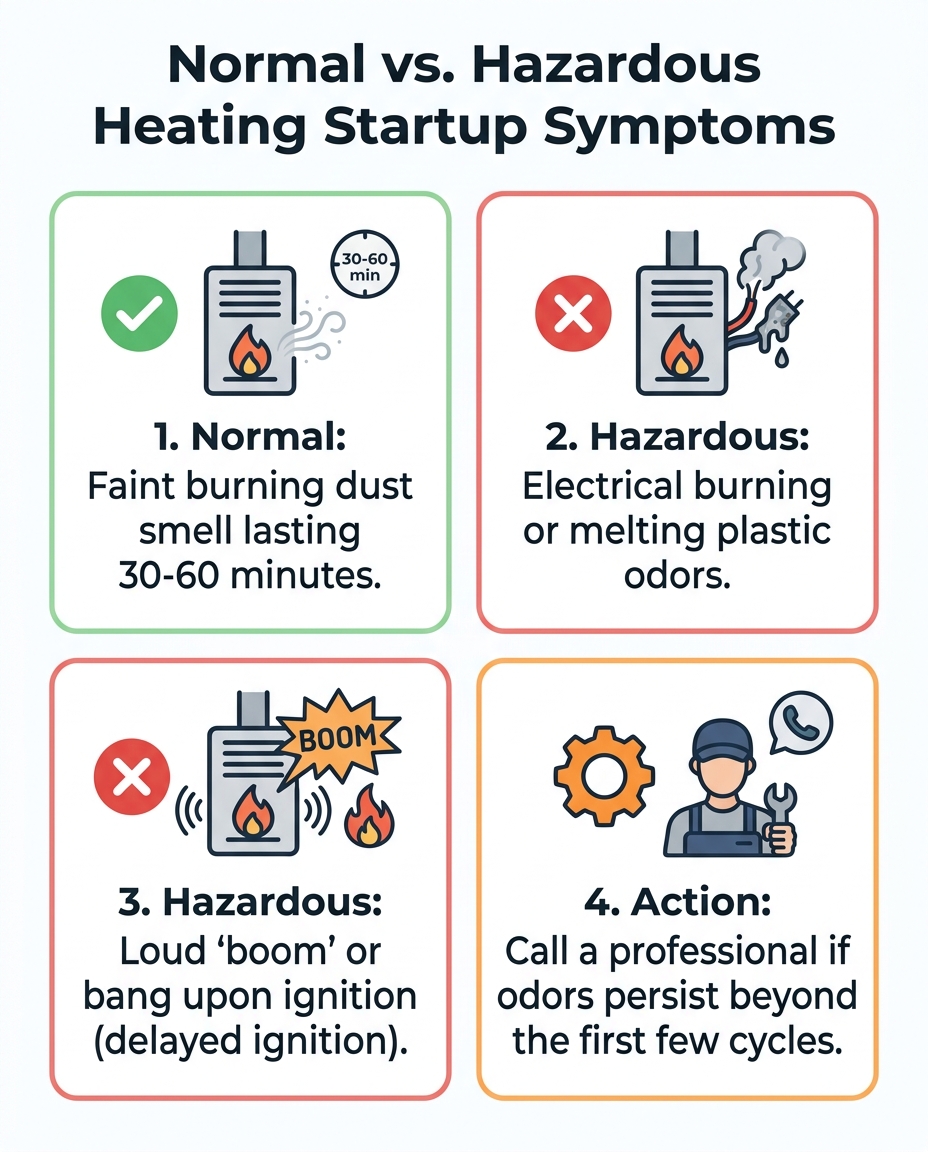
While a brief burning dust smell is a standard mechanical reaction, other odors and sounds are massive red flags. Drawing a clear boundary between harmless dust burn-off and hazardous mechanical failure is the most important part of fall troubleshooting. If your furnace smells like burning dust when turned on, the odor should dissipate entirely within 30 to 60 minutes. If the smell persists, or if it takes on a different chemical profile, you are likely facing a serious malfunction.
• Faint burning dust or hair — Probable Cause: Standard burn-off of dormant summer debris on the heat exchanger. — Action Required: Monitor. Should clear within 45 to 60 minutes of continuous running.
• Electrical burning or ozone — Probable Cause: Overheating blower motor, failing capacitor, or frayed electrical wiring. — Action Required: Shut system down immediately at the thermostat and call a professional.
• Melting plastic or rubber — Probable Cause: A foreign object dropped into a vent, or melting wire casings near the burner. — Action Required: Shut system down immediately to prevent toxic fumes and fire hazards.
• Rotten eggs or sulfur — Probable Cause: Natural gas leak near the gas valve, manifold, or supply line. — Action Required: Evacuate the home, leave doors open, and call your gas utility provider.
The Danger of Delayed Ignition: Beyond odors, you must listen to how your system starts. If you hear a loud "boom" or a heavy metallic bang when the heater kicks on, you are experiencing delayed ignition. This happens when the gas valve opens, but the igniter fails to spark immediately. Gas pools inside the combustion chamber. When the spark finally triggers, the excess gas ignites all at once, creating a small internal explosion. This violent force can crack the heat exchanger over time.
The Environmental Protection Agency (EPA) strongly warns against operating a furnace with a cracked heat exchanger. A compromised heat exchanger allows deadly, odorless carbon monoxide gas to mix with the air being pushed into your living spaces. This is precisely why professional pre-winter inspections are vital—technicians use specialized combustion analyzers to detect microscopic cracks and gas leaks long before they trigger your ceiling alarms.

Why Fall Heating Startup is the Ideal Time to Evaluate AC Replacement
It might seem counterintuitive to think about cooling when you are troubleshooting your heater, but the two systems are intimately connected. An aging HVAC system that struggled to keep your home cool during the peak of summer will almost always reveal compounding issues during the fall transition. The blower motor that labored to push heavy, humid air in July is the exact same motor responsible for distributing warm air in October. If it is failing, you will feel it now.
A typical pattern we see involves proactive homeowners choosing to upgrade their entire home comfort system at once rather than waiting for individual components to fail. For example, one local homeowner recently decided to address their aging equipment by having a new central air unit, heater, and water heater installed simultaneously. The installation team finished the project sooner than expected, leaving the family completely prepared for the winter and perfectly positioned for the following summer. This approach avoids the chaotic rush of the first hot days of spring when service schedules are completely booked.
Furthermore, there are significant mechanical efficiencies gained by replacing both sides of the system together. Your air conditioner and your furnace share the same indoor air handler and blower fan. Upgrading the outdoor condenser while leaving an outdated, inefficient indoor blower motor in place severely limits the performance of the new equipment. By scheduling an AC replacement alongside a heating system upgrade, you ensure that all components are perfectly matched, communicating seamlessly, and operating at maximum energy efficiency.
Comparing Your Next Steps: Wait, Repair, or Replace
When you encounter a mid fall / October heating startup issue, deciding how to proceed can feel overwhelming. Should you just let the system run, pay for a targeted fix, or invest in a completely new system? Having a clear decision-making framework helps remove the stress from the situation.
Delaying necessary upgrades often leads to highly stressful, poorly timed breakdowns. For instance, one homeowner found that their older AC unit absolutely refused to turn on during the very first hot day of the year—which happened to be just four days after their builder's warranty expired. Fortunately, the repair was covered under the manufacturer's warranty and labor charges were waived, but relying on last-minute emergency fixes is a risky strategy for maintaining home comfort. Here is how to evaluate your current situation:
• When to Wait It Out: If your system is relatively young (under 10 years old), has been regularly maintained, and the only symptom is a faint burning dust odor that completely disappears within an hour, you are likely safe to just let the system run. This is a standard burn-off cycle.
• When to Schedule a Targeted Repair: If the burning smell persists for hours, if you hear clicking noises before ignition, or if certain rooms feel noticeably colder than others, a targeted repair is the logical step. A professional tune-up can clean the burners, recalibrate the thermostat, and clear the blower wheel to restore proper airflow without requiring a full system overhaul.
• When to Plan a Full Replacement: The tipping point for a full replacement occurs when safety is compromised or repair costs become mathematically illogical. If a technician discovers a cracked heat exchanger, if the system requires frequent, expensive repairs every season, or if your heating issues are paired with an air conditioner that is over 12 years old and uses phased-out refrigerant, replacement is the most cost-effective long-term choice.
Ultimately, investing in a proper, professional installation provides long-term cost benefits and peace of mind that temporary, rushed fixes simply cannot match.
How Precise Sizing Impacts Both Heating and Cooling Efficiency
Whether you are installing a new high-efficiency furnace or a modern air conditioner, the single most important factor determining its lifespan is how precisely it is sized for your specific home. South Jersey experiences intense summer humidity followed by rapid, unpredictable autumn temperature swings. Your HVAC system must be perfectly calibrated to manage both of these extreme weather conditions without faltering.
Many big-box estimates still rely on outdated "rule of thumb" visual checks, guessing the size of the unit based solely on the square footage of the house. This is a critical error. A proper Cherry Hill AC installation requires a stringent Manual J load calculation. This calculation factors in the quality of your insulation, the number of windows, the direction your home faces, and the height of your ceilings.
The Dangers of Poor Sizing:
• Oversized Systems: An oversized heater or air conditioner will "short-cycle." It blasts the home with conditioned air and shuts off within minutes. In the winter, this leaves distant rooms freezing cold while the main hallway is sweltering. In the summer, short-cycling cools the air too quickly without running long enough to extract the heavy humidity, leaving your home feeling cold but uncomfortably clammy.
• Undersized Systems: A unit that is too small will run continuously, struggling to reach the thermostat setting. This drives up your energy bills, accelerates mechanical wear and tear, and inevitably leads to premature system failure.
By demanding precise load calculations, you ensure that your new equipment operates exactly as the manufacturer intended, providing optimal comfort and efficiency regardless of what the regional weather dictates.
Pre-Winter Inspections and Navigating System Upgrades
Before the deep winter freezes arrive, taking the time to address your HVAC concerns protects both your property and your family. Pre-winter professional inspections are fundamentally about safety. Technicians do not just change filters; they measure gas pressure, test safety limit switches, and evaluate the draft inducer motor to ensure all combustion gases are safely venting out of your home.
If an inspection reveals that major repairs or a full system replacement are necessary, you must also navigate local building codes. Upgrading heavy mechanical equipment, altering ductwork, or running new electrical lines requires adherence to strict municipal safety standards. Many homeowners wonder about the regulatory side of these upgrades, frequently asking, do you need a permit to replace AC in New Jersey? The short answer is yes. Permitting ensures that the installation meets all state and local fire, electrical, and mechanical codes.
While the permitting process might sound intimidating, a professional HVAC installation team handles these regulatory requirements seamlessly. They pull the necessary permits, schedule the municipal inspections, and ensure that every wire, pipe, and vent is installed to code, protecting you from future liabilities or insurance complications.
Secure Your Home's Winter Comfort and Safety Today
Understanding the standard symptoms of a mid fall / October heating startup empowers you to make smarter, safer home maintenance decisions. While a brief odor of burning dust is usually nothing to worry about, ignoring persistent smells, loud bangs, or poor airflow can lead to dangerous situations and costly emergency breakdowns. You do not have to guess whether your system is safe to operate.
Expert help is readily available to evaluate any concerning odors, noises, or performance issues you experience this season. Whether you need a thorough safety inspection, a targeted repair, or a complete AC installation in Cinnaminson bundled with a new furnace, taking action now ensures your home remains a safe, comfortable haven. Schedule your comprehensive system evaluation today, long before the freezing temperatures arrive, and enjoy the confidence of a perfectly operating home comfort system.
Frequently Asked Questions
Why does my furnace smell like burning dust when turned on?
Your furnace smells like burning dust because microscopic debris, pet dander, and household dust settle on the internal heat exchanger during the dormant summer months. When the system ignites for the first time in the fall, the metal components heat up rapidly, instantly vaporizing the accumulated dust. The blower motor then pushes this harmless vaporized debris through your ductwork, resulting in the temporary odor.
How long should a furnace smell like burning dust?
The standard burning dust odor should completely dissipate within 30 to 60 minutes of the system running continuously. Once the initial layer of dormant debris has burned off the heat exchanger, the air circulating through your home should smell clean and neutral. If the smell persists for several hours or returns during subsequent heating cycles, you should turn the system off and request a professional evaluation.
What causes delayed ignition in a furnace?
Delayed ignition occurs when the gas valve opens to release fuel into the combustion chamber, but the electronic igniter or pilot light fails to spark immediately. Gas continues to pool inside the chamber until the spark finally triggers, causing all the accumulated gas to ignite at once with a loud bang or "boom." This mini-explosion puts immense stress on the heat exchanger and requires immediate professional repair to prevent serious structural damage.
How do I know if my furnace odor is dangerous?
A dangerous furnace odor usually smells distinctly chemical or electrical, unlike the organic smell of burning dust. Smells resembling melting plastic, burning electrical wires, ozone, or the rotten egg scent of a natural gas leak are severe warning signs. If you detect any of these hazardous odors, shut the system down at the thermostat immediately and contact a professional technician or your gas utility provider.
What is normal when turning on the heat for the first time?
It is completely normal to experience a brief, faint burning odor and to hear the metal ductwork slightly expand and "pop" as warm air travels through cold vents for the first time. You should also expect the blower motor to run smoothly without grinding or squealing. Any persistent smells, loud banging noises, or continuous short-cycling are abnormal and warrant a professional inspection.
Is fall a good time to install a new air conditioner?
Yes, fall is an excellent time to install a new air conditioner, especially if you are also upgrading your heating system. Replacing both the indoor furnace and the outdoor AC condenser at the same time ensures the components share a modern, high-efficiency blower motor and communicate perfectly. Furthermore, scheduling off-season AC installations helps you avoid the massive scheduling delays that inevitably occur during the first heat wave of spring.
