




Why High Humidity in the Delaware Valley Makes Your AC Work So Much Harder
How high humidity in the Delaware Valley makes your AC work harder than in dry climates comes down to one core difference: your system has to fight two battles at once — cooling the air and pulling moisture out of it.
In a dry climate like Arizona, an air conditioner mainly handles temperature. In the Delaware Valley, it also has to act as a dehumidifier. Philadelphia-area summers average relative humidity levels between 72% and 74%, with peak afternoon humidity pushing close to 80% on the worst days. That extra moisture load forces your system to run longer, consume more energy, and wear down faster.
Here's a quick breakdown of why humidity hits harder here than in dry climates:
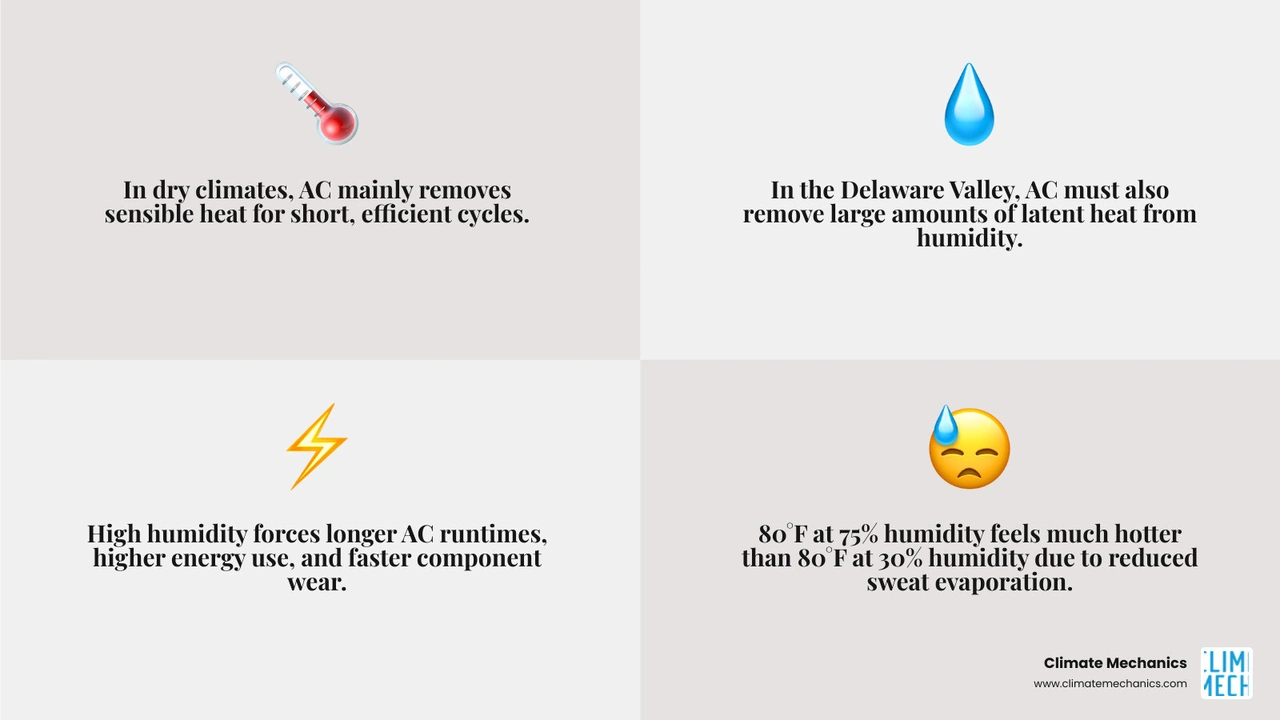
• Dry climates (like the Southwest): AC removes mostly heat. Short, efficient cycles. Lower energy use.
• Delaware Valley summers: AC must remove both heat and large amounts of moisture from the air. Longer cycles. Higher energy bills. More wear on components.
• The result: Your AC works significantly harder here — even on days when the temperature is not extreme — because moisture in the air carries its own heat load (called latent heat) that takes extra energy to remove.
• The comfort factor: High humidity slows down sweat evaporation, your body's natural cooling system. So 80°F at 75% humidity feels much worse than 80°F at 30% humidity — which pushes homeowners to lower the thermostat even further, adding even more strain to the system.
If your home feels sticky, your energy bills spike every summer, or your AC runs nonstop without ever feeling comfortable — humidity is likely the culprit.
How High Humidity in the Delaware Valley Makes Your AC Work Harder Than Dry Climates
When we think about summer heat, we usually look at the thermometer. But temperature is only half the story. The true enemy of summer comfort in South Jersey communities like Marlton, Cherry Hill, and Haddonfield is the heavy, moisture-laden air.
To understand how high humidity in the Delaware Valley makes your AC work harder than dry climates, we have to look at how air conditioning actually works. Your AC does not actually "create" cold air; instead, it extracts heat from your indoor air and transfers it outside.
This heat comes in two distinct forms:
1. Sensible Heat: This is the heat you can measure directly with a thermometer. It is the molecular movement of air that raises the temperature.
2. Latent Heat: This is the hidden thermal energy stored in water vapor. It does not change the temperature on the thermometer, but it represents a massive energy load that your AC must physically condense out of the air to make you feel comfortable.
In dry, desert climates, almost 100% of an air conditioner’s capacity is dedicated to lowering the sensible heat (dropping the actual temperature). But in our muggy Delaware Valley climate, up to 30% to 40% of your AC's cooling capacity is consumed just by dealing with latent heat—pulling water out of the air before it can even begin to lower the indoor temperature.
To put this energy penalty into perspective, consider the physical reality of cooling a standard 2,200-square-foot home from 75°F down to 70°F:
• Dry Climate (e.g., Arid West) — Starting Conditions: 75°F at 15% Relative Humidity — Latent Heat Load: Negligible — Energy Required to Reach 70°F / 50% RH: Approx. 2,101 Watt-hours (Wh)
• Humid Climate (Delaware Valley) — Starting Conditions: 75°F at 80% Relative Humidity — Latent Heat Load: Extremely High — Energy Required to Reach 70°F / 50% RH: Approx. 4,475 Watt-hours (Wh)
As the math shows, cooling the exact same size home to the exact same temperature requires more than twice the electrical energy in a humid climate compared to a dry one. Your system has to run twice as long and consume more than double the power simply because of the massive volume of water suspended in our local air.
Understanding How High Humidity in the Delaware Valley Makes Your AC Work Harder Than Dry Climates
How does this moisture removal process work mechanically? As warm, humid air from your living room is drawn into the return vents, it passes over the freezing-cold evaporator coils inside your indoor air handler.
When the hot, damp air hits these cold metal coils, the moisture in the air reaches its dew point and condenses into liquid water—much like droplets forming on a cold glass of iced tea on a July afternoon in Pennsauken. This water drips down into a condensate pan and drains away outside or through a basement floor drain.
However, this condensation process releases latent heat back onto the coils, which means the refrigerant flowing through your AC lines has to absorb all of that extra heat energy. This dramatically increases the refrigerant pressure within the system, forcing your outdoor compressor to work significantly harder to pump and compress the refrigerant.
Because the compressor has to run under higher pressure and for much longer cycles to pull gallons of water out of your indoor air every day, it consumes a staggering amount of electricity. Heating and cooling already account for 45% to 60% of a home’s total energy use, making it the highest operating cost of any household system. When you add local humidity to the mix, those operating costs can skyrocket. Fortunately, there are actionable steps you can take to mitigate this, which you can read about in our guide on 4 Ways to Lower Your AC Costs This Summer.
The Science Behind How High Humidity in the Delaware Valley Makes Your AC Work Harder Than Dry Climates
To fully appreciate the science of summer discomfort, we have to look at how our bodies interact with the air. Humans do not actually feel temperature; we feel the rate at which our bodies lose heat.
Our primary method of cooling down is sweat evaporation. When sweat evaporates from our skin, it carries heat away with it. However, relative humidity measures how full of moisture the air already is. If the air in your Collingswood or Camden home is already saturated with water vapor (above 60% relative humidity), your sweat cannot evaporate effectively. It simply sits on your skin, leaving you feeling sticky, clammy, and uncomfortably hot.
This is where the concept of "apparent temperature" or the "heat index" comes into play. For example:
• If your thermostat reads 75°F in a dry climate (30% humidity), it actually feels like 73°F to your body.
• If your thermostat reads 75°F in a humid Delaware Valley summer (70% humidity), the air index makes it feel like 78°F to 80°F!
Because 75°F feels like 80°F, your natural reaction is to walk over to the thermostat and crank it down to 70°F or even lower. This creates a costly, vicious cycle: you force your AC to run marathon cycles to reach an artificially low temperature setting, all because the system isn't successfully managing the indoor humidity.
The Mechanical Toll of Excess Moisture on Your Air Conditioner
Running an air conditioner under these conditions is like forcing a runner to sprint a marathon while carrying a heavy, water-logged backpack. The mechanical toll on your system is severe and can lead to premature breakdowns.
When high humidity forces your system to run constantly, several mechanical failures become much more common:
1. Condensate Overload: On a typical muggy afternoon in Willingboro or Burlington, your AC can pull multiple gallons of water out of your indoor air daily. This puts an enormous burden on your condensate drain system. If your drain line has even a minor restriction, the sheer volume of water will cause the drain pan to overflow, leading to water damage in your ceilings, walls, or basement.
2. Frozen Evaporator Coils: It sounds counterintuitive, but high humidity can actually cause your air conditioner's indoor coils to freeze solid. If airflow is restricted by even 10% (due to a dirty air filter or dusty ductwork), the heavy moisture passing over the cold coils will quickly turn to frost. Once a thin layer of ice forms, it insulates the coil, prevents heat transfer, and causes the entire unit to freeze into a solid block of ice, shutting down your cooling completely.
3. Accelerated Compressor Wear: The compressor is the heart of your AC system. High humidity forces the compressor to run longer, hotter cycles under elevated refrigerant pressures. This constant strain accelerates the breakdown of lubricating oil inside the compressor, leading to capacitor failures, blower motor burnout, and eventual compressor failure—the most expensive repair an HVAC system can face.
Signs Your AC is Struggling with Humidity
How do you know if your cooling system is losing the battle against Delaware Valley moisture? Keep an eye out for these classic warning signs in your home:
• The "Cool but Clammy" Feeling: If your home feels like a cold, damp cave—where the thermometer says 71°F but you feel sticky and uncomfortable—your AC is cooling the air but failing to dehumidify it.
• Musty Odors: When indoor humidity levels consistently exceed the 60% threshold, it creates a breeding ground for mold and mildew. If you notice a damp, earthy smell near your vents or in your basement, moisture is pooling inside your system or ductwork. This is a major red flag for your family's health; to understand why, check out our article on Why Indoor Air Quality is Important.
• Constant Runtime: Your AC should ideally run in 15-to-20-minute cycles to cool your home and effectively pull moisture from the air. If your system is running continuously for hours without a break on an 85°F day, it is struggling under the latent heat load.
• Short Cycling: If your AC turns on, runs for 5 to 8 minutes, and shuts off, only to turn back on a few minutes later, it is short cycling. This is often caused by an oversized system that cools the temperature too quickly but shuts down before it has run long enough to condense moisture out of the air, leaving your home cold but incredibly humid.
Essential HVAC Features for Hot and Humid Conditions
If you are upgrading your HVAC system or want to optimize your current setup for our local climate, certain features are absolutely non-negotiable for handling South Jersey's humid summers.
• Variable-Speed Compressors (Inverter Technology): Traditional single-stage AC units are either 100% on or 100% off. When they cycle off, dehumidification stops instantly. Variable-speed systems, however, can scale their output down to run longer, gentler cycles at lower speeds. This continuous, low-energy operation keeps air moving across the cold evaporator coils constantly, providing unparalleled moisture removal and keeping your indoor humidity perfectly balanced.
• High SEER2 Ratings: SEER2 (Seasonal Energy Efficiency Ratio) measures how efficiently your system cools. Upgrading from an older, inefficient 10 SEER system to a modern 16 SEER2 or higher unit can reduce your cooling energy consumption by up to 60%. In a high-humidity climate where systems run longer cycles, these efficiency gains translate directly into massive monthly utility savings.
• Smart Thermostats with Humidity Sensors: Modern smart thermostats do not just monitor temperature; they measure relative humidity. Many can be configured to run "dehumidification mode," which automatically slows down the indoor blower fan speed when humidity is high. Slower airflow allows the air to spend more time in contact with the freezing cold evaporator coils, pulling significantly more moisture out of the air before distributing it to your rooms.
Sizing and Airflow Considerations
When it comes to air conditioning in South Jersey, bigger is definitely not better.
Historically, many systems in older Audubon or Haddonfield homes were sized using rough rules of thumb based solely on square footage. This almost always results in an oversized system.
An oversized AC will blast cold air into your home, satisfy the thermostat in 5 to 10 minutes, and shut off. Because it takes at least 10 to 15 minutes of continuous runtime for the evaporator coils to get cold enough to start condensing water out of the air, an oversized system will leave your home feeling incredibly sticky and clammy.
At Climate Mechanics, we perform precise Manual J load calculations before recommending any system. This scientific calculation takes into account your home’s exact square footage, insulation levels, window orientations, local climate patterns, and typical occupant load to ensure your new system is sized perfectly. A properly sized system will run longer, highly efficient cycles that thoroughly dehumidify your living space while consuming less electricity.
Furthermore, even minor airflow restrictions can cripple your system's ability to dehumidify. A mere 10% restriction in airflow—caused by crushed ductwork, blocked vents, or a clogged filter—can cause your coil temperature to drop too low, leading to frozen coils, system shutdowns, and skyrocketing energy bills.
Practical Solutions for Delaware Valley Homeowners
If you want to protect your air conditioner, slash your summer energy bills, and finally banish that sticky feeling from your home, you need a proactive strategy. The most effective solution for our local climate is integrating a whole-home dehumidifier directly into your existing HVAC system.
While portable dehumidifiers can help treat a single room (like a damp basement corner), they require manual emptying, are noisy, and consume a lot of electricity. A whole-home dehumidifier, on the other hand, is installed directly into your ductwork. It monitors the air throughout your entire house and removes moisture independently of your air conditioner.
By removing moisture from the air before it reaches your living spaces, a whole-home dehumidifier allows you to raise your thermostat setting by 3 to 4 degrees while feeling exactly as comfortable as you would at a lower temperature. Because every degree you raise your thermostat saves you roughly 6% to 8% on your cooling costs, this simple adjustment can lower your summer energy bills by up to 35%!
To learn more about how dedicated moisture control can transform your indoor comfort, read our detailed guides on Dehumidifiers in Humid Climates Benefits and discover the 4 Benefits of Using a Dehumidifier for Your New Jersey Home. If you have a subterranean space, you will also want to read up on Why You Need a Dehumidifier in Your New Jersey Homes Basement to protect your home's foundation and structural integrity.
Maintenance Strategies to Protect Your System
You wouldn't drive your car on a cross-country road trip without checking the oil, and you shouldn't force your AC to face a South Jersey summer without proper preparation. Homeowners who skip annual maintenance often pay 20% to 30% more in utility costs during peak summer months due to lost efficiency.
To keep your system running smoothly through the muggiest July afternoons, implement these essential maintenance steps:
• Keep the Evaporator and Condenser Coils Clean: Dust and dirt act as insulators. If your indoor evaporator coil is coated in dust, it cannot transfer heat or condense moisture effectively. If your outdoor condenser coil is blocked by grass clippings, cottonwood seeds, or dirt, it cannot release heat, forcing your compressor to run hotter and work harder.
• Clear the Condensate Drain Line: Flush your drain line regularly to prevent algae growth and clogs. A blocked drain line can trigger safety switches that shut down your AC completely, or worse, cause water to overflow and damage your home.
• Replace Air Filters Monthly: A clogged air filter restricts airflow, which starves your system of air, lowers coil temperatures, and can cause your system to freeze up. Change your filters every 30 to 90 days depending on your household size and whether you have pets.
For a complete checklist on preparing your system for the summer heat, refer to our AC Maintenance Tips for Summer. If you live in Cherry Hill, you can book specialized service directly through our AC Maintenance Cherry Hill NJ page, or if you are located in Delran, visit our AC Maintenance Delran NJ portal to schedule your seasonal tune-up.
Frequently Asked Questions about Humidity and AC Performance
Why does my house feel humid even when the AC is running?
There are several common culprits for this. First, your system may be oversized, causing it to "short cycle" (turning on and off too quickly) before it has run long enough to condense moisture out of the air. Second, your fan may be set to "ON" instead of "AUTO." When the fan is set to "ON," it runs continuously, blowing air over wet coils even after the cooling cycle ends, which re-evaporates the collected water back into your home. Finally, dirty coils, low refrigerant levels, or leaky ductwork pulling humid air from your crawlspace or attic can also prevent proper dehumidification.
What is the ideal indoor humidity level for summer?
According to the Environmental Protection Agency (EPA), the ideal indoor relative humidity range during the summer is between 30% and 50%. Keeping your humidity below 50% prevents mold and mildew growth, discourages dust mites, protects wood furnishings and musical instruments, and ensures your body can cool itself naturally through sweat evaporation.
Can a whole-home dehumidifier help lower my energy bills?
Yes, absolutely! When a dedicated dehumidifier handles the moisture load, your air conditioner only has to focus on lowering the temperature. Because dry air feels significantly cooler than damp air, you can comfortably set your thermostat 3 to 4 degrees higher without noticing a difference in comfort. This reduced workload on your AC can lower your seasonal cooling costs by up to 35% and dramatically extend the lifespan of your cooling equipment.
Conclusion
Managing summer comfort in South Jersey is about far more than just dropping the temperature. Because how high humidity in the Delaware Valley makes your AC work harder than dry climates is a scientific reality, local homeowners must take moisture control seriously to protect their equipment and keep energy bills under control.
At Climate Mechanics, we have spent over 38 years providing South Jersey homeowners with personalized, expert HVAC solutions. Our NATE and NCI-certified technicians serve Maple Shade, Pennsauken, Audubon, Willingboro, Collingswood, Haddonfield, Burlington, Marlton, Camden, and the surrounding areas. Whether you need a seasonal tune-up, a custom load calculation, or a whole-home dehumidifier installation, we are here to ensure your home remains a cool, dry, and comfortable sanctuary all summer long.
Ready to reclaim your home from summer mugginess? Contact us today to schedule your professional air conditioning service!
