


Why South Jersey Sunrooms and Home Additions Are So Hard to Keep Comfortable
If you've ever wondered how a ductless mini split cools a home addition or sunroom in South Jersey, here's the short answer: it uses an outdoor heat pump connected to a wall-mounted indoor unit by a small refrigerant line, absorbing heat from inside the room and moving it outside — no ductwork needed, no major construction required.
How a ductless mini split cools a South Jersey home addition or sunroom:
1. The indoor air handler pulls warm air from the room across a cold refrigerant coil
2. The refrigerant absorbs that heat and carries it through a small line to the outdoor unit
3. The outdoor condenser releases the heat outside
4. Cool, dehumidified air is blown back into the room
5. The system adjusts continuously to maintain your set temperature
Sunrooms and home additions are some of the most frustrating spaces to keep comfortable in South Jersey. They're often cut off from the home's existing ductwork, exposed to intense summer sun, and the last places central HVAC systems reach — if they reach them at all. Come July, these rooms can feel like ovens. By November, they're barely usable.
The good news is that a ductless mini split is purpose-built for exactly this situation. It delivers targeted, efficient cooling (and heating) to one specific space, without tearing apart walls or overloading your existing system.
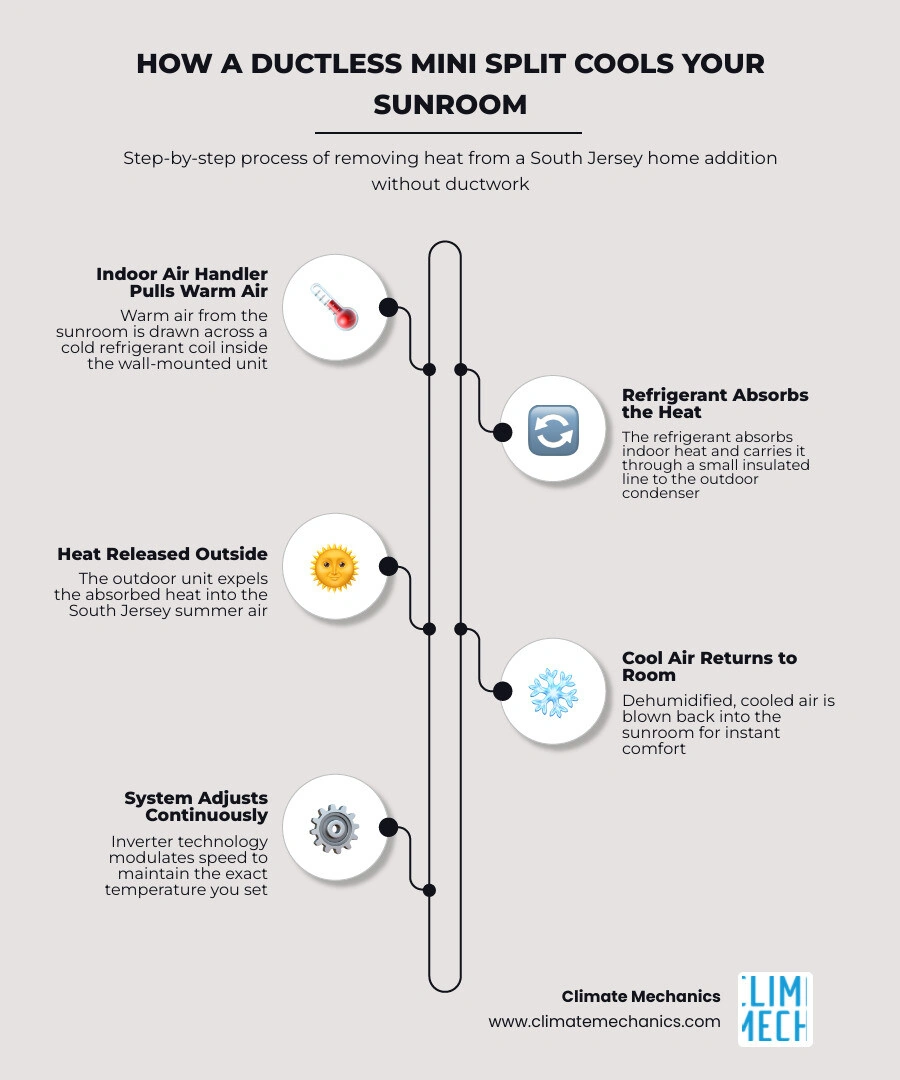
Understanding How a Ductless Mini Split Cools a Home Addition or Sunroom in South Jersey
To understand why these systems are so incredibly effective, it helps to look at the science of comfort. Traditional air conditioners blow cold air into a room, but a ductless mini-split cools a space primarily by removing the heat that is already there.
A standard ductless setup consists of two main components: an outdoor compressor (or condenser) and an indoor air handler (the sleek unit mounted on your wall or ceiling). These two units are connected by a small, three-inch conduit containing refrigerant lines, a condensate drain, and power cables.
When you turn the system on, the indoor air handler pulls the warm, stagnant air from your sunroom or home addition and passes it over an evaporator coil filled with cold refrigerant. The refrigerant absorbs the heat from the air, instantly cooling it. The indoor fan then blows this refreshed, cool air back into the room. Meanwhile, the heat absorbed by the refrigerant travels through the copper lines to the outdoor condenser, where it is released into the South Jersey air.
Because each indoor air handler operates independently with its own thermostat, you get true zone control. This means you only cool the sunroom when you are actually using it, rather than paying to condition an empty space. If you want to explore how these systems can transform your home's comfort, you can read more about our Ductless Systems services.
How a ductless mini split cools a home addition or sunroom in south jersey during humid summers
South Jersey summers are famous for two things: high temperatures and thick, sticky humidity. Whether you live in Pennsauken, Willingboro, or Marlton, July and August can make an unconditioned sunroom feel like a tropical rainforest.
This is where the magic of inverter-driven compressors and variable-speed fans comes into play. Traditional air conditioners operate on an "on-or-off" cycle. They blast cold air at 100% capacity until the thermostat is satisfied, shut off, and then turn back on when the room warms up. This constant cycling is terrible for humidity control because an AC needs to run consistently to pull moisture out of the air.
A modern ductless mini-split, built to meet the rigorous June 2026 energy efficiency standards, uses an inverter compressor. Think of it like a dimmer switch instead of a standard light switch. It continuously adjusts its speed to match the exact cooling needs of the room. By running at lower, steadier speeds, the system keeps air moving across the cold coils longer, pulling massive amounts of moisture out of your sunroom without over-cooling the space. The result is a crisp, dry, and comfortable room, even on the most humid summer afternoons. To see how these advanced systems tackle sticky summer weather, check out our guide on Ductless AC Systems.
How a ductless mini split cools a home addition or sunroom in south jersey compared to central HVAC
When building a home addition or enclosing a patio into a sunroom, many homeowners assume the easiest route is simply extending their existing central HVAC ductwork. However, this is often a recipe for comfort issues and high utility bills.
First, your existing central AC was sized specifically for your home's original square footage. Forcing it to cool an extra 300 to 500 square feet of glass-walled sunroom will overload the system, leading to premature wear, frequent breakdowns, and lukewarm air throughout the entire house.
Second, traditional ductwork is incredibly inefficient. According to the U.S. Department of Energy, typical home duct systems lose 20% to 30% of their conditioned air through leaks, seams, and poor insulation. Because mini-splits deliver air directly into the room without ducts, they completely eliminate this energy waste.
Here is a quick look at how the two options stack up:
• Ductwork Required — Ductless Mini-Split System: None (only a small 3-inch wall hole) — Extending Central HVAC: Heavy construction, bulkheads, and drywall repair
• Energy Efficiency — Ductless Mini-Split System: Extremely high (SEER2 ratings up to 20-33) — Extending Central HVAC: Moderate (loses 20-30% of air through duct leaks)
• Temperature Control — Ductless Mini-Split System: Independent thermostat for the addition — Extending Central HVAC: Tied to the main home's single thermostat
• Installation Time — Ductless Mini-Split System: Typically completed in 1 day — Extending Central HVAC: 3 to 5 days of invasive construction
• Impact on Existing HVAC — Ductless Mini-Split System: None (extends the lifespan of your main system) — Extending Central HVAC: High risk of overloading and shortening system life
Choosing to go ductless protects your main system and ensures your new space gets the exact amount of cooling it needs. For a deeper dive into these comparisons, read about The Advantages of Switching to a Ductless HVAC System.
Key Benefits of Going Ductless for Your New Living Space
Beyond the incredible temperature control, installing a ductless mini-split in your South Jersey home addition offers several lifestyle upgrades.
First and foremost is the whisper-quiet operation. Older window units and portable air conditioners rattle, buzz, and drown out conversation or the television. A ductless indoor air handler operates at sound levels as low as 20 to 49 decibels—which is quieter than a library whisper. The loudest components are housed in the outdoor unit, which sits safely outside your home.
Additionally, ductless systems are champion savers when it comes to your electric bill. With SEER2 (Seasonal Energy Efficiency Ratio) ratings ranging from 20 to 33, they far exceed standard central AC systems. Learn more about how these systems can lower your monthly utility costs by reviewing the Benefits of Ductless AC Systems.
Zoned Comfort and Year-Round Usability
A major advantage of a mini-split is that it isn't just an air conditioner—it is a heat pump. That means when the South Jersey winter rolls into places like Haddonfield or Collingswood, the system reverses its refrigerant cycle to pull heat from the outdoor air and pump it indoors.
Many homeowners worry that heat pumps can't handle freezing New Jersey winters. However, modern systems equipped with hyper-heating technology can operate at high efficiency even when outdoor temperatures drop well below zero (down to -13°F or -15°F). This year-round capability transforms your sunroom from a seasonal porch into a true 365-day living space. Whether you need a cozy reading nook in January or a cool oasis in July, you have complete control. Discover more about these year-round comfort advantages by reading about Ductless HVAC Systems Benefits.
Ideal Placement for Maximum Airflow
Every home addition is unique, which is why ductless systems offer incredible installation flexibility. You aren't limited to a bulky unit blocking your beautiful sunroom windows.
The most common option is a wall-mounted unit, placed high on an exterior wall to distribute air evenly across the room. If you prefer a more seamless look, ceiling cassettes can be installed flush with the ceiling, directing airflow in four directions. There are also floor-mounted models that sit low to the ground, perfect for rooms with low knee-walls or cathedral ceilings.
To find the perfect setup for your room's layout, take a look at our articles on AC Split Mini Systems Best Locations and Ideal Rooms for AC Split Mini Installation.
Sizing and Selecting the Right System for Your South Jersey Home
Getting the maximum comfort and efficiency out of your mini-split depends heavily on proper sizing. If a system is too small, it will run constantly, driving up your electric bills and failing to keep the room cool on hot Camden County afternoons. If it is too large, it will cool the room too quickly without running long enough to remove humidity, leaving you with a cold, damp, and clammy space.
To determine the correct BTU (British Thermal Unit) capacity, we don't just guess based on square footage. We perform a detailed Manual J load calculation. This scientific assessment takes into account:
• The square footage of your addition or sunroom
• The number, size, and orientation of the windows (especially critical in sunrooms with high solar heat gain)
• The quality and R-value of the insulation in the walls, floor, and ceiling
• Ceiling heights and open floor plan connections to the rest of the house
A typical 300 to 500-square-foot sunroom usually requires a unit ranging from 9,000 to 12,000 BTUs, but sun-drenched spaces with lots of glass may require a slightly larger capacity to offset the greenhouse effect. To learn how we fine-tune these systems for peak performance, read about how to Maximize Efficiency AC Split Mini Systems.
Local Regulations and Placement Considerations
When installing a mini-split, we also have to plan for local South Jersey municipal codes and property rules. Towns like Haddonfield, Collingswood, and Audubon often have specific zoning laws regarding where outdoor condenser units can be placed.
Most local municipalities require a setback of 5 to 8 feet from property lines. Additionally, if you have a historic home or live in a highly regulated neighborhood, there may be aesthetic guidelines. To keep your home looking beautiful, we use high-quality line hide vinyl casings. These paintable covers conceal the copper refrigerant lines and wiring on the exterior of your home, blending them seamlessly into your siding or brickwork.
What to Expect During Professional Installation and Maintenance
One of the best things about a ductless mini-split is how quickly it can be installed. Unlike central air systems that require weeks of invasive ductwork construction, a single-zone mini-split installation is typically completed in less than a single day.
Our professional installation process includes:
1. Site Assessment & Design: We help you choose the perfect indoor unit style and location for optimal airflow.
2. Wall Penetration: We drill a small, neat three-inch hole through the exterior wall to run the copper lines, drain tube, and electrical cables.
3. Indoor & Outdoor Mounting: We securely mount the indoor air handler and place the outdoor condenser on a level, vibration-absorbing pad.
4. Electrical Work: We run a dedicated circuit breaker (typically 20 to 30 amps) to power the outdoor unit safely.
5. Testing & Commissioning: We vacuum the lines, release the refrigerant, check for leaks, and test the system's airflow to ensure perfect operation.
If you live in Camden County, you can see how we serve your neighborhood by visiting our page on Ductless AC Cherry Hill NJ.
New Jersey Rebates and Financial Incentives
Because ductless mini-splits are incredibly energy-efficient, there are fantastic financial incentives available to South Jersey homeowners.
Through the New Jersey Clean Energy Program and local utility initiatives (such as those from PSE&G or Atlantic City Electric), you may qualify for substantial rebates on high-efficiency heat pump systems. Additionally, the federal Inflation Reduction Act provides significant tax credits for qualifying energy-efficient upgrades. When we design your system, we always help you identify the maximum rebates and credits available to keep your upgrade as affordable as possible.
Long-Term Maintenance for Peak Efficiency
While ductless systems are highly reliable, they do require simple, regular maintenance to keep running at peak efficiency for their 15 to 20-year lifespan.
As a homeowner, your primary job is to clean the reusable air filters inside the indoor unit once a month. It only takes a few minutes—you simply pop open the front panel, slide the filters out, rinse them in the sink, let them dry, and slide them back in.
Once a year, it is highly recommended to schedule a professional tune-up. We will deep-clean the evaporator and condenser coils, check refrigerant levels, inspect the electrical connections, and clear out the condensate drain lines to prevent any water leaks. If you are in Burlington County, you can schedule your seasonal tune-up through our Ductless AC System Moorestown NJ service page.
Frequently Asked Questions About Sunroom Cooling in South Jersey
Do I need a local permit to install a mini-split in New Jersey?
Yes. In almost all South Jersey municipalities—including Pennsauken, Burlington, and Willingboro—a local building and electrical permit is required to install a ductless mini-split. This ensures that the electrical wiring is safely connected to a dedicated breaker and that the outdoor unit complies with local property setbacks. As a professional, fully licensed contractor, we handle the entire permitting and inspection process for you.
Can a mini-split system be expanded if I add more rooms later?
Absolutely. While a single-zone system is perfect for a single sunroom or home addition, you can also opt for a multi-zone outdoor compressor. A single multi-zone outdoor unit can support up to five (and sometimes more) indoor air handlers. If you decide to cool your master bedroom, a home office, or a finished basement in the future, we can easily run additional lines from the same outdoor unit.
What should I do if my mini-split starts making unusual noises?
During normal operation, your mini-split should be nearly silent. However, if you begin to hear strange noises, it is a sign that the system needs attention. Plastic expanding and contracting during temperature shifts can sometimes cause a mild clicking sound, but persistent clicking or rattling could indicate a loose fan wheel or fan motor issue. If you notice odd sounds, check out our troubleshooting guides on AC Split Mini Unit Making Strange Noises and AC Split Mini System Clicking Noises to understand what might be happening.
Conclusion
A beautiful sunroom or home addition shouldn't be off-limits for half the year. By installing a ductless mini-split, you can reclaim your space and enjoy reliable, whisper-quiet, and highly efficient comfort all year long.
At Climate Mechanics, we bring over 38 years of NATE and NCI-certified HVAC expertise to every home we visit. From Haddonfield and Collingswood to Burlington and Marlton, we pride ourselves on delivering personalized, friendly service that keeps our neighbors comfortable.
Ready to transform your home addition into a year-round paradise? Contact us today to request a free in-home assessment, or explore our specialized Ductless Systems services to find the perfect fit for your home.
