


Why New Jersey Homeowners Are Choosing Radiant Floor Heating
If you've ever wondered what are the benefits of radiant floor heating in a New Jersey home, here's the short answer:
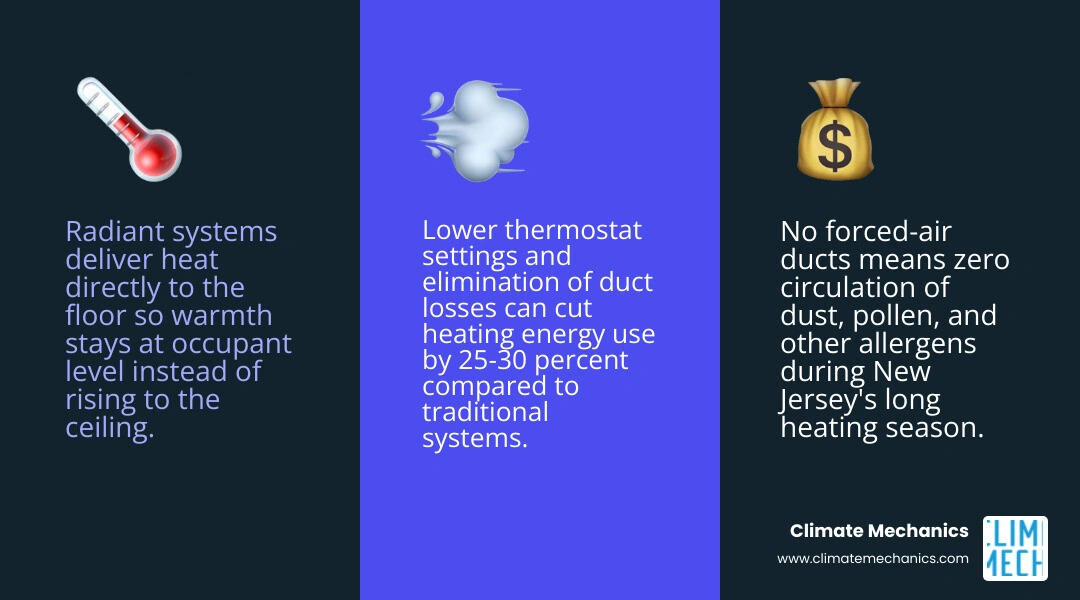
• Even, consistent warmth from floor to ceiling — no cold spots or drafts
• Better indoor air quality — no ducts blowing dust and allergens around
• Energy savings of 25–30% compared to forced-air systems
• Silent operation — no blower noise, no rattling vents
• Stable humidity levels — radiant heat doesn't dry out your air
• Zone control — heat only the rooms you're using
• Long lifespan — PEX tubing can last 50+ years
New Jersey winters are no joke. From nor'easters in Bergen County to persistent coastal chill along the Shore, keeping a home warm and comfortable puts real pressure on your heating system — and your energy bills. If your current setup leaves some rooms freezing while others overheat, or if your forced-air system kicks on with a roar and still can't get things right, you're not alone. Radiant floor heating is a proven alternative that warms your home from the ground up, quietly, efficiently, and evenly — without the drawbacks that come with ductwork.
Understanding Radiant Floor Heating in the Garden State
To understand why radiant systems are so effective, it helps to look at how they deliver warmth. Traditional systems rely on convection, which means they heat the air and blow it into the room. Because warm air naturally rises, it immediately climbs to the ceiling, leaving the floor level drafty and cold.
Radiant Heat, on the other hand, relies on radiation and direct contact. It warms the floor itself, which then radiates heat upward to warm the objects, furniture, and people in the room directly.
There are two primary types of radiant floor heating systems used in New Jersey homes:
1. Hydronic Radiant Systems: These are the most popular and efficient systems for whole-home heating. They use a network of flexible, durable PEX (cross-linked polyethylene) tubing installed beneath your floors. Warm water is pumped from a central boiler or a specialized heat pump through these tubes, transferring heat evenly across the entire floor surface.
2. Electric Radiant Systems: These systems use electric cables or pre-spaced heating mats installed directly under the flooring. Because electricity is generally more expensive to run than natural gas or heat pumps in South Jersey, electric radiant floors are typically reserved for smaller, targeted zones, such as a master bathroom or a cozy home office.
Both systems leverage the concept of "thermal mass." Your flooring material (such as tile or concrete) absorbs the heat and holds onto it, slowly releasing it into your living spaces over time. This keeps your home at a stable, comfortable temperature without the constant on-and-off cycling common with traditional forced-air systems.
What Are the Benefits of Radiant Floor Heating in a New Jersey Home?
When we look at what are the benefits of radiant floor heating in a New Jersey home, the advantages go far beyond simply avoiding cold feet on a January morning. In towns like Marlton, Haddonfield, and Audubon, homeowners are discovering that radiant heat transforms how their living spaces feel and function.
By choosing this technology, you are investing in a system that delivers consistent warmth, silent operation, and exceptional energy efficiency. If you are weighing your options for an upcoming remodel or a new build, reading about Why Choose Radiant Heating can help clarify why this luxury upgrade has become a practical favorite for so many families.
Comfort and Health: What Are the Benefits of Radiant Floor Heating in a New Jersey Home?
The physical comfort of radiant heat is unmatched. Because the heat rises slowly and evenly from the floor, the temperature remains uniform throughout the room. There are no cold pockets, no hot drafts, and no shivering while you wait for a furnace to kick back on.
But the health benefits are just as significant, particularly when it comes to indoor air quality:
• Allergy and Asthma Relief: Forced-air systems blow air through ductwork, which naturally collects dust, pet dander, pollen, and mold spores. When the heat turns on, these particles are blasted into your breathing zones. Radiant heating involves zero air movement, meaning allergens stay settled on the floor where they can be easily vacuumed away.
• No Dry, Arid Air: Furnaces blast dry, superheated air into your home, which rapidly strips moisture from your skin, eyes, and nasal passages. Radiant systems warm surfaces directly, leaving the ambient air moisture intact.
• Balanced Humidity: Because radiant heat doesn't dry out your home's air, it works in perfect harmony with your natural indoor environment. If you struggle with dry winter air, understanding How Does a Humidifier Help to Combat Dry Winter Air can help you maintain the perfect balance of warmth and humidity all winter long.
Efficiency and Savings: What Are the Benefits of Radiant Floor Heating in a New Jersey Home?
New Jersey homeowners face some of the highest winter heating demands in the country. Fortunately, radiant floor heating is exceptionally energy-efficient, offering several ways to lower your monthly utility bills:
• Lower Thermostat Settings: Because radiant heat warms your body directly from the feet up, you will actually feel warmer at lower air temperatures. Most homeowners find they can set their thermostats 3 to 5 degrees lower than they would with a forced-air system while maintaining the exact same level of personal comfort.
• Elimination of Duct Losses: According to the U.S. Department of Energy, typical duct systems lose 20% to 30% of their heated air through leaks, gaps, and poor insulation. Because hydronic radiant systems do not use ducts, they suffer absolutely zero duct-related heat loss.
• Zoning Capabilities: With a hydronic radiant system, your home is divided into distinct zones, each controlled by its own thermostat. This means you don't have to waste energy heating guest bedrooms or formal dining rooms that aren't in use. You can focus the warmth exactly where you need it.
For those interested in upgrading their overall home efficiency, exploring Energy Efficient Heating Systems is an excellent way to see how radiant technology fits into a modern, eco-friendly home.
Comparing Radiant Heat to Traditional New Jersey Heating Systems
To truly appreciate radiant heat, it helps to compare it directly to the systems most New Jersey homeowners are familiar with: forced-air furnaces, traditional baseboard heaters, and modern heat pumps.
• Forced-Air Systems: Powered by gas or electric Furnaces, forced-air systems are common but suffer from rapid heat loss, noisy blower fans, and drafty air currents. They also create severe temperature stratification, where the warmest air sits uselessly near your ceiling.
• Baseboard Radiators: Often connected to central Boilers, baseboard systems require very high water temperatures (often 140°F to 180°F) to warm a room. This makes them much less efficient than hydronic radiant floors, which deliver the same comfort using water temperatures of just 80°F to 120°F.
• Heat Pumps: While modern Heat Pumps are incredibly efficient, forced-air heat pumps still rely on blowing air. However, pairing an air-to-water heat pump with a hydronic radiant floor system creates one of the most efficient, comfortable heating combinations available today.
• Heat Distribution — Radiant Floor Heating: Uniform, from the ground up — Forced-Air (Furnace): Uneven, hot air rises to ceiling — Baseboard Heating: Concentrated near walls
• Energy Efficiency — Radiant Floor Heating: High (no duct loss, low temp water) — Forced-Air (Furnace): Moderate (susceptible to duct leaks) — Baseboard Heating: Low to Moderate (requires high temp water)
• Air Quality — Radiant Floor Heating: Excellent (no dust movement) — Forced-Air (Furnace): Poor (circulates airborne allergens) — Baseboard Heating: Moderate (minimal air movement)
• Noise Level — Radiant Floor Heating: Completely silent — Forced-Air (Furnace): Loud blower fans and popping ducts — Baseboard Heating: Quiet, but occasionally clicks/hums
• Aesthetics — Radiant Floor Heating: Completely invisible — Forced-Air (Furnace): Requires floor registers or wall vents — Baseboard Heating: Bulky wall-mounted units
Key Installation and Flooring Considerations for NJ Homeowners
If you are planning to bring the luxury of radiant heat into your South Jersey home, there are a few practical considerations to keep in mind regarding installation and flooring compatibility.
• New Construction vs. Retrofits: Installing radiant heating is easiest during a new build or a major renovation when the subfloors are fully exposed. However, retrofitting is highly achievable. We can install hydronic tubing between floor joists from underneath (in an unfinished basement) or use low-profile, above-floor panels that add minimal height to your existing floors.
• The Importance of Insulation: A radiant system is only as good as the insulation beneath it. Without a proper thermal break, heat will migrate downward into your basement or crawlspace instead of upward into your living room. Following proper Home Winter Insulation Tips ensures that every bit of warmth is directed exactly where you want it.
• Flooring Materials:
— Ceramic Tile and Stone: These are the absolute best conductors of heat. They warm up quickly, retain heat beautifully, and are highly resistant to thermal expansion.
— Engineered Hardwood and LVT: Excellent choices that work wonderfully with radiant systems, provided the floor temperature is kept within the manufacturer's recommended limits.
— Solid Hardwood: Can be used, but requires careful temperature management to prevent the wood from shrinking or cracking during dry winter months.
— Carpet: Act as an insulator, which reduces the heat transfer efficiency. If you want carpet, choose a thin pile with a dense, high-quality pad designed specifically for radiant systems.
Frequently Asked Questions About Radiant Floor Heating
How long do radiant floors take to heat up?
Because radiant systems heat the physical mass of your floor rather than just blowing hot air, they have a slower response time than forced-air systems.
• Electric systems typically take 30 minutes to 2 hours to warm up.
• Hydronic systems can take 2 to 8 hours to reach your target temperature, depending on the thickness of the floor and the level of insulation underneath.
Because of this slower response, radiant floors are designed to be kept at a steady, consistent temperature throughout the winter rather than being turned up and down constantly. This set-it-and-forget-it approach actually maximizes both comfort and energy savings.
What maintenance is required for a hydronic radiant system?
One of the best things about radiant floor heating is that it has very few moving parts, which translates to incredibly low maintenance. Unlike forced-air systems, there are no duct systems to clean or air filters to change every month.
For a hydronic system, keeping it running smoothly involves:
• Checking the system pressure and inspecting the manifold for leaks once a year.
• Ensuring the water chemistry in your closed-loop system remains balanced to prevent corrosion.
• Servicing the boiler or heat pump that supplies the hot water.
By staying on top of these basic checks, your PEX tubing can easily last 50 years or more. To keep your entire home comfort system in peak condition, check out our guide on How to Keep Your Heating System Functioning Properly All Winter Long.
Can radiant floor heating be used for snow melting in New Jersey?
Yes! The same hydronic technology that keeps your living room cozy can be extended outdoors. Snow-melting systems can be installed beneath concrete, asphalt, or pavers for your driveway, walkways, and patio.
When winter storms hit South Jersey, automated sensors detect moisture and freezing temperatures, circulating warm water through the outdoor PEX tubing to melt snow and prevent dangerous ice buildup. This eliminates the need for shoveling, salting, and snow blowing, protecting both your back and your landscaping.
Conclusion
Investing in radiant floor heating is one of the most effective ways to elevate the comfort, health, and energy efficiency of your New Jersey home. By delivering quiet, even warmth right where you need it most, these systems eliminate the drafts, noise, and dust of traditional heating methods while helping you save on monthly utility bills.
At Climate Mechanics, we bring over 38 years of NATE-certified expertise and personalized service to homeowners across South Jersey, including Marlton, Audubon, Haddonfield, and surrounding communities. Whether you are building your dream home, finishing a cold basement, or remodeling a master bath, our team is here to design and install the perfect radiant solution for your family.
Ready to say goodbye to cold floors and uneven heating? Schedule your radiant heating consultation with Climate Mechanics today and take the first step toward year-round comfort.
