



The Late-Summer Surprise: Why Your AC Suddenly Froze in August
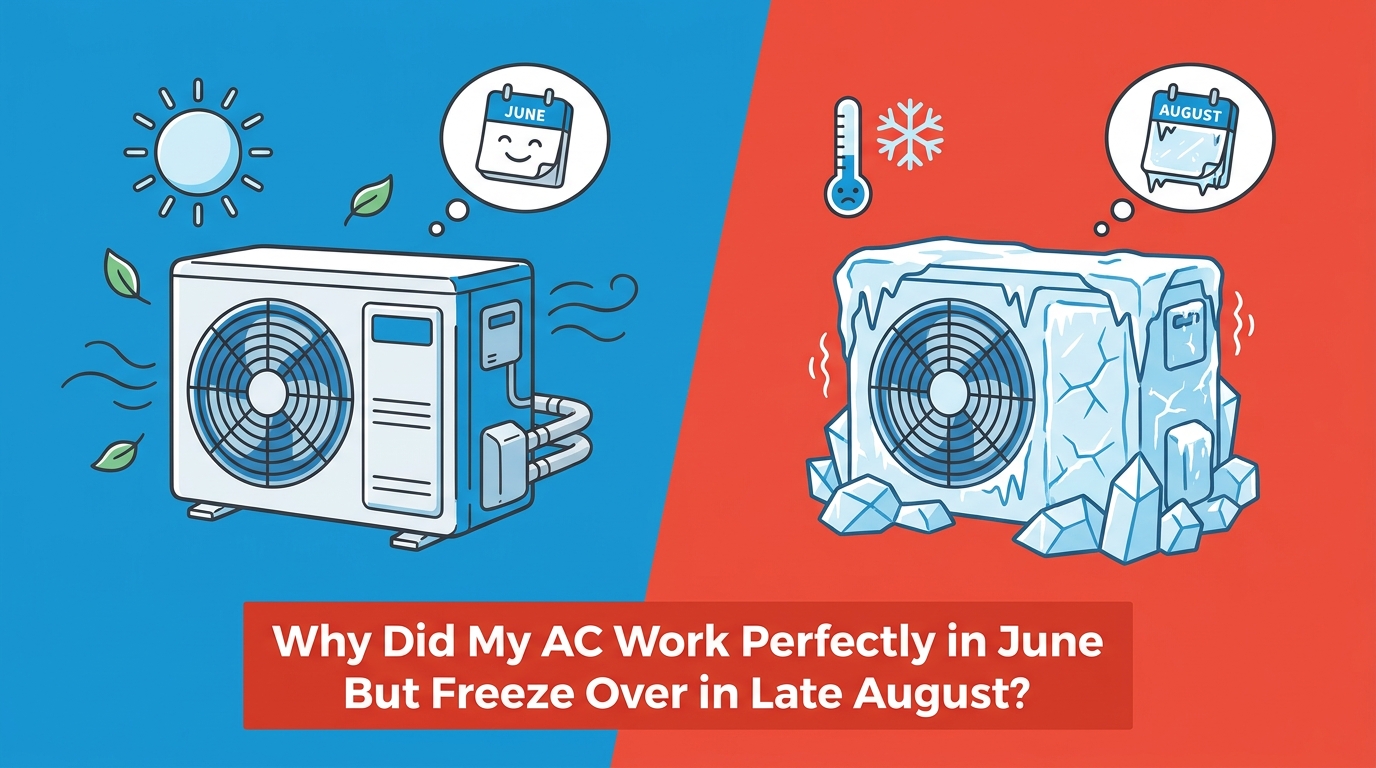
As the season enters its final stretch, you might be staring at a block of ice on your indoor unit and asking yourself: why did my AC work perfectly in June but freeze over in late August? It is a frustrating and confusing scenario. Your system handled the early summer heat waves without breaking a sweat, keeping your home perfectly comfortable. Now, just as you are looking forward to the end-of-season cooling relief and the back-to-school transition, the evaporator coil has turned into a solid block of ice, and the vents are blowing warm air.
In our years of serving Cinnaminson and surrounding South Jersey communities, the team at Climate Mechanics has seen this exact scenario countless times. This late-summer surprise rarely happens overnight. In almost every case, continuous operation masks a slow, underlying issue until the system finally hits its breaking point. When you find your equipment frozen solid, you are faced with a critical decision: do you simply turn it off, let the ice thaw, change the filter, and hope it survives the rest of the season? Or do you call a professional to diagnose a potential slow refrigerant leak before the compressor sustains permanent damage?
If you need immediate help, our experienced team provides comprehensive air conditioning services, including emergency AC repair in Cinnaminson to get your system safely back online.
The Compounding Effect: 60+ Days of Continuous Cooling
To understand why an air conditioner freezes late in the season, we have to look at the cumulative strain placed on the equipment. An HVAC system is designed to compensate for minor issues early on. If there is a slight airflow restriction or a tiny drop in refrigerant in June, the unit might just run a few minutes longer each cycle to reach your target temperature. You likely will not even notice the difference.
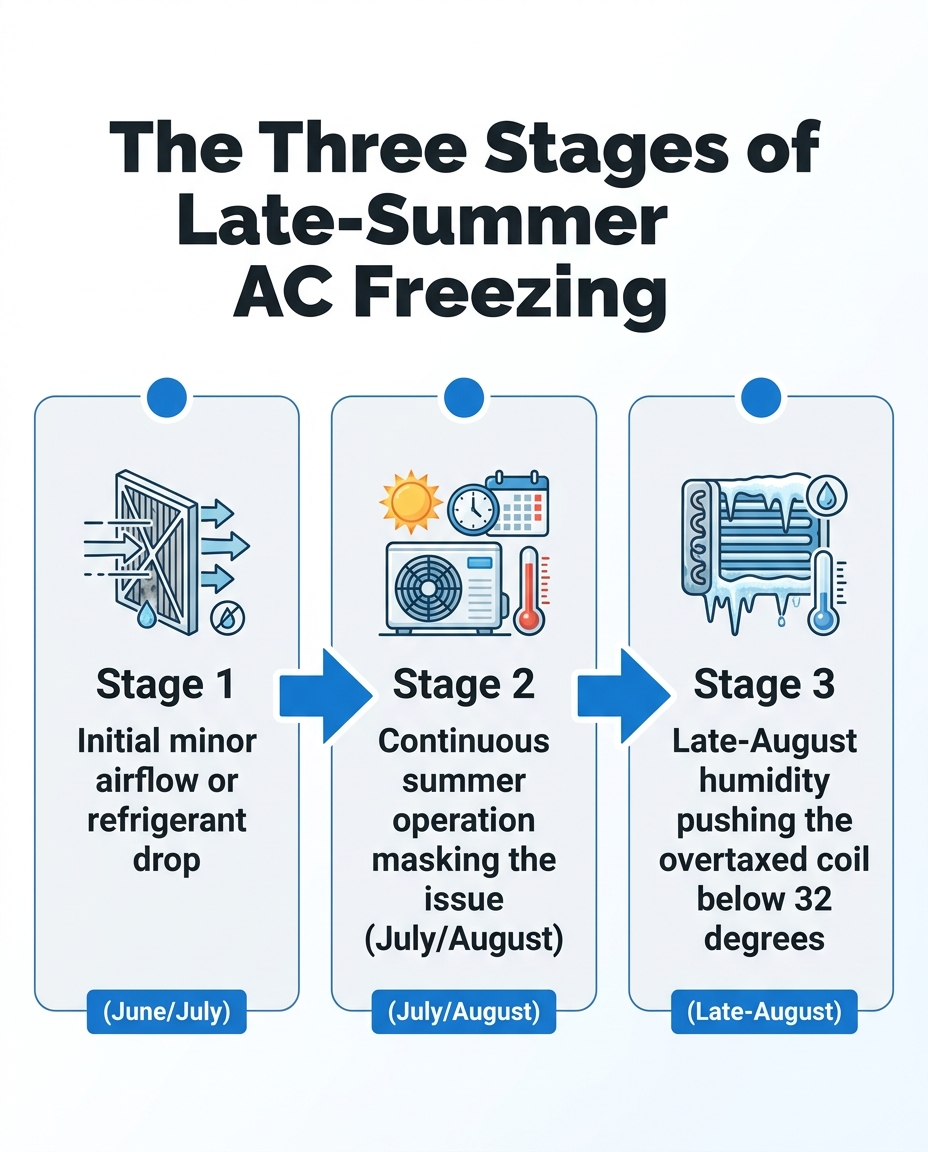
However, as the weeks pass, this extra work takes a toll. A pattern we see often is that it typically takes 60 to 90 days for a micro-leak or a progressive airflow restriction to manifest completely. If you have been wondering why your AC runs constantly in New Jersey summer heat, this compounding effect is the direct result. The freezing process usually follows a specific timeline:
1. Stage 1: The Initial Drop. Early in the summer, a minor issue causes the evaporator coil's temperature to drop just a few degrees below its normal operating range. It is still above freezing, so no ice forms yet.
2. Stage 2: Continuous Operation. As July brings intense heat, the system runs almost non-stop. This continuous operation prevents the coil from naturally warming up during off-cycles, masking the slow drop in internal temperature.
3. Stage 3: The Breaking Point. By late August, the cumulative wear, combined with restricted airflow or lowered pressure, pushes the coil temperature below 32 degrees Fahrenheit. Moisture in the air freezes on contact, creating a snowball effect until the entire coil is encased in ice.
Our technicians at Climate Mechanics know this compounding strain explains exactly why a system in Cinnaminson NJ can seem perfectly fine for months before suddenly failing right before the weather begins to cool down.

How Late-Summer Humidity Accelerates Evaporator Coil Freezing
Your air conditioner does more than just lower the temperature of your home; it also acts as a powerful dehumidifier. The indoor evaporator coil extracts heat and moisture from the air circulating through your ductwork. Under normal conditions, this moisture condenses into water droplets on the cold metal fins and drips safely into the drain pan below.
However, our team knows firsthand how the specific climate of the mid-Atlantic region plays a massive role in late-season breakdowns. We consistently see that during peak South Jersey August humidity, the outdoor moisture levels remain consistently high. This forces your system to pull massive amounts of moisture from the indoor air. According to ASHRAE humidity and cooling load standards, removing this latent heat (humidity) requires a significant portion of your air conditioner's total capacity.
When the system is already overtaxed from months of use, and an underlying issue has caused the coil temperature to drop below 32 degrees, this excessive condensation becomes a serious problem. The heavy moisture no longer drips away as water. Instead, it freezes instantly upon touching the super-cooled metal. Because of the sheer volume of water being pulled from the humid late-summer air, a slightly cold coil can turn into a solid block of ice in a matter of hours. This is why end-of-season cooling demands often result in sudden, severe freezing rather than a slow, gradual frost.
The 90-Day Filter Trap: Progressive Airflow Restriction
One of the most common culprits behind a frozen air conditioner is also the easiest to prevent: a dirty air filter. We always tell our Cinnaminson NJ customers that installing a fresh, clean filter at the beginning of June is a great start, but it isn't a "set it and forget it" solution.
As the summer drags on, that filter catches dust, pet dander, pollen, and airborne debris. By the time August arrives, a filter that has not been changed in 90 days is often severely clogged. Department of Energy (DOE) data shows that a dirty air filter can reduce system airflow by up to 15 percent.
The physics of airflow: Your evaporator coil relies on a steady stream of warm, unconditioned air from your home blowing across it to keep the metal fins above the freezing point. When a clogged filter restricts that airflow, the cold refrigerant inside the coil absorbs less heat. As a result, the temperature of the coil slowly drops. Over weeks of continuous operation, this progressive restriction starves the system of the heat it needs, eventually causing the ambient moisture to freeze.
The easiest fix: Checking and replacing a dirty filter is the simplest, safest maintenance task a homeowner can perform. If your system is freezing, inspecting the filter should always be your very first step.
Micro-Leaks: The Slow Drain on Refrigerant Pressure
If your air filter is perfectly clean and the system is still turning into an ice block, the culprit is often a micro-leak in the refrigerant lines. A micro-leak is a microscopic pinhole—often caused by formicary corrosion on the copper coils—that allows tiny amounts of refrigerant to escape over a long period. Because the leak is so small, it easily goes unnoticed during the early summer months.
Air conditioning systems operate as closed loops. The relationship between refrigerant pressure and temperature is direct: as the pressure inside the system slowly drops due to a leak, the temperature of the evaporator coil drops right along with it. Continuous operation during the hottest days prevents the system pressures from equalizing, eventually pushing the coil below the freezing point.
A pattern we see often at Climate Mechanics is a homeowner noticing their system struggling slightly in July, only for a micro-leak to completely freeze the unit by late August. Just recently, a local customer called us when their AC was freezing up right as they were preparing to host a back-to-school gathering. Our technician quickly diagnosed a formicary corrosion pinhole that had been slowly leaking since June. Catching these small issues early—or relying on professional diagnostics when they finally surface—is exactly how you prevent major late-summer breakdowns.
If a micro-leak is causing your late August or end-of-season cooling failure, simply "topping off" the refrigerant is not a solution. Professional diagnostics are required to locate the exact source of the leak, repair the copper, and recharge the system to factory specifications.
Frequently Asked Questions About Summer AC Freezing
Why does my AC freeze up after running for a while?
Continuous running prevents the evaporator coil from naturally thawing during off-cycles. When your system runs for hours at a time, minor airflow restrictions or slight refrigerant deficits compound. The longer the compressor runs without a break, the further the coil temperature drops, eventually turning normal condensation into a thick layer of ice.
Can a dirty filter cause my AC to freeze in summer?
Yes, a dirty filter is one of the leading causes of a frozen AC unit. A clogged filter severely restricts the volume of warm indoor air blowing across the evaporator coil. Without that warm air to absorb the cooling energy, the coil's temperature drops below freezing, and the system turns into a block of ice. This effect worsens as the filter collects more dust over the season in Cinnaminson NJ.
Can low refrigerant cause AC to freeze?
Yes, low refrigerant directly leads to an abnormal drop in coil temperature. Because the system's pressure and temperature are linked, a loss of pressure means the refrigerant expands too much and becomes too cold. The moisture in the humid summer air then freezes immediately upon contact with the super-cooled metal fins.
How long does it take for AC to unfreeze?
It typically takes anywhere from 2 to 24 hours for an air conditioner to unfreeze, depending on the severity of the ice buildup and the ambient temperature. To speed up the process safely, you must turn the cooling function off at the thermostat and leave the fan setting to "On" so warm air constantly circulates over the frozen coil.
Why is my AC blowing warm air before freezing?
As ice begins to form on the evaporator coil, it physically blocks the spaces between the metal fins, restricting airflow. The system struggles to remove heat from the air passing through, resulting in warm, unconditioned air blowing out of your vents. Eventually, the ice completely blocks the coil, and the system fails to cool altogether.
What to Do When Your AC Freezes (And What Needs a Pro)
When you discover a frozen air conditioner, your immediate priority is protecting the compressor from permanent damage. Running a frozen system forces the compressor to work against extreme pressure, which can lead to a catastrophic electrical failure. Here is exactly what our experts recommend you do:
• Step 1: Turn the thermostat to "Off." Stop the cooling cycle immediately. Do not simply raise the temperature; switch the system entirely off to stop the outdoor compressor from running.
• Step 2: Turn the fan to "On." Switch your thermostat's fan setting from "Auto" to "On." This forces the indoor blower motor to circulate warm house air over the frozen coil, helping the ice melt safely and naturally. Never use sharp tools, hammers, or heat guns to chip away the ice, as you will puncture the delicate copper coils.
• Step 3: Check the air filter. Once the system is fully thawed (which can take a full day), pull out the air filter. If it is caked in dust, replace it with a fresh one.
If you replace a dirty filter, turn the system back on, and it freezes again a few days later, you have a deeper mechanical issue.
• Turning the system off to thaw the ice — Requires a Licensed Professional: Checking refrigerant pressure levels
• Running the indoor fan to speed up melting — Requires a Licensed Professional: Locating and repairing micro-leaks
• Replacing a clogged or dirty air filter — Requires a Licensed Professional: Cleaning a deeply impacted evaporator coil
• Clearing debris away from the outdoor unit — Requires a Licensed Professional: Testing blower motor electrical draw
We recently had a Cinnaminson homeowner call us in a panic when their system froze solid right at the end of August. Because they immediately turned the system off and called our dispatch early, our team at Climate Mechanics was able to thaw the unit safely, diagnose a failing blower motor, and repair it without any permanent damage to the expensive compressor.
Understanding South Jersey's intense summer demands means knowing that these machines take a beating. This is why routine AC maintenance is so critical—a thorough inspection catches slow leaks and restricted airflow long before late August or end-of-season cooling demands push the system over the edge.
Don't Sweat the End of Summer: Get Your AC Back Online
A frozen air conditioner in late summer is rarely a random fluke; it is the result of cumulative wear, tear, and compounding strain over months of continuous operation in Cinnaminson NJ. While thawing the unit and swapping the filter might buy you a few days, ignoring a deeper issue like a micro-leak or a failing blower motor will eventually lead to a much larger compressor failure.
If you are still asking yourself why did my AC work perfectly in June but freeze over in late August, it is time to get a definitive answer. Do not let a slow leak ruin the final weeks of summer comfort. Reach out to our team at Climate Mechanics today to schedule an expert diagnostic, and ask about joining our comprehensive HVAC maintenance program to ensure your system stays reliable year after year.
