


Is Your AC Running Constantly in New Jersey Summer Heat? Here's What's Happening
If your ac running constantly in new jersey summer heat and your home still feels warm and stuffy, you're not alone — and you're right to be concerned. During a typical summer, a healthy central air system cycles on and off every 10 to 20 minutes. When it runs nonstop and still can't keep up, something is off.
Quick answer: Why is your AC running constantly in NJ summer heat?
Here are the most common reasons:
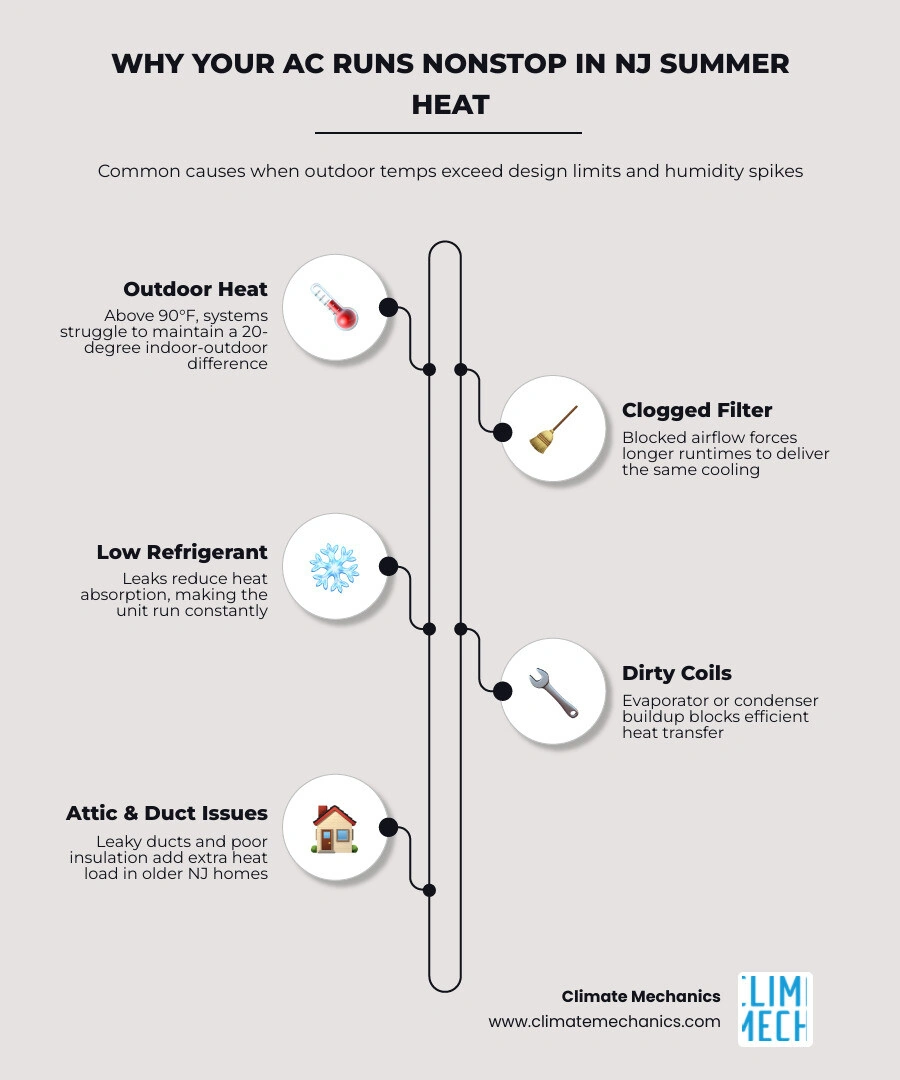
1. Outdoor temps exceed design limits — Most systems are built to maintain about a 20-degree difference between indoor and outdoor temperatures. When it's 100°F outside, the system works harder just to hit 78–80°F inside.
2. Dirty air filter — A clogged filter blocks airflow, forcing the system to run longer to move the same amount of cool air.
3. Low refrigerant — Usually caused by a leak, this reduces the system's ability to absorb heat from your home.
4. Dirty evaporator or condenser coils — Dirty coils can't transfer heat efficiently, making the system work overtime.
5. Attic heat gain or leaky ductwork — Common in older New Jersey homes, this adds heat load that your AC can't overcome.
6. Aging or undersized equipment — A system over 10–15 years old may simply lack the capacity to handle today's heat and humidity.
7. Thermostat issues — Wrong fan settings, poor placement, or dead batteries can cause the system to behave abnormally.
New Jersey summers are particularly demanding. High humidity means your AC isn't just cooling the air — it's also pulling moisture out of it. That extra workload can push even a well-maintained system to run longer than usual. When you combine that with older homes, aging equipment, and back-to-back heat waves, it's easy to see why so many South Jersey homeowners end up calling for help mid-July rather than before the season starts.
The good news is that many causes of nonstop AC operation are fixable — and some you can check yourself before picking up the phone.
Why Is Your AC Running Constantly in New Jersey Summer Heat?
When the July and August sun beats down on communities like Cherry Hill, Marlton, and Haddonfield, local temperatures regularly climb into the 90s, and relative humidity often exceeds 70%. During these intense heat waves, many homeowners notice their air conditioning systems simply will not shut off.
Before assuming your system is broken, it is important to understand how air conditioners are engineered. HVAC systems are not designed to create an icebox inside your home regardless of how hot it gets outside. Instead, they are sized based on regional "design conditions."
In South Jersey, systems are typically sized to maintain an indoor temperature of 75°F when the outdoor temperature is 91°F. If we hit a record-breaking heat wave where temperatures climb toward 95°F or 100°F, your system is pushed well beyond its normal operating parameters. In these extreme conditions, running all day is actually a normal response as the system fights to keep your indoor climate livable. This is a primary reason why you might find your Why Does My AC Run All Day Without Stopping in a South Jersey Summer during peak heat waves.
Additionally, New Jersey's coastal and suburban humidity introduces a massive "latent heat" load. Your air conditioner must first extract gallons of airborne moisture before it can effectively lower the "sensible heat" (the actual temperature you feel). If your home has high humidity, the cooling cycles will naturally stretch longer to accomplish both tasks.
Understanding the Delta T and the 20-Degree Rule
To determine if your constantly running air conditioner is performing properly or struggling with a mechanical issue, you can measure its "Delta T." This is the temperature difference between the air entering your system's return vents and the air exiting your supply registers.
Under normal, healthy operating conditions, a central air conditioning system should achieve a temperature drop of 16 to 22 degrees Fahrenheit.
You can perform a simple diagnostic check at home:
1. Take a standard digital kitchen thermometer.
2. Hold it next to your closest return air vent (where air enters the system) for a few minutes and record the temperature.
3. Hold it inside one of your active supply registers (where cool air blows out) and record that temperature.
4. Subtract the supply temperature from the return temperature.
If your Delta T is less than 16 degrees, your system is not cooling efficiently, which explains why it is running nonstop without satisfying the thermostat. If the difference is greater than 22 degrees, your system is likely suffering from a severe airflow restriction, which can lead to ice forming on your coils.
Single-Stage vs. Variable-Speed Systems in Extreme Heat
Not all air conditioners handle extreme summer heat the same way. The compressor technology inside your outdoor unit dictates how the system cycles.
• Single-Stage Systems: These units operate like a light switch—they are either 100% on or completely off. During mild weather, they cycle on and off every 10 to 20 minutes. However, during a New Jersey heat wave, a single-stage system will run continuously at full capacity to keep up with the thermal load.
• Variable-Speed Systems: These modern, highly efficient units function more like a dimmer switch. They can adjust their output anywhere from 30% to 100% capacity. A variable-speed system is actually designed to run almost continuously at a lower, whisper-quiet speed. This constant operation maintains a steady temperature, maximizes dehumidification, and uses significantly less energy than a single-stage unit turning on and off repeatedly.
• Operational Output — Single-Stage Systems: 100% capacity only — Variable-Speed Systems: Variable (30% to 100% capacity)
• Runtime in Heat Waves — Single-Stage Systems: Runs continuously at full power — Variable-Speed Systems: Runs continuously at optimized low power
• Dehumidification — Single-Stage Systems: Moderate (only dehumidifies during active cycles) — Variable-Speed Systems: Excellent (continuous low-speed moisture removal)
• Energy Efficiency — Single-Stage Systems: Lower (high starting current draw) — Variable-Speed Systems: Higher (steady low-speed power consumption)
• Indoor Comfort — Single-Stage Systems: Temperature swings between cycles — Variable-Speed Systems: Ultra-consistent temperatures
Common Causes of Nonstop AC Operation in Garden State Homes
When an air conditioner runs nonstop but the indoor temperature continues to climb past 80°F, it is a clear sign that an underlying issue is preventing the system from cooling properly. If you find yourself asking, "Why Is My AC Blowing Warm Air," several common mechanical and environmental culprits may be at play.
Airflow Restrictions and Clogged Filters
Airflow is the lifeblood of your cooling system. Your air conditioner cannot cool your home if it cannot pull warm indoor air across the cold evaporator coils.
A dirty, clogged air filter is the single most common cause of a constantly running AC. When dust, pet dander, and pollen cake the filter surface, static pressure increases, and airflow drops dramatically.
This restriction causes two major issues:
• The system must run much longer to move enough cooled air to satisfy the thermostat.
• The lack of warm air passing over the evaporator coil causes the coil's temperature to drop below freezing. Condensation on the coil turns to ice, completely blocking airflow and potentially causing liquid refrigerant to flood back and destroy your compressor.
Regularly keeping up with AC Maintenance Tips for Summer, including replacing your air filters every 30 to 90 days, is essential to prevent these costly issues.
Low Refrigerant and the R-410A Phase-Out in 2026
Your air conditioner does not "use up" refrigerant; it is a closed system that circulates the same chemical charge to transfer heat out of your home. If your system is low on refrigerant, it means you have a leak.
Common signs of low refrigerant include:
• Lukewarm air blowing from your supply vents.
• An AC system that runs 24/7 without lowering the indoor temperature.
• Ice forming on the outdoor copper refrigerant lines.
• Hissing or bubbling noises coming from the indoor or outdoor unit.
As of January 1, 2026, environmental regulations have initiated the formal phase-out of R-410A refrigerant (often referred to by the brand name Puron) in new residential systems. While existing systems can still be serviced, the cost of R-410A refrigerant is expected to rise as supply decreases. Finding and repairing pinhole leaks early is now more critical than ever to avoid expensive recharge costs and prevent Common Problems with AC Units.
Attic Heat Gain and Aging Ductwork in Older NJ Homes
Many homes in older South Jersey communities—such as Burlington, Willingboro, and Camden—feature aging duct systems and poor attic insulation.
During the peak of summer, attic temperatures can easily reach 130°F to 140°F. If your attic has insufficient floor insulation, that massive thermal load radiates directly down through your second-floor ceilings.
Furthermore, aging ductwork often develops leaks, disconnected joints, or fallen insulation. If your return ducts are located in a hot attic and have leaks, they will pull superheated, dusty attic air directly into your air conditioner. This places an immense thermal load on the system, forcing it to run continuously just to combat the heat leaking into the ductwork before the air ever reaches your living spaces.
DIY Troubleshooting: What to Check Before Calling a Professional
Before you schedule an emergency service call, there are several safe, simple checks you can perform to resolve minor issues on your own. If your system is suffering from an AC Not Responding to Temperature Adjustments, walk through this checklist first.
Verifying Thermostat Settings and Power Supply
• Check the Fan Setting: Ensure your thermostat's fan setting is set to "AUTO" rather than "ON." When set to "ON," the indoor blower fan runs continuously, even when the outdoor compressor is off. This can blow uncooled, humid air back into your home, making it feel warm and drafty.
• Inspect Thermostat Battery and Placement: If your thermostat screen is blank or flashing, replace the batteries. Additionally, ensure there are no heat-generating appliances, lamps, or direct sunlight hitting the thermostat, which can trick it into thinking your home is much hotter than it actually is.
• Check Your Electrical Panel: If your indoor unit is blowing warm air but the outdoor unit is completely silent, check your main home electrical panel. The outdoor condenser runs on a high-voltage double-pole breaker that can occasionally trip during summer power surges. Reset it once if tripped; if it trips again immediately, do not force it, as this indicates a serious electrical short.
Clearing the Outdoor Condenser Unit
Your outdoor unit needs to release the heat it extracted from your home. If it is choked by debris, it cannot breathe.
• Maintain a Breathing Zone: Clear a two-foot perimeter around your outdoor condenser unit. Trim back shrubs, weeds, tall grass, and decorative plantings.
• Clear the Fins: Cottonwood seeds, lawn clippings, and autumn leaves can clog the delicate metal fins of your condenser. Turn off the system at the thermostat, and use a low-pressure garden hose to gently rinse the coils from top to bottom. Never use a pressure washer, as this will bend the aluminum fins and permanently restrict airflow.
When to Repair vs. Replace Your Struggling Air Conditioner
It can be difficult to decide whether to keep patching up an older air conditioner or invest in a complete system replacement. In New Jersey, central air conditioning systems typically have a functional lifespan of about 10 to 15 years. If your system is approaching or has surpassed this mark and is running constantly, it may be losing its mechanical efficiency.
When diagnosing a system that is struggling to keep up, look for clear Signs AC Unit Needs Professional Attention to guide your decision.
Signs of a Serious Mechanical or Electrical Failure
While dirty filters and blocked vents are easy DIY fixes, other symptoms point to major component failures that require NATE-certified expertise:
• Failed Capacitor: The capacitor acts as a temporary battery to start and run the compressor and fan motor. During extreme summer heat, capacitors are highly prone to swelling and failing. If you hear a humming sound from your outdoor unit but the fan isn't spinning, a failed capacitor is the likely culprit.
• Compressor Damage: The compressor is the heart of your system. If it is worn out, it cannot pump refrigerant efficiently, leading to continuous runtime with little to no cooling. Replacing a compressor is a major repair that often warrants replacing the entire outdoor unit.
• Frequent Electrical Faults: If your system repeatedly trips its breaker or outdoor disconnect switch, there is an internal electrical short or motor winding failure that requires immediate professional diagnostics to prevent Spot Signs Air Conditioning Trouble.
Financial Assistance and Energy Efficiency Programs in NJ
If you need to replace a failing system, there are several financial resources available to New Jersey homeowners to help offset the cost of upgrading to energy-efficient equipment:
• LIHEAP (Low Income Home Energy Assistance Program): This federally funded program helps qualifying low-income families with heating and cooling costs, emergency repairs, and weatherization assistance.
• NJ Clean Energy Program: New Jersey offers robust rebates and incentives for homeowners who install high-efficiency SEER2 air conditioners and heat pumps.
• Utility Rebates: Local South Jersey utilities often offer direct rebate programs for qualifying energy-efficient HVAC upgrades.
Upgrading to a modern, high-efficiency system not only restores reliable cooling during heat waves but also provides long-term savings. To learn more about managing your summer utility expenses, check out our guide on 4 Ways to Lower Your AC Costs This Summer.
Frequently Asked Questions About AC Running Constantly in New Jersey Summer Heat
Is it normal to have my ac running constantly in new jersey summer heat when it exceeds 90 degrees?
Yes, to an extent. When outdoor temperatures climb above 90°F, standard single-stage air conditioners are designed to run for extended periods—sometimes continuously during the hottest afternoon hours (typically 2:00 PM to 6:00 PM)—to maintain your indoor target temperature.
However, if your system runs 24/7 without stopping, even during the cooler overnight hours, or if your indoor temperature continues to rise despite the constant operation, this points to a mechanical issue, an airflow restriction, or a system capacity problem. If your system is cycling on and off every few minutes instead of running steady, you may want to read about Why AC Keeps Shutting Down So Quickly to understand short-cycling.
What should I do immediately if I notice my ac running constantly in new jersey summer heat with ice on the lines?
If you see ice forming on your indoor evaporator coil or the copper refrigerant lines leading to your outdoor unit, take these steps immediately:
1. Turn the system OFF at your thermostat. Running a frozen system can cause catastrophic liquid slugging, which can permanently destroy your compressor.
2. Switch the fan setting to "ON" (not "Auto"). This forces room-temperature air to blow across the frozen coil, safely melting the ice.
3. Check your air filter. If the filter is dirty, replace it.
4. Wait for the ice to melt completely before turning the cooling back on. If ice reforms quickly after restarting with a clean filter, turn the system off again and call a professional, as this indicates a refrigerant leak or an internal blower motor failure.
Why is my upstairs always hot while the AC runs nonstop downstairs?
This is a very common issue in multi-story New Jersey homes. It is caused by a combination of factors:
• Thermodynamics: Warm air naturally rises, while cool air sinks to the lowest level of your home.
• Attic Heat Transfer: Poor attic insulation allows extreme heat to radiate through your second-floor ceilings.
• Unbalanced Ductwork: Many older homes have single-zone duct systems that do not distribute air evenly between floors.
To resolve this, you can adjust the manual dampers in your ductwork to direct more airflow upstairs for the summer. Alternatively, installing a zoned system or retrofitting your second floor with a ductless mini-split system can provide targeted, highly efficient cooling where you need it most.
Conclusion
When your air conditioner runs constantly during a grueling New Jersey summer heat wave, it puts immense stress on your equipment and your energy bills. While basic steps like replacing a clogged air filter or clearing debris from your outdoor unit can resolve simple airflow issues, persistent nonstop operation usually points to deeper technical problems like refrigerant leaks, failing electrical components, or ductwork imbalances.
At Climate Mechanics, we bring 40 years of NATE and NCI-certified expertise to homeowners across South Jersey—including Maple Shade, Pennsauken, Audubon, Willingboro, Collingswood, Haddonfield, Burlington, Marlton, and Camden. We pride ourselves on delivering personalized, honest service to keep your family comfortable when the summer heat is at its worst.
Don't let a struggling air conditioner leave you sweating through the next heat wave. Contact us today to schedule your comprehensive cooling system inspection and restore peace of mind to your home.
Schedule Your Professional Air Conditioning Services with Climate Mechanics Today
