




The Myth of Gutting Your Historic Home for Modern Cooling
It is a common misconception that achieving modern indoor comfort means sacrificing your property's original architectural charm. When evaluating Central Air vs High-Velocity Systems for Historic Haddonfield Homes, many property owners assume that adding whole-home cooling requires tearing down 100-year-old plaster walls to make room for massive metal ducts. If you are currently sweating through the August late-summer heat as the back-to-school season approaches in a beautiful home equipped with radiator heat and absolutely no existing ductwork, the prospect of a major, invasive renovation can feel overwhelming.
The primary decision you face is choosing between the highly invasive retrofitting required for traditional central air and the minimally invasive alternatives designed specifically for older structures. You do not have to accept destroyed woodwork or dropped ceilings just to stay cool.
If you are exploring air conditioning solutions for an older property, understanding your options is the first step toward lasting comfort.
The Reality of Retrofitting
For decades, the HVAC industry relied on a one-size-fits-all approach. At Climate Mechanics, we've seen the aftermath of contractors looking at a Victorian or Colonial home and immediately starting to plan where to build bulky soffits or how much closet space to steal. This approach created a persistent myth that historic preservation and modern climate control were mutually exclusive. Today, the technology has evolved significantly. Homeowners now have access to specialized systems engineered specifically to navigate the tight, uncompromising spaces of historic construction without leaving a massive footprint.
Understanding the fundamental differences between conventional rigid ductwork and flexible, high-velocity tubing is crucial. Making the wrong choice can permanently alter the floor plan and aesthetic value of your home. Making the right choice allows you to enjoy precise temperature control while leaving your home's historic integrity completely intact.
Why Historic Haddonfield Architecture Complicates Traditional AC
Homes built in the 18th and 19th centuries were simply not designed with modern forced-air climate control in mind. When upgrading home AC units in Historic Haddonfield, our team at Climate Mechanics knows firsthand that the unique structural characteristics of these properties present several distinct engineering challenges that standard HVAC installations struggle to overcome.
Three Major Structural Hurdles
1. The Absence of Ventilation Shafts: Historic homes were typically built with boiler systems and cast-iron radiators for winter heating. Because they relied on radiant heat rather than forced air, these houses completely lack the internal wall cavities, return air drops, and hidden chases that modern homes use to conceal ductwork. Every path for air distribution has to be created from scratch.
2. Fragile Plaster-and-Lath Walls: Unlike modern drywall, which can be easily cut, patched, and painted, historic walls are constructed using wooden lath strips covered in multiple coats of heavy plaster. Cutting into plaster-and-lath is incredibly messy, highly destructive, and notoriously difficult to repair seamlessly. The vibrations from heavy power tools can also cause surrounding plaster to crack or detach from the lath entirely.
3. Missing Modern Vapor Barriers: Older properties were built to "breathe." They lack the tight envelopes, modern insulation, and synthetic vapor barriers found in new construction. This makes moisture control a significant challenge, as humid summer air easily infiltrates the living space, forcing the cooling system to work overtime to remove dampness from the air.
These structural realities mean that forcing a standard, builder-grade HVAC system into a historic property is a high-risk endeavor. The installer must fight the home's natural architecture at every turn, which usually leads to compromises in both the system's performance and the home's appearance.
Traditional Central Air: The Impact of Rigid Ductwork
Traditional central air conditioning relies on moving a large volume of air at a relatively low velocity. To accomplish this, the system requires a massive network of rigid sheet metal ductwork. While this is perfectly fine for a modern suburban build with a spacious attic and deep wall cavities, it becomes a severe liability in a historic retrofit.
The Physical Space Requirement
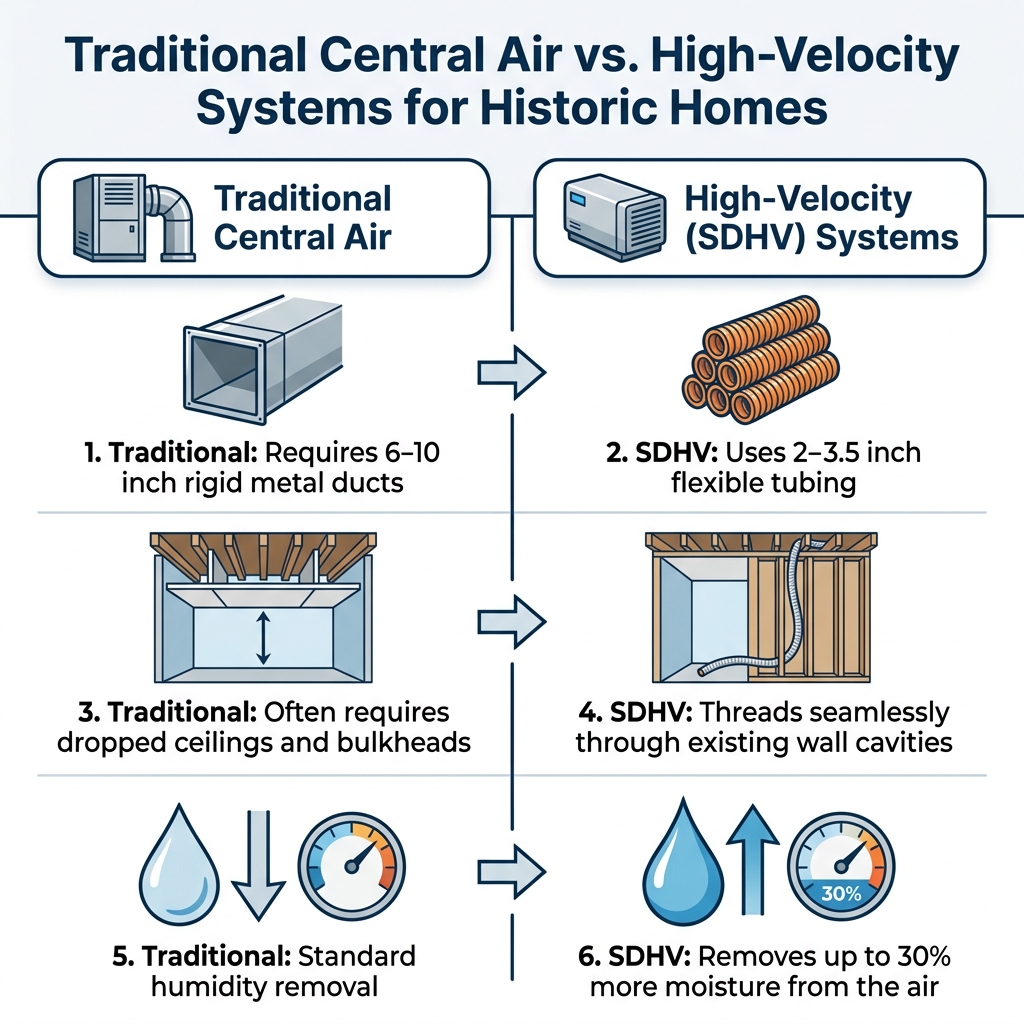
Standard rigid metal ducts require a minimum of 6 to 10 inches of clearance inside walls, floors, and ceilings. In a home built in 1890, those wide-open internal spaces simply do not exist. To run these massive metal trunks from the basement or attic to the main living areas, installers are forced to carve out substantial amounts of interior space.
This frequent necessity leads to the construction of bulkheads—large, boxed-in enclosures built into the corners of rooms to hide the vertical ductwork. It also frequently requires dropping the ceilings in hallways or bathrooms to conceal horizontal runs.
The Aesthetic Cost
The aesthetic impact of these modifications can be devastating to a historic property. Dropping a ceiling often means covering up or destroying original crown molding and intricate plaster medallions. Building bulkheads disrupts the clean, symmetrical lines of formal dining rooms and parlors.
Furthermore, traditional ductwork often claims a significant portion of the home's existing storage. It is incredibly common for contractors to run vertical duct trunks straight through the back of bedroom closets. In older homes where closet space is already notoriously scarce, sacrificing a third of your storage to house a metal air shaft is a heavy price to pay for summer comfort.
The Small-Duct High-Velocity (SDHV) Alternative
If traditional ductwork is a blunt instrument, Small-duct high-velocity (SDHV) tubing is a surgical tool. Engineered specifically for preservation and retrofitting, high-velocity systems bypass the need for massive renovations and destructive teardowns.
How Flexible Tubing Changes the Game
Instead of relying on large metal trunks, an SDHV system uses an incredibly compact air handler (usually hidden in an attic, basement, or crawlspace) connected to a network of flexible, insulated hoses. These hoses are typically only 2 to 3.5 inches in diameter. Because they are flexible and narrow, installers can thread them through existing wall cavities, down through closets, and around structural obstacles without tearing down plaster or framing bulkheads.
The vents themselves are equally discrete. Rather than large, stamped-metal grilles that dominate the wall, SDHV systems terminate in small, circular outlets that are usually about 5 inches wide. These outlets can be seamlessly integrated into ceilings, floors, or high up on walls. They can even be fitted with custom wood covers to match original 19th-century hardwood floors perfectly.
The Principle of Aspiration
SDHV systems do not just look different; they deliver air differently. Traditional systems "dump" cold air into a room, which can create hot and cold spots. High-velocity systems use the principle of aspiration. The air is delivered into the room at a higher speed, creating a gentle suction effect that continuously draws the room's existing air into the airstream. This mixes the air rapidly and evenly, eliminating drafts and ensuring a perfectly consistent temperature from floor to ceiling.
Comparing the Two Approaches
• Duct Size — Traditional Central Air: 6 to 10 inches (rigid metal) — High-Velocity (SDHV) System: 2 to 3.5 inches (flexible tubing)
• Installation Impact — Traditional Central Air: Highly invasive; requires cutting walls — High-Velocity (SDHV) System: Minimally invasive; threads through cavities
• Aesthetic Changes — Traditional Central Air: Often requires bulkheads & dropped ceilings — High-Velocity (SDHV) System: Preserves original ceiling heights & moldings
• Vent Style — Traditional Central Air: Large, prominent metal grilles — High-Velocity (SDHV) System: Small, discrete 5-inch circular outlets
• Air Delivery — Traditional Central Air: Low velocity, can create hot/cold spots — High-Velocity (SDHV) System: High velocity aspiration, even mixing

Tackling South Jersey Humidity: Which System Wins?
Cooling the air is only half the battle; managing moisture is where the real comfort lies. With summer temperatures regularly exceeding the 90s, the hot, highly humid South Jersey summers interact aggressively with older, uninsulated homes. The late-summer heat brings soaring relative humidity that peaks the cooling load on historic properties, making superior dehumidification a critical advantage.
The Strain of Late-Summer Heat
When the August heat peaks and families are transitioning into back-to-school routines, the strain on an improperly sized or struggling system is intense. At Climate Mechanics, we see this pattern frequently. One local homeowner reached out on a sweltering holiday weekend when their central air unit stopped working completely. Worried about the timing and needing immediate relief, they called at 6 PM. We arranged for a technician to arrive quickly, and the underlying fault was identified and fixed within 30 minutes. While rapid response is crucial during a summer breakdown, preventing that system stress in the first place starts with having equipment that can handle the heavy local moisture load.
The Dehumidification Difference
Traditional central air can sometimes struggle to keep up with extreme humidity if the ductwork is leaky or the system is not perfectly sized for an older, drafty home. If the system cools the room too quickly without running long enough to pull moisture from the air, you are left with a cold, clammy environment.
High-velocity systems excel in these specific conditions. Because the air handler uses a thicker cooling coil and the air passes over it at a colder temperature, the system extracts significantly more water from the indoor air.
• Superior Moisture Removal: SDHV systems can remove up to 30% more humidity than conventional central air systems.
• Lower Thermostat Settings: Because the air is drier, it feels cooler on your skin. Homeowners often find they can set their thermostat a few degrees higher while feeling just as comfortable.
• Protecting the Home: Removing excess moisture helps protect antique wooden furniture, original hardwood floors, and historic plaster from swelling and warping during the humid summer months.
Preserving Your Home's Aesthetic Integrity
Historic Haddonfield is known for its stunning colonial and Victorian architecture. The value of these homes lies heavily in their original details—the intricate crown moldings, the unpainted woodwork, the pocket doors, and the sweeping ceiling heights. Achieving modern cooling comfort should never require sacrificing the very elements that make your home special.
The Value of Specialized Expertise
Retrofitting an older property is not a standard job; it requires a deep respect for the structure. At Climate Mechanics, our specialized expertise in retrofitting delicate historic properties ensures that we approach every installation with a preservation-first mindset. We understand how to map out a system that works with the home's natural layout rather than fighting against it.
Working with professionals who understand the fragile nature of historic properties means your original architectural details remain intact. The goal is to make the climate control invisible. When guests walk into your parlor, they should feel the perfect temperature, but they should never notice where the air is coming from. By utilizing flexible tubing and strategic vent placement, the aesthetic integrity of your property is preserved for the next generation.
Alternative Considerations: Ductless Mini-Splits
While high-velocity systems are the gold standard for invisible, whole-home cooling in historic properties, it is important to acknowledge a third option. For specific zoning needs or isolated spaces, ductless AC systems offer a highly effective alternative.
How Ductless Systems Operate
As the name implies, ductless systems work entirely without ductwork. They consist of an outdoor compressor connected directly to one or more indoor air handlers via a small conduit line containing refrigerant and electrical wiring. These indoor units are typically mounted high on a wall or positioned near the floor.
Comparing Visual Impact and Utility
The primary tradeoff with a ductless system is visual. While an SDHV system uses nearly invisible 5-inch ceiling or floor vents, a ductless system requires a visible rectangular unit to be mounted in the room. In a highly formal, historic dining room, this wall cassette can be aesthetically disruptive.
However, there are distinct benefits of ductless AC systems when used strategically. They are highly effective for targeted zoning. If you have a third-floor attic conversion, a newly added sunroom, or an isolated master suite where even flexible tubing cannot easily reach, a ductless mini-split provides powerful, efficient cooling exactly where you need it without impacting the rest of the home's architecture.
Making the Right Choice for Your Historic Property
Upgrading the climate control in a historic home requires carefully balancing the need for effective moisture removal with the absolute necessity of architectural preservation. The physical realities of older construction—fragile plaster, lack of ventilation shafts, and missing vapor barriers—demand a specialized approach.
You do not have to settle for the invasive bulkheads, dropped ceilings, and lost closet space that come with traditional rigid metal ductwork. By opting for a small-duct high-velocity system, you can thread modern comfort seamlessly through the existing footprint of your home, managing intense summer humidity without leaving a scar on your ceiling.
Every historic floor plan is unique, and the best way to determine your optimal retrofit strategy is through a professional assessment. If you are ready to explore your options for AC installation in Haddonfield, the team at Climate Mechanics can help you map out a minimally invasive solution that respects your home's history while delivering the modern comfort you deserve.
Frequently Asked Questions
How do you add AC to a historic house with plaster walls?
Adding AC to a historic house with plaster walls is best achieved using a Small-Duct High-Velocity (SDHV) system. Instead of cutting large holes for rigid metal ducts, installers thread flexible, 2-to-3-inch tubing through the existing wall cavities and floor joists. This minimally invasive method allows the tubing to bend around obstacles, keeping the fragile plaster-and-lath walls completely intact while delivering whole-home cooling.
Does high-velocity AC dehumidify better than central air?
Yes, high-velocity AC systems generally provide superior dehumidification compared to traditional central air. Because the air moves across a thicker, colder evaporator coil, the system extracts up to 30% more moisture from the indoor air. This enhanced moisture removal is especially beneficial in older, uninsulated homes that struggle with high summer humidity.
Can you cool a historic home without existing ductwork?
You can absolutely cool a historic home without existing ductwork by utilizing either an SDHV system or ductless mini-splits. High-velocity systems introduce a network of tiny, flexible tubes that fit inside existing walls without major renovations. Alternatively, ductless systems use wall-mounted air handlers that connect directly to an outdoor compressor, bypassing the need for internal ducting entirely.
How much space do high-velocity ducts actually need?
High-velocity ducts require significantly less space than traditional HVAC systems. The flexible, insulated supply tubing is typically only 2 to 3.5 inches in outer diameter. This narrow profile allows the tubes to slide easily inside standard interior walls, tight crawlspaces, and shallow ceiling joists without requiring the construction of bulky soffits or drop ceilings.
Are small-duct high-velocity systems noisier than traditional central air?
When properly installed, small-duct high-velocity systems are incredibly quiet and often less noticeable than traditional forced-air systems. The flexible tubing is heavily insulated with sound-absorbing materials that dampen airflow noise. Additionally, the principle of aspiration allows the air to mix smoothly into the room without the loud rushing sound commonly associated with standard metal vents.
What is the aesthetic impact of SDHV vents in older ceilings?
The aesthetic impact of SDHV vents is minimal, making them ideal for preserving historic ceilings. Instead of large, obtrusive metal grilles, the system uses small, circular outlets that are roughly 5 inches wide. These discrete vents can be painted to blend perfectly into the plaster, or fitted with custom wood finishes to match original architectural details seamlessly.
