



The Late-Summer AC Slump: Why Cooling Drops in August
Your system has been running nonstop all afternoon, yet the indoor temperature keeps creeping up, leaving you searching for answers on diagnosing a sudden drop in AC cooling capacity after a long South Jersey summer. A sudden loss of cooling power is incredibly frustrating, especially when it happens right in August as the back-to-school season begins and you are trying to keep your home comfortable for your family.
Most homeowners don't realize that late-summer air conditioning failures are rarely random events. Instead, they are usually the inevitable tipping point of months of continuous operation and cumulative wear. What feels like an overnight breakdown is often the final result of a minor issue that has been compounding since June. The most important step you can take right now is determining whether your system is suffering from a simple, easily correctable airflow problem or a complex mechanical degradation that requires a professional.
If you are dealing with a complete system failure and need immediate assistance, reaching out for AC repair in Cinnaminson is the safest way to accurately identify the root cause and restore your home's comfort.
Why Minor AC Issues Become Major Failures by Late Summer
To understand why your system suddenly stops blowing cold air in August, you have to look at how it operates throughout the season. Air conditioning systems are subjected to what HVAC professionals call "cumulative stress." Every minor inefficiency—a slightly dirty filter, a tiny refrigerant leak, or a dusty outdoor coil—forces the system to work just a little bit harder to achieve the same temperature.
Over the course of a long season, the sustained heat forces the unit to operate near maximum capacity for months. Constant cycling prevents the internal components from resting, which accelerates mechanical fatigue. If you have noticed your AC running constantly in the New Jersey summer heat, that continuous runtime is exactly what pushes minor issues to their breaking point.
The Compounding Effect of Continuous Operation
Here is how the heat load builds up over the summer and strains your equipment:
• Compressor fatigue: The compressor is the heart of your system. When it runs endlessly without cooling the house, it overheats, leading to internal wear and eventual shutdown.
• Blower motor strain: Your indoor fan motor has to push air through the ductwork. If resistance increases, the motor draws more electricity and runs much hotter than designed.
• Thermal overload: Safety switches are designed to trip when components get too hot. In late summer, these switches activate more frequently due to the compounded heat stress.
• Operating Cycles — Early Summer (June): Normal on/off cycling with adequate rest periods. — Late Summer (August): Continuous operation with little to no downtime.
• Coil Cleanliness — Early Summer (June): Relatively clean, allowing for optimal heat transfer. — Late Summer (August): Coated in months of dust, pollen, and yard debris.
• Refrigerant Levels — Early Summer (June): Slight micro-leak may go entirely unnoticed. — Late Summer (August): Leak has depleted charge, causing system failure.
An issue that started as a minor inefficiency in June might only become noticeable as a significant capacity drop during the peak heat of August late-summer wear.
Safe Visual Checks to Perform Before Calling a Technician
Before assuming your system needs a major overhaul, there is a strict boundary between safe homeowner checks and licensed professional work. Sometimes, a sudden drop in cooling capacity is simply a severe airflow restriction that mimics a larger mechanical failure. Here are the safe, non-technical troubleshooting steps you can take in the South Jersey / Cinnaminson area.
Airflow and Filter Inspections
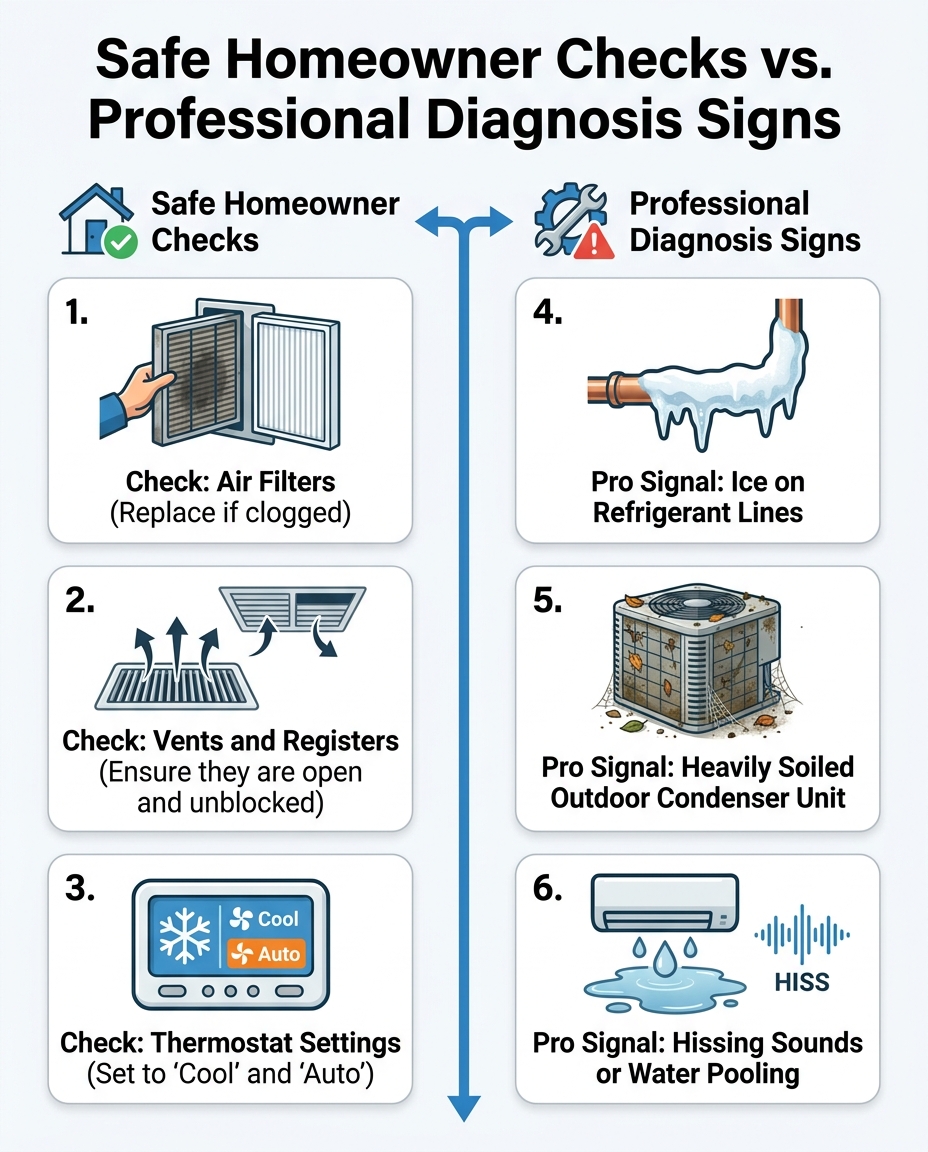
1. Inspect and replace the air filter: A severely clogged filter is the number one cause of restricted airflow. Pull your filter out and hold it up to a light source. If you cannot see light passing through the material, it is choked with dust and must be replaced immediately.
2. Check all room vents and registers: Walk through every room in your house and ensure that all supply and return vents are fully open. Make sure no rugs, curtains, or pieces of furniture have been moved over the vents, as this traps air and forces the blower motor to work harder.
3. Verify thermostat settings: Double-check that your thermostat is set to "Cool" and that the fan switch is set to "Auto" rather than "On." If the fan is set to "On," it will blow air continuously, even when the compressor isn't running, which can feel like the system is blowing warm air.
4. Look for visible ice: Check the indoor air handler and the copper pipes leading to the outdoor unit. If you see a buildup of white frost or solid ice, turn the system off immediately to let it thaw.
If you perform these basic visual checks and the system still fails to cool your home, the issue has likely moved beyond a simple fix. At this stage, routine AC maintenance or targeted repair is required to diagnose the underlying mechanical fault.

How South Jersey Humidity Chokes Your Outdoor Condenser Coils
One of the primary causes of late-summer capacity drops is a heavily soiled outdoor condenser coil. The outdoor unit's main job is to release the heat absorbed from inside your home out into the ambient air. To do this efficiently, the aluminum fins on the condenser coil must remain clean and clear of obstructions.
Our South Jersey coastal plain climate makes this incredibly difficult. The extended periods of high humidity keep the outdoor coils damp with condensation. As the summer progresses, lawnmowers kick up grass clippings, trees drop pollen, and wind blows dirt directly into the wet unit. Because the coils are moist, this debris adheres to the aluminum fins like a thick layer of cement.
The Impact of Moisture and Debris
When the outdoor coil becomes insulated by this layer of grime, it fails to transfer heat effectively. The system will continue to run endlessly, trying to cool the house, but it will only blow lukewarm air because the heat has nowhere to go. This is a classic example of August late-summer wear compounding into a complete loss of capacity.
A critical warning: Never attempt aggressive DIY cleaning on your outdoor unit. The aluminum fins are paper-thin and easily bent. Using a high-pressure washer or stiff brush will flatten the fins, permanently blocking airflow and ruining the unit. Professional coil cleaning uses specialized, non-acidic foaming chemicals that push debris out from the inside without damaging the delicate metal.
The Slow Drain: Refrigerant Micro-Leaks and Frozen Coils
The second major cause of cumulative failure in late summer is a slow refrigerant leak. It is a common misconception that air conditioners "consume" or "use up" refrigerant over time. Air conditioners operate on a closed-loop system. If your refrigerant level is low, it always indicates that there is a leak somewhere in the copper lines or coils.
A micro-leak that started as a pinhole in the spring will slowly deplete the system's charge over the course of the summer. The system will compensate for a while by running longer cycles, which is why the problem often goes unnoticed until August.
Why Your AC Freezes in the Summer Heat
The short answer is physics. When the refrigerant level drops too low, it causes a severe pressure drop inside the indoor evaporator coil. This pressure drop causes the temperature of the coil to plummet below freezing. As warm, humid indoor air blows across the freezing coil, the moisture in the air instantly turns to frost.
Eventually, that frost builds into a solid block of ice, completely blocking airflow through the system. You will likely notice the following signs:
• Water pooling: As the ice block eventually melts when the system cycles off, it overwhelms the drain pan and leaks around the indoor unit.
• Ice on copper lines: Visible frost tracking all the way from the indoor unit to the outdoor condenser.
• Zero airflow: The blower motor runs, but no air comes out of the vents because the ice block is acting as a solid wall.
Why Cumulative Wear Requires Expert Professional Diagnosis
Simply changing a filter or attempting to add refrigerant blindly will not fix a system suffering from deep cumulative wear or a frozen evaporator coil. Resolving a late-summer breakdown requires accurately diagnosing the root cause rather than applying a temporary band-aid.
One local homeowner experienced this exact scenario when their central air unit went down unexpectedly just as Labor Day weekend was approaching. Because they recognized the urgent need for professional help, a service technician was dispatched to the home. The technician identified the exact problem causing the sudden failure and repaired the unit quickly, getting the system back up and running within 30 minutes. This swift resolution is only possible when a trained expert evaluates the system as a whole.
Working with NATE-certified technicians means you are relying on professionals who have passed rigorous hands-on exams testing real-world HVAC knowledge. They are trained to identify and resolve complex, cumulative root causes. Handling refrigerants, diagnosing electrical shorts, and performing internal coil cleanings require specialized tools and strict adherence to EPA licensing regulations. When you rely on professional AC service, you ensure the repair is done safely and correctly the first time.
Frequently Asked Questions About Late-Summer AC Performance
Why did my AC suddenly stop cooling in late summer?
A sudden loss of cooling in late summer is often due to cumulative wear reaching a tipping point. This usually stems from severe dirt buildup on the outdoor condenser coils or a slow refrigerant leak that has finally dropped the system pressure too low to function. Months of continuous high-load operation push these minor issues into full system failures.
How do I know if my AC has a refrigerant leak?
Signs of a refrigerant leak include visible ice on the copper refrigerant lines, a hissing or bubbling sound near the indoor or outdoor unit, and the system running constantly while only blowing warm air. Because the system is a closed loop, low refrigerant always points to a leak that requires professional repair.
What are the signs of a dirty AC coil?
A heavily soiled outdoor coil will cause reduced cooling capacity, significantly longer cooling cycles, and higher energy bills as the system struggles to release heat. You will also likely see visible debris, grass clippings, or a paste-like grime coating the aluminum fins on the outdoor unit.
Why is my AC running constantly but not cooling the house?
This indicates the system is failing to transfer heat effectively from inside your home to the outside. It is usually caused by a severely clogged air filter blocking indoor airflow, dirty outdoor condenser coils trapping heat, or a lack of refrigerant preventing the cooling cycle from operating.
Can a dirty filter stop an AC from cooling entirely?
Yes, a severely clogged air filter restricts airflow so much that the system cannot pull enough warm air from the home to cool it. Without enough warm air passing over the indoor coil, the coil can actually drop below freezing, turning into a block of ice and stopping the cooling process completely.
Restore Your Home's Comfort for the Rest of the Season
While a sudden drop in cooling capacity during the hottest part of August is stressful, the underlying causes are highly diagnosable and entirely repairable. Late-summer failures are the result of cumulative wear, and understanding the difference between a simple filter swap and a complex mechanical issue is the first step toward restoring your home's comfort.
If you have performed the safe visual checks—inspecting your filter, verifying your thermostat, and checking your vents—and your system is still blowing warm air, it is time to bring in an expert. Do not let a frozen coil or a choked condenser unit compromise your comfort as the season winds down. By exploring professional air conditioning services, you can get clear answers on what is failing and secure a lasting solution that keeps your family cool and comfortable.
