



How South Jersey Homeowners Can Maximize HVAC Savings With Every Available Incentive
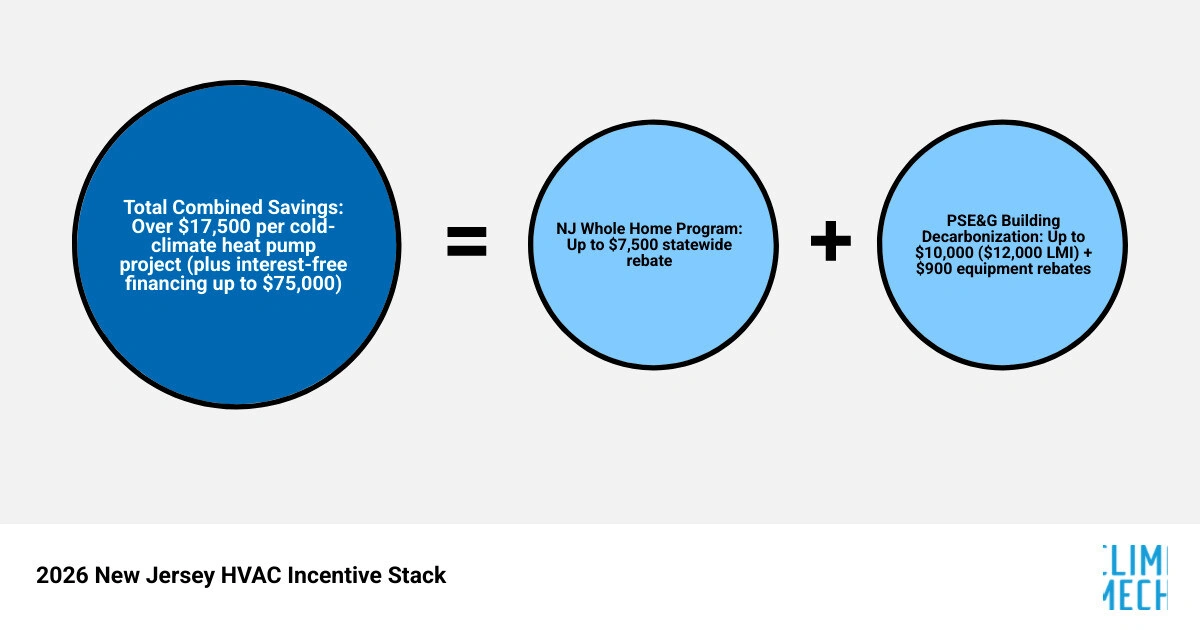
If you're trying to figure out how to stack PSE&G rebates with federal tax credits for HVAC in New Jersey, here's the fast answer: for equipment installed in 2026, federal Section 25C tax credits are no longer available — they expired December 31, 2025. Your best move now is combining PSE&G's Building Decarbonization rebates with the statewide NJ Whole Home program, which can stack to deliver over $17,500 in total incentives on a qualifying cold-climate heat pump installation.
Quick Answer: How to Stack NJ HVAC Incentives in 2026
• Statewide rebate — Program: NJ Whole Home Program — Maximum Amount: Up to $7,500
• Utility conversion rebate — Program: PSE&G Building Decarbonization (Clean Heat) — Maximum Amount: Up to $10,000 ($12,000 LMI)
• Equipment rebate — Program: PSE&G HVAC Instant Rebates — Maximum Amount: Up to $900
• Federal tax credit — Program: Section 25C (expired 12/31/2025) — Maximum Amount: $0 for 2026 installs
• Interest-free financing — Program: PSE&G On-Bill Repayment — Maximum Amount: Up to $75,000
Note: If your qualifying equipment was installed and placed in service before December 31, 2025, you may still claim the Section 25C credit when you file your 2025 taxes.
For South Jersey homeowners dealing with high energy bills and aging HVAC systems, the incentive landscape in 2026 is actually one of the strongest in the country — even without the federal tax credit. New Jersey's utility programs have stepped up to fill that gap in a meaningful way.
The challenge is that these programs aren't always easy to navigate on your own. There are multiple layers, income tiers, equipment requirements, and contractor rules. Miss one step and you could leave thousands of dollars on the table.
This guide breaks it all down clearly so you can claim every dollar you're entitled to.
The 2026 Landscape: How to Stack PSEG Rebates with Federal Tax Credits for HVAC in New Jersey
We have officially entered June 2026, and the rules of the game have shifted. For several years, the "holy grail" of HVAC savings was combining local utility programs with the federal Section 25C Energy Efficient Home Improvement Credit. However, because the federal Section 25C tax credits officially expired on December 31, 2025, any system installed in 2026 must rely entirely on state and utility rebates.
While that sounds like a setback, New Jersey homeowners actually have access to incredibly robust state-level programs. In fact, utility programs like PSE&G’s Building Decarbonization initiative offer much larger upfront savings than the old federal tax credits ever did. Instead of waiting until tax season to get a percentage of your money back, you can now secure massive instant discounts directly on your installation invoice.
If you are looking to maximize your ROI, focusing on Energy Efficient Heating Systems is your best strategy. By understanding how the current utility programs stack, you can still achieve a highly affordable upgrade.
• Federal 25C Tax Credit — 2025 Retroactive Stacking: Up to $2,000 (For systems installed by 12/31/2025) — 2026 Utility-Only Stacking: $0 (Expired)
• NJ Whole Home Rebate — 2025 Retroactive Stacking: Up to $7,500 — 2026 Utility-Only Stacking: Up to $7,500
• PSE&G Decarbonization Rebate — 2025 Retroactive Stacking: Up to $10,000 ($12,000 LMI) — 2026 Utility-Only Stacking: Up to $10,000 ($12,000 LMI)
• PSE&G Equipment Rebate — 2025 Retroactive Stacking: Up to $900 — 2026 Utility-Only Stacking: Up to $900
• On-Bill Financing Limit — 2025 Retroactive Stacking: Up to $25,000 — 2026 Utility-Only Stacking: Up to $75,000 (Standard + Decarb)
Understanding the 2025 Retroactive Rules for How to Stack PSEG Rebates with Federal Tax Credits for HVAC in New Jersey
If you had a high-efficiency heat pump, central air conditioner, or furnace installed on or before December 31, 2025, you are in luck. You can still claim your Section 25C federal tax credit retroactively when you file your taxes.
Under the retroactive rules, the federal credit covers 30% of the total installation cost, capped at:
• $2,000 per year for qualifying air-source heat pumps.
• $600 per year for qualifying central air conditioners, gas furnaces, or hot water boilers.
• $1,200 annual overall limit for building envelope improvements (like insulation and air sealing).
To claim this retroactive credit, you must file IRS Form 5695 alongside your tax return. You will need to keep all supporting documentation, including your final paid invoice, the manufacturer's certification statement showing the equipment meets ENERGY STAR requirements, the AHRI certificate, and municipal permit sign-offs.
Additionally, if you installed qualifying smart controls, you might wonder: Can Smart Thermostats Reduce Your Energy Consumption? Absolutely, and under the 2025 rules, qualifying smart thermostats also yielded minor tax credits while qualifying for instant $75 to $100 utility rebates.
Navigating 2026 Rules on How to Stack PSEG Rebates with Federal Tax Credits for HVAC in New Jersey
For installations happening right now in June 2026, the focus is entirely on localized, high-value utility and state programs. The state of New Jersey has built a powerful two-layer incentive stack:
1. The NJ Whole Home Program: Administered statewide, this program offers up to $7,500 in cash-back incentives based on modeled home energy savings. To unlock the highest tiers, you must achieve a 33% modeled energy reduction, which is typically accomplished by combining a cold-climate heat pump with air sealing and insulation.
2. PSE&G Building Decarbonization and Equipment Rebates: PSE&G offers up to $10,000 (or $12,000 for income-qualified households) for full fossil fuel displacement. This is combined with instant equipment rebates of up to $900 for qualifying heat pumps.
When you stack these two layers, a South Jersey homeowner can easily secure $17,500 to $21,500 in total incentives. Because modern systems rely heavily on smart controls, combining these upgrades with a professional Home Efficiency Smart Thermostat Installation ensures that your new system operates at peak efficiency while qualifying for additional utility rebates.
PSE&G HVAC Rebates and Building Decarbonization Pathways
PSE&G’s residential decarbonization program is designed to encourage homeowners to transition away from fossil-fuel heating systems (like oil, propane, or older natural gas systems) to clean-burning, high-efficiency heat pumps. To make this transition accessible, PSE&G has structured three distinct pathways:
• Clean Heat Pathway (Full Displacement): This is the gold standard for savings. If you completely decommission, remove, or permanently disable your old fossil-fuel heating system and install a cold-climate air-source heat pump (ccASHP) sized to handle 100% of your home's heating load, you qualify for the maximum rebate. Standard customers receive the lesser of $10,000 or 50% of the project cost. Low-to-moderate-income (LMI) customers receive the lesser of $12,000 or 60% of the project cost.
• Dual Heat Pathway (Dual-Fuel System): If you prefer to keep your existing fossil-fuel furnace as a backup for extremely cold days, you can install a high-efficiency heat pump alongside it. The system must utilize integrated smart controls that automatically switch between the heat pump and the furnace based on outdoor temperatures. This pathway offers standard rebates up to $5,000 (50% cap) and LMI rebates up to $6,000 (60% cap).
• Hybrid Heat Pathway (Partial Displacement): If you are only replacing your central air conditioner but want to upgrade to a heat pump to handle your cooling and shoulder-season heating, this is your pathway. It offers standard rebates up to $2,000 (30% cap) and LMI rebates up to $3,000 (40% cap).
To unlock these massive rebates, the equipment must meet strict performance standards. For example, cold-climate air-source heat pumps must have a Coefficient of Performance (COP) of 1.75 or higher at 5°F. Navigating these technical details is why consulting a professional HVAC Installation Services Guide is highly recommended before purchasing equipment.
Standard vs. Income-Qualified (LMI) PSE&G Rebates
One of the most compassionate and financially rewarding aspects of the New Jersey energy landscape is the enhanced support for low-to-moderate-income (LMI) households. If your household qualifies, you can access significantly higher rebate caps and special "adders."
LMI eligibility is determined through three simple pathways:
1. Geographic Designation: Your primary residence is located in a state-designated Overburdened Community (OBC) or a low-to-moderate-income census tract.
2. Safety Net Program Participation: A member of your household is currently enrolled in programs like LIHEAP, SNAP, Lifeline, or Section 8 housing.
3. Income Verification: Your household income is at or below 400% of the Federal Poverty Guidelines (for example, up to $128,600 annually for a family of four).
In addition to bumping the Clean Heat rebate cap from $10,000 to $12,000, LMI customers qualify for an extra $300 per-measure adder on standard HVAC equipment rebates. If you are replacing an old, inefficient gas furnace with a modern high-efficiency system, you might wonder: How Can Buying a New Furnace Save You Money? Between the standard gas combi rebates (up to $1,050), LMI adders, and monthly utility savings, the payback period drops dramatically.
PSE&G On-Bill Repayment and Financing Options
Even with $17,500 in stacked rebates, a whole-home HVAC conversion requires upfront capital. To eliminate this barrier, PSE&G offers an industry-leading On-Bill Repayment (OBR) program.
This program allows you to finance the remaining balance of your installation directly through your monthly PSE&G utility bill at 0% interest (APR). Here is how the financing limits break down:
• Standard HVAC Projects: Up to $25,000 in interest-free financing.
• Building Decarbonization Projects: Up to an additional $50,000 in interest-free financing.
• Maximum Combined Limit: Up to $75,000 total per utility account.
The repayment terms are incredibly flexible, offering 84-month (7-year) or 120-month (10-year) terms depending on the total project cost and your income qualification. Best of all, because this is a utility-backed program designed to improve home efficiency, no credit check is required for active PSE&G customers in good standing.
Understanding the Benefits of Financing Your HVAC System can help you preserve your personal savings while immediately enjoying lower monthly energy bills. If you are ready to explore your options, you can learn more about how we facilitate this process on our Financing page.
Step-by-Step Guide to Claiming and Stacking Your Incentives
To ensure you don't miss out on a single dollar of savings, follow this proven step-by-step process:
1. Choose a Participating PSE&G Contractor: You cannot claim these rebates on a DIY project or by working with an unapproved contractor. The contractor must be a licensed, BPI-certified participating trade ally in PSE&G's network (like our team at Climate Mechanics).
2. Schedule a Whole-Home Energy Audit: To qualify for the NJ Whole Home program's $7,500 rebate, a certified auditor must perform energy modeling on your home to establish your baseline energy use.
3. Perform Heat Load Calculations: Your contractor must perform ACCA Manual J load calculations and Manual S equipment selection. This ensures your new heat pump is precisely sized for your home's unique footprint.
4. Select Qualifying Equipment: Ensure your contractor selects equipment listed on the NEEP (Northeast Energy Efficiency Partnerships) cold-climate database with a COP of 1.75 or higher at 5°F.
5. Verify LMI Status Upfront: If you qualify for LMI incentives, submit your census tract, safety net program, or income documentation before the installation begins to secure your enhanced rebate caps.
6. Secure Municipal Permits: All qualifying installations must be fully permitted through your local South Jersey municipality.
7. Apply Instant Rebates at Sale: Your participating contractor will apply the PSE&G equipment and decarbonization rebates as an instant discount directly on your invoice, meaning you only pay (or finance) the net balance.
8. Submit Final Documentation: Within 30 to 120 days of installation, your contractor will submit the final paid invoice, model/serial numbers, AHRI certificate, and permit sign-offs to PSE&G and the NJ Whole Home program to finalize the funding.
Ready to start the process? You can easily Request Estimate online to have one of our system designers evaluate your home.
Frequently Asked Questions about New Jersey HVAC Incentives
Can I stack NJ Whole Home rebates with PSE&G utility rebates?
Yes! The NJ Whole Home program and PSE&G’s utility rebates are designed to stack. This "two-layer stack" is explicitly permitted because the Whole Home program is a statewide efficiency initiative, while PSE&G rebates are utility-specific equipment incentives.
What are the requirements for PSE&G cold-climate heat pump rebates?
To qualify for the highest rebate tiers, the system must be an AHRI-matched split or packaged system meeting ENERGY STAR SEER2, EER2, and HSPF2 ratings. For cold-climate designations, the system must maintain a Coefficient of Performance (COP) of at least 1.75 at 5°F.
Has New Jersey launched the federal IRA HEAR/HOMES rebates yet?
No. While New Jersey was allocated over $185 million in federal funding under the Inflation Reduction Act's HEAR (Home Electrification and Appliance Rebates) and HOMES programs, the state has not yet launched consumer-facing programs for these funds. For now, homeowners must rely on the existing NJ Whole Home and PSE&G programs.
Conclusion
Navigating the incentive landscape can feel overwhelming, but the savings are well worth the effort. By stacking the NJ Whole Home program with PSE&G's Building Decarbonization pathway and interest-free on-bill financing, you can replace your aging, inefficient system with a state-of-the-art cold-climate heat pump for a fraction of the standard cost.
At Climate Mechanics, we bring over 38 years of NATE and NCI-certified expertise to every project. We proudly serve our neighbors throughout South Jersey, including Maple Shade, Pennsauken, Audubon, Willingboro, Collingswood, Haddonfield, Burlington, Marlton, and Camden.
We handle all the complex paperwork, load calculations, and utility submissions for you, ensuring your rebates are applied instantly to your invoice. If you want to learn more about why making the switch is so beneficial, read our guide on Why Updating Your HVAC System Is So Important, or explore our dedicated Heat Pump Services page to take the first step toward a more comfortable, energy-efficient home.
