


How Energy Savings From a New AC Offset Replacement in South Jersey — Quick Answer
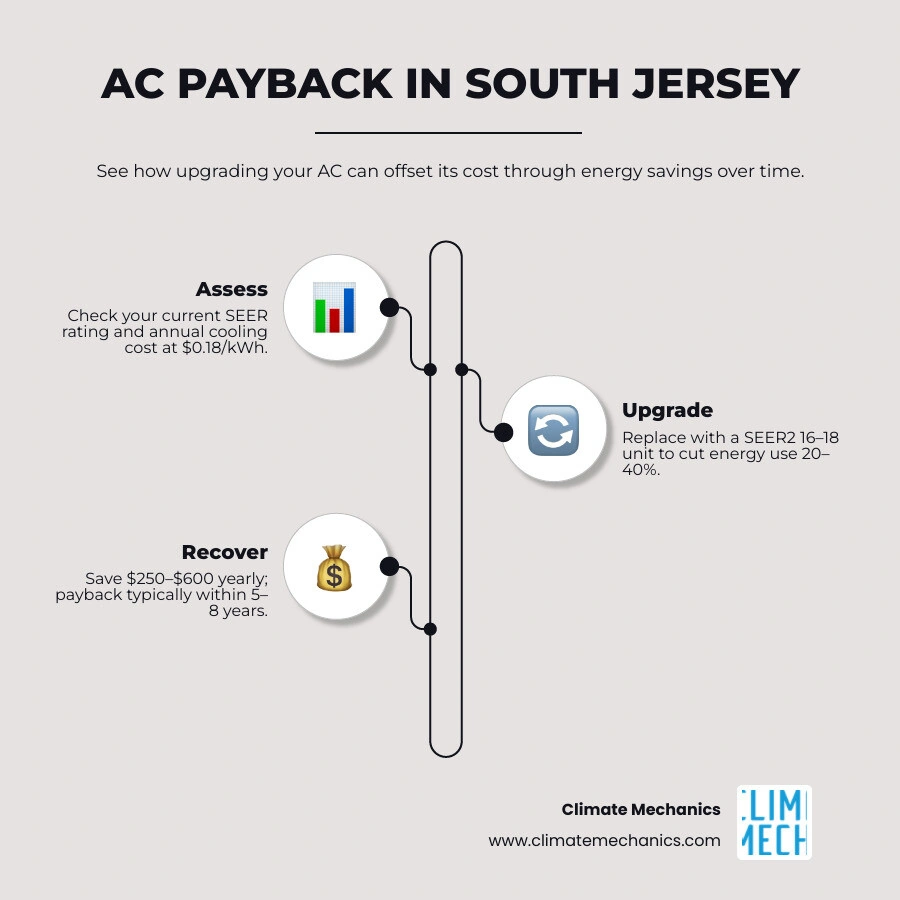
How energy savings from a new AC offset replacement in South Jersey works is simpler than most homeowners expect. When you swap an aging, low-efficiency system for a modern high-efficiency unit, the reduction in monthly cooling costs chips away at your total replacement investment year after year until the system has essentially paid for itself.
Here is a quick breakdown of what South Jersey homeowners typically see:
• 10 SEER — New System SEER2: 13 SEER2 — Estimated Annual Savings: ~$250/year — Approximate Payback Window: 6–9 years
• 10 SEER — New System SEER2: 16 SEER2 — Estimated Annual Savings: ~$300–$500/year — Approximate Payback Window: 5–8 years
• 13 SEER — New System SEER2: 16 SEER2 — Estimated Annual Savings: ~$200–$350/year — Approximate Payback Window: 5–8 years
• 13 SEER — New System SEER2: 18 SEER2 — Estimated Annual Savings: ~$300–$600/year — Approximate Payback Window: 5–8 years
Savings vary based on home size, cooling hours, ductwork condition, and local electricity rates near $0.18/kWh.
Heating and cooling account for roughly 30 to 50 percent of the average homeowner's energy bill. In South Jersey, where humid summers stretch from late May through September and electricity costs sit around $0.18 per kilowatt-hour, an outdated AC unit quietly drains hundreds of dollars every cooling season. If your system is running on a SEER rating from 10 to 13 years ago, there is a good chance you are spending far more than you need to just to stay comfortable.
The good news is that upgrading to a modern high-efficiency system does not just improve comfort — the energy savings actively work to offset the cost of the replacement itself. Add in available rebates from Atlantic City Electric and South Jersey Gas, plus federal tax credits still in play, and the financial case becomes even clearer.
This guide walks you through exactly how to calculate that payback, what South Jersey's climate means for your savings, and how to make the most of every incentive available to you.
Understanding SEER2 and Energy Efficiency in South Jersey
When shopping for a new air conditioning system, you will quickly encounter the term SEER2. If you bought your last air conditioner over a decade ago, you probably remember looking at SEER ratings. Today, the industry has shifted to a more rigorous standard designed to give you a more accurate picture of real-world energy consumption.
The Department of Energy (DOE) enforces strict regional minimum efficiency standards. In New Jersey, the minimum efficiency requirement for a newly installed central air conditioner is 13.4 SEER2 (which is equivalent to 14.0 SEER under the old rating system).
To help visualize how upgrading to different efficiency tiers impacts your wallet, consider the efficiency jumps and relative energy reduction below:
• 10 SEER — New System Rating (SEER2): 14.3 SEER2 (Standard) — Relative Energy Reduction: ~29% — Estimated 5-Year Savings: ~$950 — Estimated 10-Year Savings: ~$2,000
• 10 SEER — New System Rating (SEER2): 16.0 SEER2 (Mid-Efficiency) — Relative Energy Reduction: ~38% — Estimated 5-Year Savings: ~$1,200 — Estimated 10-Year Savings: ~$2,500
• 10 SEER — New System Rating (SEER2): 18.0+ SEER2 (High-Efficiency) — Relative Energy Reduction: ~45%+ — Estimated 5-Year Savings: ~$1,500+ — Estimated 10-Year Savings: ~$3,000+
What is SEER2 and Why Does It Matter?
SEER2 stands for Seasonal Energy Efficiency Ratio 2. Like the original SEER metric, it measures the total cooling output of an air conditioner over a typical cooling season divided by the total electrical energy input during that same period.
However, SEER2 testing procedures, introduced in 2023, are much more demanding. The testing protocols use a higher external static pressure to better mimic the real-world conditions of home ductwork. Because of this, SEER2 ratings are typically about 5% lower than legacy SEER numbers for the exact same piece of equipment, but they offer a much more honest representation of what you will actually pay your utility provider.
Upgrading to a higher SEER2 unit means your system will pull less power from the grid to achieve the same level of indoor cooling. If you want to maximize these efficiency gains right away, you can also implement simple, low-cost strategies alongside your upgrade, such as those outlined in our guide on 4 Ways to Lower Your AC Costs This Summer.
How Energy Savings From a New AC Offset Replacement in South Jersey
So, how do these ratings translate into actual dollars? New Jersey homeowners pay an average electricity rate of $0.18 per kilowatt-hour (kWh). In our climate, a standard 3-ton central AC unit runs for roughly 1,100 cooling hours per year.
If you are replacing an older 10 SEER unit with a modern 16 SEER2 unit, the math is compelling:
• An older 10 SEER unit running for 1,100 hours will consume approximately 3,800 kWh annually. At $0.18/kWh, that costs about $684 per year just in cooling electricity.
• A new 16 SEER2 unit performing the same amount of cooling will consume roughly 2,475 kWh. At $0.18/kWh, this costs about $446 per year.
This single upgrade saves you $238 annually in direct electricity costs. Over the typical 15- to 20-year lifespan of a professionally installed system, those annual savings accumulate into thousands of dollars back in your pocket.
If you live in Camden County and are ready to see how a high-efficiency system fits your home, reach out to our team for a professional AC Installation Cherry Hill NJ.
How Climate and Coastal Factors Impact Your Savings
A national average calculation is a helpful starting point, but South Jersey homes experience unique climate pressures. Our geographic location between the Delaware River and the Atlantic Ocean creates a distinct microclimate that directly impacts how hard your air conditioner has to work.
When we design and size systems for our neighbors, we look closely at local environmental factors to ensure you choose a SEER2 rating that delivers the fastest payback. If you are nearby in Burlington County, our local experts can help you navigate these choices with our tailored AC Installation Mt Laurel NJ services.
Humidity and Cooling Hours in South Jersey
South Jersey summers are notorious for high humidity. When your home is humid, your air conditioner has to perform two distinct tasks: lowering the air temperature (sensible cooling) and removing moisture from the air (latent cooling).
Older, single-stage air conditioners are either 100% on or 100% off. When they cycle on, they quickly lower the temperature and then shut off, often leaving the indoor air feeling clammy because they did not run long enough to extract the humidity.
Modern high-efficiency systems, especially those with two-stage or variable-speed compressors, run for longer, gentler cycles. They excel at managing latent heat, keeping your home incredibly comfortable at a slightly higher thermostat setting. Because you feel cooler at 74°F with low humidity than you do at 71°F with high humidity, you can set your thermostat higher and watch your energy bills drop even further.
If you want to experience the comfort of advanced humidity control, check out our options for AC Installation Marlton NJ.
Coastal Corrosion and Equipment Lifespan
For homes located closer to coastal waters or tidal rivers, salt air is a major factor in system degradation. Salt spray accelerates the corrosion of the outdoor condenser’s delicate aluminum fins and copper coils.
As these coils corrode, their ability to transfer heat diminishes rapidly. A system that started as a 14 SEER2 unit can easily degrade to the efficiency of an 8 SEER unit within just a few years if it is not protected against the elements.
When upgrading your system in coastal-adjacent areas, look for units featuring corrosion-resistant coil coatings or all-aluminum evaporator and condenser coils. This ensures that your high-efficiency system actually maintains its rated efficiency and achieves its expected 15-to-20-year lifespan.
For homeowners in historic and river-adjacent areas, we provide specialized system designs through our AC Installation Moorestown NJ services.
Maximizing ROI: How Energy Savings From a New AC Offset Replacement in South Jersey
Investing in a new central air conditioning system is a significant home improvement. To make an informed decision, it is best to view this upgrade through the lens of a long-term financial investment.
Beyond the immediate monthly drop in your utility bills, a new, high-efficiency cooling system also raises your home's market appeal. Surveys show that up to 85% of home buyers prefer properties with newly updated, energy-efficient HVAC systems.
If you are planning to sell your home in the next few years, or if you simply want to secure long-term comfort, we can help you design a system with our AC Installation Pennsauken NJ services.
Calculating Your Payback Period
Calculating your personalized payback period is straightforward. The basic formula is:
$$\text{Payback Period (Years)} = \frac{\text{Net Investment Cost (After Rebates & Credits)}}{\text{Annual Energy Savings}}$$
Let’s look at a realistic scenario:
• Suppose you upgrade to a high-efficiency system that reduces your annual cooling costs by $400 per year compared to your old, failing unit.
• After applying federal tax credits, utility rebates, and manufacturer incentives, your net investment is fully optimized.
• If the net investment is offset by these savings, your system will completely pay for itself within 5 to 8 years.
Considering that a well-maintained system will easily last 15 to 20 years, you will enjoy another 10 to 12 years of pure, unadulterated savings long after the system has paid for itself. For homeowners in Voorhees and surrounding areas, our team can run these exact calculations for your property during an AC Installation Voorhees NJ consultation.
The Role of Proper Ductwork and Professional Installation
Here is an industry secret that many budget contractors won’t tell you: an air conditioner is only as efficient as the ductwork it is connected to.
According to the Department of Energy, the average home loses 20 to 30 percent of the conditioned air moving through its duct system due to leaks, poor connections, and uninsulated ducts. If you hook a brand-new, ultra-high-efficiency 18 SEER2 air conditioner up to leaky, unsealed ductwork, its real-world operating efficiency will drop dramatically.
Additionally, improper system sizing or incorrect refrigerant charging can slash your system's efficiency by up to 15%. This is why choosing an experienced, NATE-certified contractor is so critical. During installation, our team performs a complete ductwork assessment and system load calculation to ensure you get every bit of the efficiency you are paying for.
To learn more about what to look for during your upgrade, read our guide on Professional AC Installation Expectations.
Leveraging Rebates, Tax Credits, and Financing
One of the best ways to shorten your payback period is to slash your upfront investment by taking advantage of the historic incentives available in 2026. By combining federal programs with local New Jersey utility rebates, you can save thousands of dollars on a qualifying high-efficiency installation.
If you are looking to make this investment as manageable as possible, we invite you to explore our convenient options for Financing.
Federal Tax Credits Under the Inflation Reduction Act
Under the Energy Efficient Home Improvement Credit (Section 25C), federal tax credits allow homeowners to offset a significant portion of their energy-efficient home upgrades:
• Central Air Conditioners: Homeowners can claim a tax credit of 30% of the total project cost, capped at $600, for qualifying high-efficiency central AC systems that meet ENERGY STAR requirements (typically 16 SEER2 or higher).
• Heat Pumps: If you choose to upgrade to an energy-efficient heat pump (which provides both heating and cooling), you may qualify for a tax credit of up to 30%, capped at $2,000.
These tax credits are a direct reduction in the federal income tax you owe, making them incredibly valuable. If you are located in Haddonfield, our team can help you identify exactly which systems qualify for these federal incentives during your AC Installation Haddonfield NJ project.
South Jersey Utility Rebates and 0% Financing
In addition to federal tax credits, our local South Jersey utility companies offer incredibly generous rebates and financing programs through New Jersey's Clean Energy Program™:
• Atlantic City Electric: Offers substantial rebates on qualifying high-efficiency central air conditioners and cold-climate heat pumps, plus additional rebates for installing smart thermostats.
• South Jersey Gas: Provides rebates of up to $1,750 for high-efficiency heating and cooling upgrades.
• 0% APR Financing: Through programs like the National Energy Improvement Fund (NEIF) and local utility partnerships, qualified homeowners can access 0% APR financing for up to 84 months. This allows you to pay for your system over time using the money you are actively saving on your monthly utility bills.
To understand how to leverage these programs to your advantage, take a look at our detailed breakdown of the Benefits of Financing Your HVAC System.
When to Repair vs. Replace Your Air Conditioner
It is the classic homeowner dilemma: do you patch up your old air conditioner one more time, or do you bite the bullet and replace it?
While repairing a system might seem like the cheaper option in the short term, repeatedly pouring money into an inefficient, aging unit is often a classic case of throwing good money after bad. If you want to dive deeper into this decision, check out our comprehensive guide on When to Consider an AC Replacement.
Warning Signs You Need a New Air Conditioner
If your air conditioner is exhibiting any of the following warning signs, it is likely time to start planning for a replacement:
1. The System is Over 10–15 Years Old: The average lifespan of a residential AC unit in South Jersey is about 15 years. Beyond this point, major component failures become highly likely.
2. Rising Utility Bills: If your summer electric bills are climbing year after year despite identical usage, your system's compressor is losing its efficiency.
3. Frequent, Costly Repairs: If you have had to call an HVAC technician more than once in the last two seasons, or if a single repair estimate approaches 50% of the cost of a new system, replacement is the smarter financial move.
4. Uneven Cooling and Humidity Issues: If some rooms are freezing while others are warm, or if your home constantly feels humid, your system is struggling to keep up.
For a closer look at these symptoms, read our article on 4 Signs It's Time for a New AC Unit.
How Energy Savings From a New AC Offset Replacement in South Jersey Justifies Upgrading
Many homeowners wait until their air conditioner suffers a catastrophic breakdown in the middle of a July heatwave before they replace it. Unfortunately, this often leads to rushed decisions, limited equipment availability, and higher emergency installation rates.
By contrast, planning a proactive replacement during the shoulder seasons (spring or fall) gives you the time to research the best SEER2 options, secure the best financing terms, and schedule the installation at your convenience. The immediate monthly energy savings you gain from a new, high-efficiency system will immediately begin offsetting your investment, sparing you from stressful summer breakdowns.
To learn why timing your upgrade matters, read our guide on Why Replace AC This Fall.
Frequently Asked Questions About South Jersey AC Replacements
What is the typical payback period for a high-efficiency AC in NJ?
For most South Jersey homeowners, a high-efficiency AC upgrade (such as moving from a 10 SEER to a 16 SEER2 system) pays for itself within 5 to 8 years. The exact timeline depends on your local electricity rates, how cool you keep your home, and whether you qualify for utility rebates and federal tax credits.
To see if your current system is a prime candidate for an upgrade, read our helpful overview: You Need a New Air Conditioner.
Can I combine federal tax credits with local utility rebates?
Yes! This is known as "incentive stacking," and it is one of the best ways to maximize your savings. You can claim the federal Energy Efficient Home Improvement Credit on your tax return while simultaneously receiving mail-in rebates or instant discounts from Atlantic City Electric or South Jersey Gas.
If you live in Delran or surrounding areas, we can help you coordinate these programs during your AC Installation Delran NJ project.
How does SEER2 differ from the old SEER rating?
SEER2 is the modern efficiency standard introduced by the Department of Energy in 2023. It uses a revised testing procedure that subjects the air conditioner to higher external static pressure, which more accurately reflects the airflow restrictions found in real home ductwork.
Because the testing is harder, a SEER2 rating is typically about 5% lower than its legacy SEER equivalent, but it is much more accurate. For example, a system rated at 16 SEER under the old system will be rated around 15.2 SEER2 today.
If you are located in Cinnaminson, we can explain these ratings in person during an AC Installation Cinnaminson NJ consultation.
Conclusion
Upgrading your air conditioning system is not just about avoiding summer breakdowns — it is a smart financial decision that pays dividends every month. By understanding how energy savings from a new AC offset replacement in South Jersey works, you can make an investment that keeps your family cool, lowers your carbon footprint, and puts money back into your household budget.
At Climate Mechanics, we bring over 38 years of NATE and NCI-certified expertise to every home we serve. We don't believe in one-size-fits-all solutions. Our team will carefully evaluate your home's layout, analyze your current ductwork, and help you select a high-efficiency SEER2 system that maximizes your local utility rebates and federal tax credits.
Whether you need a proactive replacement or emergency service on your current unit, our local experts are here to help. Contact us today to schedule your consultation, or reach out to our team for reliable AC Repair Delran NJ. Let us help you start saving today!
