


Why Knowing How to Compare AC Unit Efficiency Ratings Before Buying in South Jersey Can Save You Thousands
If you want to know how to compare AC unit efficiency ratings before buying in South Jersey, here is a quick breakdown:
1. Find the SEER2 rating on the yellow EnergyGuide label on any unit you're considering — higher numbers mean lower energy use
2. Check the minimum — New Jersey requires at least 13.4 SEER2 for new installations
3. Target 15–18 SEER2 for the best balance of upfront cost and long-term savings in South Jersey's hot, humid summers
4. Look beyond SEER2 — also check EER2 for peak-heat-day performance and HSPF2 if you're buying a heat pump
5. Factor in your home — insulation quality, duct condition, and system sizing all affect real-world efficiency, regardless of the rating on the label
South Jersey summers are no joke. The heat runs long, the humidity is high, and if your AC isn't efficient, your energy bills will show it every month. Choosing a new air conditioner based on price alone — without understanding efficiency ratings — is one of the most common and costly mistakes homeowners make. A unit that costs less upfront but carries a low SEER2 rating can easily end up costing you far more over the 15-year life of the system.
The good news is that comparing AC efficiency ratings is not as complicated as it might seem. Once you know what the numbers mean and what to look for in South Jersey specifically, you can make a confident, informed decision.
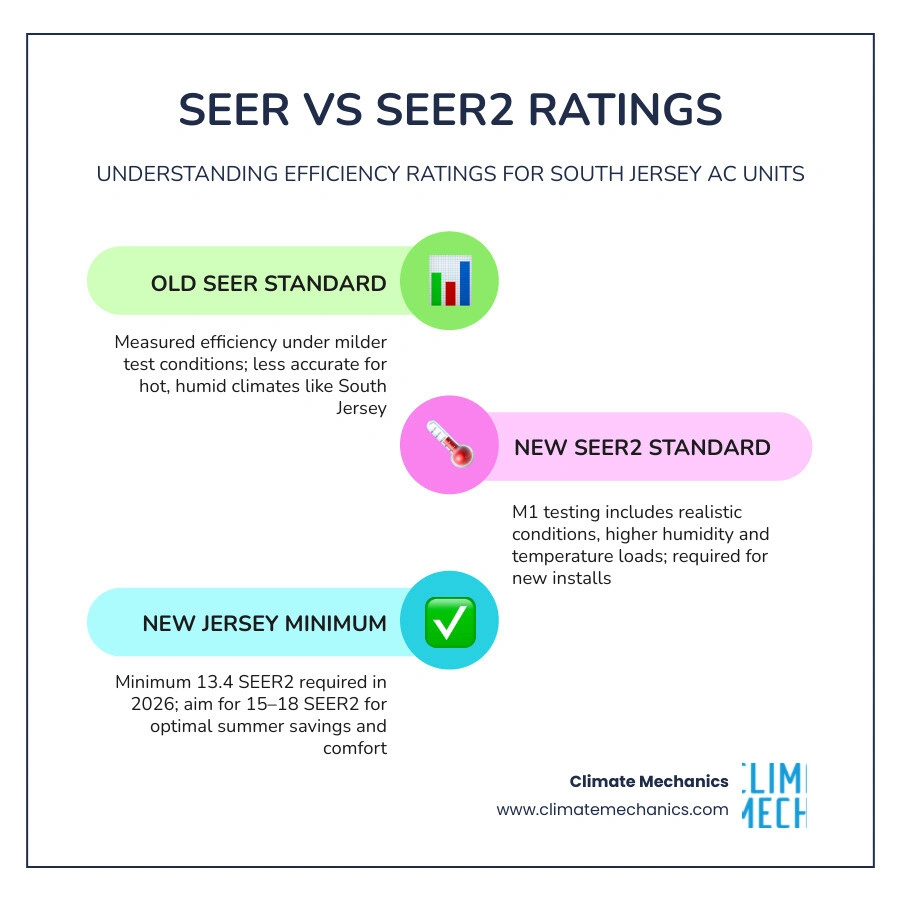
In this guide, we will break down exactly how to evaluate these numbers so you can protect your comfort and your wallet. If you want to dive deeper into practical ways to keep your cooling bills manageable, check out our guide on 4 Ways to Lower Your AC Costs This Summer.
Decoding the Metrics: SEER2, EER2, and HSPF2
When shopping for a cooling system in South Jersey, you will run into a handful of acronyms. Understanding what these metrics mean is the first step in learning how to compare AC unit efficiency ratings before buying in South Jersey.
• SEER2 — What It Stands For: Seasonal Energy Efficiency Ratio 2 — What It Measures: Average cooling efficiency over an entire season under realistic duct pressure. — Why It Matters in South Jersey: Dictates your overall summer energy bills.
• EER2 — What It Stands For: Energy Efficiency Ratio 2 — What It Measures: Cooling efficiency at a constant, high outdoor temperature (95°F). — Why It Matters in South Jersey: Determines how hard your system works on our hottest July afternoons.
• HSPF2 — What It Stands For: Heating Seasonal Performance Factor 2 — What It Measures: Heating efficiency over an entire winter season (for heat pumps). — Why It Matters in South Jersey: Crucial if you use a heat pump for year-round comfort.
The Shift from SEER to SEER2
Historically, the HVAC industry relied on SEER (Seasonal Energy Efficiency Ratio). However, effective January 1, 2023, the Department of Energy mandated a transition to SEER2.
Why the change? The older SEER testing protocol did not accurately account for the static pressure created by a home's ductwork. The new SEER2 standard uses the "M1" testing procedure, which subjects the equipment to five times higher external static pressure. Because this test is much more rigorous, SEER2 ratings are typically about 4.5% lower than older SEER ratings for the same physical equipment.
However, a system rated 14 SEER2 is actually about 4.71% more efficient than a system rated 14 SEER. When comparing models, make sure you are comparing apples to apples: SEER2 to SEER2, not older SEER to newer SEER2.
EER2 and HSPF2
While SEER2 tells you the average efficiency over the whole summer, EER2 measures how efficiently the system operates under a heavy load on a scorching 95°F day. If we get a sustained heatwave in Marlton or Pennsauken, a system with a high EER2 will hold up better without sending your electricity meter into overdrive.
If you are considering a heat pump instead of a traditional air conditioner, you also need to look at HSPF2. This measures heating efficiency during our chilly winters. To learn more about how these systems function year-round, take a look at Your Guide to Heat Pumps.
Why You Need to Know How to Compare AC Unit Efficiency Ratings Before Buying in South Jersey
Knowing how to read these metrics directly impacts three major areas of homeownership:
• Energy Bills: An 18 SEER2 unit is roughly 20% more energy-efficient than a standard 14 SEER2 unit. A top-tier 20 SEER2 unit is about 43% more efficient than a 14 SEER2 baseline. Over a 10-to-15-year lifespan, those percentage points translate to thousands of dollars saved on electricity.
• Humidity Control: High-efficiency systems (typically those with ratings above 16 SEER2) often feature multi-stage or variable-speed compressors. Because they can run at lower, steadier speeds, they excel at pulling moisture out of the air. This is a game-changer for sticky South Jersey summers.
• System Longevity: High-efficiency systems don't have to start and stop constantly to keep your home cool. This reduces wear and tear on vital components, potentially extending the lifespan of your unit.
When your system runs efficiently, you can keep your home perfectly chilled without dreading the mailbox. Discover more about how modern systems Can Cool Home More Efficiently.
A Step-by-Step Guide on How to Compare AC Unit Efficiency Ratings Before Buying in South Jersey
Now that you know the language, let’s look at how to put this knowledge into action when you are ready to shop.
Step 1: Locate and Read the EnergyGuide Label
Every new air conditioner or heat pump is required to display a bright yellow EnergyGuide label. This is your primary source of truth.
• Look for the bold number in the center. This will display the SEER2 (and sometimes EER2) rating.
• Compare this number to the range scale printed below it, which shows how this specific model stacks up against similar units on the market.
Step 2: Verify AHRI Matching
An air conditioning system consists of two main parts: the outdoor condenser and the indoor evaporator coil (often attached to your furnace or air handler). If you connect a brand-new, high-efficiency outdoor unit to an old, dirty, or mismatched indoor coil, you will not get the efficiency printed on the box.
We always recommend checking the Air-Conditioning, Heating, and Refrigeration Institute (AHRI) directory. A certified HVAC professional should provide you with an AHRI Certificate of Product Performance, which proves that the indoor and outdoor components are certified to work together to achieve their rated efficiency.
Step 3: Understand New Jersey's Regional Minimums
The Department of Energy divides the United States into regions with different minimum efficiency requirements. New Jersey is categorized in the Northern region.
• As of 2026, the absolute legal minimum for a new split-system central air conditioner installation in New Jersey is 14.0 SEER (which translates to 13.4 SEER2).
• You cannot legally install a system with a lower rating than this. However, just because 13.4 SEER2 is the minimum doesn't mean it's the right choice for your home.
Key Factors on How to Compare AC Unit Efficiency Ratings Before Buying in South Jersey for Long-Term Savings
To find the perfect balance between your initial budget and long-term savings, consider these structural differences:
Compressor Technology
• Single-Stage Compressors: These units operate like a light switch — they are either 100% on or completely off. They are the most affordable upfront but the least efficient, as they constantly cycle on and off.
• Two-Stage Compressors: These can run on a high setting for hot afternoons and a low setting (around 65-70% capacity) for milder days. They offer a great middle-ground for efficiency and humidity control.
• Variable-Speed Compressors: These operate like a dimmer switch, adjusting their output incrementally between 25% and 100% capacity. They run almost continuously at very low, highly efficient speeds, keeping your indoor climate incredibly stable.
Calculating the Payback Period
A higher SEER2 unit will carry a higher upfront cost than a baseline 13.4 SEER2 model. To determine if the upgrade is worth it, calculate your return on investment (ROI):
1. Estimate your average annual cooling costs.
2. Compare the projected energy savings of the higher-efficiency model (for example, upgrading from 14 SEER to an 18 SEER2 unit can save roughly $3,646 in electricity costs over a 10-year period).
3. If you plan to stay in your South Jersey home for more than five years, investing in a mid-to-high efficiency system (16 to 18 SEER2) almost always pays for itself. If this is a temporary starter home, a standard 14 or 15 SEER2 model might make more financial sense.
If you are looking at heat pumps as a year-round solution, it helps to understand how heating and cooling efficiencies tie together. Read more in our article on Understanding Heat Pumps.
Real-World Efficiency: How South Jersey’s Climate and Your Home Affect Performance
A SEER2 rating is determined in a controlled laboratory environment. In the real world, several local environmental and structural factors will impact whether your system actually achieves that level of efficiency.
The South Jersey Climate Factor
Whether you live inland in Cherry Hill or closer to the water in Pennsauken or Audubon, our climate presents unique challenges:
• High Humidity: When the air is thick with moisture, your AC has to work twice as hard to lower the indoor temperature. If your system cannot handle the latent heat (humidity), you will find yourself lowering the thermostat further, wasting energy.
• Coastal Corrosion: If you live near tidal rivers or coastal areas, salt air and moisture can corrode the aluminum fins on your outdoor condenser coil. Corroded coils cannot transfer heat effectively, which drags down your system's efficiency. Looking for units with specialized anti-corrosion coil coatings is essential in these zones.
Home Structure and Maintenance
An ultra-high 20 SEER2 air conditioner won't save you money if your home's envelope is drafty.
• Ductwork Integrity: The typical home loses up to 20% to 30% of its conditioned air through leaks, cracks, and poorly connected ducts. If your ductwork is leaking in an unconditioned attic or crawl space, your high-efficiency system is simply cooling the great outdoors.
• Insulation Levels: Proper attic insulation (aiming for R-49 or higher in our climate zone) keeps summer heat from radiating down through your ceilings, reducing the workload on your AC.
• Air Filters: A clogged air filter restricts airflow, forcing your blower motor to work harder and consume more electricity. We recommend checking your filters monthly and replacing them at least every three months to maintain peak efficiency.
To see how these climate and structural factors play out when comparing different HVAC setups, read our guide on Heat Pump vs Furnace: A Practical Guide for South Jersey Homeowners.
The Critical Role of Proper Sizing and Professional Installation
Perhaps the most surprising statistic in the HVAC industry is this: nine out of ten air conditioners and heat pumps have an installation or maintenance issue that, when corrected, would improve operating efficiency.
You can buy the most expensive, highest-efficiency system on the market, but if it is installed incorrectly or sized wrong, it will perform poorly.
Why Sizing Must Rely on a Manual J Load Calculation
Many contractors still rely on outdated "rules of thumb" (such as allocating 1 ton of cooling capacity for every 500 square feet). This is a mistake. Two homes of identical size in Haddonfield or Collingswood can have completely different cooling needs based on:
• The number and orientation of windows
• Ceiling heights and layout
• Quality and thickness of insulation
• Air infiltration rates
To get the right size, your contractor must perform a Manual J load calculation. This scientific method determines the exact BTU capacity your home requires.
The Dangers of Improper Sizing
An improperly sized air conditioner will fail to deliver the efficiency printed on its label, leading to two main issues:
• Oversized Systems (Short-Cycling, Poor Humidity Control, Premature Wear & Tear): If a system is too big, it will cool your home too quickly and shut off. This is called "short-cycling." Because it doesn't run long enough, it never has a chance to remove humidity, leaving your home feeling cool but damp and clammy. This constant starting and stopping also causes energy spikes and premature equipment failure.
• Undersized Systems (Runs Continuously, Fails to Cool Home, Extreme Utility Bills): A system that is too small will run continuously on hot days, struggling to reach your target temperature. This leads to high energy bills and excessive wear on the compressor.
New Jersey Rebates, Tax Credits, and Financial Incentives
One of the best ways to offset the higher upfront cost of a high-efficiency AC or heat pump is by taking advantage of federal, state, and utility incentives.
Federal Tax Credits (Inflation Reduction Act)
Under the Energy Efficient Home Improvement Credit (Section 25C), homeowners can claim a federal tax credit for qualifying high-efficiency HVAC equipment.
• Central Air Conditioners: You can claim 30% of the installation cost, up to $600, for systems that meet specific ENERGY STAR requirements.
• Heat Pumps: Because of their exceptional efficiency, qualifying split-system heat pumps can qualify for a tax credit of 30% of the cost, up to $2,000 per year.
State and Utility Rebates
Through the New Jersey Clean Energy Program and local utility providers (such as PSE&G or Atlantic City Electric), South Jersey homeowners can access substantial rebates. These programs frequently offer:
• Cash-back rebates for installing qualifying SEER2/EER2 air conditioners.
• Even larger incentives if you upgrade to an energy-efficient heat pump system.
• On-bill repayment programs or low-interest financing options to make the upgrade highly accessible.
Note: Rebate requirements change frequently, so it is always best to check with your utility provider or a certified HVAC partner before finalizing your purchase.
Frequently Asked Questions About AC Efficiency in South Jersey
How do I find the SEER or SEER2 rating of my current AC unit?
To find your current system's rating:
1. Locate the outdoor condenser unit and look for the manufacturer's data plate (a metal sticker on the side of the unit).
2. Look for the model number. The first few numbers often indicate the nominal tonnage and efficiency.
3. If the rating isn't explicitly listed as "SEER" or "SEER2," write down the brand, model number, and serial number, and look it up online or ask an HVAC professional to check the AHRI database for you.
What is the minimum SEER2 rating required in New Jersey for 2026?
As of 2026, New Jersey (which falls under the Department of Energy's Northern region) requires a minimum of 13.4 SEER2 (equivalent to 14.0 SEER) for all new residential split-system air conditioner installations.
Is a high-SEER2 air conditioner always worth the extra upfront cost?
Not always, but it usually is if you plan to stay in your home for more than 5 years. If you live in an area like Willingboro or Camden and run your AC consistently from late May through September, the monthly energy savings of a 16–18 SEER2 unit will quickly offset the higher initial price tag. However, if you are planning to move within a year or two, a standard-efficiency 13.4 or 14.3 SEER2 unit may be the more practical financial choice.
Conclusion
Choosing a new air conditioner is a major investment that will affect your comfort, monthly expenses, and peace of mind for the next 15 years. Now that you know how to compare AC unit efficiency ratings before buying in South Jersey, you can confidently look past the marketing jargon and select a system that delivers true, long-term value.
At Climate Mechanics, we bring over 38 years of NATE and NCI-certified expertise to every project. We don't believe in one-size-fits-all solutions. Our team provides personalized service to homeowners across Maple Shade, Pennsauken, Audubon, Willingboro, Collingswood, Haddonfield, Burlington, Marlton, and Camden, ensuring your new system is sized perfectly, installed flawlessly, and optimized for maximum real-world efficiency.
Ready to upgrade your home comfort and start slashing your summer utility bills? Schedule your central AC consultation with Climate Mechanics today and let our certified specialists help you find the perfect system for your South Jersey home.
