



Why New Jersey Homeowners Need to Understand Heat Pump Defrost Mode This Winter
How does heat pump defrost mode work during New Jersey winter cold spells? Here's the quick answer:
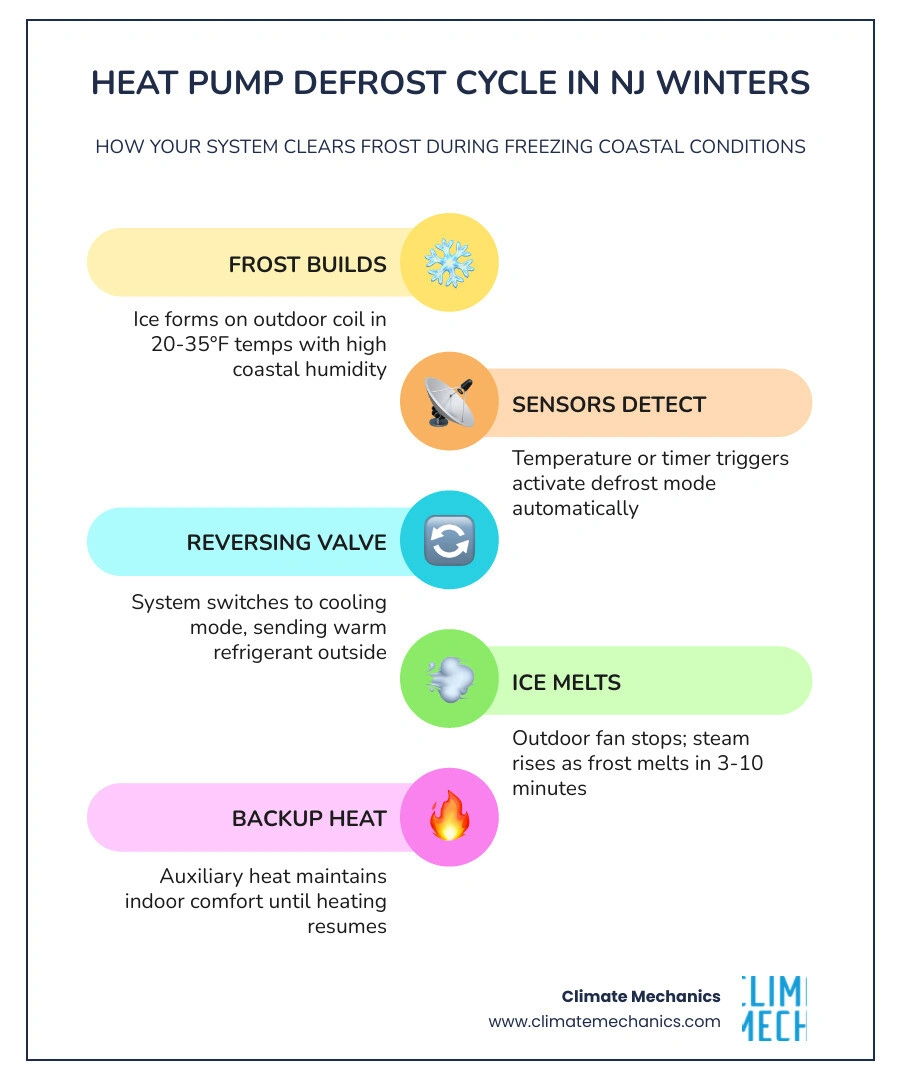
1. Frost builds up on the outdoor coil when temperatures drop and humidity is high — common during NJ winters
2. Sensors detect the ice buildup (or a timer triggers) and signal the system to enter defrost mode
3. The reversing valve switches the heat pump temporarily into cooling mode, sending warm refrigerant to the outdoor coil
4. The outdoor fan shuts off to maximize heat concentration on the coil
5. Ice melts — you may see steam rising from the outdoor unit (this is normal)
6. Backup heat activates to keep your home warm during the 3–10 minute cycle
7. The system returns to normal heating mode automatically
That cold, damp New Jersey morning — temperatures in the low 30s, fog rolling in off the coast — is exactly when your heat pump works hardest. And it's exactly when you might notice something strange: steam rising from the outdoor unit, a brief pause in warm air, or "AUX" appearing on your thermostat. For many South Jersey homeowners, this looks alarming. It isn't. It's your heat pump doing its job.
New Jersey winters sit in what engineers call the "frost danger zone" — temperatures between 20°F and 35°F combined with coastal humidity. That combination causes ice to form on the outdoor coil faster than in drier climates, meaning your system may enter defrost mode every 30 to 90 minutes during a cold spell. Understanding why this happens — and knowing when it signals a real problem — can save you from unnecessary worry and unnecessary service calls.
How Does Heat Pump Defrost Mode Work During New Jersey Winter Cold Spells?
To understand how your heat pump defrosts, we first have to look at how it heats your home in places like Cherry Hill, Marlton, or Willingboro during a freezing January snap.
Unlike a traditional furnace that burns natural gas or heating oil to create heat, a heat pump is an energy-efficient marvel that moves heat from one place to another. Even when it feels freezing outside, there is still thermal energy in the outdoor air. Your heat pump extracts this heat using a specialized refrigerant and brings it indoors. For a deeper look at this process, check out our guide on Understanding Heat Pumps.
However, to pull heat out of the cold New Jersey air, the refrigerant circulating through the outdoor coil must be significantly colder than the air itself—usually about 10°F to 20°F colder.
Imagine it is a damp, 34°F morning in Pennsauken. Because your heat pump's outdoor coil is running at a frosty 14°F to 24°F, any moisture in the air will instantly condense onto the metal fins of the coil and freeze.
As a thin layer of frost forms, it acts as an insulator. This is bad news for your system's efficiency. The ice blocks the airflow and prevents the refrigerant from absorbing ambient heat. If left unchecked, your heat pump would eventually become encased in a solid block of ice, causing Common Heat Pump Performance Issues and eventually shutting down entirely.
That is where the defrost mode comes in. It is essentially your heat pump’s built-in self-care cycle. By temporarily reversing its operation, the system warms up its own outdoor components, melts the accumulated ice, and restores the airflow needed to keep your home warm and cozy.

Step-by-Step: The Defrost Cycle Process
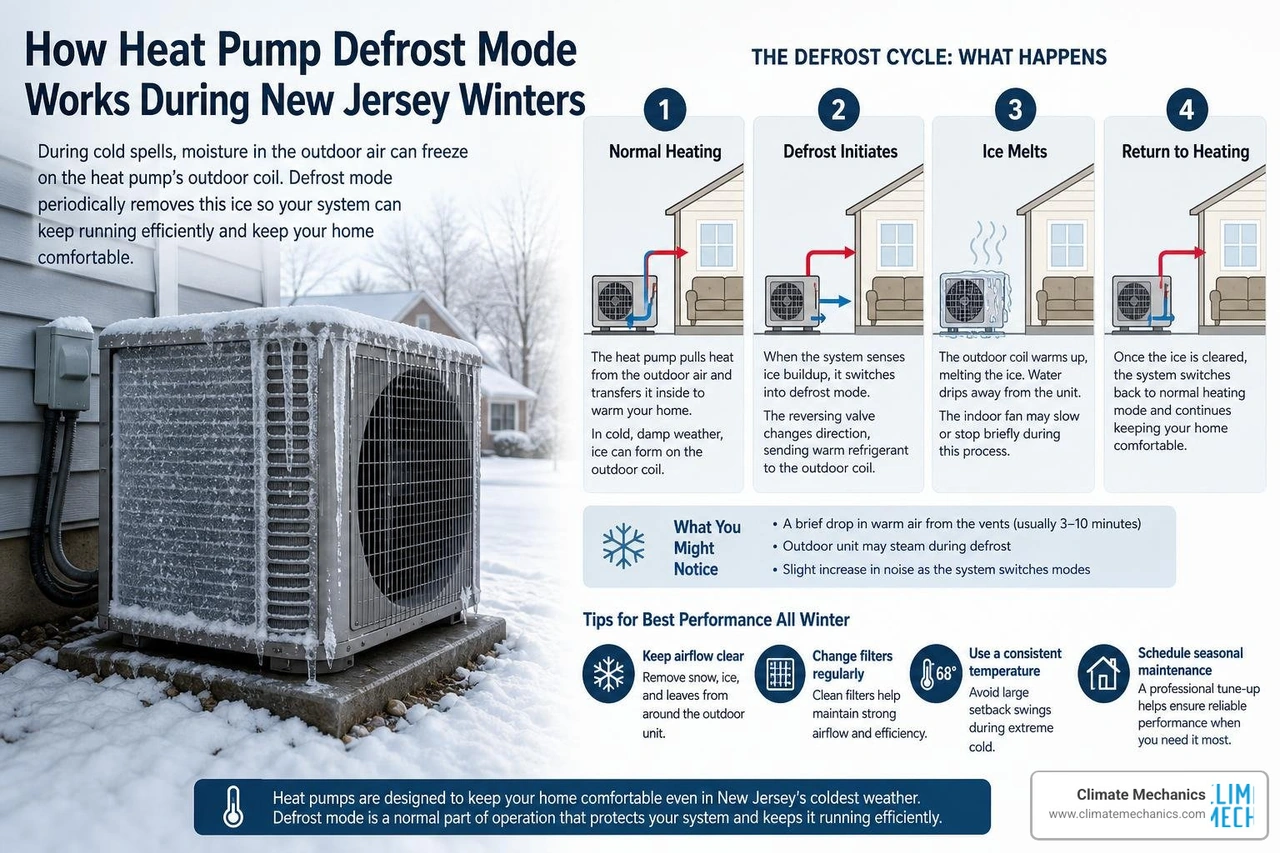
When your heat pump decides it is time to clear the ice, it initiates a highly coordinated sequence of events. Here is exactly what happens step-by-step:
1. The Trigger: The system’s control board determines that ice has formed on the outdoor coil. This detection happens either through a pre-set timer or advanced temperature and humidity sensors.
2. The Reversal: The heat pump's reversing valve receives an electrical signal and physically shifts. This reverses the flow of refrigerant. The indoor coil, which was acting as the condenser (releasing heat), now becomes the evaporator (absorbing heat). The outdoor coil becomes the condenser, heating up rapidly.
3. The Fan Shutdown: The outdoor unit’s fan stops spinning. By turning off the fan, the system prevents cold winter air from blowing across the outdoor coil, allowing the heat from the refrigerant to concentrate entirely on melting the ice.
4. The Compressor Power-Up: The compressor continues to run, pumping hot, pressurized refrigerant directly through the outdoor coil.
5. The Melt and Vaporization: As the outdoor coil temperature climbs above freezing (often reaching up to 57°F by the end of the cycle), the ice quickly melts and drains away. The heat causes some of the meltwater to turn into water vapor, creating a visible cloud of steam.
6. The Backup Heat Engagement: Because the system is temporarily running in "cooling mode" to heat the outdoor unit, it would normally blow cold air into your home. To prevent this, your indoor air handler automatically engages its auxiliary (AUX) electric heat strips or switches to a dual-fuel gas furnace.
7. The Return to Normal: Once sensors detect that the outdoor coil has warmed up sufficiently, or a safety timer limit is reached, the reversing valve shifts back with a soft "whoosh" sound. The outdoor fan restarts, the auxiliary heat turns off, and your system goes right back to heating your home.
If your system struggles to complete this transition smoothly, you may be dealing with a system that is Heat Pump Not Switching Modes Properly, which requires professional diagnostics to prevent high energy bills.
How Does Heat Pump Defrost Mode Work During New Jersey Winter Cold Spells for Demand vs. Timed Systems?
Not all heat pumps defrost the same way. The frequency and efficiency of this cycle depend heavily on whether your system uses timed defrost or demand defrost technology.
• Timed Defrost Systems: Older or more basic heat pumps rely on simple mechanical timers. These systems check for frost at fixed intervals—typically every 30, 60, or 90 minutes of compressor run time. If the outdoor coil temperature is below freezing when the timer goes off, the system initiates a defrost cycle, regardless of whether there is actually ice on the coil. This can lead to unnecessary defrost cycles on dry, cold days, wasting energy and reducing overall system efficiency.
• Demand Defrost Systems: Modern, high-efficiency heat pumps use intelligent defrosting algorithms and solid-state sensors. These systems monitor outdoor ambient temperature, coil temperature, and sometimes even airflow or optical frost sensors. A demand defrost system only initiates a cycle when it detects a true physical restriction on the coil.
By only running when absolutely necessary, demand defrost technology can significantly reduce the number of cycles, shorten the duration of each cycle to just 3 to 5 minutes, and dramatically improve your Home Comfort with Efficient Heat Pump operation.
What Homeowners Experience During Defrost Mode
If you are new to owning a heat pump in South Jersey, your first winter can bring a few surprises. During a defrost cycle, you might observe several sensory changes that seem like a system failure but are actually signs of perfect operation.
Here is what you should expect to see, hear, and feel:
• The Steam Cloud: As the ice on your outdoor unit melts against the warm coil, a thick cloud of white steam will often rise from the unit. Many homeowners mistake this for smoke and worry that their system is on fire. Don't panic! It is simply harmless water vapor. It should have no smell and will dissipate quickly.
• Strange Noises: When the reversing valve shifts, you will often hear a distinct "swooshing" or hissing sound as the refrigerant changes direction. You may also notice the outdoor fan motor stop completely while the compressor continues to hum, sometimes changing pitch.
• Thermostat Indicators: You may see "AUX," "AUX HT," or "Defrost" light up on your thermostat screen. This tells you that the system is currently managing the defrost cycle and utilizing your backup heating source to keep the indoor air warm.
• Minor Air Temperature Shifts: If your system uses electric backup heat strips, you might feel a very brief, slight dip in air temperature from your vents just as the cycle begins and ends. This is normal and usually amounts to no more than a 0.5°F to 1°F temporary change. For a deeper comparison of how these systems feel compared to traditional gas heat, read our Heat Pump vs Furnace A Practical Guide for South Jersey Homeowners.
How Does Heat Pump Defrost Mode Work During New Jersey Winter Cold Spells When Backup Heat Activates?
Because the heat pump is technically running in reverse (cooling mode) during defrost, the indoor coil becomes cold. Without a backup heat source, your system would blow chilly air into your living room for up to 10 minutes.
To prevent this, modern systems integrate auxiliary heat. For standard all-electric systems, this means electric resistance heat strips inside your indoor air handler turn on automatically. If you have a dual-fuel (or hybrid) system, your heat pump will temporarily shut off its compressor and fire up your natural gas or propane furnace.
Approximately 99% of homeowners with properly configured backup electric heat strips will not notice any change in indoor comfort during a defrost cycle. The transition is seamless, ensuring your family stays warm in Audubon or Collingswood even when the outdoor unit is busy melting a sheet of ice. To learn more about how backup systems integrate with your primary unit, explore A Comprehensive Guide to Heat Pumps.
Troubleshooting: When Defrost Mode Fails
While a frosted coil is normal, a heavily iced-over heat pump is not. If your defrost system fails, ice will continue to accumulate until it completely wraps the unit in a thick, solid block. This starves the system of air, spikes your utility bills, and can permanently damage the compressor.
Several issues can cause defrost mode to fail:
• Faulty Defrost Sensors or Thermostats: If the sensor on the outdoor coil fails or goes out of calibration, it won't detect when the coil drops below freezing, preventing the cycle from ever starting.
• Bad Defrost Control Board: The control board is the brain of the operation. If a relay or circuit on the board burns out, it cannot send the signal to reverse the refrigerant flow or shut off the fan.
• Reversing Valve Failure: If the physical valve becomes stuck, the system cannot switch into defrost mode (or might get stuck in defrost mode permanently).
• Low Refrigerant Charge: If your system has a leak, low refrigerant levels mean the coil cannot get warm enough during the defrost cycle to melt the ice before the safety timer cuts off.
To help you distinguish between normal winter operation and a system malfunction, refer to this handy comparison table:
• A thin, light layer of frost evenly distributed across the coil fins. — What is Abnormal (Call for Service)?: A thick, solid block of ice encasing the entire unit, or ice packed inside the top fan grille.
• A defrost cycle that lasts between 3 and 10 minutes. — What is Abnormal (Call for Service)?: A system that stays in defrost mode for more than 15 to 20 minutes, or cycles back-to-back constantly.
• Harmless, odorless white steam rising from the outdoor unit. — What is Abnormal (Call for Service)?: Thick, dark smoke accompanied by a burning electrical smell or chemical odor.
• A brief "swoosh" sound when the cycle starts and stops. — What is Abnormal (Call for Service)?: Loud, metal-on-metal grinding, clanking, or severe vibrating noises.
• Warm air continuing to blow indoors thanks to AUX heat. — What is Abnormal (Call for Service)?: Cold air blowing from your vents for extended periods while the outdoor unit is frozen.
If you notice any of the abnormal signs listed above, it is time to check out Heat Pump Warning Signs to Watch and schedule professional help. Ignoring these symptoms can lead to severe compressor damage. If your system is already showing these signs, read about the Signs Your Heat Pump Needs Repair to understand your next steps.
Frequently Asked Questions about Heat Pump Defrosting
How long does a typical defrost cycle last?
Under normal conditions with a modern heat pump, a defrost cycle will last between 3 to 10 minutes. High-efficiency systems utilizing demand defrost technology often finish the job in just 3 to 5 minutes because they only activate when a small, manageable amount of frost is detected. If your system takes longer than 15 minutes to clear the coil, or if it runs continuously without returning to normal heating, it indicates a control or refrigerant issue.
How often should my heat pump defrost in freezing weather?
In cold, humid conditions typical of New Jersey winters, a heat pump may enter defrost mode every 30 to 90 minutes during wet, below-freezing weather (such as during freezing rain, heavy fog, or wet snow). When the air is very cold but extremely dry (below 15°F), there is less moisture in the air to freeze, so you might only see your system defrost every few hours or a couple of times a day.
Should I manually clear ice off my outdoor unit?
No, you should never try to chip or pry ice off your heat pump's coils manually. The copper tubing and aluminum fins are incredibly delicate; hitting them with a shovel, screwdriver, or ice pick can easily puncture the coil, leading to costly repairs.
Additionally, never pour boiling water directly onto a frozen unit, as the extreme temperature shock can crack components. If you need to help your system, clear away loose snow accumulation from around the base and sides of the unit to ensure proper airflow, and make sure the top is clear of falling icicles from your gutters. For more safe troubleshooting tips, visit our guide on Reliable Heat Pump Repair Troubleshooting.
Conclusion
Your heat pump’s defrost mode is a vital, normal part of keeping your home warm during South Jersey's cold snaps. While the steam clouds and swooshing sounds can be surprising at first, they are simply signs of a smart system maintaining its own efficiency.
However, when winter weather gets extreme in Maple Shade, Willingboro, Haddonfield, or Marlton, your heat pump needs to be in peak condition to handle the load. The best way to prevent defrost failures and ensure uninterrupted comfort is through regular, professional preventative maintenance.
At Climate Mechanics, we bring over 38 years of NATE and NCI-certified expertise to every home we serve in South Jersey. Whether you are looking to upgrade to a modern, cold-climate demand defrost system or need a winter tune-up to keep your existing unit running flawlessly, our team is here to help.
Ready to upgrade your winter comfort? Check out our guide on Heat Pump Installation Home Comfort Upgrade, or take action today and Schedule your professional heat pump service with Climate Mechanics.
