



Why Is My AC Blowing Warm Air on a Hot, Humid New Jersey Day?
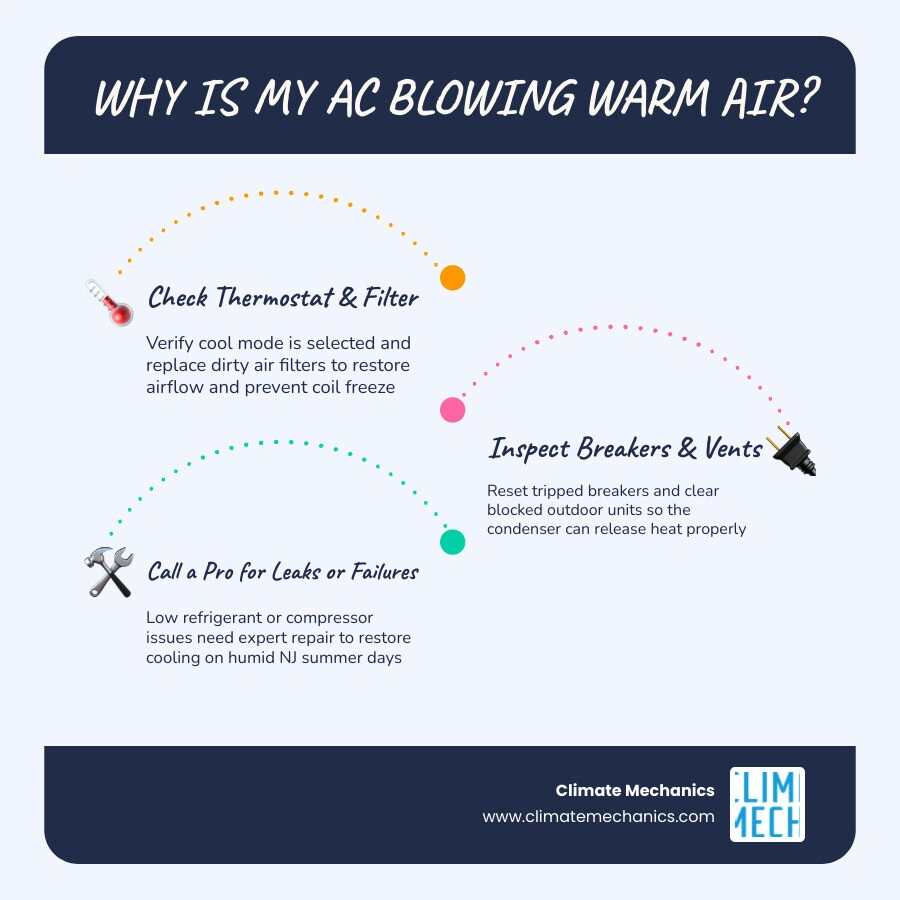
If you're dealing with why is my AC blowing warm air on a hot humid New Jersey day, here are the most common reasons it happens:
1. Thermostat set to heat or fan set to "On" — the quickest fix to check first
2. Dirty or clogged air filter — restricts airflow and can cause the evaporator coil to freeze
3. Tripped circuit breaker — cuts power to the outdoor unit while the indoor fan keeps running
4. Low refrigerant due to a leak — prevents the system from absorbing heat effectively
5. Frozen evaporator coil — blocks cool air and causes the system to push out warm air instead
6. Dirty condenser coils or blocked outdoor unit — traps heat and reduces cooling capacity
7. Compressor or electrical failure — stops the cooling cycle entirely
New Jersey summers are genuinely tough on air conditioning systems. Relative humidity in July and August regularly exceeds 70%, which means your AC isn't just fighting heat — it's also working overtime to pull moisture out of the air before it can cool your home down. That double load puts real stress on every part of the system, and even a small issue that might go unnoticed in a drier climate can leave you sweating through a South Jersey afternoon.
The good news is that roughly 40% of warm air service calls come down to something simple: a wrong thermostat setting, a tripped breaker, or a filter that's overdue for a change. The rest require a closer look — but knowing where to start saves time and frustration.
This guide walks you through exactly what to check, what it means, and when it's time to call in a professional.
Why Is My AC Blowing Warm Air on a Hot Humid New Jersey Day?
When summer weather hits South Jersey towns like Marlton, Pennsauken, and Maple Shade, outdoor temperatures can easily climb into the 90s while relative humidity levels soar. This combination puts immense physical strain on your central air system.
An air conditioner does not actually "create" cold air; instead, it acts as a heat and moisture sponge. It absorbs the heat and humidity from inside your home and transfers it outdoors. When your system is faced with an exceptionally hot and muggy day, every component must operate in perfect harmony to keep up with this heat transfer process.
If a single component fails or is restricted, the entire cooling cycle breaks down. The result is a system that blows lukewarm or outright hot air through your supply registers, turning your home into a virtual sauna. To get to the bottom of this issue, we must look at both the simple issues you can check yourself and the deeper mechanical problems that require professional diagnostic tools.
Immediate Troubleshooting: Why Is My AC Blowing Warm Air on a Hot Humid New Jersey Day?
Before you assume your system has suffered a total mechanical failure, there are several immediate checks you can perform. Taking ten minutes to run through this quick DIY checklist can save you from an unnecessary service call:
• Check the Thermostat Mode: It sounds incredibly simple, but seasonal weather swings in New Jersey can lead to accidental settings. Ensure your thermostat is set firmly to COOL, and that the target temperature is set lower than the current room temperature.
• Inspect the Fan Setting (ON vs. AUTO): If your thermostat fan is set to ON, the indoor blower motor will run continuously, even when the outdoor compressor is resting. On a humid day, running the fan on "ON" can actually blow moisture that was just removed from your indoor air right back into your home, resulting in a humid, warm breeze. Always switch the fan setting to AUTO so the blower only runs when the system is actively cooling.
• Examine the Air Filter: A dirty air filter can reduce your system's overall efficiency by 5% to 15%. More importantly, on a humid day, restricted airflow prevents the warm indoor air from passing over the cold evaporator coils fast enough. This causes the moisture on the coils to freeze, blocking the airflow entirely and leaving you with warm air coming out of your vents. For a deeper look at this issue, read our guide on Why Is My AC Blowing Warm Air.
• Locate Tripped Circuit Breakers: Your central AC system runs on two separate high-voltage circuits: one for the indoor air handler and one for the outdoor condenser unit. If a summer thunderstorm or a sudden power surge trips the breaker for the outdoor unit, your indoor blower will continue to run, pushing uncooled, humid room-temperature air through your vents. Check your home’s main electrical panel and reset any tripped breakers once. If it trips again, do not force it; call a professional.
For more proactive steps you can take to keep your system in top shape during the peak of summer, check out our AC Maintenance Tips for Summer.
Professional Solutions: Why Is My AC Blowing Warm Air on a Hot Humid New Jersey Day?
If your thermostat settings are correct, your breakers are on, and you have a fresh air filter, the problem likely lies deeper within the system's mechanical or sealed refrigeration loop. These issues require specialized tools, EPA certifications, and advanced electrical diagnostics to resolve safely.
• Low Refrigerant and Refrigerant Leaks: Refrigerant is the lifeblood of your AC. It evaporates inside the indoor coil to absorb heat and condenses outside to release it. If your system has a slow leak, the drop in pressure prevents the refrigerant from absorbing heat efficiently. You might notice a faint hissing or bubbling sound near your indoor unit, or you may see ice forming on the copper lines running outside.
• Compressor Failure: The compressor is the heart of your outdoor unit. It pumps the refrigerant through the system under high pressure. If the compressor fails to start due to a faulty capacitor, a bad contactor, or internal mechanical wear, the refrigerant cannot circulate, and no heat transfer will take place.
• Dirty Condenser Coils: The outdoor unit is constantly exposed to the elements. In South Jersey suburbs like Audubon and Collingswood, cottonwood fuzz, grass clippings, pollen, and dirt can quickly coat the delicate aluminum fins of your outdoor condenser. This layer of grime acts like an insulating blanket, preventing the outdoor coil from releasing heat. The system will quickly overheat, forcing the compressor to shut down to protect itself while the indoor fan keeps running.
• Electrical Failures: Summer heat waves cause electrical components to run hotter and pull more current. Capacitors (which act like temporary batteries to jump-start your fan motors and compressor) are highly sensitive to heat and are the most common electrical failure point during a heatwave.
If you suspect any of these technical issues are plaguing your home, you can read more about the Signs You Need Expert AC Repair to understand what our NATE-certified technicians look for. You can also explore other Common Problems with AC Units to help identify your specific symptoms.
The Impact of High New Jersey Humidity on AC Performance
New Jersey’s average relative humidity often exceeds 70% during July and August. To understand why this makes your air conditioner struggle so much, we have to look at the physics of cooling, specifically the difference between sensible heat and latent heat.
• Sensible Heat: This is the actual temperature of the air that you can read on a standard thermometer. When an AC lowers the air temperature, it is removing sensible heat.
• Latent Heat: This is the hidden heat stored in water vapor. When your air conditioner removes moisture from the air, it is dealing with latent heat.
On a dry, hot day, your AC can dedicate nearly 100% of its cooling capacity to lowering the actual air temperature (sensible cooling). However, on a muggy South Jersey day, your system must first condense and remove gallons of water from the air (latent cooling) before you will feel any noticeable drop in temperature. If your system is already struggling with a minor mechanical issue, this massive latent heat load will quickly overwhelm it, leading to a system that is AC Running Constantly in New Jersey Summer Heat without making a dent in your comfort.
The 20-Degree Rule and Delta T
Many homeowners wonder why their system can't seem to cool their home below 78 degrees when it is 98 degrees outside. This is due to the 20-Degree Rule. Standard residential air conditioning systems are designed to create a maximum temperature drop (known in the industry as Delta T) of 16 to 22 degrees between the air entering your return vents and the air exiting your supply registers.
When outdoor temperatures soar well past design limits, your AC will run continuously just to maintain a safe, reasonable indoor temperature. If your system is running all day but the air coming out is barely cool, you can read more about Why Does My AC Run All Day Without Stopping in a South Jersey Summer to determine if your unit is simply at its physical limit or if a true component failure has occurred.
• Sensible Heat — What It Measures: Dry bulb temperature (what you read on a thermostat) — How the AC Removes It: Passing warm indoor air over cold evaporator coils to lower its temperature — Impact on Comfort: Lowers the physical temperature of your home
• Latent Heat — What It Measures: Moisture and humidity levels in the indoor air — How the AC Removes It: Condensing water vapor into liquid water on the cold coil and draining it away — Impact on Comfort: Lowers the "real feel" index and eliminates that sticky, clammy feeling
Common Mechanical and Electrical Causes of Warm Air
When we look beyond basic troubleshooting, several distinct mechanical failures can cause your system to blow warm air. Understanding these issues can help you describe the problem more accurately when you speak with a technician.
Frozen Evaporator Coils
Your indoor evaporator coil typically sits inside your furnace or air handler cabinet. When airflow is restricted (due to a clogged filter, closed registers, or undersized ductwork) or when refrigerant levels are low, the temperature of this coil will drop below 32°F.
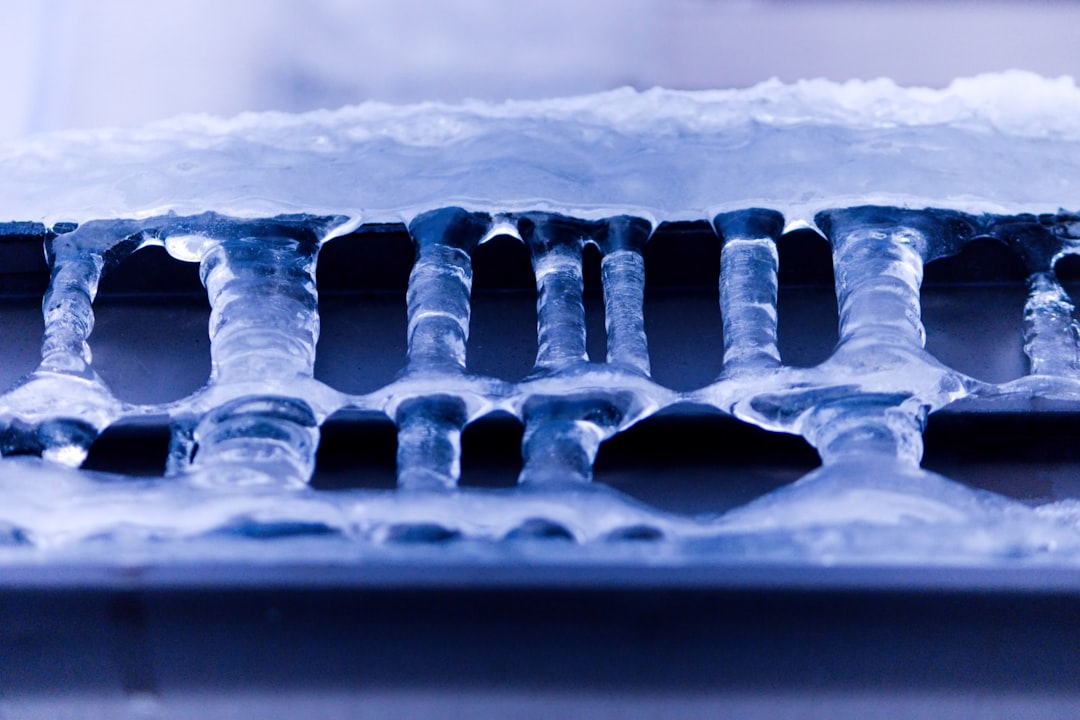
The moisture that condensates out of your humid indoor air will instantly freeze on the coil surface. As the ice builds up, it acts as a massive thermal barrier, blocking all airflow. The system will struggle to pull heat from your home, and the warm air generated by the indoor blower motor itself will be pushed back through your home. If you suspect your system is icing over, you can read our detailed guide on AC Freezing Up - What to Know to learn how to thaw it safely.
Dirty Outdoor Condenser Unit
Your outdoor condenser coil needs to "breathe" to release the heat it gathered from inside your home. If the coil is clogged with dirt, pollen, or yard debris, the heat remains trapped inside the refrigerant loop.
This causes system pressures and temperatures to spike. To prevent permanent damage to the compressor motor, an internal safety switch (called an overload protector) will trip, shutting down the compressor. Since the indoor blower is on a separate circuit, it will continue to circulate uncooled air throughout your home.
The Refrigerant Transition and Environmental Standards
As we navigate through June 2026, the HVAC industry is undergoing major environmental transitions that directly affect older air conditioning systems in South Jersey.
• The R-22 Phase-Out: If your air conditioner was installed before 2010, it likely uses R-22 refrigerant (commonly known as Freon). Production and import of R-22 have been completely banned. Because of this, R-22 prices have tripled in recent years, making leak repairs on these older systems incredibly expensive. If your older system has a leak, it is often far more practical to upgrade to a modern system.
• The R-410A Phase-Out and SEER2 Standards: As of January 1, 2026, the EPA has banned the manufacture and import of R-410A refrigerant in new equipment, transitioning the industry toward more environmentally friendly A2L refrigerants (such as R-454B). Additionally, all new systems in New Jersey must meet strict minimum SEER2 efficiency ratings.
Upgrading from an older 10–12 SEER system to a modern 15–20+ SEER unit can save South Jersey homeowners $300 to $600+ in annual cooling costs, while dramatically improving humidity control. If your system is leaking refrigerant, you can read our resources on Refrigerant Leaks - Major Concern and Why Refrigerant Leak So Serious to help you weigh your repair vs. replacement options.
When these mechanical or electrical issues occur, they can also cause your system to start short-cycling. If your unit is rapidly starting and stopping, read our article on AC Keeps Turning On and Off in New Jersey Summer Heat - What Is Wrong to get to the root of the problem.
Frequently Asked Questions About AC Troubleshooting
Why is my AC blowing air but the house isn’t getting any cooler?
This is almost always a sign that your indoor blower fan is working perfectly, but your outdoor condenser unit is not running. Walk outside and check your outdoor unit. Is the fan spinning? Do you hear the low hum of the compressor?
If the outdoor unit is completely silent while the indoor vents are blowing warm air, you likely have a tripped outdoor circuit breaker, a blown disconnect fuse, or a failed capacitor. Without the outdoor unit running, no heat is being removed from your home, and the system is simply acting as a giant, inefficient fan.
Can a dirty air filter cause my AC to blow warm air?
Yes, absolutely. A heavily clogged air filter severely restricts the volume of air passing through your system. When there isn't enough warm air flowing over the cold evaporator coil, the refrigerant inside the coil cannot absorb enough heat to stay above freezing.
The condensation on the coil will rapidly turn to ice, completely blocking the airflow. Once the coil is frozen solid, the air coming out of your vents will drop to a weak, lukewarm trickle. Replacing your filter every 30 days during the peak summer months is one of the easiest ways to prevent this entire failure cycle.
What should I do immediately if my AC freezes up?
If you notice ice on your indoor evaporator coil or on the copper refrigerant lines outside, follow these emergency steps immediately:
1. Turn the AC OFF at the thermostat. This stops the cooling cycle and prevents the compressor from trying to pump refrigerant through a frozen system, which can cause permanent mechanical damage.
2. Switch the fan setting to ON. This keeps the indoor blower running without running the outdoor unit. The warm air from your home will blow over the frozen coil, safely melting the ice over the course of several hours.
3. Check your air filter. If it is dirty, replace it immediately.
4. Do not turn the cooling back on until the ice has completely melted. Once the system is dry, you can try running it again with a clean filter. If ice begins to form a second time, you have a refrigerant leak or an internal airflow restriction and need to call a professional technician.
Conclusion
A hot, humid New Jersey day is the absolute worst time for your air conditioning to start blowing warm air. Whether you're dealing with a simple thermostat setting, a clogged air filter, a frozen coil, or a complex refrigerant leak, getting your home back to a cool, comfortable state is your top priority.
At Climate Mechanics, we bring over 38 years of NATE and NCI-certified expertise to every home we serve. As a local, family-owned business, we provide personalized, highly reliable service to our neighbors throughout South Jersey, including Maple Shade, Marlton, Pennsauken, Audubon, Willingboro, Collingswood, Haddonfield, Burlington, and Camden, NJ. We understand the unique challenges that Jersey humidity presents to your cooling system, and we have the specialized diagnostic tools to get your system running efficiently again.
Don't spend another hot, sticky night tossing and turning. Schedule professional air conditioning services with Climate Mechanics today, and let our experienced team restore comfort and peace of mind to your home.
