


Why Poor Attic Insulation Makes Your AC Run Constantly in New Jersey
How poor attic insulation makes ac run constantly in a new jersey home is one of the most common — and most overlooked — causes of sky-high summer energy bills across South Jersey. If your AC never seems to shut off, even when it's running perfectly, your attic may be the real problem.
Here's the short answer:
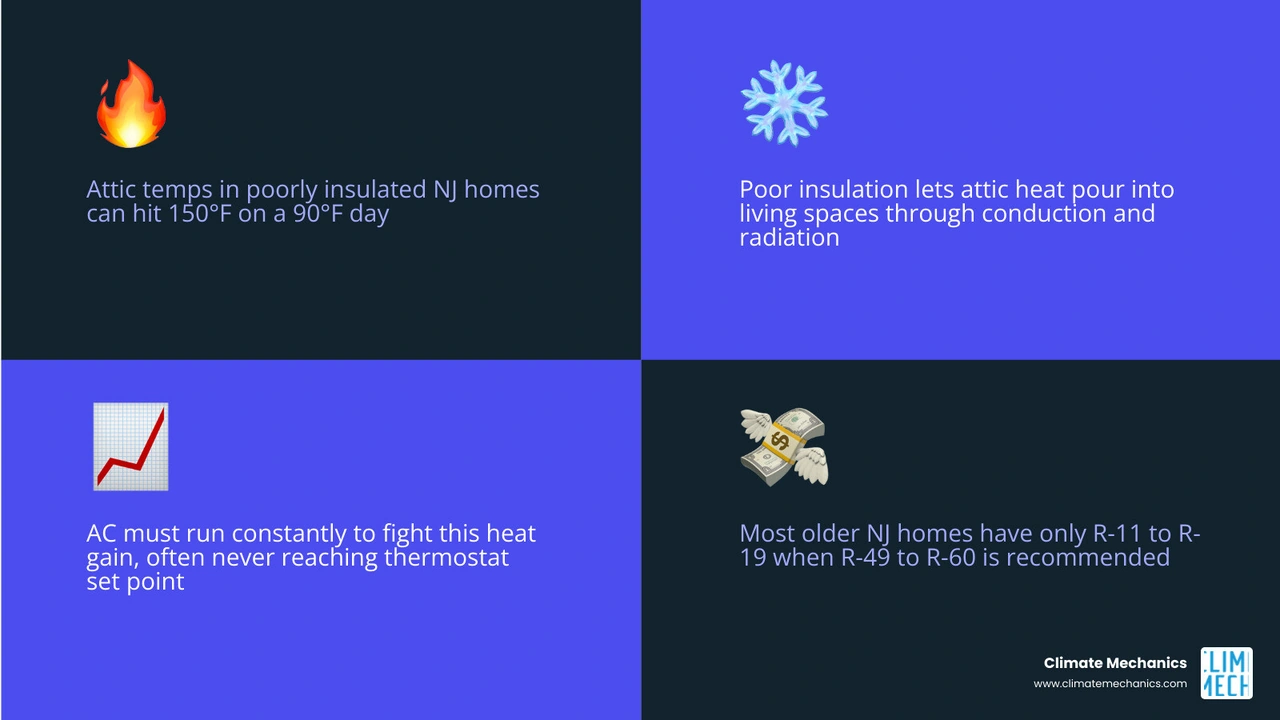
• Poor attic insulation allows heat to pour into your living space from above
• Attic temperatures in under-insulated homes can hit 150°F or more on a 90°F summer day
• Your AC has to run continuously just to fight that heat gain — and often still can't keep up
• Most older NJ homes have R-11 to R-19 attic insulation, when R-49 to R-60 is the current standard
• The result is constant AC operation, uneven room temperatures, and worn-out equipment
Many South Jersey homeowners assume their AC unit is broken when the house won't cool down. But when a technician checks the system and finds nothing wrong, the attic is almost always the next place to look. A poorly insulated attic doesn't just make your home uncomfortable — it quietly drives up your energy bills every single summer while shortening the life of your cooling equipment.
Basic how poor attic insulation makes ac run constantly in a new jersey home terms:
• ac never reaches set temperature during a south jersey heat wave what is wrong
• ac running constantly in new jersey summer heat
• why does my ac run all day without stopping in a south jersey summer
The Science of Heat Transfer: How Poor Attic Insulation Makes AC Run Constantly in a New Jersey Home
To understand why your air conditioner is working overtime, we have to look at the basic physics of heat transfer. Heat is naturally stubborn. It always moves from a warmer area to a cooler area until the temperatures equalize. Inside your home, this happens through three primary mechanisms:
• Conduction: Direct heat transfer through solid materials, such as your roof deck, rafters, and the drywall of your ceiling.
• Convection: Heat transfer through air movement. Hot air rises, and cool air sinks.
• Radiation: Electromagnetic heat waves from the sun hitting your roof shingles and radiating down into the attic space.
During a typical South Jersey summer, radiant heat from the sun bakes your roof. If your attic lacks proper protection, this space transforms into a giant radiator. Temperatures up there can easily climb to 150°F or more on a humid 90°F day in Marlton or Pennsauken.
Without a thick thermal barrier (insulation) to slow this conductive heat flow, that massive thermal load transfers directly through your ceiling drywall into your second-floor bedrooms. Your air conditioner is forced to engage in a continuous battle, running non-stop just to neutralize the heat radiating from above. This is a primary driver behind an AC Running Constantly in New Jersey Summer Heat.
Understanding the Stack Effect and Heat Gain
While most homeowners associate the "stack effect" with winter heating, a reverse version of this phenomenon happens during the hot summer months. The stack effect is driven by differences in indoor and outdoor air temperatures and atmospheric pressure.
In the summer, your air conditioner creates a pocket of cool, dense air at the lower levels of your home. Meanwhile, superheated air sits trapped in your uninsulated attic. If your home's thermal envelope is compromised by air leaks and thin insulation, the high pressure of the hot attic air forces its way down through recessed lights, wire penetrations, and the attic hatch.
As this superheated air infiltrates your living spaces, it displaces the cool air, pushing it lower and eventually out of minor leaks in your home's lower levels. This continuous cycle of hot air infiltration forces your HVAC system to run non-stop to maintain a stable thermostat setting.
Why New Jersey's Humid Climate Amplifies Attic Heat
Our local climate in South Jersey presents a unique double-whammy for air conditioning systems. We experience rapid seasonal transitions, shifting from a wet, rainy spring directly into oppressive, humid summer heat waves.
This high outdoor humidity adds "latent heat" to your home. Your AC doesn't just have to lower the air temperature (sensible cooling); it also has to work incredibly hard to wring moisture out of the air (latent cooling). When poor attic insulation allows both extreme heat and humid outdoor air to seep into your home, your AC is hit from both sides. The system runs continuously because it is struggling to manage both the soaring temperature and the heavy moisture load.
Key Signs Your Attic Insulation is Failing Your AC
How do you know if your attic is the culprit behind your cooling woes? While a constantly running AC is a major clue, there are several other warning signs that point directly to inadequate insulation.
• The Hot Second-Floor Syndrome: If your downstairs feels comfortable but your upstairs bedrooms feel like a sauna, your attic insulation is likely failing to block the heat radiating from the roof.
• Uneven Cooling and Drafts: Walking from room to room shouldn't feel like crossing different climate zones. Hot spots and drafty areas are classic signs of thin insulation and air leaks.
• Shocking Summer Utility Bills: If your energy bills are skyrocketing but your daily comfort habits haven't changed, your system is consuming excessive power to fight attic heat gain.
• Excessive AC Cycling or Continuous Running: When the outdoor temperature rises, a system fighting poor insulation won't cycle off. It will run all day long without ever reaching your thermostat's target temperature.
If you are noticing these symptoms, you are likely asking yourself Why Does My AC Run All Day Without Stopping in a South Jersey Summer.
How Poor Attic Insulation Makes AC Run Constantly in a New Jersey Home During Peak Summer
During peak summer stretches in towns like Willingboro and Haddonfield, outdoor temperatures regularly climb into the 90s. In an under-insulated home, this is when the cooling system begins to fail entirely.
When your attic is acting like a furnace right above your head, your AC must run continuously. Because the ceiling heat gain is constant, the thermostat never senses that the target temperature has been reached. This continuous operation places immense wear and tear on your compressor, fan motors, and electrical components, significantly shortening the overall lifespan of your expensive HVAC system.
Distinguishing Between AC Mechanical Issues and Insulation Problems
Before assuming you need a brand-new AC, it is vital to distinguish between a mechanical failure and an insulation deficit.
• Airflow Quality — Likely an AC Mechanical Issue: Very weak airflow coming from all supply registers. — Likely an Attic Insulation/Envelope Issue: Strong airflow, but the air cannot keep up with room heat.
• Air Temperature — Likely an AC Mechanical Issue: The air coming out of the vents feels lukewarm or warm. — Likely an Attic Insulation/Envelope Issue: The air is cold, but upstairs rooms remain hot.
• System Behavior — Likely an AC Mechanical Issue: Strange noises, frozen outdoor coils, or frequent short-cycling. — Likely an Attic Insulation/Envelope Issue: Normal system sounds, but it runs continuously without stopping.
• Seasonal Consistency — Likely an AC Mechanical Issue: Cooling issues occur even on mild, 75°F spring days. — Likely an Attic Insulation/Envelope Issue: The system works fine on mild days but struggles on hot afternoons.
If your system is blowing warm air, you may want to read more about Why Is My AC Blowing Warm Air to rule out refrigerant leaks or compressor failures before addressing your insulation.
Recommended Attic R-Values and Insulation Types for NJ Homes
To keep the summer heat where it belongs—outside—your attic needs the right level of thermal resistance, which is measured in R-value. The higher the R-value, the better the material is at resisting heat flow.
The U.S. Department of Energy places South Jersey (including Camden, Burlington, and Gloucester counties) within Climate Zones 4 and 5. For these regions, the current standard for an uninsulated attic is R-49 to R-60. If you already have a few inches of older insulation, you still need to bring the total up to these levels to prevent excessive AC runtimes.
Here is a comparison of the most common insulation materials used to achieve these modern standards:
• Blown-In Cellulose — R-Value Per Inch: ~3.2 to 3.8 — Best Used For: Attic floor top-ups and hard-to-reach joist cavities. — Key Advantages: Excellent coverage, eco-friendly, and highly cost-effective.
• Fiberglass Batt / Loose-Fill — R-Value Per Inch: ~2.2 to 3.7 — Best Used For: Standard joist spacing and open attic floors. — Key Advantages: Budget-friendly and widely available.
• Spray Foam (Closed-Cell) — R-Value Per Inch: ~6.0 to 7.0 — Best Used For: Roof rafters, knee walls, and tight air sealing. — Key Advantages: Superior R-value per inch; acts as a built-in air and moisture barrier.
Upgrading Older NJ Homes from R-11 to Modern Standards
Many beautiful homes in historic areas like Haddonfield, Collingswood, and Burlington were built before modern energy codes were established. It is incredibly common to find older homes running on outdated R-11 or R-19 attic insulation—which translates to a meager 3 to 6 inches of compressed fiberglass.
If you climb into your attic and can easily see the tops of your wooden floor joists, your home is severely under-insulated. To meet the recommended R-49 standard, you generally need about 15 inches of blown-in cellulose or 12 to 15 inches of fiberglass. Upgrading to these modern levels can reduce ceiling heat gain by 70% or more, allowing your AC to cycle normally again. For tips on managing your home's thermal boundaries throughout the seasons, check out our guide on Home Winter Insulation Tips.
The Crucial Partnership of Attic Insulation and Ventilation
Many homeowners make the mistake of focusing solely on insulation while ignoring attic ventilation. In reality, insulation and ventilation are two sides of the same coin. They must work together as a balanced system to protect your home.
• Insulation acts as a barrier, slowing down the transfer of heat from your attic into your ceiling.
• Ventilation physically removes the superheated air from your attic, replacing it with cooler outdoor air.
A properly ventilated attic should maintain a steady exchange of air. Cool air is drawn in through your soffit vents (located under the eaves) and exhausted out through your ridge vent (running along the peak of the roof).
Without this airflow, heat builds up in a dead zone above your ceilings, baking your roof shingles from underneath and causing them to curl or fail prematurely. It also forces your insulation to work twice as hard. If you want to keep your energy bills manageable, check out these 4 Ways to Lower Your AC Costs This Summer.
How Poor Attic Insulation Makes AC Run Constantly in a New Jersey Home with Blocked Vents
A very common issue we encounter in South Jersey homes is blocked soffit vents. During past DIY insulation projects or careless installations, loose-fill insulation is often pushed all the way to the edge of the attic floor, completely covering the soffit intakes.
When soffit vents are blocked, air cannot enter the attic. The ridge vent at the top becomes useless, and heat remains permanently trapped. This restricted airflow turns your attic into a pressure cooker, forcing your AC to run non-stop against a continuous thermal load. Installing attic baffles (or rafter vents) is a critical step to ensure that your new insulation never blocks these vital airways.
Accompanying Issues: Air Leaks and Ductwork Problems
If your HVAC ductwork runs through an unconditioned attic, poor insulation and air leaks can severely degrade your system's efficiency. Any gaps or unsealed joints in your ducts will suck in superheated, dusty attic air, blowing it directly into your bedrooms. This doesn't just make your AC run constantly; it also introduces allergens and moisture, dragging down your indoor air quality.
To combat these hidden issues, we recommend combining insulation upgrades with professional air sealing. By sealing wire penetrations, plumbing stacks, and light fixtures with expanding foam, we can prevent conditioned air from escaping. If you want to learn more about keeping your indoor air clean and healthy, check out these Improve Indoor Air Quality Steps.
Professional Solutions to Stop Constant AC Operation
If your air conditioner is running constantly, the solution isn't to ignore it or keep turning down the thermostat. Taking a proactive approach will restore your comfort and protect your wallet. Here is the step-by-step process we recommend:
1. Schedule a Professional Assessment: A comprehensive home inspection utilizing thermal imaging can pinpoint exactly where insulation is thin and where air leaks are occurring.
2. Perform Comprehensive Air Sealing: Before blowing in new insulation, it is critical to seal the gaps around chimneys, pipes, light fixtures, and attic hatches.
3. Upgrade Insulation to R-49+: Add a continuous layer of blown-in cellulose or fiberglass to bring your attic up to modern South Jersey standards.
4. Verify Attic Ventilation: Ensure your soffit and ridge vents are completely clear and operating at the proper 1:150 ventilation ratio.
5. Seal and Insulate Attic Ductwork: Protect your ductwork from attic temperature extremes so that the air arriving at your vents stays crisp and cold.
By taking these steps, you will see a dramatic drop in your AC runtime. If your cooling system is older, combining these home envelope upgrades with modern equipment can maximize your savings. Learn more about Why Updating Your HVAC System Is So Important.
Minimizing HVAC Strain and Protecting Your Investment
When your AC doesn't have to run 24/7 to fight attic heat, the physical strain on the system drops dramatically. This means fewer emergency breakdowns during hot July afternoons in Audubon or Cherry Hill, lower repair costs, and a much longer lifespan for your equipment.
Once your home is properly insulated, keeping up with basic seasonal check-ups will ensure your system remains in peak condition year-round. Discover How to Minimize the Strain on Your HVAC System During Fall to protect your investment as the seasons transition.
Frequently Asked Questions About Attic Insulation and AC Performance
Is it normal for my AC to run continuously during a New Jersey summer?
During short stretches of extreme, record-breaking summer heat, it is normal for an AC to run for extended periods. However, the system should still be able to steadily cool your home and eventually cycle off. If your AC runs continuously all day long on a standard 85°F or 90°F day, and your indoor temperature never quite reaches your thermostat setting, there is an underlying issue—most likely poor attic insulation or a system mechanical problem.
How do I know if my attic insulation is the main reason my house won't cool down?
The most common indicator is a significant temperature difference between your first and second floors. If your downstairs feels cool but your upstairs bedrooms are hot and stuffy, attic heat is radiating through your ceiling. You can also do a quick visual check: crawl into your attic and look at the floor. If you can see the wooden floor joists, your insulation is less than 10 inches deep, which is far below the recommended levels for New Jersey homes.
Are there New Jersey rebates available for upgrading attic insulation?
Yes! Through the New Jersey Clean Energy Program and various local utility programs (such as those offered by PSE&G or Atlantic City Electric), South Jersey homeowners can often qualify for significant rebates and interest-free financing incentives for energy-efficiency upgrades. These programs frequently cover air sealing, attic insulation upgrades, and HVAC system replacements when performed by a participating certified contractor.
Conclusion
If your air conditioner is running constantly, fighting a hot attic is a battle it simply cannot win. Upgrading your attic insulation and sealing air leaks is one of the most effective ways to lower your energy bills, improve your indoor comfort, and protect your cooling system from premature wear and tear.
At Climate Mechanics, we bring over 38 years of NATE and NCI-certified expertise to homeowners across South Jersey—including Maple Shade, Marlton, Pennsauken, Audubon, Willingboro, Collingswood, Haddonfield, Burlington, and Camden. We provide personalized, reliable solutions to keep your home comfortable in every season.
Don't let a hot attic wear down your air conditioner and drive up your summer bills. Schedule professional air conditioning services today with our friendly team to get your home running efficiently again!
