



Why Humidity Is Quietly Destroying Old AC Systems Across New Jersey
How humidity affects how quickly an old AC degrades in New Jersey is one of the most overlooked threats to home comfort in the region — and the damage happens faster than most homeowners expect.
Here is a quick answer:
High humidity accelerates old AC degradation in New Jersey by:
• Forcing the compressor to remove both heat and moisture from the air simultaneously, dramatically increasing mechanical wear
• Causing corrosion on evaporator coils, copper refrigerant lines, and electrical components
• Triggering short-cycling, where the system turns on and off rapidly, stressing internal parts
• Promoting mold and mildew growth inside drain pans and coil chambers
• Expanding and contracting rubber seals and metal fittings through seasonal temperature and humidity swings, causing leaks over time
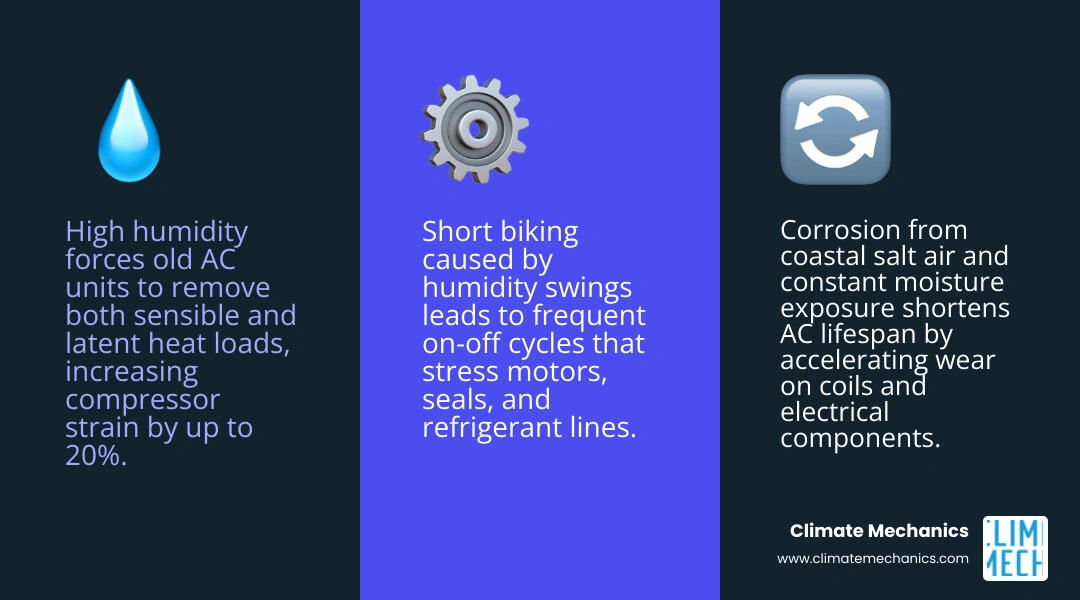
Research shows that energy consumption rises 10 to 20% when indoor relative humidity climbs from 40% to 60%. For an aging AC system already working near its limits, that extra strain does not just cost more on your energy bill — it shortens the life of the unit month by month.
New Jersey summers regularly push outdoor humidity above 70%, and coastal areas near the Jersey Shore add salt air into the equation, which speeds up corrosion on metal components even further. An AC unit that might last 12 to 15 years in a drier climate can deteriorate significantly faster here in South Jersey when it is not properly supported.
If your system is more than 10 years old, the combination of high latent heat load and New Jersey's humid climate is not something you can afford to ignore.
Understanding How Humidity Affects How Quickly an Old AC Degrades in New Jersey
To understand why your air conditioner is struggling, it helps to understand what an AC actually does. Most people think an air conditioner simply blows cold air into a room. In reality, it acts as a heat and moisture magnet, pulling warmth and water vapor out of your indoor air.
In places like Willingboro or Maple Shade, our summer air is incredibly thick. When your indoor air contains high levels of water vapor, your air conditioner must deal with two distinct types of heat loads:
1. Sensible Heat Load: This is the actual temperature of the air that you can read on a standard thermometer.
2. Latent Heat Load: This is the hidden heat stored within water vapor. Removing this moisture requires a massive amount of energy because the AC must condense water vapor into liquid water to drain it away.
An aging air conditioning system is physically less equipped to handle these heavy latent loads. As a system ages, it naturally experiences AC Unit Age and Degradation. The internal components become less efficient, meaning the compressor must run much longer to achieve the same level of dehumidification.
When you have a high latent load, you will often find your AC Running Constantly in New Jersey Summer Heat. This non-stop operation creates a vicious cycle. The longer the system runs to pull moisture out of the air, the hotter the compressor gets, accelerating the breakdown of internal lubricants and leading to premature mechanical failure.
The Science of How Humidity Affects How Quickly an Old AC Degrades in New Jersey
At the heart of your air conditioner is the vapor compression cycle. Refrigerant is pumped through a loop, changing from liquid to gas and back again to absorb and release heat.
When warm, humid air passes over the cold evaporator coils, the moisture in the air reaches its dew point and condenses onto the metal surface of the coils—much like condensation forming on a cold glass of iced tea on a July afternoon in Pennsauken. This liquid water then drips down into a condensate pan and flows out of your home.
However, high humidity decreases the heat transfer efficiency of this process. If the evaporator coils are constantly coated in a thick layer of water, it creates a minor thermal barrier. The system has to work harder to pull heat out of the air through that layer of moisture.
For an older system with slightly degraded blower motors or dirty coils, this means the vapor compression cycle must run at higher pressures and temperatures, wearing out the system's mechanical parts at an exponential rate.
Coastal Factors: How Humidity Affects How Quickly an Old AC Degrades in New Jersey
While inland South Jersey towns like Marlton and Haddonfield deal with heavy humidity, our coastal areas face a double whammy: high humidity combined with salt-laden ocean air.
If you live close to the coast, salt air corrosion is a constant threat. When salt-heavy moisture settles on your outdoor condenser unit, it triggers galvanic corrosion. This is an electrochemical process where two different metals (usually the aluminum cooling fins and the copper refrigerant tubes) degrade rapidly in the presence of an electrolyte—in this case, salty water.
This corrosive environment leads to common New Jersey AC Issues, such as pinhole leaks in the refrigerant lines. Once refrigerant begins to leak, the system’s pressure drops, forcing the compressor to work even harder in high-humidity conditions.
Eventually, the aluminum fins on the outdoor coil will begin to crumble into a white powder, destroying the unit's ability to shed heat and rendering the air conditioner useless.
Vulnerable Components: Where Moisture Strikes Hardest
High humidity does not degrade your system uniformly; it targets specific, highly vulnerable mechanical and electrical weak points.
When moisture levels remain high inside and outside your home, several key components are placed in the direct line of fire:
• The Compressor: Often called the heart of the AC, the compressor is forced to run longer, hotter cycles to remove latent heat. This leads to overheating and eventual compressor burnout.
• Electrical Contactors and Relays: High outdoor humidity causes condensation to build up on electrical connections. This moisture can lead to arcing, corroded contacts, and short circuits, particularly during sudden summer storms.
• Fan Motors: The condenser fan motor outdoors and the blower motor indoors must run for extended periods. High humidity can degrade the bearing lubricants inside these motors, causing them to seize.
• Condensate Drain Lines: When your AC is pulling gallons of water out of your indoor air every day, your drain lines are working overtime. In an older system, this constant flow of warm, dark water creates the perfect breeding ground for algae, mold, and slime, which can clog the line and cause water to back up into your home.
• Evaporator Coils: High indoor humidity combined with household dust creates a sticky paste that clings to the indoor evaporator coils, blocking airflow and promoting mold growth.
Coils and Seals under Constant Moisture Stress
The indoor evaporator coils and the copper refrigerant lines that connect them to the outdoor unit are under constant physical stress. As the air conditioner cycles on and off, these metals experience thermal expansion and contraction.
When you add high humidity to this thermal cycle, the external surfaces of the copper lines are constantly wet. Over time, this moisture reacts with microscopic pollutants in your home's air (like cleaning chemicals or off-gassing from carpets) to cause formicary corrosion. This specific type of corrosion creates microscopic, tunnel-like holes through the copper tubing, leading to slow, hard-to-find refrigerant leaks.
Additionally, older systems rely on rubber seals and gaskets within the refrigerant valves and compressor housing. The constant presence of moisture, combined with the rapid temperature swings of the system turning on and off, causes these rubber components to dry out, crack, and fail, resulting in sudden system pressure loss.
The Short-Cycling Trap and Seasonal Weather Swings
One of the most destructive phenomena an air conditioner can experience in a humid climate is short-cycling. This occurs when the system turns on, runs for a few minutes, shuts off, and then turns back on again shortly after.
If you are wondering Why Does My AC Keep Turning On and Off in New Jersey Summer Heat? What Is Wrong?, humidity is often the underlying culprit. Many older systems were either slightly oversized when installed, or their internal sensors have degraded over time.
When an AC is oversized, it cools the home's air temperature down so quickly that it shuts off before it has a chance to run long enough to pull moisture out of the air. This leaves you with indoor air that is cool but incredibly damp and clammy.
Because the air is still humid, the thermostat quickly registers that the home feels warm again, prompting the system to turn back on. This constant cycling back and forth is why you might notice your AC keeps shutting down so quickly.
Short-cycling causes massive wear and tear on the compressor's startup capacitor and motor windings, which draw up to six times more electrical current during startup than they do while running continuously.
How New Jersey's Seasonal Humidity Patterns Accelerate Wear
New Jersey's weather is notoriously inconsistent. We experience dramatic seasonal shifts that place unique stresses on residential HVAC systems.
• Spring Transition — Humidity & Temperature Patterns: Cool mornings, warm afternoons; fluctuating humidity levels. — Impact on Older AC Systems: Metal components expand and contract rapidly, loosening joints and fittings.
• Peak Summer (July-August) — Humidity & Temperature Patterns: Sustained high temperatures (90°F+) and relative humidity often exceeding 75%. — Impact on Older AC Systems: Continuous latent load forces the compressor to run non-stop, accelerating mechanical wear.
• Autumn Drop — Humidity & Temperature Patterns: Rapidly cooling temperatures; damp, rainy periods. — Impact on Older AC Systems: Moisture settles on outdoor units without the heat needed to dry it, encouraging rust and mold.
These seasonal swings mean your air conditioner never gets to operate in a stable environment. The constant expansion and contraction of metals, combined with prolonged periods of high moisture exposure, mean that an old AC unit in Audubon or Collingswood faces a much harsher operational life than a system in a more stable, dry climate.
Mitigating Moisture Damage: Maintenance and the 2026 Refrigerant Transition
While New Jersey's climate is tough on older air conditioners, there are proactive steps you can take to protect your system and prolong its life.
The single most effective way to protect an aging air conditioner is through regular, professional maintenance. Keeping up with your AC Tips for Summer is essential for preventing humidity-driven breakdowns.
During a professional maintenance visit, a technician will clean your evaporator and condenser coils, clear out the condensate drain lines, check refrigerant levels, and inspect electrical contacts for signs of moisture damage.
Additionally, managing your home's Indoor Air Quality Importance plays a major role in AC longevity. Installing a whole-home dehumidifier is one of the best ways to support an older air conditioner.
By actively pulling moisture out of the air before it reaches your AC's evaporator coils, a whole-home dehumidifier takes the latent heat load off your cooling system. This allows your old AC to focus solely on lowering the air temperature, which reduces its workload, stops short-cycling, and can add years of reliable service to an aging unit.
Navigating the 2026 Refrigerant Transition (R-454B) with an Older System
As of June 2026, the HVAC industry is in the midst of a major environmental transition. New environmental regulations have phased out the production of systems using R-410A refrigerant in favor of more eco-friendly, low-global-warming-potential (GWP) alternatives, primarily R-454B.
For homeowners in South Jersey with older systems, this transition introduces several challenges:
• Refrigerant Compatibility: Older units designed for R-22 or R-410A cannot be retrofitted or charged with R-454B. They operate on entirely different pressures and use different lubricants.
• Rising Repair Costs: As R-410A is gradually phased down, the cost of sourcing this older refrigerant for repairs will rise significantly.
• The Upgrade Decision: If your older system suffers a major humidity-related failure—such as a corroded evaporator coil or a burned-out compressor—investing in a costly repair with outdated refrigerant may not make financial sense.
If your system is showing signs of severe humidity degradation, upgrading to a modern, high-efficiency system designed for R-454B will not only lower your energy bills but will also provide significantly better humidity control through variable-speed compressor technology.
Frequently Asked Questions About AC Degradation in New Jersey
How does high humidity physically damage an older AC compressor?
High humidity forces the air conditioner to run much longer cycles to remove water vapor from the air. This continuous operation causes the compressor to run hot.
Over time, this excess heat breaks down the chemical properties of the lubricating oil inside the compressor. Without proper lubrication, the internal metal pistons and bearings experience severe friction, leading to mechanical wear, overheating, and eventual electrical burnout.
Can a whole-home dehumidifier extend the life of my aging AC?
Yes, absolutely. A whole-home dehumidifier acts as a partner to your air conditioner. By handling the "latent load" (the moisture removal), the dehumidifier allows your AC to focus purely on the "sensible load" (cooling the air temperature).
This significantly reduces the run-time of your AC compressor and fan motors, lowers your energy bills, prevents short-cycling, and helps protect the system's vital components from moisture-related wear.
What are the signs that humidity has severely degraded my AC?
If your system is struggling with humidity-related wear, you will likely notice several warning signs:
• Musty Odors: A buildup of mold or mildew on dirty evaporator coils or in a clogged drain pan will blow a damp, musty smell through your vents.
• Frozen Evaporator Coils: When airflow is restricted by dirt and moisture, or if refrigerant is low due to corrosion leaks, the moisture on your coils can freeze, turning the indoor unit into a block of ice.
• Uneven Cooling and Damp Air: If your home feels cold but sticky, or if rooms upstairs feel significantly muggier than downstairs, your system is failing to remove moisture.
• Frequent Cycling: The unit turns on and off rapidly without ever completing a full cooling cycle.
If you are experiencing these issues regularly, it may be time to consult our AC Replacement Guide to weigh the benefits of a new, highly efficient system against the ongoing costs of repairing an aging unit.
Conclusion
Managing high humidity in South Jersey is a tough job, especially for an older air conditioner. The combination of high latent heat loads, seasonal temperature swings, and coastal salt air can rapidly accelerate the breakdown of your system's most important components.
At Climate Mechanics, we bring over 38 years of NATE and NCI-certified expertise to homeowners across South Jersey, including Camden, Burlington, Marlton, and Haddonfield. We know exactly how our local climate impacts your cooling system, and we are dedicated to providing the personalized, high-quality service you need to keep your home comfortable all summer long.
If your aging air conditioner is struggling to keep up with the summer humidity, or if you want to explore how a whole-home dehumidifier can protect your current system, we are here to help.
Schedule AC Repair in Delran NJ with the trusted team at Climate Mechanics today, and let us help you keep your home cool, dry, and comfortable through the worst of the summer heat.
