



Why Humidity Makes AC Service Frequency a Bigger Deal in New Jersey
If you've ever wondered how often should you service your air conditioner in a humid New Jersey climate, here's the short answer:
• Central AC: Once per year, ideally in early spring before cooling season begins
• Heat pumps: Twice per year — once in spring, once in fall
• Systems 10+ years old: Consider biannual service regardless of system type
• All systems in high-humidity areas: Never skip a year — humidity accelerates wear faster than in dry climates
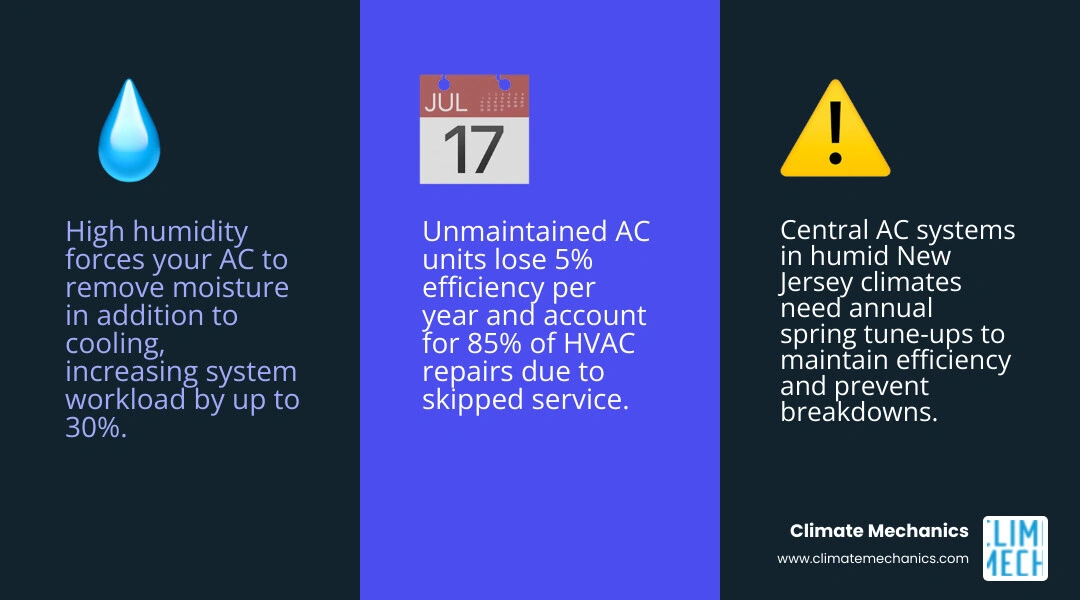
New Jersey summers are no joke. The state routinely sees heat index values well above 90°F, paired with humidity levels that force your air conditioner to work overtime — not just to cool your home, but to pull moisture out of the air at the same time. That dual workload puts serious strain on components like evaporator coils, condensate drain lines, and compressors.
Most homeowners only think about AC maintenance after something breaks. By then, a small problem has often become an expensive repair — or worse, a full system failure during the hottest week of July. According to industry data, 85% of HVAC repairs are linked to a lack of routine maintenance, and unmaintained systems lose roughly 5% of their operating efficiency every year they go without a tune-up.
In a climate like South Jersey's, skipping service isn't just inconvenient — it's costly.
Explore more about how often should you service your air conditioner in a humid new jersey climate:
• ac tune-up guide for new jersey homeowners
• is the climate mechanics maintenance plan worth it in a six month new jersey cooling season
How Often Should You Service Your Air Conditioner in a Humid New Jersey Climate?
For South Jersey residents living in areas like Cherry Hill, Marlton, or Pennsauken, the local climate features a distinct seasonal shift. While we experience freezing winters, our summers are characterized by thick, heavy humidity rolling off the Delaware River and the Atlantic.
To keep your home comfortable and your energy bills manageable, we recommend scheduling professional AC maintenance at least once per year as a baseline. However, depending on your equipment type, system age, and household needs, a biannual (twice-yearly) schedule is often the gold standard.
Regular professional checkups do more than just keep the air cool; they prevent the compounding wear and tear caused by our region's heavy moisture. If you want to know exactly what goes into a seasonal checkup, our AC Tune-Up Guide for New Jersey Homeowners covers the entire process in detail.
Standard Maintenance Frequency for Central AC Systems
If your home relies on a traditional central air conditioning system, you should have it professionally serviced once a year in the early spring. This timing is critical. Booking your service in March or April ensures that any hidden issues—like a slow refrigerant leak or a failing capacitor—are resolved before the first major heatwave hits in June or July.
Skipping this annual visit can trigger a domino effect. A layer of dust just 1/16th of an inch thick on your AC coils can reduce system efficiency by 20%. When you combine dirty coils with summer humidity, your system has to run much longer cycles to cool your home, leading to high utility bills and premature component failure.
Furthermore, regular professional servicing is a strict requirement for most manufacturer warranties. If a major part like the compressor fails and you cannot provide documented proof of annual professional maintenance, the manufacturer may deny your warranty claim. To understand how to protect your investment, read more about Why Should I Purchase an HVAC Maintenance Plan.
Why Heat Pumps Require Twice-Yearly Servicing
Unlike central air conditioners that sit idle during the winter, heat pumps work hard all year long. In the summer, they extract heat from your home and dump it outside. In the winter, they reverse the process to keep you warm.
Because heat pumps run across all four seasons—often accumulating over 2,000 operating hours annually in New Jersey—they require twice-yearly maintenance.
• Spring Service: Focuses on the cooling components, clearing out winter debris, and preparing the system for high-humidity moisture removal.
• Fall Service: Prepares the reversing valve, auxiliary heating elements, and defrost controls for the freezing winter ahead.
Without this biannual attention, heat pumps degrade rapidly, losing efficiency and risking sudden breakdowns when you need them most. For a deeper dive into why these seasonal transitions require professional oversight, explore Why Year-Round HVAC Maintenance Matters More in a Hot and Cold Climate Like South Jersey.
How New Jersey's High Humidity Impacts Your AC System
To understand why our climate demands such strict maintenance, we have to look at how humidity changes the physics of air conditioning.
Your AC has two main jobs: lowering the air temperature (sensible cooling) and removing moisture from the air (latent cooling). When warm, humid air passes over the freezing evaporator coils inside your home, the moisture in the air condenses into liquid water, dripping down into a drain pan and flowing outside.
In a dry climate, the AC focuses almost entirely on sensible cooling. In South Jersey, however, the heavy atmospheric moisture forces the system to spend a massive amount of energy just extracting water from the air. This constant state of high-demand operation accelerates mechanical wear, reduces overall efficiency, and shortens the system's lifespan if it isn't properly maintained. Learn more about this dynamic in our guide on How High Humidity in the Delaware Valley Makes Your AC Work Harder Than Dry Climates.
How Often Should You Service Your Air Conditioner in a Humid New Jersey Climate to Prevent Coil Degradation?
The combination of moisture, outdoor dust, and seasonal pollen creates a harsh environment for your AC's evaporator and condenser coils. When humidity is high, the moisture on the coils acts like a magnet for airborne dirt, pet dander, and pollen. This mixture forms a thick, insulating grime that blocks heat transfer.
Over time, this damp buildup can lead to "pitting corrosion" on copper coils, resulting in microscopic refrigerant leaks. In coastal or riverfront areas near Camden or Burlington, salt air and industrial pollutants can speed up this degradation even further.
To prevent this, professional coil cleaning should be performed at least once a year. If you have an older system, keeping those coils clean is the single best way to prevent a catastrophic breakdown. For more information on this topic, read How Humidity Affects How Quickly an Old AC Degrades in New Jersey.
Preventing Mold, Mildew, and Indoor Air Quality Issues
Your AC’s dark, damp internal environment is a prime breeding ground for mold, mildew, and bacteria. When the system extracts gallons of water from your indoor air every day, that water must drain away quickly.
If the condensate drain line is partially blocked, standing water will sit in the drain pan. In our warm New Jersey summers, this standing water can grow mold within 24 to 48 hours. When the blower fan turns on, it can carry mold spores throughout your entire home, causing musty odors, respiratory issues, and severe allergy flare-ups.
Regular professional maintenance includes flushing the drain lines, sanitizing the drain pan, and checking the coils for biological growth. This keeps your indoor air healthy and your home smelling fresh. For more DIY and professional tips on keeping your system clean, check out our AC Maintenance Tips for Summer.
Essential Maintenance Tasks for Humid Climates
While homeowners can handle minor upkeep, a professional tune-up requires specialized tools, diagnostic instruments, and certified expertise. Below is a breakdown of what should be left to the pros versus what you can do yourself:
• Air Filter Replacement — DIY (Homeowner): Yes — Professional Technician: Yes — Why It Matters: Maintains airflow and protects system components.
• Clearing Condenser Debris — DIY (Homeowner): Yes — Professional Technician: Yes — Why It Matters: Ensures proper airflow around the outdoor unit.
• Flushing Condensate Drain — DIY (Homeowner): Yes (Basic) — Professional Technician: Yes (Deep Flush) — Why It Matters: Prevents water damage, mold, and drain pan overflows.
• Coil Cleaning — DIY (Homeowner): No — Professional Technician: Yes — Why It Matters: Removes grime to maintain heat transfer efficiency.
• Refrigerant Charge Check — DIY (Homeowner): No — Professional Technician: Yes — Why It Matters: Ensures proper cooling capacity and compressor health.
• Electrical Connections Tightening — DIY (Homeowner): No — Professional Technician: Yes — Why It Matters: Prevents electrical shorts, component damage, and fires.
• Thermostat Calibration — DIY (Homeowner): No — Professional Technician: Yes — Why It Matters: Ensures accurate temperature and humidity control.
Clearing the Condensate Drain Line
One of the most common service calls we receive during a humid July in places like Haddonfield or Audubon is for a clogged condensate drain line. As moisture drains from your indoor coil, it carries microscopic dust particles with it. Over time, algae and bacterial slime feed on this mixture, forming a thick clog.
When the line clogs, the water has nowhere to go. It will back up into the drain pan. If your system has a safety float switch, it will shut down the AC to prevent an overflow. If you have an older system without a safety switch, that water can overflow, causing thousands of dollars in water damage to your ceilings, walls, and floors.
Homeowner Tip: You can perform a basic preventative flush by pouring a cup of distilled white vinegar down your condensate drain line once a month during the summer. This helps kill algae before it can form a solid clog. However, if the line is already fully blocked, you will need a professional technician to safely clear it using specialized vacuum or pressurized tools.
How Often Should You Service Your Air Conditioner in a Humid New Jersey Climate for Optimal Airflow?
Airflow is the lifeblood of your air conditioning system. When airflow is restricted, your AC has to work much harder to move cooled air through your home. In a humid climate, restricted airflow causes the temperature of the evaporator coil to drop too low, which can cause the moisture on the coil to freeze solid, completely blocking the system.
The primary cause of restricted airflow is a dirty air filter. In South Jersey, high humidity can cause filters to damp-clog faster, especially if you have pets or live near areas with high pollen counts.
We recommend inspecting your air filter every 30 days and replacing it at least every 1 to 3 months. For detailed guidance on selecting the right filter and maintaining optimal airflow, refer to our articles on How Often Should You Change Your Air Filter and AC Tip: Change Your Filter.
Signs Your AC Needs Service Before Your Scheduled Visit
Even with a regular maintenance schedule, the extreme humidity of a New Jersey summer can sometimes push an older or heavily used system past its limit.
Keep an eye out for these warning signs that indicate your system needs professional attention immediately:
• Weak Airflow: If you feel barely any air coming out of your registers, your blower motor may be failing, or your evaporator coil could be frozen.
• Warm Air: If the air coming from your vents is lukewarm, you could be dealing with a refrigerant leak or a failed compressor capacitor.
• Short Cycling: If your AC turns on and off every few minutes without completing a full cooling cycle, it is putting massive strain on the compressor and failing to dehumidify your home.
• Musty Odors: A strong, damp, or earthy smell when the system runs indicates mold or mildew growth inside the ductwork, drain pan, or coils.
• Unusual Noises: Squealing, grinding, or rattling sounds indicate loose or failing mechanical parts that need immediate repair before they cause secondary damage.
• Spiking Utility Bills: A sudden, unexplained jump in your electric bill means your system is losing efficiency rapidly and working much harder than it should.
Frequently Asked Questions about New Jersey AC Maintenance
When is the best time of year to schedule AC service in New Jersey?
The absolute best time to schedule your AC service is early spring (March to April). Scheduling during these months ensures your system is clean and fully operational before the summer heat arrives. It also allows you to beat the summer rush, giving you access to flexible scheduling times with certified technicians.
How long does a typical central air conditioner last in New Jersey?
In our humid Mid-Atlantic climate, a central air conditioner typically lasts 10 to 15 years. However, this lifespan is heavily dependent on maintenance. A neglected system constantly fighting high humidity often fails between 8 and 12 years. Conversely, a well-maintained system that receives regular professional tune-ups can easily last 15 to 20 years. For more details on system longevity, read about the Average Lifespan of a Central Air Conditioner in a Humid Mid-Atlantic Climate.
Does a brand-new AC system really need annual professional service?
Yes, absolutely. In fact, skipping annual service on a new system is one of the most common mistakes homeowners make. Nearly all major HVAC manufacturers require documented proof of annual professional maintenance to keep their 10-year parts warranties valid. If a component fails and you cannot show that the system was serviced annually by a licensed professional, you may have to pay for the replacement parts out of pocket.
Conclusion
Living in South Jersey means dealing with hot, sticky summers that put your air conditioning system to the test. Knowing how often should you service your air conditioner in a humid New Jersey climate—and sticking to that schedule—is the best way to keep your home comfortable, protect your indoor air quality, and keep your energy bills low.
At Climate Mechanics, we bring over 38 years of NATE and NCI-certified expertise to every home we serve. We provide personalized, reliable heating, cooling, and air quality services to homeowners across South Jersey, including Maple Shade, Pennsauken, Audubon, Willingboro, Collingswood, Haddonfield, Burlington, Marlton, and Camden.
If you want peace of mind all summer long, our customized maintenance plans are designed to keep your system running at peak efficiency. Find out if our program is right for your home by reading Is the Climate Mechanics Maintenance Plan Worth It in a Six-Month New Jersey Cooling Season.
Don't wait for your system to struggle in the summer heat. Schedule your professional AC maintenance in Voorhees, NJ today and let our family keep yours comfortable.
