


Surviving the First Fall Cold Snap: When to Worry About Your Heating System
Here at Climate Mechanics, we know the panic that sets in when you wake up to a crisp morning, switch your thermostat to "heat," and suddenly notice a sharp burning smell—prompting you to wonder if your seasonal home maintenance checklist missed something crucial. That first cold snap always tests a dormant heating system. After sitting idle for months, your furnace or heat pump is suddenly forced to perform, and the results can be alarming. A burning odor or a strange grinding noise during that October first heating cycle often leaves homeowners scrambling to figure out if their house is in danger or if the system just needs a moment to wake up.
Proper seasonal triage is the critical first step in protecting your home and your peace of mind. Knowing how to interpret these initial symptoms helps you make an informed decision about whether you are dealing with a harmless seasonal quirk or a failing component that requires our professional intervention. If it turns out that your system has reached the end of its lifespan, navigating local compliance and municipal permitting becomes a non-negotiable part of the upgrade process.
For comprehensive heating services and expert furnace replacement in Cinnaminson, proper triage is your first line of defense.
The transition from South Jersey's hot, humid summers to sudden fall cooling creates specific dormancy issues for residential HVAC systems. Moisture and inactivity take a toll on mechanical parts, meaning that first startup is a high-stress event for the equipment. Understanding what to expect during this transition ensures you do not panic over normal operations—and ensures you do not ignore the warning signs of a true mechanical failure.
The Essential Fall HVAC Triage Checklist: Dust Burn-Off vs. Danger
Distinguishing between a system that is merely clearing its throat and one that is crying out for help requires knowing exactly what to look, listen, and smell for. Our technicians frequently field frantic calls during the October first heating cycle regarding a phenomenon known as "dust burn-off." While your system sits unused throughout the summer, microscopic dust particles, pet dander, and airborne debris settle directly onto the heat exchanger and burner components. When the furnace ignites for the first time, this layer of debris instantly incinerates.
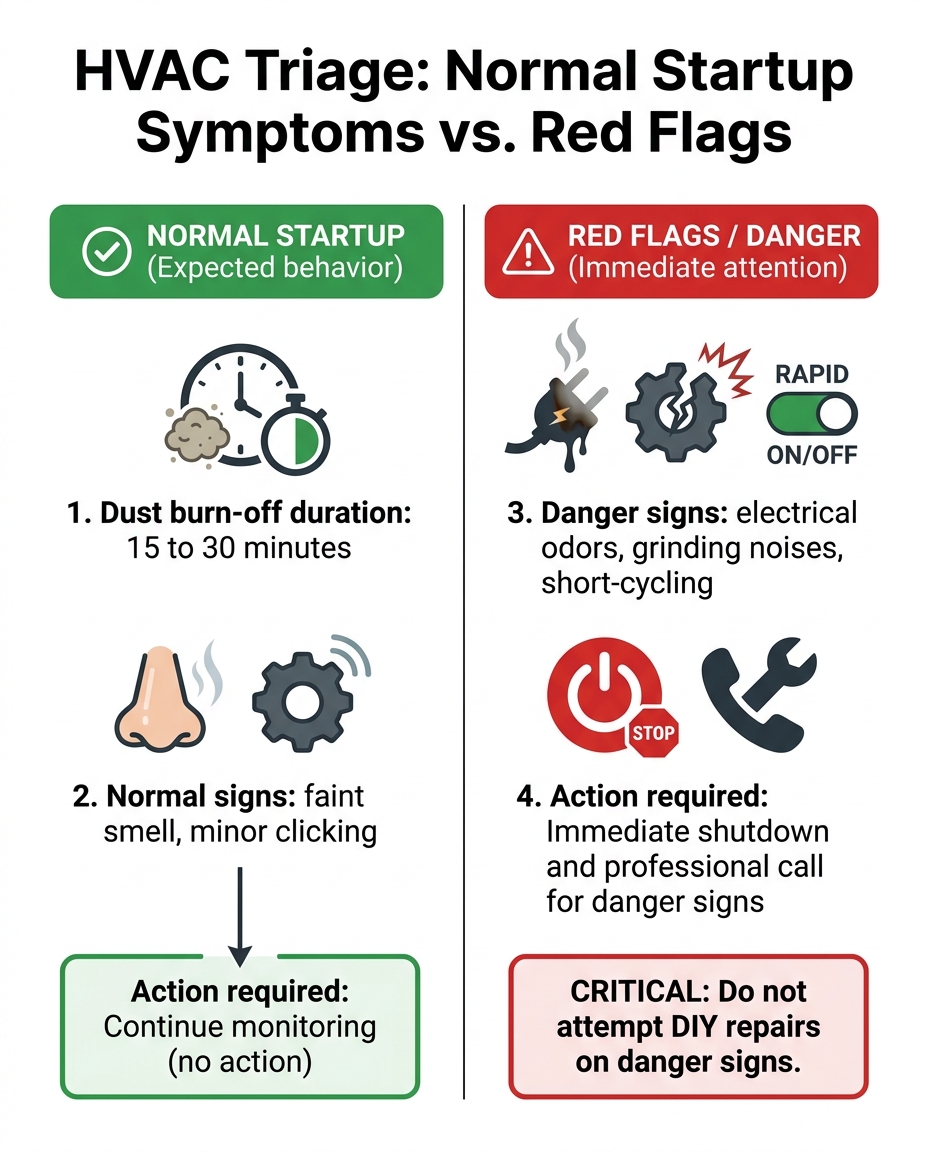
The standard timeline: Typical dust burn-off produces a distinct, campfire-like odor that lasts anywhere from 15 to 30 minutes. If your home is properly ventilated, the smell should dissipate completely within the first hour of operation. However, while dust burn-off is harmless, other odors and sounds indicate serious mechanical distress that requires immediate attention.
Diagnosing internal components is never a DIY task. Opening the furnace cabinet exposes you to high-voltage electricity, moving parts, and potential gas leaks. Your role as a homeowner is strictly observation and triage from the outside.
Normal Seasonal Quirks
During the first few cycles of the season, our team expects to see a few specific behaviors that are entirely standard and should not cause alarm. Watch for these normal operational quirks:
• Brief, faint burning dust smell: This is the harmless incineration of settled summer debris and should fade quickly.
• Minor clicking sounds: You may hear a series of light clicks as the thermostat communicates with the control board and the relays engage.
• Slight delay in warm air: On the very first cycle, the blower may push out a burst of room-temperature air before the heat exchanger reaches its optimal operating temperature.
Warning Signs to Call a Professional
If your system exhibits any of the following symptoms, shut it off immediately at the thermostat and contact a licensed technician. These are clear indicators of mechanical failure:
• Loud banging, screeching, or grinding noises: These sounds typically point to failing blower motor bearings, a loose fan belt, or a delayed ignition issue that causes a small gas build-up before lighting.
• Continuous short-cycling: If the unit turns on and off rapidly without ever reaching the target temperature, it may be overheating or suffering from a blocked airflow issue.
• Persistent odors: Electrical burning smells, the scent of melting plastic, or the unmistakable odor of raw gas or rotten eggs are extreme safety hazards that do not fade after the first hour.

Recognizing True Mechanical Failures During the First Cold Snap
In our years servicing homes across South Jersey, we've found that the root cause of many early-season heating failures actually begins months earlier. The specific mix of intense summer humidity followed by rapid fall cooling creates a perfect storm for condensation issues inside dormant furnaces. While you rely on your air conditioner to manage indoor comfort, the internal components of your heating system are sitting in a dark, potentially damp basement or utility closet.
The hidden impact of humidity: High moisture levels in the air can cause surface rust to form on delicate flame sensors, heat exchangers, and pilot assemblies. Furthermore, electrical contactors—the switches that control the flow of high-voltage power to your motors—can become sticky or corroded while sitting idle. When the thermostat finally calls for heat in Cinnaminson NJ and surrounding South Jersey areas, these compromised parts struggle to engage, leading to failed ignitions or electrical shorts.
Ignoring these warning signs during the first cycle is a risky gamble. A furnace that struggles to start in October is highly likely to suffer a catastrophic breakdown in the middle of January when it is forced to run continuously. Operating a compromised system drastically reduces energy efficiency, driving up your utility bills while delivering uneven comfort.
More importantly, ignoring mechanical distress poses severe safety hazards. A rusted or cracked heat exchanger can allow deadly carbon monoxide to mix with the breathable air circulating through your home's ductwork. If any abnormal symptoms persist beyond the initial startup phase, scheduling a comprehensive pre-winter inspection with our team is the only way to verify the system is safe to operate.
Repair or Replace? Making the Call Before Winter Hits
Once a professional confirms that your system has suffered a mechanical failure during the October first heating cycle, you face a critical decision: invest in a repair or commit to a full system replacement. Making this call before freezing temperatures arrive gives you the leverage to explore your options without the pressure of an emergency no-heat situation.
The evaluation framework: The choice between repairing and replacing largely depends on the age of the unit, the severity of the necessary repair relative to the system's remaining lifespan, and the overall safety of the equipment. A simple guideline our team shares with homeowners is the 50% rule: if a major component failure approaches half the investment of a new, high-efficiency system, and the existing unit is over a decade old, replacement is generally the wiser decision.
• System Age — When to Repair: Under 10 years old with a solid maintenance history. — When to Replace: Over 15 years old, or facing frequent breakdowns.
• Component Failure — When to Repair: Minor parts like capacitors, ignitors, or flame sensors. — When to Replace: Major components like a cracked heat exchanger or failed blower motor.
• Safety Risk — When to Repair: No structural damage or carbon monoxide risks present. — When to Replace: Any breach in the heat exchanger that compromises indoor air quality.
• Energy Efficiency — When to Repair: Current utility bills remain stable and manageable. — When to Replace: Noticeable spikes in energy usage despite regular maintenance.
If the heat exchanger is cracked or major internal components have failed, replacing the unit is almost always the safest and most efficient route. Homeowners upgrading their heating infrastructure often consider comprehensive system updates, including AC replacement, to ensure year-round efficiency and perfectly matched equipment.
Modern, energy-efficient HVAC systems offer vastly superior performance compared to models manufactured just a decade ago. Additionally, generic federal tax credits or local utility incentive programs may be available to help offset the initial investment of upgrading to high-efficiency equipment. Always consult with your tax professional or local utility provider to verify which current programs apply to your specific installation.
Do You Need a Permit for HVAC Replacement in New Jersey?
If you determine that replacing your failing equipment is the best path forward, a crucial administrative question often arises: do you need a permit to swap out an old furnace? The short answer is yes. Replacing an HVAC system requires a municipal permit in almost all New Jersey jurisdictions, including Cinnaminson NJ and surrounding South Jersey areas.
While a homeowner might view a furnace replacement as a simple swap—taking an old box out and putting a new box in—local building codes classify this as a major structural and mechanical update. The process involves volatile fuel sources, high-voltage electrical connections, and complex venting systems that directly impact the safety of the dwelling.
The permitting process requires submitting detailed load calculations, providing exact equipment specifications, and scheduling municipal inspections at various stages of the project. This ensures that the new system is not just functional, but legally compliant. When you invest in professional furnace installation, a reputable contractor will manage these permits on your behalf, ensuring the system is safe and up to code.
Why Municipalities Require HVAC Permits
Local governments enforce permitting requirements to protect homeowners from substandard workmanship and severe safety hazards. The municipal inspection process focuses on several critical verification points:
• Verification of proper gas line connections and venting: Inspectors ensure that natural gas or propane lines are leak-free and that exhaust flues are correctly routed to prevent carbon monoxide buildup inside the home.
• Ensuring electrical loads meet current safety codes: Modern systems often have different electrical requirements than older units. Inspectors verify that the breaker panel and wiring can safely handle the new load without fire risks.
• Confirming proper equipment sizing: Installing a system that is too large or too small for the home's square footage leads to rapid wear, poor humidity control, and wasted energy. Code enforcement often requires proof of proper load calculations.
The Hidden Risks of Unpermitted Heating Installations
In an effort to save a little time or bypass official channels, some homeowners are tempted to hire unlicensed handymen or "moonlighting" technicians who offer to install equipment without pulling the required permits. We've seen firsthand how bypassing the permitting process during your October first heating cycle upgrade carries significant, long-lasting consequences that far outweigh any perceived convenience.
Manufacturer warranties are at stake: Almost all major HVAC manufacturers explicitly state in their warranty documentation that the equipment must be installed by a licensed professional in accordance with local building codes. If a major component fails down the road and there is no record of a permitted installation, the manufacturer will frequently void the warranty, leaving you entirely responsible for expensive repair costs.
Real estate transaction hurdles: Unpermitted work is a massive red flag during the home selling process. When a prospective buyer hires a home inspector, any discrepancies between the age of the HVAC equipment and the municipal permit records will be flagged. Failed home inspections due to unpermitted HVAC work can delay closings, force costly retroactive permitting, or derail a real estate transaction entirely.
Severe insurance liabilities: Perhaps the most dangerous risk involves your homeowners insurance. If an unpermitted furnace is installed improperly and subsequently causes a fire, gas leak, or significant property damage, your insurance provider has grounds to deny the claim. Operating unpermitted, high-voltage, gas-burning equipment leaves your family and your financial future highly vulnerable.
How Local Mechanics Streamline South Jersey Permitting
Navigating the bureaucratic maze of municipal offices can be an overwhelming prospect for a homeowner who just wants their heat turned back on. Different townships have different application guidelines, required documentation formats, and inspection schedules. Figuring out the specific requirements for Cinnaminson NJ and surrounding South Jersey areas is not something you should have to manage on your own.
An experienced, local team handles the entire administrative process from start to finish. We pull the necessary permits, submit the required mechanical drawings and load calculations, and coordinate directly with the township to schedule the final municipal inspection. This ensures your project moves forward without unnecessary delays or legal headaches.
Contrast this streamlined approach with out-of-town contractors or national chains who might leave the administrative burden entirely on the homeowner's shoulders. As local mechanics rather than an impersonal corporate entity, Climate Mechanics seamlessly navigates local Burlington County and South Jersey permit requirements so homeowners don't have to. We understand the specific codes and expectations of local inspectors, ensuring the job is done right the first time.
If you are also considering updating your cooling equipment in the future, the administrative rules are very similar. You can find further reading on whether you need a permit to replace AC in New Jersey by visiting our detailed guide on do you need a permit to replace AC in New Jersey.
Frequently Asked Questions About Fall Heating Startup and Permitting
Why does my heater smell like burning dust when I turn it on?
That campfire-like smell is the result of dust and debris incinerating on the heat exchanger. Over the summer, particles settle on the dormant internal components of your furnace. When you run the system for the first time during the October first heating cycle, the sudden heat burns this layer off. The odor is completely normal and should naturally dissipate within 15 to 30 minutes of operation.
What is included in a fall HVAC maintenance checklist?
A comprehensive fall checklist covers both homeowner tasks and professional diagnostics. On the homeowner side, it includes replacing the air filter, clearing debris away from outdoor heat pumps, and testing carbon monoxide detectors. When our team performs a professional tune-up, we go much deeper, inspecting the heat exchanger for cracks, testing electrical contactors, cleaning the flame sensor, and verifying proper gas pressure for safe winter operation.
When should I turn my heat on for the first time in the fall?
It is best to perform a test run of your heating system before the first freezing night arrives. Picking a mild day in early to mid-fall allows you to observe the system's startup behavior without the pressure of needing immediate warmth. If the system struggles to start or produces dangerous odors, testing early gives you plenty of time to schedule professional repairs before peak winter demand hits.
What furnace noises are dangerous?
While minor clicking during startup is normal, loud grinding, screeching, or booming sounds are major red flags. A loud "boom" when the furnace ignites indicates delayed ignition, meaning gas is building up before lighting, which is a serious safety hazard. Grinding or squealing noises typically point to failing motor bearings or a damaged blower belt that requires immediate professional replacement.
How do I prep my HVAC system for winter?
Start by ensuring all indoor vents are open and unobstructed by furniture or rugs to guarantee proper airflow. Next, replace your system's air filter to prevent the blower motor from overworking. Finally, the most important preparation step is scheduling a professional pre-winter inspection to verify that all internal components, especially the heat exchanger and safety limit switches, are functioning correctly and safely.
Can I replace my own furnace without a permit?
No, replacing a furnace without a municipal permit is illegal in almost all jurisdictions and highly dangerous. Building codes require permits to ensure that gas lines, high-voltage electrical wiring, and exhaust venting are handled according to strict safety standards. Attempting a DIY installation or bypassing the permit process can void your manufacturer warranty and lead to severe insurance liabilities.
What happens if I skip the permit for my HVAC installation?
Skipping the permit leaves you vulnerable to a host of long-term financial and legal issues. If unpermitted work is discovered during a future home sale, you may fail the home inspection and face severe complications. Furthermore, if the unpermitted equipment causes property damage, your homeowners insurance will likely deny the claim, leaving you entirely responsible for the consequences.
Make Your Home Winter-Ready with Professional, Permitted Solutions
Distinguishing harmless dust burn-off from a true mechanical failure is the most critical step of your seasonal home maintenance checklist. When that first cold snap hits Cinnaminson NJ and surrounding South Jersey areas, paying close attention to the smells and sounds of your system dictates whether you can relax or need to call for help.
If your system's symptoms point to a total breakdown, remember that proper permitting for a replacement is non-negotiable. Securing the right permits protects your family, preserves your manufacturer warranty, and ensures your home remains fully compliant with local safety codes. Schedule an inspection or consultation with our local experts today to secure clear, non-DIY criteria and ensure your system is safe, compliant, and ready to keep you warm all winter long.
