


Why Year-Round HVAC Maintenance Matters More in a Hot and Cold Climate Like South Jersey
Why year-round HVAC maintenance matters more in a hot and cold climate like South Jersey comes down to one simple fact: your system never really gets a break. South Jersey summers are hot, humid, and relentless. Winters bring freezing temperatures, nor'easters, and bitter wind chills. And in between, the shoulder seasons whipsaw back and forth in ways that put constant stress on your heating and cooling equipment — stress that systems in milder climates simply don't face.
Without consistent maintenance, that wear adds up fast. HVAC systems in hot and humid climates can lose up to 5% efficiency every single year. Over time, that means energy bills that climb 20–30% higher than they need to be — and a system that breaks down years before it should.
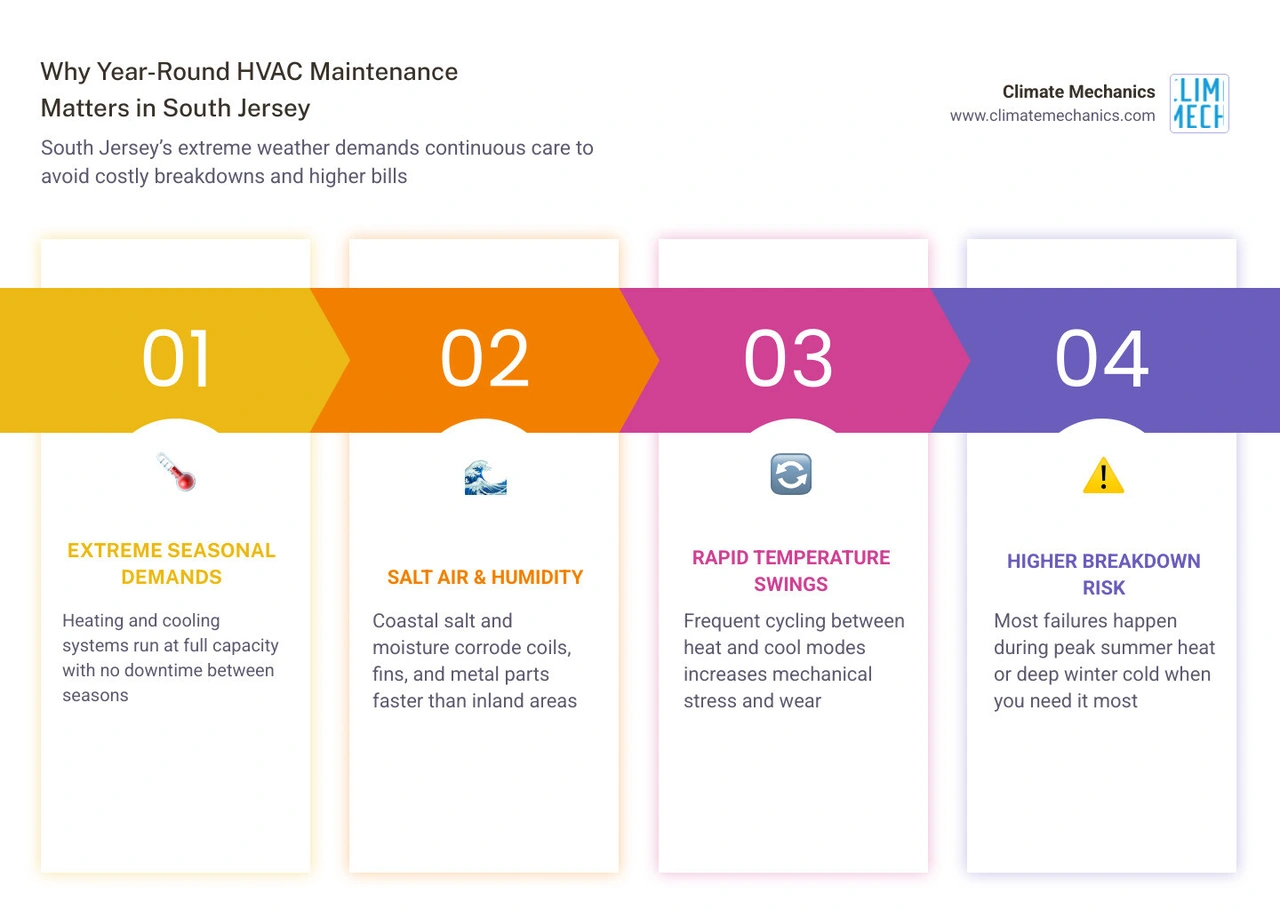
Here's a quick summary of why South Jersey homeowners need year-round HVAC care:
• Extreme seasonal demands — Both heating and cooling systems are pushed to their limits, not just one or the other
• Salt air and coastal humidity — Microscopic salt particles and high humidity accelerate corrosion on metal components
• Rapid temperature swings — Frequent cycling between heating and cooling modes increases mechanical wear
• Higher breakdown risk — Most HVAC failures happen during peak summer heat or deep winter cold, exactly when you need the system most
• Shorter system lifespan without care — Neglected units may last only 5–7 years efficiently, versus 10–15 years with regular maintenance
• Rising energy costs — A poorly maintained system works harder and costs more to run every single month
Understanding South Jersey's Unique Coastal Climate Challenges

Living in South Jersey—whether you are settled in Haddonfield, Audubon, or closer to the Delaware River in Camden and Pennsauken—means enjoying the beautiful seasonal shifts of the Mid-Atlantic. However, our geography presents a highly demanding environment for residential heating and cooling systems.
We live in what climatologists refer to as IECC Climate Zone 4A (mixed-humid). This means we experience both scorching, muggy summers and bitterly cold, freezing winters. Our systems don't have the luxury of dealing with only one type of extreme weather. To make matters worse, our proximity to coastal air and major waterways introduces elements like salt-tinged moisture and heavy humidity that act as silent, slow-moving saboteurs to outdoor machinery.
Understanding these geographic challenges is the first step in protecting your home comfort. There are Four Reasons to Schedule Regular HVAC Maintenance that directly address these environmental stressors, keeping your home safe and your utility bills manageable throughout the year.
The Impact of Salt Air and High Humidity on Coastal HVAC Systems
If you think salt air corrosion is only a problem for homes sitting directly on the beach, think again. Strong coastal winds and weather patterns carry microscopic salt particles miles inland, settling quietly on outdoor condenser units in communities like Marlton, Cherry Hill, and Maple Shade.
When salt air combines with South Jersey’s summer humidity—which routinely exceeds 70%—it creates a highly corrosive electrochemical reaction.
• Coil Fins and Copper Components: The delicate aluminum fins on your outdoor condenser coil are highly vulnerable. Salt particles trap moisture against these fins, leading to a phenomenon known as "white rust" or galvanic corrosion.
• Equipment Degradation: Over time, this corrosion causes the aluminum fins to weaken, lose their heat-transfer capabilities, and eventually crumble. Once the fins degrade, your air conditioner cannot dissipate heat efficiently.
• System Strain: This forces the compressor to run hotter and longer, consuming up to 25% more electricity and shortening the system's life.
Implementing professional HVAC System Preventative Maintenance ensures that these corrosive salt deposits and dirt accumulations are washed away safely using specialized coil cleaners, protecting the copper and aluminum components before permanent pitting and leaks develop.
How Rapid Temperature Swings Accelerate Equipment Wear
The shoulder seasons in South Jersey (specifically late spring and early autumn) are notorious for rapid temperature flips. It is not uncommon to need your furnace or heat pump’s heating mode on a chilly 42°F morning in Willingboro, only to switch over to air conditioning by 3:00 PM when the afternoon temperature climbs to an unexpectedly humid 78°F.
These rapid temperature swings cause intense thermal expansion and contraction within your HVAC system. Metal components expand when hot and contract when cold. This constant cycling puts immense physical stress on:
• Solder joints
• Electrical connections
• Fan motors
• Refrigerant lines
Additionally, frequent system cycling (turning on and off repeatedly to match fluctuating outdoor temperatures) draws high electrical currents. This places a heavy burden on your system's start capacitor and contactor. Without regular inspections to monitor these electrical parts, a sudden temperature swing can easily push a weakened capacitor over the edge, leaving you without heating or cooling when you need it most.
Why Year-Round HVAC Maintenance Matters More in a Hot and Cold Climate Like South Jersey
In milder regions of the country, an annual HVAC checkup is often considered a luxury or a quick precaution. But in South Jersey, skipping even a single maintenance season is a major gamble. Because our local weather forces us to run our air conditioning continuously for four months and our heating systems for another five, our HVAC equipment experiences virtually no downtime.
This continuous stress accelerates mechanical wear, degrades lubrication, and causes electrical connections to loosen. Proactive, twice-yearly maintenance is the only reliable way to counteract this constant workload, optimize seasonal performance, and keep your energy efficiency as high as possible.
Understanding Why Year-Round HVAC Maintenance Matters More in a Hot and Cold Climate Like South Jersey for System Lifespan
An HVAC system is one of the most significant financial investments you will make in your home. In a harsh, humid climate like ours, the difference between a maintained system and a neglected one is stark:
• Regularly Maintained — Average Lifespan: 10 to 15+ Years — Energy Efficiency Over Time: Retains up to 95% of original efficiency
• Neglected / Untuned — Average Lifespan: 5 to 7 Years — Energy Efficiency Over Time: Loses up to 5% efficiency annually
When you invest in a professional Maintenance Program, you are directly extending the physical lifespan of your system. Technicians can catch minor alignment issues, worn belts, or dirty burners before they cause major, cascading mechanical failures.
Furthermore, almost all major HVAC manufacturers require documented proof of regular, professional maintenance to keep their factory warranties valid. If your compressor fails in year four but you have never had the system professionally serviced, the manufacturer may deny your warranty claim, leaving you to pay for a costly replacement out of pocket. Regular tune-ups are essential to keep your warranty protective shield intact. Discover How Maintenance Program Save You Money by protecting both your equipment and your long-term budget.
Why Year-Round HVAC Maintenance Matters More in a Hot and Cold Climate Like South Jersey to Prevent Emergency Breakdowns
There is a well-known rule in the HVAC industry: systems never break down on a pleasant, 72-degree day. They fail during the absolute worst weather—like a humid 98°F July heatwave in Collingswood or a freezing 15°F January blizzard in Burlington.
During these peak seasons, your heating and cooling equipment runs at maximum capacity. If your system has weak electrical components, clogged drains, or dirty coils, the extra strain of peak operation will trigger a breakdown.
• Capacitor Failure: The capacitor acts like a temporary battery that delivers the high-voltage jolt your compressor needs to start up. High heat degrades capacitors rapidly. A weak capacitor will eventually fail, causing the compressor to overheat and shut down.
• Contactor Pitting: Contactors act as the electrical switches that send power to your system's motors. Over time, high voltage creates tiny sparks that "pit" or burn the metal surface of the contactor. If the contactor pits and sticks, your system may run continuously or fail to turn on at all.
Investing in a year-round Why Should I Purchase an HVAC Maintenance Plan allows certified technicians to test electrical components under load, identify pitting, measure capacitor capacitance, and replace failing parts before they leave you stranded in an uncomfortable home.
Seasonal Maintenance Checklists: Spring vs. Fall Tasks
To keep your system running reliably through South Jersey's seasonal shifts, professional maintenance must be divided into two distinct phases: Spring Prep (focused on cooling and humidity control) and Fall Prep (focused on heating performance and safety).
• Clean Condenser & Evaporator Coils — Spring Tune-Up (AC Prep): Yes — Fall Tune-Up (Furnace/Heater Prep): No
• Inspect Heat Exchanger for Cracks — Spring Tune-Up (AC Prep): No — Fall Tune-Up (Furnace/Heater Prep): Yes
• Check Refrigerant Levels & Temperature Split — Spring Tune-Up (AC Prep): Yes — Fall Tune-Up (Furnace/Heater Prep): No
• Test Ignition System & Burners — Spring Tune-Up (AC Prep): No — Fall Tune-Up (Furnace/Heater Prep): Yes
• Clear Condensate Drain Lines — Spring Tune-Up (AC Prep): Yes — Fall Tune-Up (Furnace/Heater Prep): Yes
• Test Thermostat & Safety Controls — Spring Tune-Up (AC Prep): Yes — Fall Tune-Up (Furnace/Heater Prep): Yes
• Replace Air Filter — Spring Tune-Up (AC Prep): Yes — Fall Tune-Up (Furnace/Heater Prep): Yes
Spring Maintenance Tasks to Prepare Your AC for Summer Heat
Before the first muggy heatwave rolls into Audubon or Maple Shade, your air conditioner needs to be thoroughly prepped. A comprehensive spring checkup ensures your system can handle the upcoming heavy workload.
• Clean the Condenser Coils: Outdoor coils collect pollen, grass clippings, dirt, and salt residue over the winter. Washing these coils ensures proper heat transfer.
• Check Refrigerant Levels: Low refrigerant indicates a leak. Running an AC with low refrigerant causes the evaporator coil to freeze and can permanently damage the compressor.
• Measure the "Temperature Split": Technicians measure the air temperature entering the return vents versus the cold air coming out of the supply vents. A healthy system should have a split of 16°F to 20°F.
• Clear Condensate Drains: Air conditioners extract gallons of water from South Jersey's humid air daily. If the drain line is clogged with algae or sludge, water can back up, causing severe water damage to your ceilings and walls.
• Replace Air Filters: A fresh filter ensures unrestricted airflow, which is vital for system efficiency.
For actionable steps you can take at home, check out our AC Maintenance Tips for Summer and follow our step-by-step guide on Steps to Get Your HVAC System Ready for Summer.
Fall Maintenance Tasks to Prepare Your Furnace for Winter Cold
As summer fades and autumn leaves settle in Willingboro and Marlton, it is time to shift your focus to heating safety and reliability. Winter heating maintenance is not just about comfort—it is a critical safety measure for your family.
• Inspect the Heat Exchanger: In gas furnaces, the heat exchanger keeps toxic combustion gases, including carbon monoxide, separated from the air circulating through your home. Technicians must inspect the heat exchanger for microscopic cracks. A cracked heat exchanger can leak carbon monoxide into your home, posing a serious safety hazard.
• Test Safety Controls: Limit switches and pressure switches must be tested to ensure the furnace will automatically shut down if it overheats or experiences a venting failure.
• Clean and Adjust Burners: Dirty burners prevent complete combustion, wasting fuel and producing higher levels of carbon monoxide.
• Calibrate the Thermostat: Ensuring your thermostat reads temperatures accurately prevents short cycling and keeps your home comfortable.
Prepare your heating system thoroughly by reviewing our Regular Furnace Maintenance Tips and following our guides on Steps to Winterize Your Heating System and Tips for Preparing Your Furnace for Winter. For more details, explore the Four Reasons to Schedule a Furnace Tune-Up Before Winter.
Financial and Comfort Benefits of Proactive HVAC Care
Investing in year-round HVAC maintenance is one of those rare decisions where doing the right thing for your home also saves you money. When your system is clean, calibrated, and properly lubricated, it operates with minimal friction. This translates directly to financial savings and improved indoor comfort.
• Lower Utility Bills: Well-maintained systems use up to 40% less energy than neglected units. Keeping your coils clean and your system running efficiently can easily save you 20–30% on your monthly heating and cooling costs.
• Fewer Emergency Repairs: Statistics show that preventative maintenance reduces the risk of unexpected breakdowns by up to 95%. Catching small issues early prevents costly emergency repairs when service rates are highest.
• Superior Humidity Control: In South Jersey, summer comfort is all about removing moisture from the air. A well-tuned AC or heat pump runs proper cycles, allowing it to extract excess humidity effectively and eliminate that "clammy" indoor feeling.
• Enhanced Indoor Air Quality: Dust, pet dander, and pollen accumulate inside your ductwork and HVAC cabinets. Regular maintenance cleans these interior components, preventing allergens from continuously circulating through your living spaces.
Frequently Asked Questions about South Jersey HVAC Maintenance
What are the signs my HVAC system is struggling with coastal weather?
If your system is feeling the strain of South Jersey's humid, salt-tinged climate, it will usually let you know through several warning signs:
• Musty Odors (Dirty Sock Syndrome): High humidity can lead to mold and bacterial growth on your indoor coils, creating a distinct, musty smell when the system runs.
• Condensation on Windows: If your home feels damp or you notice water droplets forming on your windows, your system is struggling to manage indoor humidity.
• Weak Airflow: Dust, salt crusting, or a clogged filter can restrict airflow, forcing your system to work harder to cool or heat your home.
• Short Cycling: If your system turns on and off rapidly without completing a full cycle, it may be overheating, struggling with airflow, or dealing with failing electrical components.
How often should I change my air filters in South Jersey?
As a general rule, you should check your air filter every 30 days and replace it at least every 90 days. However, during peak summer and winter seasons, or if you have pets or allergy sufferers in your home, you should replace it monthly.
According to the U.S. Department of Energy, simply changing a dirty, clogged filter with a clean one can improve your system's efficiency by up to 15%. For the best balance of filtration and system safety, look for filters with a MERV rating of around 8. This provides excellent filtration without putting excessive strain on your system's blower motor.
Can regular maintenance really extend my system's lifespan in a humid environment?
Absolutely. While we cannot change the outdoor humidity or salt air in places like Pennsauken, Camden, or Haddonfield, we can control how our systems respond to them.
Regular professional maintenance washes away corrosive salt deposits and dirt before they can eat through aluminum fins and copper tubing. Combined with protective coatings and timely component replacements, regular preventative care can help your system reach its full 10-to-15-year lifespan, rather than failing prematurely at 5 to 7 years due to neglect.
Conclusion
At Climate Mechanics, we understand the unique demands that South Jersey's climate places on your home's heating and cooling systems. With over 38 years of NATE and NCI-certified expertise, our team is dedicated to providing the personalized, high-quality service your family deserves. Whether you are located in Maple Shade, Pennsauken, Audubon, Willingboro, Collingswood, Haddonfield, Burlington, Marlton, or Camden, we are here to ensure your home remains comfortable and safe all year long.
Don't wait for the next extreme heatwave or winter storm to find out if your system is up to the challenge. Contact us today to schedule your comprehensive seasonal tune-up and experience the peace of mind that comes with professional, year-round care.
Ready to protect your comfort? Explore our professional HVAC services and let us put our decades of local expertise to work for your home!
