



What NATE Certification Really Means for South Jersey Homeowners
What does nate certified mean for an hvac technician in new jersey? It means the technician has passed rigorous, independent exams that prove real-world knowledge of heating, ventilation, air conditioning, and refrigeration systems — going well beyond the minimum legal requirements to work in the field.
Here is a quick breakdown:
• NATE stands for North American Technician Excellence — the largest nonprofit certification organization for HVACR technicians in the United States
• Voluntary credential — not legally required, but widely recognized as the gold standard for technician competence
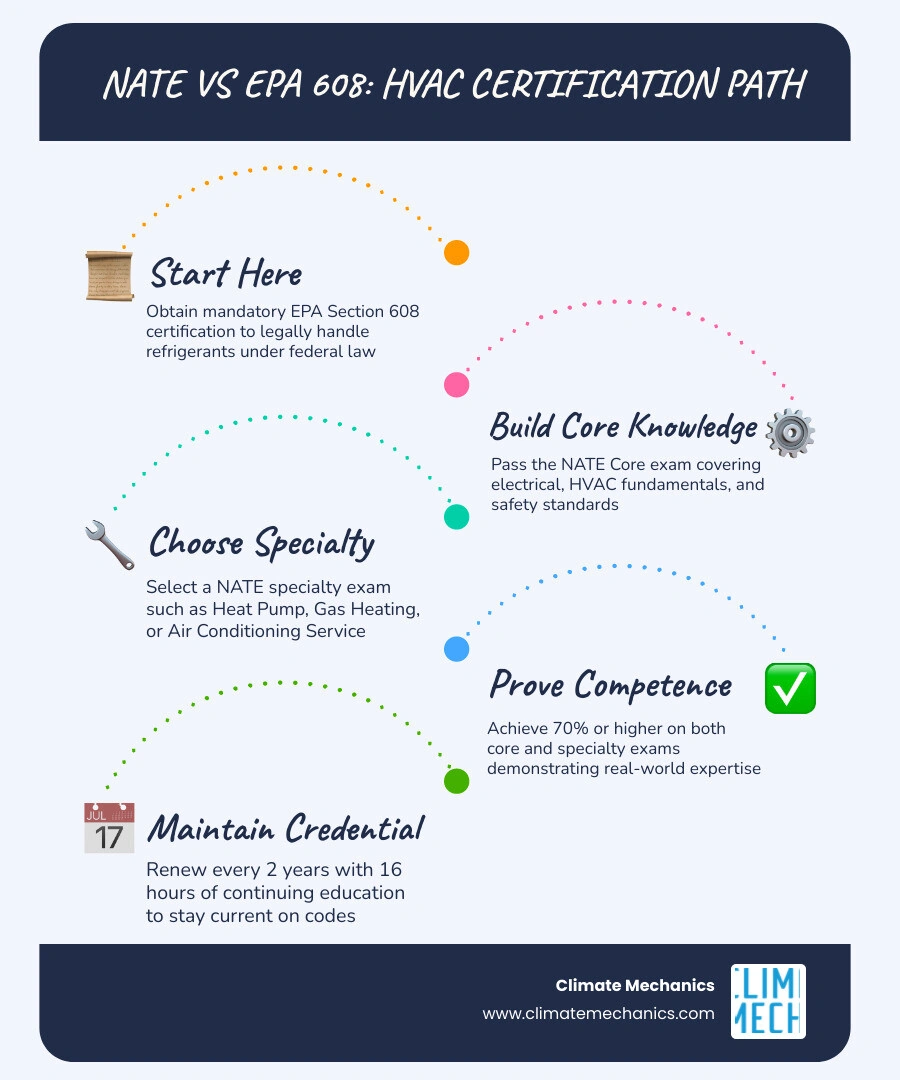
• Exam-based — technicians must score 70% or higher on a core exam plus at least one specialty exam
• Time-limited — certification is valid for two years and requires 16 hours of continuing education to renew
• Independently verified — you can confirm any technician's status at natex.org
If you are a South Jersey homeowner dealing with inconsistent heating or cooling, unexplained energy bill spikes, or a string of HVAC companies that never seem to fix the problem for good, the credentials of the technician walking into your home matter more than most people realize.
Not every technician who shows up with a van and a tool bag has proven their knowledge to anyone. NATE certification changes that. It is a third-party signal — backed by the EPA and ASHRAE — that the person working on your system has demonstrated real competence, not just logged hours.
Over 41,000 technicians across the country have earned this credential. The ones who have it tend to make fewer mistakes, require fewer return visits, and install equipment in ways that actually hit the efficiency numbers manufacturers promise.
What Does NATE Certified Mean for an HVAC Technician in New Jersey?
Understanding What Does NATE Certified Mean for an HVAC Technician in New Jersey
When you are choosing an HVAC technician to service your home in Marlton, Haddonfield, or Maple Shade, you will see a lot of logos on service trucks. Among those, the North American Technician Excellence (NATE) patch is the most significant.
But what does nate certified mean for an hvac technician in new jersey on a practical, day-to-day level?
Unlike state-level registrations that focus on business licensing, NATE is a voluntary, nationwide credential designed to test actual field competency. It was founded in 1997 as a collaborative effort by major HVAC industry trade associations to establish a clear, uncompromised benchmark for technical excellence.
When a technician is NATE-certified, it means they have chosen to put their skills to the test. They have demonstrated a deep understanding of thermodynamics, electrical systems, airflow dynamics, and complex diagnostic procedures. They aren't just learning on the job at your expense; they have already proven to a national board of experts that they know exactly what they are doing.
NATE Certification vs. Mandatory EPA Section 608 Licensing
It is common for homeowners to confuse NATE certification with other HVAC credentials, particularly the EPA Section 608 certification. However, these serve entirely different purposes.
The EPA Section 608 certification is a federal legal requirement mandated by the Federal Clean Air Act. Anyone who maintains, services, repairs, or disposes of equipment that could release ozone-depleting refrigerants into the atmosphere must hold this certification. It is not optional. If a technician handles refrigerant in your air conditioner or heat pump, they must have this license by law. However, the EPA 608 exam only measures a technician's understanding of environmental safety regulations and refrigerant handling protocols. It does not measure whether they know how to properly diagnose a faulty compressor, wire a thermostat, or design a duct system.
In contrast, NATE certification is voluntary. It tests a technician's practical, real-world competence in installing, repairing, and maintaining heating and cooling systems.
• Legal Requirement — EPA Section 608 Certification: Mandatory by federal law for handling refrigerants — NATE Certification: Completely voluntary, industry-recognized gold standard
• Primary Focus — EPA Section 608 Certification: Environmental safety, refrigerant recovery, and leak prevention — NATE Certification: Technical competence, diagnostics, installation, and repair
• Validity — EPA Section 608 Certification: Lifetime (does not expire) — NATE Certification: Valid for 2 years (requires continuing education to renew)
• Passing Score — EPA Section 608 Certification: Varies by section — NATE Certification: 70% or higher on all required exams
• Who Issues It — EPA Section 608 Certification: EPA-approved testing organizations — NATE Certification: North American Technician Excellence (NATE)
The Rigorous Standards Behind NATE Certification

Earning a NATE certification is famously difficult. The exams are designed to test real-world working knowledge rather than simple memorization. To pass, candidates must score a 70% or higher. The questions are developed by a nationwide committee of HVAC experts who regularly revise the tests to keep pace with changing technology, such as the industry-wide transition to low-GWP (Global Warming Potential) refrigerants in 2026.
The Two Pathways to Proving Field Competence
When looking at what to look for in an HVAC company, understanding how their technicians are certified can give you immense peace of mind. NATE offers two main pathways for technicians to prove their field competence:
1. The Traditional Core + Specialty Pathway: Under this classic model, a technician must pass a 50-question Core Exam covering fundamental HVACR knowledge (including safety, tools, basic construction, basic electricity, and temperature/humidity measurements). After passing the Core, they must pass a 100-question Specialty Exam in their chosen area of focus, such as Air Conditioning Service, Gas Heating Installation, or Heat Pump Service.
2. The Certified HVAC Professional (CHP-5) Pathway: This modern pathway allows technicians to earn their certification through five smaller, highly focused domain exams (30 questions each) taken sequentially. These modules cover HVAC Fundamentals, Electrical and Controls, Comfort and Airflow, Installation, and Service.
Both pathways require an incredible amount of practical experience. NATE recommends that technicians have at least one year of field experience before attempting an installation specialty exam, and at least two years of hands-on experience before taking a service specialty exam.
Ongoing Education and Recertification Requirements
Technology does not stand still, and neither does a NATE-certified technician. Unlike certifications that are earned once and forgotten, a NATE professional credential is only valid for two years.
To maintain their certified status, technicians must complete 16 hours of NATE-approved continuing education (CEHs) every two years and pay a renewal fee. If they fail to complete these hours, their certification expires, and they must retake the difficult exams from scratch. This ongoing requirement ensures that the technician servicing your home in Pennsauken or Willingboro is fully up-to-date on the latest variable-speed heat pumps, smart thermostats, and zoning systems.
Why Hiring a NATE-Certified Professional Protects Your New Jersey Home
Your heating and cooling system is one of the most expensive mechanical investments in your home. Entrusting its care to an uncertified technician can lead to premature system failure, high utility bills, and safety hazards. When you see professional HVAC repair indicators, calling a certified expert is the best way to safeguard your investment.
Why Homeowners Ask: What Does NATE Certified Mean for an HVAC Technician in New Jersey?
New Jersey experiences extreme seasonal weather, from freezing winter nights in Burlington to humid, sweltering summer days in Camden. Our HVAC systems work incredibly hard, and they require precise calibration to operate efficiently.
When a NATE-certified technician handles your system, you receive:
• Fewer Callbacks: Studies show that jobs performed by NATE-certified technicians have significantly fewer installation and repair errors, meaning the job gets done right the first time.
• Lower Utility Bills: An HVAC system that is installed or repaired precisely to manufacturer specifications will run at peak efficiency, saving you money on monthly energy bills.
• System Longevity: Improper airflow or incorrect refrigerant charges can cause compressors and heat exchangers to fail years ahead of schedule. Certified technicians ensure your system is set up for a long, reliable lifespan.
• Reliable Furnace Repairs: During a cold South Jersey winter, you cannot afford diagnostic guesswork. Hiring NATE-certified technicians for reliable furnace repairs by technicians ensures your heating system is diagnosed safely and accurately.
Impact on New Jersey Heat Pump Rebates and Incentives
In 2026, New Jersey homeowners have access to substantial state and federal financial incentives for upgrading to high-efficiency electric heat pumps. Programs like the New Jersey Clean Energy Program and various utility-sponsored rebates offer thousands of dollars in savings.
However, these rebate programs have strict guidelines. To qualify for the maximum financial incentives, the state often requires that the equipment be installed by an approved contractor employing certified technicians. Because bad installations can cause a 15% to 40% loss in system efficiency, rebate programs use NATE certification (or equivalent credentials) as a quality-assurance gatekeeper. If your system is installed incorrectly by an uncertified technician, you could lose out on both your rebate and your expected energy savings.
How to Verify Your Technician's NATE Credentials
You should never simply take a company's word that their technicians are NATE certified. Because NATE certifications are awarded to individual technicians and not to the HVAC company as a whole, credentials can vary from one employee to another.
To verify that the specific technician sent to your home in Audubon, Collingswood, or Camden is certified, follow this simple process:
1. Ask for the Technician's Name: When scheduling your service or when the technician arrives, ask for their full name and their NATE ID card.
2. Visit the Registry: Go to the official NATE website at natex.org and use the "Verify a NATE ID" or "Find a Technician" search tool.
3. Check their Specialty Stamps: Ensure their specific certifications match the work they are performing. For example, if they are installing a new heat pump, verify that they hold a NATE specialty stamp in Heat Pump Installation or Heat Pump Service.
Verifying these credentials is a key step in protecting your home. If you want to see why specialized training makes such a massive difference, check out these 4 reasons to choose Climate Mechanics for air conditioning services.
Frequently Asked Questions About NATE-Certified HVAC Experts
Is NATE certification legally required for HVAC technicians in New Jersey?
No. NATE certification is a voluntary, third-party credential. In New Jersey, the state requires HVAC contractors to hold a Master Hearth Specialist or Master HVACR Contractor license to run an HVAC business, and technicians must hold an EPA Section 608 license to handle refrigerants. NATE is an additional credential that top-tier technicians earn to prove their superior expertise.
Which NATE specialties are most important for New Jersey homes?
Because New Jersey experiences both hot summers and freezing winters, the most critical specialties for local technicians are Heat Pump Service/Installation, Gas Heating Installation/Service (for natural gas furnaces), and Air Conditioning Service.
How often do technicians have to renew their NATE certification?
NATE certifications expire every two years. To renew, technicians must complete 16 hours of continuing education courses to keep up with the latest industry standards and equipment advancements.
Trust South Jersey's Certified Comfort Experts
When you need heating, cooling, or indoor air quality services in Maple Shade, Pennsauken, Audubon, Willingboro, Collingswood, Haddonfield, Burlington, Marlton, or Camden, you deserve to work with professionals who have proven their skills at the highest level.
At Climate Mechanics, we bring over 38 years of NATE and NCI-certified expertise straight to your door. We do not believe in cutting corners or sending uncertified, inexperienced technicians to diagnose your home's vital systems. Our team is fully committed to ongoing training, absolute technical precision, and the personalized service that our South Jersey neighbors have trusted for decades.
Do not leave your home's comfort and safety to chance. Schedule Professional HVAC Services with the certified experts at Climate Mechanics today!
