


The Gas Pedal Myth: Why Lowering the Thermostat Doesn't Mean Faster Cooling
If you are wondering what actually happens when you set your thermostat to 65 during a 95-degree South Jersey day, the reality is that turning the dial down to an extreme temperature doesn't force your home to cool down any faster. In our years of providing cooling services throughout Cinnaminson NJ, our team at Climate Mechanics has seen this scenario play out countless times during peak summer heat waves. It is a common misconception that residential HVAC units operate like a car's gas pedal—press it harder, and the engine runs faster. When you walk into a sweltering house after a long shift and immediately drop the dial, you might think you are commanding the system to blast freezing air into the rooms, but you are simply asking the equipment to do the mechanically impossible.
Your thermostat is essentially a binary switch. It tells the cooling equipment to turn on and stay on until the target temperature is reached, at which point it turns off. The air blowing out of your vents will be the exact same temperature whether your dial is set to a reasonable 72 degrees or a highly optimistic 65-degree thermostat setting. Pushing the target down to an unattainable number does not increase the intensity or the speed of the cooling cycle. Instead, it forces the compressor to run continuously without its necessary resting periods, causing immense mechanical strain rather than providing faster relief. Whether you are looking to upgrade your air conditioning systems for better efficiency or you need reliable AC repair in Cinnaminson because your current unit is struggling, understanding this basic mechanical truth is the first step to maintaining a comfortable home.
How Your Central AC Equipment Actually Operates Under Maximum Load
The problem: Homeowners often assume that an air conditioner creates cold air and pumps it into the house. Because of this belief, it feels logical to ask the system to create "colder" air when the house is uncomfortably hot.
The cause: Air conditioners do not actually create cold air; they remove heat. The system absorbs thermal energy from your indoor air and physically transfers it outside. Standard single-stage compressors operate in a strictly binary fashion: they are either running at 100% capacity or they are completely turned off. When you lower the thermostat, you are not increasing the capacity of the unit. You are only extending the amount of time it stays in the "100% on" position. Reaching a comfortable temperature is entirely a function of time, not intensity.
The solution: Recognizing the physical limits of your central AC equipment allows you to set realistic expectations for cooling recovery times. At Climate Mechanics, we often explain to homeowners that the mechanical process of heat transfer operates at a fixed rate based on the size and design of your specific equipment. Even the most advanced systems have absolute maximum output thresholds that cannot be bypassed simply by changing the number on the wall.
Single-Stage vs. Variable-Speed Compressors
To fully grasp why the "gas pedal" approach fails, it helps to understand the difference between the two main types of residential compressors. Neither type can rush a 30-degree temperature drop, but they handle the heat load differently.
• Single-Stage — Operation Style: 100% ON or 100% OFF. No in-between speeds. — Response to Extreme Heat Settings: Blasts at full capacity continuously until the unattainable setpoint is reached, often leading to mechanical fatigue.
• Variable-Speed — Operation Style: Adjusts output in small increments (e.g., 30% to 100%) to match the exact cooling demand. — Response to Extreme Heat Settings: Ramps up to its 100% design limit during peak heat but cannot magically exceed its maximum capacity to cool the home faster.
Even with a high-efficiency variable-speed unit, 95-degree South Jersey summer days will max out the system's capabilities. Once the unit hits 100% output, it is doing everything mechanically possible to remove heat. Lowering the thermostat further changes absolutely nothing about the equipment's current performance.
The 20-Degree Differential Rule Explained
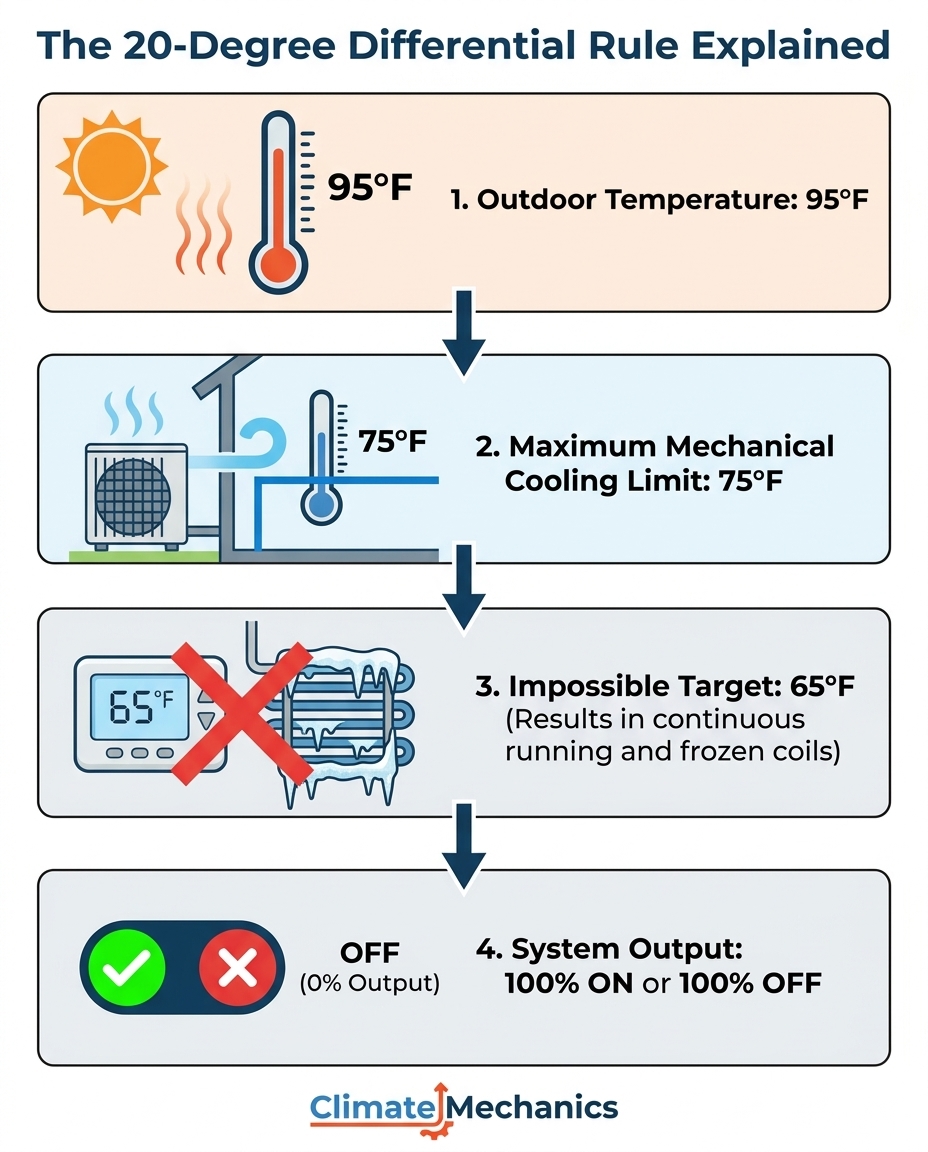
The engineering behind residential climate control is based on specific design limits established by ASHRAE (The American Society of Heating, Refrigerating and Air-Conditioning Engineers). One of the most fundamental principles in this field is the 20-degree differential rule. Residential systems are specifically sized and designed to maintain a maximum 20-degree difference between the indoor air and the outdoor air.
When you attempt to force a larger temperature gap on 95-degree South Jersey summer days, you run into the harsh mathematical reality of HVAC sizing. Here is exactly how your home's environment fights against the cooling cycle when pushed past its design limits:
1. Thermal Infiltration: Heat naturally moves toward cooler spaces. When it is sweltering outside, thermal energy constantly pushes into your home through the roof, the walls, and the foundation.
2. Attic Heat Transfer: During peak afternoon hours, a poorly ventilated attic can reach temperatures exceeding 130 degrees. This massive blanket of heat radiates down through your ceiling, fighting the air conditioner's progress every step of the way.
3. Window Solar Gain: Sunlight streaming through south- and west-facing windows acts like a greenhouse, actively warming the indoor air faster than the system can remove the heat.
4. Continuous Operation: Because the heat is entering the home almost as fast as the system can remove it, an impossible target like 65 degrees ensures the equipment never cycles off. It simply runs endlessly, consuming massive amounts of electricity without ever satisfying the thermostat.
Asking a residential system to maintain 65 degrees when the outdoor thermometer reads 95 degrees is asking for a 30-degree differential. Standard equipment is simply not built to overcome that much thermal resistance.
South Jersey Humidity: The Hidden Enemy of Your Cooling System
Temperature is only half of the comfort equation. To understand why your system struggles on peak summer afternoons, you have to look at the severe impact of regional moisture. South Jersey's oppressive summer humidity severely impacts cooling speed, fundamentally changing how the equipment operates. Ninety-five degrees in a dry, arid climate behaves very differently than 95 degrees with a 75-degree dew point.
Sensible heat is what you see on the thermometer—the actual temperature of the air. Latent heat represents the moisture suspended in that air. An air conditioner must act as a dehumidifier first. Before the sensible temperature in your living room can drop by a single degree, the equipment has to remove the heavy, latent moisture from the environment. High dew points in the mid-Atlantic region force the equipment to work twice as hard, spending massive amounts of energy just wringing water out of the air. This dual burden is exactly why you might find your AC running constantly in New Jersey summer heat without making the house feel significantly colder.
How Dew Point Affects the Cooling Cycle
The science of condensation dictates how well your system performs. Warm indoor air is pulled over the freezing cold evaporator coil inside your ductwork. When the humid air hits the cold metal, the moisture condenses into water droplets, which drip into a pan and drain away.
Because the system must spend its energy pulling this water out of the air before it can effectively lower the room's sensible temperature, high-humidity days drastically slow down the cooling process. Furthermore, indoor moisture sources like boiling pasta, running the dishwasher, or taking hot showers add additional latent heat load to the house. When you set the thermostat to an unattainable 65 degrees, the system is trapped in a never-ending battle against both the outdoor heat and the heavy indoor moisture.
The Danger Zone: Frozen Evaporator Coils and Compressor Failure
The problem: Forcing your unit to run continuously by setting the thermostat too low doesn't just waste electricity; it actively endangers the most expensive components of your HVAC system. The most common consequence of this "gas pedal" myth is a completely frozen evaporator coil.
The cause: Air conditioning systems are designed to cycle on and off. These resting periods allow the indoor coil to shed excess condensation and normalize its pressure. When an impossible 65-degree target forces continuous operation without cycling, the temperature of the refrigerant inside the coil drops below freezing. The heavy condensation we discussed earlier stops dripping into the drain pan and instead freezes directly onto the metal fins. Within hours, this frost builds into a solid block of ice. This ice severely restricts airflow, which is why you might feel warm air blowing from the vents even though the outdoor unit is roaring. Worse, this restriction can lead to liquid slugging—a catastrophic failure where unevaporated, liquid refrigerant travels backward into the compressor, destroying it from the inside out.
The solution: Preventing this kind of catastrophic breakdown requires realistic thermostat settings and routine AC maintenance to ensure proper airflow. One Cinnaminson NJ homeowner experienced this exact sequence of events when their unit abruptly stopped working on a sweltering Sunday evening. Because the system had been pushed beyond its limits during a heat wave, it required emergency intervention. Our Climate Mechanics dispatch team sent a technician out within an hour, who diagnosed the severe mechanical strain and was able to get the system repaired and fully operational before the night ended. A pattern we see often is that trying to cool the house faster results in a complete system breakdown during the absolute hottest time of the year.
What to Do Instead: Smart Thermostat Strategies for Peak Summer
Surviving a mid-Atlantic heat wave requires working with your equipment, not against it. Instead of relying on a 65-degree thermostat setting that will only freeze your coils, use these smart strategies to maintain indoor comfort safely:
• Set a realistic target: Keep your thermostat set between 72 and 78 degrees during extreme heat waves. This respects the 20-degree differential rule and allows the system to cycle normally.
• Pre-cool the house early: Drop the temperature a few degrees in the early morning when the outdoor air is cooler and the system doesn't have to fight peak solar radiation. Let the house coast through the hot afternoon.
• Utilize ceiling fans: Fans do not lower the temperature of a room, but they create a wind-chill effect on your skin. This allows you to feel comfortable at 75 degrees without forcing the AC to work harder.
• Block solar heat gain: Keep your blinds, shades, and curtains closed on south- and west-facing windows during the afternoon. Blocking direct sunlight drastically reduces the thermal load the AC has to remove.
• Avoid adding indoor heat: Delay running the oven, the clothes dryer, or the dishwasher until the sun goes down. These appliances add massive amounts of sensible and latent heat to your living space.
Frequently Asked Questions About Summer AC Performance
Does setting the AC lower make it cool faster?
No, setting the AC lower does not make it cool the house faster. Your thermostat acts as an on/off switch, not a throttle for cooling speed. The system will blow the exact same temperature air whether the dial is set to 72 degrees or 60 degrees; a lower setting only forces the unit to run for a longer, continuous period.
What is the 20 degree rule for air conditioning?
The 20-degree rule is an HVAC design standard stating that residential cooling systems are built to maintain a maximum 20-degree difference between indoor and outdoor temperatures. If it is 95 degrees outside, the system can safely and efficiently maintain an indoor temperature of about 75 degrees. Pushing beyond this differential causes continuous running and excessive mechanical wear.
Why does my AC freeze up in the summer?
Your AC freezes up when the system runs continuously without cycling, causing the indoor evaporator coil's temperature to drop below freezing. This turns standard condensation into solid ice. It is often caused by setting the thermostat too low during extreme heat, combined with restricted airflow from dirty air filters or closed vents.
Why is my AC running constantly but not cooling the house below 75?
If your AC is running constantly but hovering around 75 degrees on a very hot day, it has likely reached its maximum mechanical capacity. The system is removing heat as fast as it enters your home. High regional humidity also forces the unit to spend most of its energy removing moisture from the air before it can lower the actual temperature.
What is the safest temperature to set my thermostat during a 95-degree heat wave?
The safest temperature to set your thermostat during a 95-degree heat wave is between 74 and 78 degrees. This setting keeps the demand within the safe 20-degree differential limit, ensuring the compressor can cycle on and off normally. This prevents the coils from freezing while effectively managing indoor humidity.
Keeping Your System Running Safely Through the Hottest Days
Patience and realistic expectations are the keys to surviving extreme heat waves without suffering a sudden mechanical breakdown. When the outdoor temperature spikes, it is completely normal for your home to take longer to cool down. A system struggling to maintain a 20-degree differential might just be facing normal climate limits and doing the best it mathematically can. However, if you notice sudden drops in performance, warm air coming from the vents, or ice forming on the refrigerant lines in Cinnaminson NJ, it is time for an expert look. Don't let a frozen coil ruin your summer comfort—addressing performance issues early ensures your system stays efficient and reliable when you need it the most.
