



Surviving a Mid-Summer AC Breakdown: The R-22 Dilemma
July peak heat and humidity in South Jersey is already here, and if your air conditioner just stopped cooling, you are likely asking yourself: do I really need to replace my R-22 AC unit mid-summer or can it be patched? At Climate Mechanics, we know firsthand how incredibly stressful it is to lose your home's cooling power right when you need it most. When the indoor temperature starts climbing toward 90 degrees, our customers' first instinct is usually to find the fastest, easiest fix to get the cold air flowing again.
However, if your home relies on an older air conditioning system that uses R-22 refrigerant, what used to be a simple service call is now a highly complex situation. The decision between attempting a temporary patch and investing in a full system replacement carries significant long-term consequences for your comfort and your home's energy usage. In this guide, we will walk through the realities of the R-22 phase-out, the technical challenges of patching aging coils, and how to evaluate whether a temporary fix is worth the risk during extreme weather.
For expert air conditioning services or immediate AC repair in Cinnaminson, our team is ready to restore your home's comfort safely and effectively.
Understanding the 2020 EPA R-22 Phase-Out
To understand why patching an older air conditioner is no longer a straightforward process, you have to look at the regulatory changes that took effect over the last decade. For decades, R-22 (commonly known by the brand name Freon) was the standard refrigerant used in residential cooling systems. While it did a fantastic job of absorbing and removing heat from homes across Cinnaminson NJ and surrounding South Jersey areas, it was eventually discovered to contain ozone-depleting substances.
To protect the environment, the Environmental Protection Agency (EPA) mandated a gradual phase-out of R-22 under the Clean Air Act. This transition did not happen overnight, but it culminated in a hard deadline that permanently changed the HVAC industry.
Why is R-22 So Scarce?
The short answer is: No new R-22 is being made. On January 1, 2020, the EPA completely banned the production and import of R-22 in the United States. Because manufacturers can no longer produce it, the only R-22 available today is recovered, recycled, or reclaimed from older systems that have been taken out of service.
When a homeowner upgrades their old AC, the remaining R-22 is safely extracted by a licensed professional, sent to a specialized facility, filtered of impurities, and returned to the market as reclaimed refrigerant. Because this supply is finite and constantly shrinking, sourcing it has become an extreme bottleneck. "Topping off" a system is no longer a standard or simple maintenance task—it requires accessing a highly restricted, heavily regulated, and rapidly dwindling supply.
Is it Illegal to Use R-22?
Many homeowners worry that simply turning on their older AC unit violates the law. It is completely legal to own and operate an existing R-22 air conditioning system. You are not required by law to replace a functioning unit just because it uses the older refrigerant.
The legal restrictions apply entirely to the manufacturing, importing, and handling of the chemical itself. Only EPA-certified technicians are legally permitted to purchase, handle, recover, or recharge R-22. You cannot buy it yourself, and HVAC professionals are required to follow strict protocols to ensure none of it vents into the atmosphere during a repair. The challenge is not legality—it is the sheer difficulty of finding the refrigerant when your system develops a leak.
Can an R-22 Refrigerant Leak Actually Be Patched?
When your system is low on refrigerant, it means there is a physical hole or crack somewhere in the closed-loop system. Air conditioners do not "consume" refrigerant like a car consumes gas; if the level is low, a leak is absolutely present. But can that leak actually be fixed?
The technical reality: Locating and sealing a leak in an aging R-22 system is highly challenging. Older copper coils are often severely degraded by years of formicary corrosion—a process where volatile organic compounds in your home's air slowly eat away at the metal, making it paper-thin and porous like a sponge.
• Leak detection is difficult: Technicians must use electronic sniffers, UV dyes, or pressurized nitrogen to find the exact source of the leak. In an older system, there are often multiple microscopic leaks rather than one large hole.
• Brazing risks: Attempting to weld or braze a patch onto paper-thin, corroded copper often causes the surrounding metal to melt or crack, creating new leaks right next to the old one.
• Chemical sealants: Sometimes, chemical leak sealants are proposed as a last resort. However, these sealants can react with moisture in the system, gumming up the compressor and causing a catastrophic total system failure.
The extreme July peak heat and humidity in our region forces a struggling, undercharged R-22 system to work exponentially harder. If a patch fails under the stress of a heatwave, the system will break down completely right when it is needed most. This compounding risk is exactly why many homeowners wonder is a 12 to 15-year-old AC worth fixing in the first place.
When dealing with aging equipment, clear communication and logical planning are critical. In our years of providing HVAC services across Cinnaminson and South Jersey, the Climate Mechanics team sees this pattern often: a homeowner hopes for a quick patch on an R-22 system, only to have the same corroded coil fail again weeks later during a peak heatwave. Because our technicians assess the problem thoroughly and provide a logical path forward, our customers understand the proposed solution and have full confidence in the quality of the work. That same level of transparent, forward-looking guidance is exactly what we provide when evaluating your residential R-22 leak.
Evaluating the Cost-Benefit: Repair vs. Replace
When faced with a mid-summer breakdown, you need a transparent framework to evaluate your options without relying on guesswork. Because reclaimed R-22 is so scarce, the cost to recharge a leaking system is highly unpredictable and heavily dependent on daily market availability. Instead of looking at short-term fixes, it helps to use a mathematical approach to gauge the overall health of your investment.
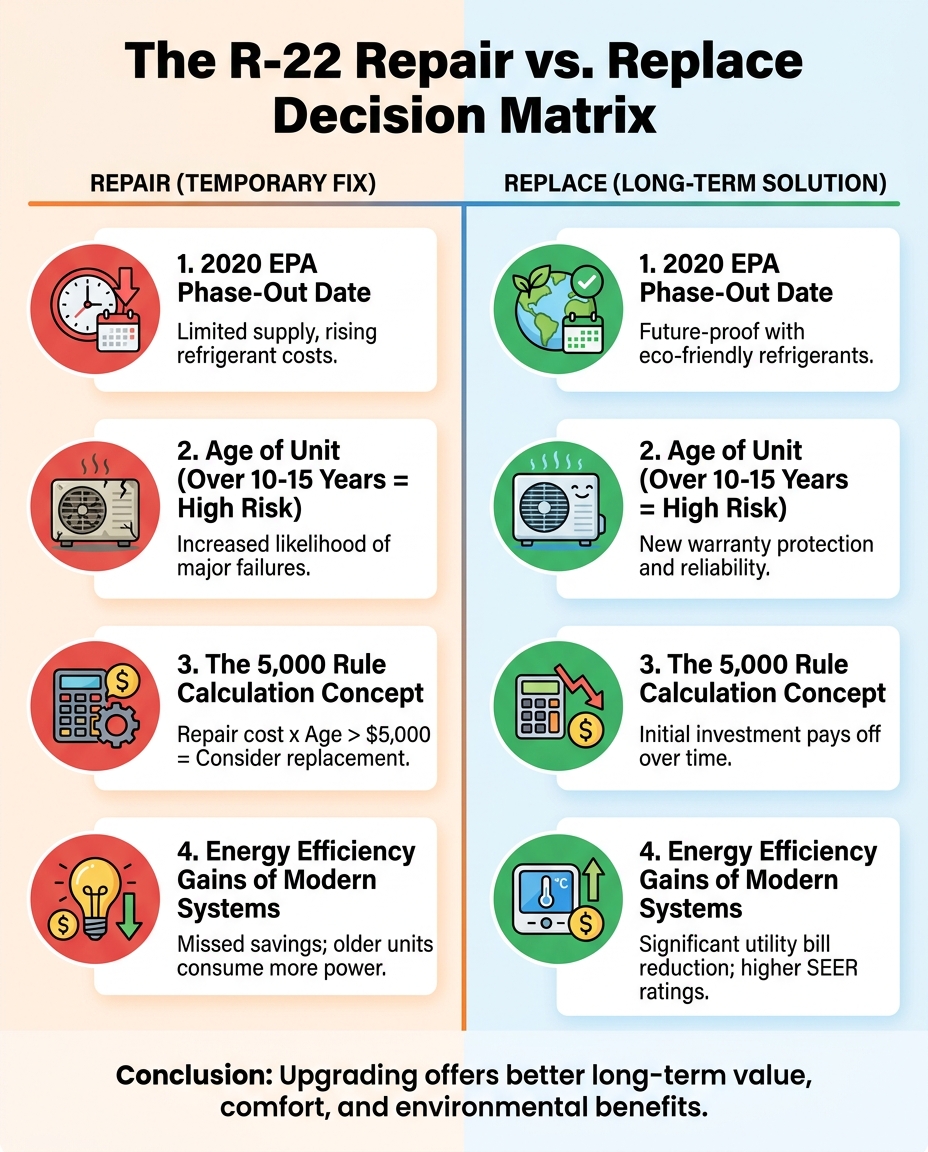
The 5,000 Rule: Our team at Climate Mechanics frequently uses this industry guideline to help homeowners make objective decisions. You multiply the age of your equipment by the estimated cost of the repair. If the resulting number exceeds 5,000, our professional consensus strongly suggests that replacing the unit is a wiser financial decision than repairing it.
Beyond the immediate repair, you must also factor in the hidden costs of keeping an obsolete system running. Older, struggling units draw significantly more electricity to provide the same amount of cooling, driving up your monthly utility bills. Furthermore, a patched system is highly prone to repeated breakdowns, leading to multiple service call fees over a single summer.
Comparison: Patching vs. Upgrading
• Reliability — Patching an Old R-22 Unit: Low. Patches on degraded copper often fail under peak summer stress. — Installing a New Modern System: High. Brand new components designed to handle extreme heatwaves.
• Energy Efficiency — Patching an Old R-22 Unit: Poor. Aging compressors and low refrigerant levels waste electricity. — Installing a New Modern System: Excellent. High SEER2 ratings significantly reduce monthly energy usage.
• Refrigerant Supply — Patching an Old R-22 Unit: Scarce. Relies entirely on limited reclaimed R-22 supplies. — Installing a New Modern System: Abundant. Uses modern, environmentally friendly refrigerants.
• Warranty Coverage — Patching an Old R-22 Unit: None. You assume all financial risk for future breakdowns. — Installing a New Modern System: Comprehensive. Backed by robust manufacturer warranties.
Empowering yourself with this knowledge allows you to make a decision based on long-term home reliability rather than taking a short-term gamble on a temporary fix. For a permanent solution, exploring an AC replacement ensures your home stays consistently cool for years to come.

Long-Term Benefits of Upgrading from R-22 Mid-Season
While the initial thought of replacing your air conditioner during a heatwave can feel overwhelming, the long-term benefits of upgrading to a modern system are substantial. Today's HVAC technology has advanced lightyears beyond the standard R-22 units installed a decade or two ago.
Transitioning to modern refrigerants: New air conditioners and heat pumps utilize modern refrigerants like R-410A or the newer R-454B. These refrigerants are readily available, highly efficient, and designed to have a significantly lower environmental impact. You will never have to worry about scarcity or phase-out bans when scheduling routine maintenance for these modern systems.
Superior comfort and humidity control: Surviving July peak heat and humidity requires more than just cold air; it requires active dehumidification. Modern high-efficiency systems often feature two-stage or variable-speed compressors. Instead of blasting on at 100% capacity and shutting off abruptly, they run at lower, continuous speeds. This constant air circulation removes significantly more moisture from your indoor air, making your home feel cooler and more comfortable at higher thermostat settings.
Financial incentives and peace of mind: Upgrading from an obsolete unit to a qualifying high-efficiency system may make you eligible for generic state energy rebates and federal tax credits. (Always verify current incentive programs with your utility provider or a tax professional to see what applies to your specific installation). Furthermore, a new system comes with a fresh manufacturer warranty.
Warranty protection can be a lifesaver. For instance, our technicians recently responded to a local homeowner whose AC wouldn't turn on during the very first hot day of the year. Because they had upgraded to a modern system with us, their manufacturer warranty was fully honored and covered the necessary components, resulting in a repaired unit without the stress of massive unexpected charges. When you upgrade to a new system with Climate Mechanics, you secure that exact kind of robust, long-term protection, ensuring you won't be left sweltering if a part fails.
Frequently Asked Questions About R-22 and AC Leaks
Is it worth fixing an R22 AC unit?
In most cases, it is not worth fixing an R-22 AC unit if it requires a major repair or a refrigerant recharge. Due to the extreme scarcity of reclaimed R-22 and the likelihood of aging components failing soon after, investing in a modern, highly efficient replacement is the safer, more reliable choice.
Can you still get R-22 freon?
Yes, but it is extremely limited. The EPA banned the production and import of new R-22 in 2020. Today, licensed HVAC professionals can only source reclaimed or recycled R-22, making it increasingly difficult to find and highly unpredictable to source during peak summer demand.
What happens if my R-22 AC leaks?
If your R-22 AC leaks, the system loses its cooling capacity and runs constantly, which drastically increases your energy bills. Running a system with low refrigerant also risks catastrophic damage to the compressor. A licensed professional must locate and seal the leak before attempting to recharge the system.
How long will a patched AC leak last?
The longevity of a patched AC leak is highly unpredictable. It depends entirely on the condition of your existing copper coils and the internal pressure of the system. In older, corroded R-22 systems, a patch may hold for a few years, or it could fail within days during extreme heatwaves.
Does a new AC system cool better than a patched R-22 unit?
Absolutely. A new AC system cools significantly better than a patched R-22 unit. Modern air conditioners and heat pumps provide superior humidity control, more consistent airflow, and highly efficient temperature regulation, completely eliminating the hot and cold spots common with aging, undercharged units.
Make the Right Choice for Your Home's Comfort
Facing a major refrigerant leak in the middle of a South Jersey summer is never easy. While the instinct to apply a quick patch is completely understandable, the risks of relying on scarce R-22 and degraded copper coils often outweigh the temporary rewards. A patch that fails during a severe heatwave leaves your family uncomfortable and forces you to start the repair process all over again.
You deserve a home cooling system you can trust. We encourage you to have a licensed professional thoroughly evaluate your specific system to determine the safest, most cost-effective path forward. If you are tired of worrying whether your old unit will survive the next heatwave, reach out to our team today to schedule a comprehensive inspection or consultation. We will help you find a reliable solution that keeps your home perfectly comfortable all summer long.
