



Is Surviving a Sweltering Weekend Without AC Worth the Risk?
Are you staring at a blank thermostat on a Saturday afternoon, wondering if paying for a weekend AC dispatch vs waiting until Monday in extreme humidity is actually worth the extra cost? When the air conditioner suddenly stops blowing cold air right at the start of the weekend, the immediate panic is entirely understandable. You are suddenly faced with a frustrating dilemma: pay an emergency dispatch fee right now, or try to tough it out for 48 hours until regular business hours resume.
This decision is about much more than just temporary physical discomfort. In a South Jersey high-humidity summer, a home can turn into an oven incredibly quickly during July's peak weather. The central issue is not just the rising temperature on the thermostat, but the rapid accumulation of dangerous indoor moisture that threatens both your family's health and your property.
When evaluating your air conditioning services options, you need an honest, objective guide to help you make the safest, most cost-effective choice. Sometimes, paying the weekend fee is the only responsible action. Other times, you can safely set up a few box fans and wait it out. Here is exactly how to tell the difference.
Understanding the AC's Role in Fighting Extreme Indoor Moisture
Most homeowners think of their air conditioner purely as a cooling machine. However, its secondary function—dehumidification—is arguably just as critical, especially in coastal and high-moisture climates. An air conditioning system is designed to remove latent heat (humidity) alongside sensible heat (temperature). As warm indoor air passes over the freezing cold evaporator coil, the moisture in that air condenses into water droplets and drains away outside.
The Environmental Protection Agency (EPA) recommends keeping indoor humidity levels between 30 and 50 percent for optimal health and property preservation. When your system fails during peak summer, your home loses its primary mechanism for moisture control. Without the AC pulling water out of the air, the indoor environment rapidly absorbs the outdoor mugginess.
When you have indoor humidity exceeding 60%, the air feels significantly hotter and heavier than the thermostat actually reads. This is because high humidity prevents human sweat from evaporating efficiently, disrupting your body's natural cooling process. A house sitting at 78 degrees with 40% humidity feels comfortable. That same house at 78 degrees with 75% humidity feels stifling, sticky, and exhausting.
If you find yourself needing AC repair in Cinnaminson or the surrounding areas, understanding this moisture dynamic is the first step in deciding whether your situation is a true emergency.
Clear Signs You Need an Immediate Weekend AC Dispatch
There are specific scenarios where waiting until Monday is not just uncomfortable, but actively dangerous. You should never gamble with extreme heat when certain vulnerability factors are present in the home. Objective criteria can help you determine when a weekend emergency call is absolutely necessary.
Health and Safety Red Flags
Certain household members are highly susceptible to heat-related illnesses. If your home includes infants, elderly individuals, or family members with respiratory conditions like asthma or COPD, a broken AC during a heatwave is an immediate hazard. You must act quickly if you notice signs of heat exhaustion in family members or pets, such as heavy panting, lethargy, dizziness, or nausea.
Additionally, specific mechanical warning signs dictate an immediate shutdown and professional intervention. Follow these numbered steps to evaluate your risk:
1. Check the heat index: Look at the "feels like" temperature on your local weather app. If the indoor heat index is pushing past 85 degrees and continues to climb, the environment is becoming hazardous.
2. Assess vulnerable residents: Confirm the physical well-being of older adults, babies, and pets. They cannot regulate their body temperature as efficiently as healthy adults.
3. Look for electrical dangers: If you smell burning plastic, ozone, or notice sparking near the indoor air handler or outdoor condenser, shut the system off at the breaker immediately. Electrical faults are severe fire risks.
4. Evaluate the forecast: A complete system failure during a multi-day heatwave means the house will not cool down overnight, offering zero relief.
When this happens in our area, quick action is often the only safe path forward. In one instance, a local homeowner faced a complete AC failure on a Sunday evening. Because they recognized the health risks for their family, a technician was dispatched immediately, and the unit was fixed and running within an hour. This is exactly why emergency AC repair in Haddonfield and across South Jersey is genuinely available 24 hours a day—true emergencies warrant the dispatch fee to protect your family.
Secondary Damage: What Happens When Indoor Moisture Spikes
While personal comfort is usually the first concern, the hidden danger of a broken AC lies in the structural damage it can cause to your home. Shifting the focus from temperature to home preservation often clarifies the decision to call for weekend service.
The Problem: South Jersey's heavy summer moisture accelerates indoor damage far faster than in dry heat climates. When the air becomes stagnant and heavy, your home's interior materials begin acting like giant sponges.
The Cause: Mold and mildew spores are naturally present in the air all around us. They remain dormant until they find the right combination of warmth and moisture. When you have indoor humidity exceeding 60%, mold can begin actively growing on drywall, fabrics, and inside ductwork within 24 to 48 hours. Furthermore, expensive hardwood floors and custom cabinetry are highly sensitive to moisture swings. High humidity causes wood fibers to swell, leading to cupping, buckling, and permanent warping.
The Solution: You have to weigh the upfront cost of a weekend AC dispatch fee against the massive potential cost of water or mold damage remediation. Replacing a section of warped hardwood flooring or hiring a professional mold mitigation team will cost thousands of dollars—far exceeding any emergency HVAC service fee. If you have noticed your AC running constantly in New Jersey summer heat leading up to the failure, the system was likely already struggling to manage the moisture load, meaning the house will become saturated even faster once it breaks down entirely. Preventing secondary property damage is a completely valid, financially sound reason to call for emergency service.
When It Is Generally Safe to Wait for Monday Morning Repairs
An honest contractor will tell you when you don't need to spend extra money. Not every breakdown requires sirens and flashing lights. If the weather is cooperating and your home is structurally sound, you can often save the emergency fee and wait for regular business hours.
If you are experiencing a South Jersey high-humidity summer, but a cool front happens to be moving through, waiting becomes much more viable. Confirm that your home can safely maintain an indoor temperature below 80 degrees. If the house is reasonably comfortable, you can safely hold off.
Before you make any decisions, run through this basic troubleshooting checklist to see if you can resolve the issue without a dispatch at all:
• Check the thermostat settings: Ensure it is set to "Cool" and "Auto," not "Fan On." Someone may have accidentally bumped the settings.
• Inspect the electrical panel: Look for a tripped breaker. Sometimes a momentary power surge will trip the AC breaker. Reset it once (but never more than once, as repeated tripping indicates a dangerous short circuit).
• Examine the air filter: A severely clogged air filter will suffocate the system, causing the evaporator coil to freeze solid. If the filter is caked in dust, replace it, turn the system off to let the ice melt, and try again in a few hours.
• Utilize ceiling fans: Ensure all ceiling fans are rotating counter-clockwise to push air straight down, creating a wind-chill effect that makes the room feel cooler.
• Block out the sun: Close all blinds, shades, and curtains on the south and west-facing sides of the house to block radiant heat.
If you run through this checklist, the indoor environment remains safe, and no vulnerable family members are at risk, waiting until Monday morning is a perfectly acceptable and cost-effective choice.
Side-by-Side Decision Matrix: Emergency Dispatch vs. Waiting
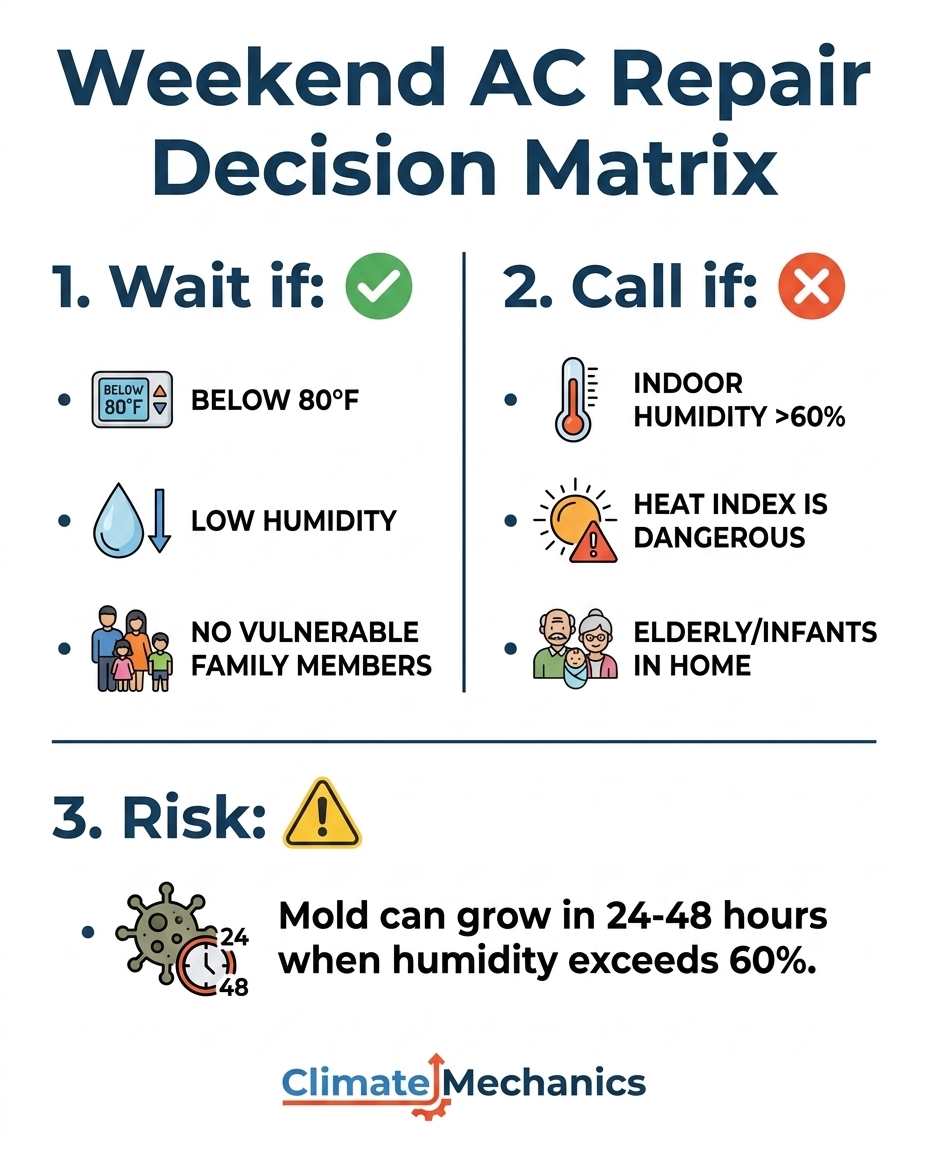
To synthesize everything discussed so far, use this quick-reference comparison to help you make a final, confident decision. Comparing the upfront cost of weekend service versus the hidden costs of property damage and health risks makes the choice clear.
• Indoor Temperature & Heat Index — Call for Weekend Emergency Dispatch: Indoor temps climbing past 82°F with high heat index. — Wait Until Monday Morning: Indoor temps holding steady below 80°F.
• Humidity Levels — Call for Weekend Emergency Dispatch: Indoor humidity exceeding 60%; air feels heavy and wet. — Wait Until Monday Morning: Humidity remains manageable; air feels relatively dry.
• Household Vulnerability — Call for Weekend Emergency Dispatch: Infants, elderly, pets, or respiratory issues present. — Wait Until Monday Morning: Healthy adults who can tolerate temporary warmth.
• Weather Forecast — Call for Weekend Emergency Dispatch: Multi-day heatwave with no overnight cooling relief. — Wait Until Monday Morning: Mild evening temperatures or an approaching cool front.
• System Symptoms — Call for Weekend Emergency Dispatch: Burning smells, sparking, or complete electrical failure. — Wait Until Monday Morning: System running but blowing lukewarm air; no smells.
• Financial Consideration — Call for Weekend Emergency Dispatch: Willing to pay dispatch fee to prevent mold/wood damage. — Wait Until Monday Morning: Prefer to save the fee; home is not at risk of moisture damage.
Real emergencies happen, and when they do, prompt action matters. During a recent summer holiday weekend in Cinnaminson NJ, a local resident experienced a total central air unit failure. They called for help at 6 PM, and because it was treated as a genuine emergency, a technician arrived quickly and had the unit back online within 30 minutes. Whether you ultimately need Cherry Hill AC repair services immediately or decide to schedule for Monday, making an informed choice keeps you in control.
Common Questions About Weekend AC Breakdowns
Is a broken AC considered an emergency?
A broken AC is considered a true emergency when indoor temperatures reach hazardous levels or vulnerable individuals are at risk. If the heat index inside the home surpasses 85 degrees, or if there are electrical burning smells coming from the HVAC equipment, you should request immediate service. For healthy adults in moderate weather, a breakdown is an inconvenience rather than a strict emergency.
How long can a house go without AC in the summer?
A well-insulated house can typically maintain safe temperatures for 12 to 24 hours without AC, depending on outdoor conditions. However, once the sun beats down on the roof for a full day, indoor temperatures will rapidly equalize with the outside heat. If a heatwave is active, the home can become unlivable by the second afternoon.
At what temperature is no AC an emergency?
Medical professionals generally consider indoor temperatures above 90 degrees to be a health emergency, particularly if the humidity is high. For infants and the elderly, the danger zone starts lower, around 85 degrees. If your thermostat reads 85 or higher and is still climbing, it is time to call for professional help.
How long does it take for mold to grow without AC?
Mold can begin germinating and growing within 24 to 48 hours in environments with high humidity. Because your AC acts as the primary dehumidifier, losing that function during a humid summer allows moisture to settle into drywall, carpets, and fabrics. Keeping air circulating with fans can slightly delay this, but it will not stop it entirely.
Does high indoor humidity damage hardwood floors?
Yes, persistent high indoor humidity exceeding 60% will cause hardwood floors to absorb moisture and expand. This expansion leads to cupping, where the edges of the floorboards raise higher than the center, or buckling, where the boards pull away from the subfloor entirely. Prolonged exposure often requires expensive sanding and refinishing.
What should I check before calling for weekend AC repair?
Before paying an emergency fee, check your thermostat settings to ensure it is set to "cool" and the batteries are fresh. Verify that the AC circuit breaker in your electrical panel has not tripped. Finally, inspect your air filter; a completely clogged filter can cause the system to freeze up and stop producing cold air.
Make the Right Call for Your Home's Comfort and Safety
Ultimately, the choice between paying for a weekend AC dispatch vs waiting until Monday in extreme humidity comes down to family safety and preventing severe moisture damage. Surviving a South Jersey high-humidity summer without air conditioning is a miserable experience, but it crosses the line into dangerous territory when indoor humidity spikes and vulnerable family members are left sweltering.
If you review the checklist and realize your situation is deteriorating, do not hesitate to seek help. Reach out to a local professional if you are unsure whether your specific scenario qualifies as an emergency. Securing a clear, objective assessment of your cooling system ensures you make the best financial and safety decision for your home.
