



The July Heatwave Stress Test: When Your AC Suddenly Struggles
Before the worst of the summer heat arrives, understanding exactly how peak July humidity in the Delaware Valley masks hidden AC airflow restrictions can save you from an unexpected cooling breakdown. When the mid-summer weather hits, the air outside doesn't just get hot; it becomes thick, heavy, and intensely oppressive. You know the feeling of stepping out your front door into a wall of moisture. What you might not realize is that your air conditioner feels that exact same heavy burden, and this extreme weather acts as a severe mechanical stress test for your entire system.
To keep your home comfortable, ensuring your air conditioning systems are fully prepared for this seasonal shift is the best way to prevent sudden failures.
A typical pattern we see is a system that worked flawlessly throughout the mild days of May suddenly failing to keep the house cool during a severe mid-summer heatwave. The air coming from the vents feels weak, the cycle runs continuously, and the indoor humidity starts to creep up. The most common homeowner reaction is to walk over to the thermostat and drop the temperature setting from 72°F down to 68°F. Unfortunately, lowering the thermostat further actually exacerbates the underlying mechanical stress. The thermostat is just an on/off switch; setting it lower does not make the air colder or blow faster. It simply forces an already struggling system to run longer.
The core issue during these peak heatwaves is rarely a sudden, catastrophic breakdown. Instead, the extreme weather is exposing a pre-existing airflow restriction that your system could easily hide when the weather was milder. Peak July in the Delaware Valley requires your system to operate at 100% of its designed capacity. If there is even a minor bottleneck in how air moves through your home, the heavy, moisture-laden air will immediately reveal it, leading to poor performance, clammy rooms, and even frozen equipment.
The Physics of "Heavy" Air: Why Blower Motors Work Overtime
To understand why your system struggles, you have to look at the physical properties of the air inside your home. Humid air is physically denser and holds significantly more heat energy than dry air. For your HVAC system, this means the air is quite literally 'heavier' for the blower motor to pull through the return grilles, push through the air filter, and force through the ductwork.
When the dew point spikes in Cinnaminson NJ and the surrounding Delaware Valley, your air conditioner has to perform two completely different jobs simultaneously:
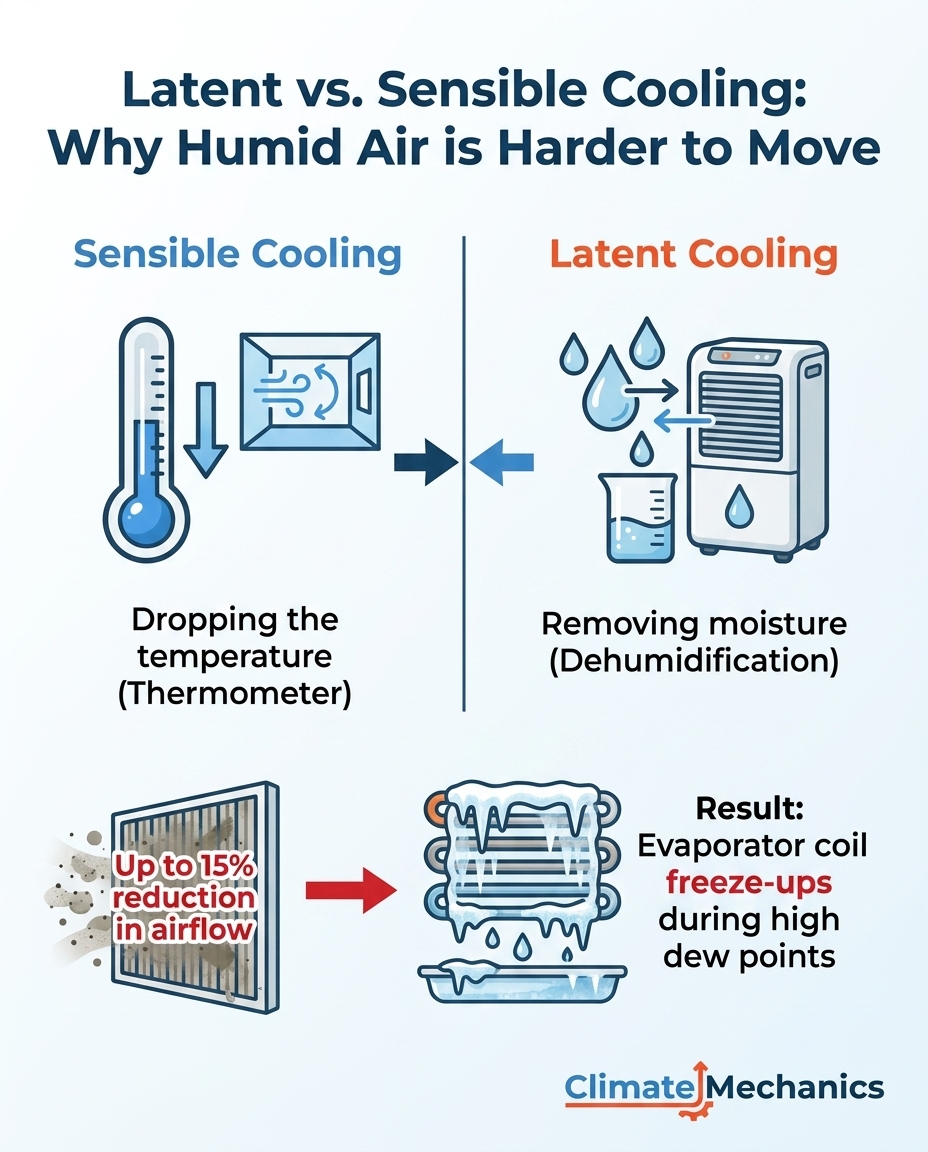
• Sensible Cooling: This is the process of dropping the actual physical temperature of the air, which is what registers on your thermostat.
• Latent Cooling: This is the process of removing invisible moisture from the air. Before your system can effectively lower the temperature, it must extract gallons of water from the indoor air.
During a humid heatwave, your evaporator coil must dedicate massive amounts of energy to latent cooling. The warm, damp air passes over the freezing cold indoor coil, and the moisture condenses into water, which then drains outside. Because the air is so heavy with moisture, the blower motor has to work overtime to maintain the correct volume of air moving over those coils. If you want to learn more about this specific regional challenge, understanding how high humidity makes your AC work harder is a great place to start.
Any restriction in airflow—no matter how small—forces the system to run longer to process the same amount of air. When the blower motor encounters resistance, it either slows down or draws more electrical current, increasing wear and tear on the components and driving up your utility bills.
The Spring Illusion: How Mild Weather Hides 15% Airflow Blockages
The problem: Many homeowners are caught off guard by mid-summer AC issues because the system seemed perfectly fine just a few weeks prior. What they don't realize is that a slightly dirty air filter, a piece of furniture blocking a return vent, or a minor ductwork kink might be reducing the system's total airflow by 10 to 15 percent.
The cause: During mild spring weather, your air conditioner has a tremendous amount of excess capacity. A system designed to cool your home on a 95-degree day only needs to run at a fraction of its potential to keep you comfortable on a 75-degree day. Because the latent heat load (the humidity) is lower, the system can easily push through a minor 15% blockage without any noticeable loss in comfort. The system simply cycles on, cools the house quickly, and shuts off. This creates the "Spring Illusion"—the false confidence that your system is operating at peak efficiency.
The solution: When Peak July in the Delaware Valley arrives, that excess capacity vanishes. The system now requires 100% of its designed airflow capacity just to handle the latent heat load. That 15% blockage that was harmless in May suddenly becomes a critical bottleneck in July, causing the system to run continuously without ever reaching the set temperature. This is why proactive seasonal check-ups are so critical. Scheduling professional AC maintenance in Cinnaminson allows a technician to measure static pressure, check blower motor amperage, and catch these hidden bottlenecks before the heavy summer air exposes them.
Refrigerant Leak or Restricted Airflow? Diagnosing Coil Freeze-Ups
When an air conditioner starts blowing warm air or the copper lines outside become covered in thick white ice, the immediate homeowner assumption is almost always the same: "I must be low on refrigerant." While a refrigerant leak can certainly cause a system to freeze, restricted airflow is just as likely to be the culprit, especially during periods of high humidity.
The actual mechanical process of a freeze-up is straightforward. Your evaporator coil gets extremely cold. It relies on a constant flow of warm, unconditioned air from your home to blow over it, which absorbs the cold and prevents the coil from dropping below freezing. If restricted airflow prevents that warm air from reaching the evaporator coil, the temperature of the coil plummets. The heavy, high-moisture air then freezes directly onto the metal fins, creating a block of ice that completely stops all cooling.
This specific symptom heavily masks the true problem, leading to misdiagnosis if you don't know what to look for. One homeowner reached out during the summer when a mini split AC unit experienced severe issues caused by another contractor's previous work. The initial assumption was a complex refrigerant failure, but a technician came out within two days to assess the situation. By looking past the obvious assumptions, they quickly identified the true underlying restriction and efficiently repaired the unit.
As local diagnosticians, we know how critical it is to look past the obvious 'low refrigerant' assumption to find the true airflow bottleneck, leveraging deep South Jersey climate expertise to get it right the first time. If you are experiencing these symptoms, seeking professional AC repair in Cherry Hill ensures the root cause is addressed, not just the symptom.
• Ice on Indoor Coil — Restricted Airflow Issue: Yes, caused by lack of warm air passing over the coil to absorb the cold. — Refrigerant Leak Issue: Yes, caused by a pressure drop that forces the coil temperature below freezing.
• Airflow from Vents — Restricted Airflow Issue: Weak, barely blowing, or completely stopped. — Refrigerant Leak Issue: Normal blowing force, but the air feels room-temperature or warm.
• Filter Condition — Restricted Airflow Issue: Often heavily clogged, grey, or collapsed inward. — Refrigerant Leak Issue: Filter may look perfectly clean.
• Professional Diagnostic — Restricted Airflow Issue: Technician checks static pressure and blower amperage. — Refrigerant Leak Issue: Technician uses gauges to check subcooling and superheat levels.
Three Common Airflow Restrictions Exposed by High Dew Points
When Peak July in the Delaware Valley pushes your system to the limit, there are three specific mechanical bottlenecks that most frequently cause the system to fail. Understanding these restrictions can help you maintain better airflow and improve your overall comfort. If you frequently struggle with dust or humidity along with these issues, exploring indoor air quality solutions can provide long-term relief.
1. Dirty or High-MERV Air Filters: The most common culprit is right in your return grille.
2. Blocked Return Vents: Starving the system of the air it needs to breathe.
3. Compromised Ductwork: Hidden leaks or crushed sections in your attic or crawlspace.
The Filter Bottleneck
Standard 1-inch air filters need much more frequent replacement during the peak cooling season. When your system runs for 12 hours a day to fight high humidity, it is filtering three times as much air—and trapping three times as much dust—as it does in the spring. Furthermore, well-intentioned homeowners often purchase the most expensive, highest-MERV rating filters available at the hardware store, thinking they are doing their system a favor. In reality, these dense, hospital-grade filters create a massive static pressure drop. They weave the filter fibers so tightly that the blower motor struggles to pull air through them. Under a heavy summer load, a high-MERV 1-inch filter can choke a system just as badly as a filter completely caked in dirt.
Return Air Starvation
The physics of return air are simple: your air conditioner can only cool the exact amount of air it can pull in. If your system is rated to move 1,200 cubic feet of air per minute (CFM), but your return vents can only supply 900 CFM due to blockages, the system will starve. Common household obstructions frequently restrict this flow. A heavy rug pushed over a floor return, a large sofa backed right up against a wall grille, or heavy drapes falling over a vent can instantly reduce your system's breathing capacity. When the heavy, humid air hits, this starvation leads directly to a frozen coil and a warm house.
Compromised Ductwork
Your ductwork is the circulatory system of your HVAC unit. Minor crushed sections, disconnected joints, or small leaks in the attic become critical failures during a heatwave. If a return duct in a 130-degree attic has a tear, the blower motor will suck that scorching, humid attic air directly into your cooling system, completely overwhelming the evaporator coil's ability to dehumidify the house.
Actionable Diagnostic Steps Before Calling a Professional
If you find yourself sweating in your living room while the AC runs constantly, there are several safe, actionable troubleshooting steps you can take before picking up the phone. Addressing a simple airflow issue might restore your comfort immediately.
• Check and replace the air filter immediately: Pull out your filter and hold it up to a light bulb. If you cannot clearly see light shining through the material, it is restricted and needs to be replaced with a clean, standard-pleated filter.
• Ensure all supply and return vents are fully open: Walk through every room in your home and verify that no furniture, rugs, or drapes are blocking the grilles. Additionally, ensure the louvers are open. Closing vents in unused rooms does not save energy; it actually increases static pressure and makes your system work harder.
• Check the outdoor unit for debris: The condenser coil outside needs to exhaust the heat removed from your home. Ensure there are no tall weeds, leaves, or yard debris packed against the metal fins blocking the exhaust airflow.
• Safely thaw the system if frozen: If you notice ice on the indoor coil or the outdoor copper lines, turn the thermostat from 'Cool' to 'Off', and turn the fan setting from 'Auto' to 'On'. This forces unconditioned indoor air over the ice to safely melt it. Never try to chip the ice away with a tool, as you can easily puncture the pressurized refrigerant lines.
Sometimes, the restriction is a combination of severe weather and an aging system. Another homeowner contacted us during hot and humid summer weather when their central air unit was completely failing to keep up. After assessing the equipment and finding a combination of severe airflow restrictions and age-related mechanical wear, they opted for a new unit installation. The family was pleased with the quick and professional work that permanently restored their comfort.
Stop Guessing and Restore Your Home's Cooling Power
Heavy summer air is a severe mechanical stress test, but it is a test your system should be able to pass. When Peak July in the Delaware Valley arrives, your home should remain a cool, dry sanctuary, regardless of the humidity outside. If your system is running constantly but the house still feels warm and clammy, you are likely dealing with an airflow restriction that the weather has finally exposed.
Guessing between a dirty filter, a blocked duct, or a mechanical failure only prolongs your discomfort and drives up your energy bills. Stop letting the heavy summer air dictate your comfort. Schedule a professional diagnostic to accurately measure your static pressure, clear out any hidden bottlenecks, and restore your home's peak cooling performance before the next heatwave hits.
