


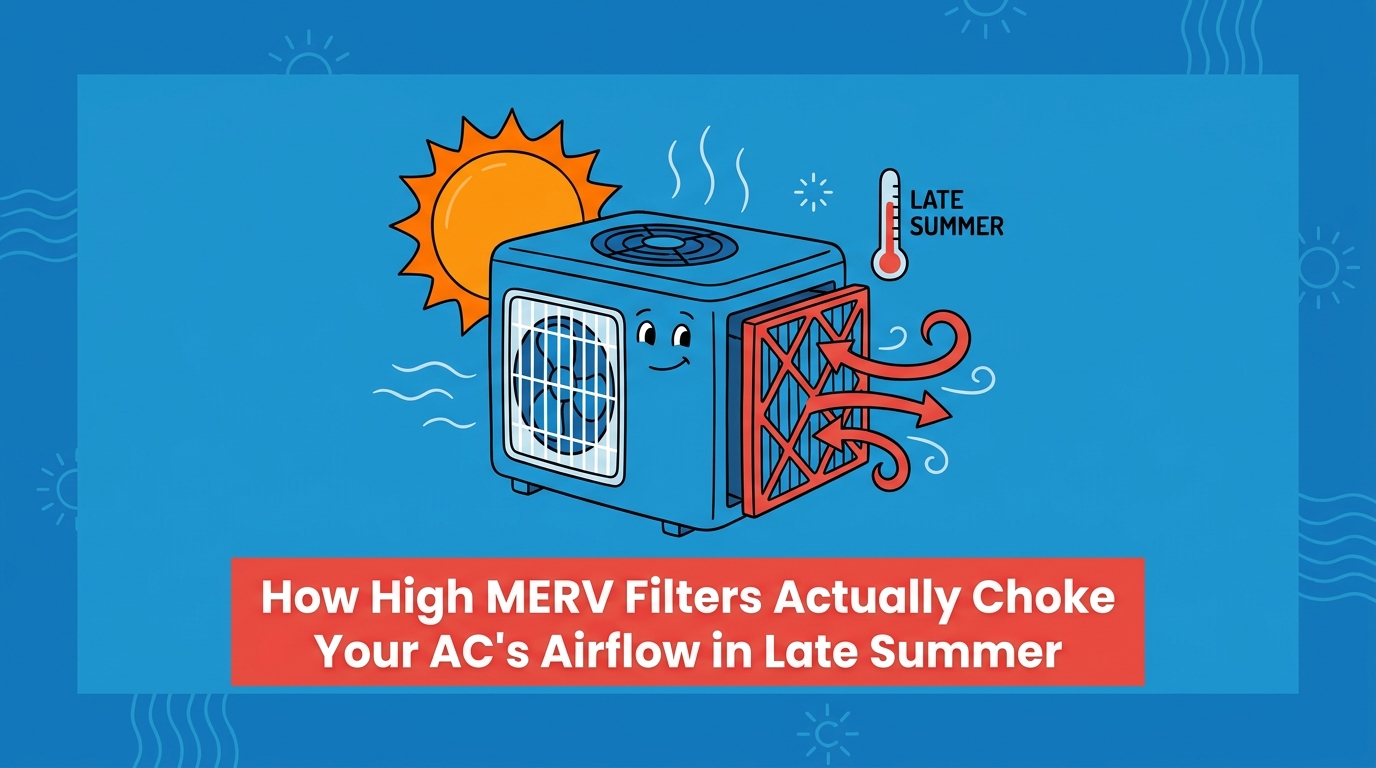

When 'Premium' Upgrades Cause Late-Summer Breakdowns: How High MERV Filters Actually Choke Your AC's Airflow in Late Summer
Your air conditioner is running nonstop, but the vents are barely pushing out any air. If you are wondering how high MERV filters actually choke your AC's airflow in late summer, you are not alone. That strange lack of cooling isn't going away on its own, and it is a common pattern our team at Climate Mechanics sees during late August end-of-season cooling. Many homeowners upgrade to the most expensive allergy filters they can find at the hardware store, assuming a higher rating equals a healthier home. Instead, they inadvertently suffocate their HVAC system, leading to frozen coils, massive energy bills, and warm air blowing through the house.
If you are dealing with this exact frustrating scenario as the back-to-school transition begins, you have a clear decision to make. You can keep the restrictive premium filter in place and risk a catastrophic end-of-season breakdown, or you can swap it out for a breathable filter that restores proper airflow and saves your equipment. Navigating this balance is a core part of effective air conditioning care, and it is one of the most frequent issues our technicians correct during AC maintenance in Cinnaminson.
The root of this problem lies in a concept called static pressure. While your intentions for better indoor air quality are entirely valid, our experience in the field shows that standard residential HVAC systems are simply not designed to pull air through dense, heavily pleated media. Understanding how this physical resistance impacts your blower motor is the first step in restoring your home's comfort before the late-summer heat completely overwhelms your system.
The Physics of Static Pressure and Filter Ratings
To understand why a premium filter can cause so much trouble, you have to understand static pressure. When our crew diagnoses a struggling blower motor, we often find static pressure is the culprit. In simple terms, static pressure is the resistance to airflow within your HVAC system. Think of it like drinking a thick milkshake through a very narrow straw. The harder you have to pull to get the liquid moving, the higher the resistance. Your air conditioner's blower motor operates on the exact same principle. It is calibrated at the factory to operate within a very specific, carefully calculated static pressure range.
When you look at a standard MERV 8 filter, the physical density of the media is relatively loose. It is designed to catch large particles like dust, hair, and lint, protecting the internal machinery without blocking the air. However, when you upgrade to a high-efficiency MERV 13 or higher filter, the physical makeup of the filter changes dramatically. The pleats are incredibly dense, tightly packed, and designed to trap microscopic particles like bacteria and fine smoke.
The static pressure penalty: This dense media acts almost like a solid wall inside your ductwork. The MERV 13+ vs MERV 8 static pressure drop is significant; we frequently see premium filters double or triple the resistance a system has to fight against. When the resistance spikes, the volume of air moving through the system plummets, setting the stage for severe mechanical stress.
Why Blower Motors Struggle Against Dense Pleats
Your blower motor is the heart of your ventilation system, responsible for maintaining a steady CFM (Cubic Feet per Minute) of airflow. When a thick filter blocks the return air, the motor has to work significantly harder to pull the same amount of air through the dense pleats. For standard permanent split capacitor (PSC) motors, our technicians note that this resistance causes them to slow down, drastically reducing the CFM circulating through your home.
For newer variable-speed motors, the system will automatically ramp up its RPMs to try and overcome the blockage. While this might maintain your CFM temporarily, it forces the motor to run hot, draw excessive electricity, and endure immense physical strain. Over time, fighting against this high static pressure will burn out the blower motor entirely, turning a simple filter upgrade into an expensive mechanical failure.
• Standard MERV 8 — Media Density: Loose, highly breathable woven fibers — Airflow Resistance (Static Pressure): Low (Allows optimal CFM) — Impact on Standard Blower Motors: Safe; motor operates within normal temperature and amp draw
• Premium MERV 13+ — Media Density: Dense, tightly packed microscopic pleats — Airflow Resistance (Static Pressure): High (Significantly reduces CFM) — Impact on Standard Blower Motors: Dangerous; causes overheating, high amp draw, and premature failure
The Anatomy of a Frozen Evaporator Coil
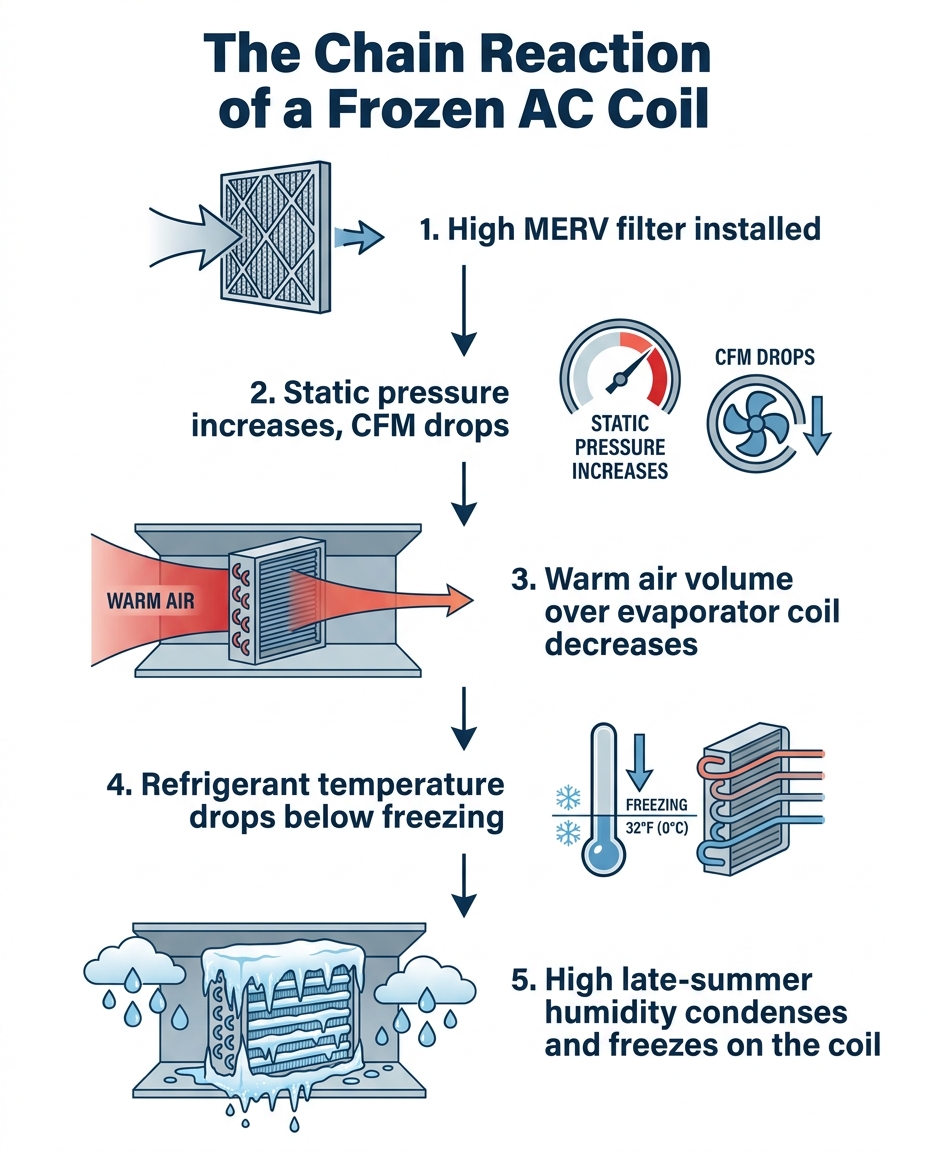
When the static pressure spikes and the airflow drops, the immediate victim is your indoor evaporator coil. This component is essentially a radiator sitting inside your ductwork, filled with very cold liquid refrigerant. Its job is to absorb heat from the warm air passing over it. When we get an emergency call for a frozen coil, we typically see a dangerous chain reaction that begins with a restricted filter.
1. The Heat Source Disappears: The evaporator coil relies on a constant, high-volume supply of warm indoor air to function. The warm air boils the cold liquid refrigerant, turning it into a gas that travels outside. When a high-MERV filter chokes the airflow, the coil is suddenly starved of the heat it needs to operate correctly.
2. Refrigerant Temperatures Plummet: Because the MERV 13+ vs MERV 8 static pressure drop severely limits the warm air reaching the coil, the refrigerant inside never absorbs enough heat to boil. Instead, it remains a liquid, and its temperature rapidly drops well below the freezing point of 32 degrees Fahrenheit.
3. Condensation Rapidly Freezes: Under normal conditions, an evaporator coil pulls moisture out of the air, creating condensation that drips harmlessly into a drain pan. However, because the physical copper and aluminum fins of the coil are now below freezing, that condensation instantly turns to frost.
4. The Runaway Ice Block: As the frost builds up, it acts as an insulator, blocking even more air from touching the cold metal. This creates a runaway feedback loop. Within just a few hours, the entire A-coil becomes encased in a solid block of ice, completely stopping all cooling in your home.

Why August Heat and Humidity Accelerate the Freeze
This airflow restriction is a problem at any time of year, but it becomes an absolute crisis during late August end-of-season cooling. Working in this region for years, our team knows firsthand that the climate plays a massive role in how quickly a system fails. With late-summer Cinnaminson and Delaware Valley humidity averages frequently exceeding 60-70%, the moisture load on your evaporator coil is immense. Your system is pulling gallons of water out of the air every single day.
When you combine that extreme moisture load with a heavily restricted filter, you create the perfect storm for rapid ice accumulation. A system might actually tolerate a slightly restrictive filter during a mild, dry spring week because the run cycles are short and there is less condensation. System reliability can be tested at any point in the year. For example, our team helped one customer who reached out in the spring with an existing ground connection issue while waiting to test their new AC. We came out right away to fix the ground issue so their system was ready for the heat. But by the time late August arrives, the challenges we see shift from electrical connections to severe environmental stress.
During August heatwaves, your air conditioner runs in long, continuous cycles. If you have an AC running constantly in New Jersey summer heat, the coil is constantly wet. If the airflow is choked by a high-MERV filter, those long run times guarantee that the heavy condensation will freeze solid. As the local authority on HVAC performance, Climate Mechanics frequently rescues South Jersey homeowners from this specific, well-intentioned mistake. People simply want cleaner air, but the intense local humidity turns that premium filter into a system-killer.
Balancing Filtration Efficiency With System Health
Protecting your HVAC equipment must always be step one in maintaining a comfortable, functioning home. If the system breaks down because it cannot breathe, the air quality in your house will plummet anyway. The American Society of Heating, Refrigerating and Air-Conditioning Engineers (ASHRAE) strictly recommends balancing filtration efficiency with the specific airflow limits of your HVAC equipment. Our technicians constantly remind homeowners that you cannot prioritize filtration at the expense of static pressure.
A standard residential system is typically designed for mid-range filtration. The primary job of the filter in your return duct is actually not to purify the air you breathe; its job is to protect the sensitive blower wheel and evaporator coil from dust, hair, and debris. In our experience, a standard MERV 8 filter performs this job perfectly. It catches the harmful particulates that would otherwise coat your internal components, while still maintaining the proper MERV 13+ vs MERV 8 static pressure drop required to keep the system breathing easily.
Safer Alternatives for Allergy Sufferers
If you or your family members suffer from severe allergies, asthma, or respiratory sensitivities, a standard MERV 8 filter might not provide the level of purification you need. However, forcing your main HVAC blower to do the heavy lifting is the wrong approach. Instead, we recommend secondary solutions that improve indoor air quality without increasing the static pressure on your air conditioner.
• Dedicated HEPA air purifiers: Standalone units placed in high-traffic rooms or bedrooms can filter out microscopic allergens using their own built-in fans, completely bypassing your HVAC system.
• Whole-home electronic air cleaners: These systems integrate directly into your ductwork but use electrically charged plates to capture particles rather than dense physical media, keeping static pressure incredibly low.
• UV germicidal lights: Installed directly over the evaporator coil, these lights neutralize mold spores, bacteria, and viruses before they can circulate through your home, requiring zero physical airflow restriction.
Recognizing the Warning Signs of a Suffocating AC
If you recently installed a premium allergy filter, it is critical to monitor your system for the early warning signs of airflow restriction. Catching the problem before the coil freezes completely can save you from a major repair bill and days without cooling during late August end-of-season cooling. We advise our Cinnaminson customers to pay close attention to how their system sounds, feels, and operates.
The immediate checklist for airflow problems:
• Weak airflow from vents: Hold your hand over a supply register. If the air feels like a weak trickle rather than a steady breeze, your system is struggling to push air through the ductwork.
• Warm air during a cooling cycle: If the thermostat is set to cool but the air coming out of the vents feels lukewarm, the evaporator coil has likely already begun to freeze over, blocking heat transfer.
• Unusually long run times: A system that runs for hours without satisfying the thermostat is starved for air and working overtime to compensate.
• Visible ice buildup: Check the indoor air handler and the copper refrigerant lines running to the outdoor unit. If you see white frost or solid ice, the system is actively freezing.
If you notice any of these signs, take immediate action. Turn the thermostat from "Cool" to "Off," and switch the fan setting from "Auto" to "On." This will blow unchilled air over the frozen coil to help it thaw safely. Next, remove the restrictive high-MERV filter and replace it with a standard, breathable filter. Never attempt to chip ice off the coil with a tool, as our repair teams have seen too many punctured pressurized copper lines from DIY thawing attempts.
If you ignore the signs, the system will eventually shut down entirely. Just recently, our dispatch received a call on a Sunday evening during the late-summer heat from a family whose AC unit was not running at all due to severe airflow restriction. Our Climate Mechanics technicians responded quickly and had the AC unit operational within an hour by addressing the core issue. If your system remains frozen or refuses to cool after thawing and replacing the filter, it is time to call a professional for AC repair in Moorestown to assess potential compressor strain.
Frequently Asked Questions
Does a higher MERV filter restrict airflow?
Yes, a higher MERV filter significantly restricts airflow by increasing static pressure within the ductwork. Because the physical media of the filter is packed much tighter to catch microscopic particles, the blower motor has to work much harder to pull air through it. Over time, this restriction reduces the total volume of air circulating through your home and strains the system.
Can a high MERV filter cause my AC to freeze?
Absolutely, a high MERV filter is one of the most common causes of a frozen AC coil. When the dense filter blocks warm indoor air from reaching the evaporator coil, the cold liquid refrigerant inside the coil cannot absorb enough heat to boil. The temperature of the coil drops below freezing, causing normal condensation to rapidly turn into a solid block of ice.
What happens if my AC filter is too restrictive?
If your AC filter is too restrictive, your system will suffer from reduced cooling capacity, higher energy bills, and severe mechanical strain. The blower motor can overheat and burn out from fighting the high static pressure. Additionally, the lack of airflow can cause the indoor coil to freeze, which can eventually lead to liquid refrigerant flowing backward and destroying the outdoor compressor.
Why is my AC blowing warm air in late summer?
Your AC is likely blowing warm air because the evaporator coil is completely encased in ice, blocking the transfer of heat. In late summer, high humidity creates excessive condensation on the coil, and if your airflow is restricted by a dirty or overly dense filter, that condensation freezes quickly. Once the ice forms, the air passing through the ducts cannot be cooled.
Why did my AC freeze up immediately after changing the filter?
If your AC froze right after a filter change, you likely installed a filter with a much higher MERV rating than your system can handle. Upgrading from a standard fiberglass filter to a premium pleated allergy filter drastically changes the static pressure in the ductwork. The sudden drop in airflow starves the coil of heat, causing it to freeze almost immediately.
What is the best MERV rating for a standard residential AC?
For the vast majority of standard residential HVAC systems, our team recommends a MERV 8 filter as the ideal choice. It provides an excellent balance by capturing common household dust, pet dander, and pollen to protect the equipment, without restricting the airflow your blower motor needs to operate safely. If you require higher medical-grade filtration, it is best to use a separate, dedicated air purifier.
Keeping Your System Breathing Easy
At Climate Mechanics, we believe that understanding how high MERV filters actually choke your AC's airflow in late summer is the best way to protect your equipment from premature failure. By prioritizing proper static pressure and choosing a breathable MERV 8 filter, you ensure your system has the airflow it needs to tackle the severe August humidity. If your system is already struggling with ice buildup or weak airflow, a professional assessment from our team will get your home back to normal safely.
