


When the Heat Breaks Through at 2 AM
That strange noise from your outdoor unit isn't going away on its own, and when the vents stop blowing cold air at 2 AM, understanding the anatomy of a late-night AC rescue in Haddonfield becomes your immediate priority. A sudden shift in home comfort during a humid August night is more than just an inconvenience; it is a frustrating disruption that leaves you sweating in the dark. The oppressive late-summer humidity in New Jersey makes a sudden AC failure an immediate comfort crisis. You check the thermostat, and the indoor temperature is steadily climbing. The heavy, stagnant air settles into the rooms, and you are left wondering whether you should try to sleep through the heat or call for immediate help.
For comprehensive air conditioning services or immediate emergency AC repair in Haddonfield, the team at Climate Mechanics is ready to respond. Having served homeowners throughout Haddonfield, Cinnaminson, and the surrounding New Jersey communities for years, we know exactly what it takes to resolve these midnight comfort crises.
The late-night decision point: Homeowners often feel anxious about calling a technician in the middle of the night. You might worry about waking the neighbors or wonder if a 2 AM visit will actually solve the problem. However, waiting until morning often means waking up to a house that feels like a sauna, forcing your system to work twice as hard to recover once it is finally fixed. Knowing exactly what a professional technician prioritizes during an emergency visit takes the guesswork out of the situation. By the time August late-summer humidity and end-of-season wear take their toll, your system has been running a marathon for months. When we respond to a late-night call, our priority is diagnosing the exact point of failure swiftly and systematically so you can get back to sleep.
The Immediate Aftermath of a Late-Summer Breakdown
The Problem: Air conditioning systems rarely fail out of nowhere. By late August, your cooling equipment has endured months of continuous, heavy operation. The cumulative stress placed on these systems often reaches a breaking point right when you need relief the most. When high humidity combines with restricted airflow, the result is often a frozen evaporator coil or a tripped breaker during a night cycle.
The Cause: In our years of experience working on historic and older homes throughout Haddonfield, we frequently see retrofitted systems facing unique airflow and electrical challenges. Ductwork that was originally designed for heating may struggle to move heavy, conditioned air efficiently. If you have an AC running constantly in the summer heat, the system never gets a chance to cool down. Continuous afternoon running masks developing issues until the system attempts to cycle down at night. The sudden shift in temperature and humidity levels exposes weakened components.
The Solution: The first step a homeowner should take before our technicians arrive is to turn the thermostat to the "off" position. If the system is frozen, leaving it running will only cause further damage to the compressor. Turn the fan to the "on" position to help thaw any ice, and wait for professional help to arrive.
Why Systems Fail in the Dark
A pattern our team sees often is that it feels like air conditioners have a built-in sensor telling them to break down only after the sun goes down. In reality, the mechanics of a late-night failure are tied directly to the thermal load of the day.
• Continuous operation: Running non-stop during the hottest parts of the afternoon hides failing capacitors and struggling motors.
• Temperature drops: As the outside air cools slightly at night, a system with low airflow or low refrigerant is much more likely to freeze over.
• Component fatigue: End-of-season wear-and-tear culminates in component fatigue, meaning the parts simply cannot endure one more heavy cycle.
Arriving on Scene: Safety Checks and Working Quietly
When a Climate Mechanics emergency technician arrives at your home in the middle of the night, the approach is highly methodical. Arriving at a dark house requires a systematic approach that prioritizes immediate safety for both the homeowner and the technician. The first goal is to secure the work area without causing a disturbance. In dense Haddonfield residential neighborhoods, working quietly is a top priority. Our technicians use specialized lighting and step carefully to ensure that resolving your comfort crisis does not wake the entire street.
Before opening any equipment panels, the technician performs initial visual and auditory inspections. Listening to the system can reveal a lot; a buzzing sound might indicate a failed capacitor, while a humming sound could point to a locked compressor. Visual checks involve looking for ice on the refrigerant lines, scorch marks near the electrical panel, or debris blocking the outdoor condenser fan. This controlled, methodical process ensures that no potential hazards are overlooked.
Recently, our team helped a local homeowner who reached out on a Sunday evening when their system failed unexpectedly during a muggy stretch of weather. By calling our main line directly, a technician was dispatched immediately. Because the technician followed our quiet, structured diagnostic process, the root cause was identified swiftly, and the unit was fully operational within an hour—all without disturbing the peaceful neighborhood.
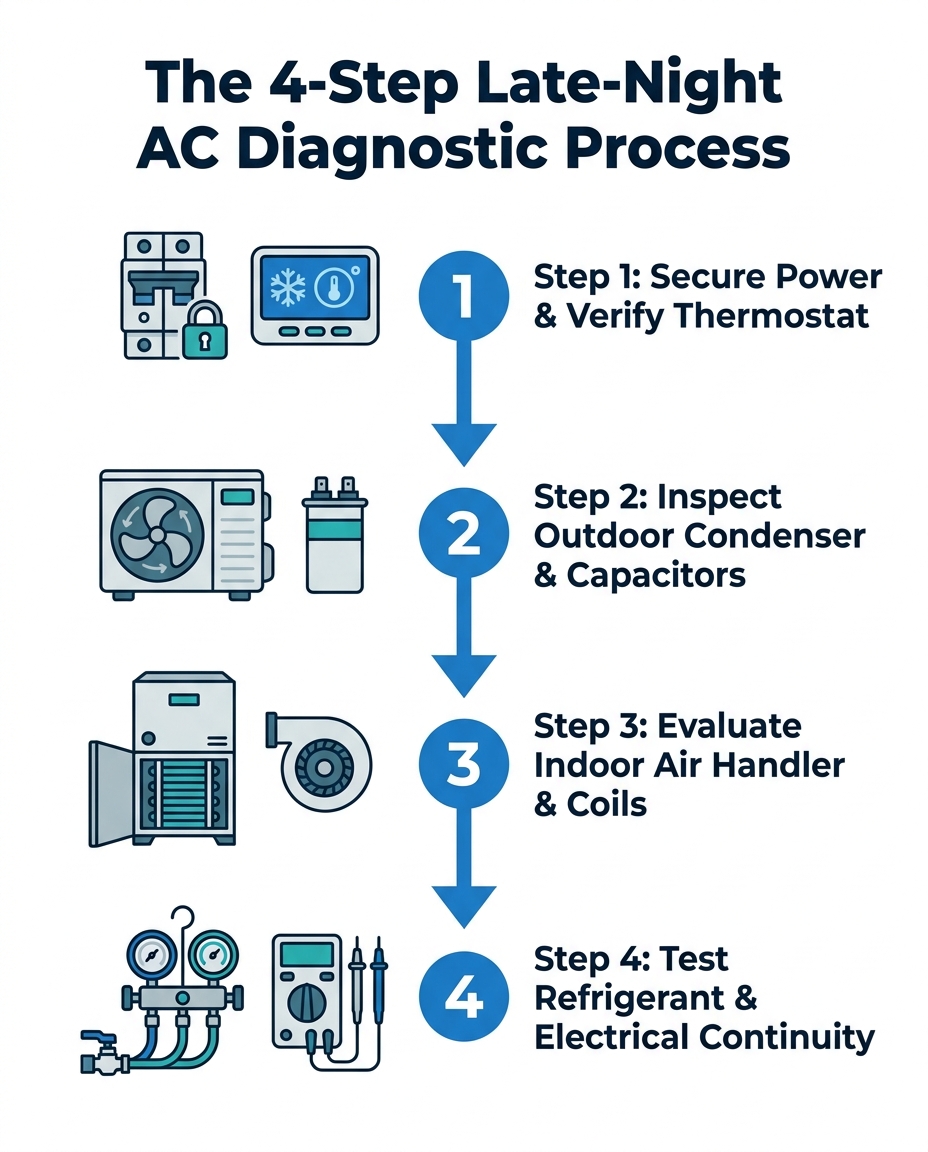

Step-by-Step: Diagnosing the Failure in the Dark
Diagnosing an air conditioning failure in the middle of the night requires precision and specialized tools. This work requires a licensed professional and should never be attempted as a DIY project, as high-voltage electricity and pressurized refrigerants pose severe safety risks. Here is the exact order of operations our Climate Mechanics professionals follow:
1. Verifying thermostat communication: The technician first checks that the thermostat is sending the correct cooling signal to the equipment and secures electrical power at the main breaker.
2. Inspecting the outdoor condenser unit: The outdoor unit is evaluated for tripped high-pressure sensors, overheated capacitors, or physical debris blocking the fan blades.
3. Checking the indoor air handler: The indoor unit is inspected for frozen evaporator coils, restricted airflow from clogged filters, or blower motor faults that prevent air circulation.
4. Testing pressures and continuity: Using specialized diagnostic tools, the technician tests refrigerant pressures and electrical continuity to pinpoint the exact failing component.
Ruling Out Electrical Hazards First
Safety protocol dictates confirming no live voltage issues exist before troubleshooting mechanical parts. Our technicians will use a multimeter to check for proper voltage at the disconnect box and the contactor. Identifying burnt wiring, loose connections, or failing contactors caused by heavy seasonal load is critical. If the electrical foundation is not secure, the mechanical components cannot function safely.
Isolating Mechanical Faults
Once electricity is ruled out as a hazard, the focus shifts to mechanical performance. Differentiating between a failed compressor and a simple blown dual-run capacitor is a key step. A bad capacitor will prevent the compressor from starting, but it is a straightforward repair. Assessing airflow restrictions that lead to system freezing is also essential, as poor airflow will quickly cause a newly repaired system to fail again.
Evaluating the Toll on Core System Components
Understanding what components typically fail and why helps homeowners make informed decisions about their home AC units. The late-summer heat places an immense burden on specific parts of your cooling system.
The Dual-Run Capacitor: This small, cylindrical component stores energy to give the compressor and fan motors the jolt of electricity they need to start. It is the most common casualty of late-summer heat waves that our technicians replace. When a capacitor fails, you might hear a clicking or humming sound from the outside unit, but the fan will not spin.
The Blower Motor: Pushing heavy, humid air through aging ductwork strains the indoor blower motor. If the air filter is dirty, the motor works even harder, eventually overheating and shutting down to protect itself.
The Refrigerant Cycle: Refrigerant issues manifest differently at night compared to the heat of the day. During the day, warm air moving over the coils keeps them from freezing, even if the refrigerant is slightly low. At night, when the ambient temperature drops, that same low refrigerant level causes the coil temperature to plunge below freezing, turning the indoor unit into a block of ice.
A thorough evaluation provides insight into when a single component can be repaired versus when the overall system integrity is compromised, ensuring you only invest in repairs that make long-term sense.
Restoring Comfort: Systematic Solutions Over Temporary Patches
The Problem: When you call for emergency service at 2 AM, the last thing you want is a rushed, "band-aid" fix that leaves the system vulnerable to failing again the very next night. Temporary patches often ignore the root cause of the breakdown.
The Cause: Rushed diagnostics happen when technicians skip steps, focusing only on getting the unit to turn on rather than ensuring it runs efficiently. For example, replacing a blown fuse without investigating why the fuse blew will only result in another blown fuse hours later.
The Solution: A fast, permanent repair is rooted in systematic diagnostics. At Climate Mechanics, we emphasize a commitment to fast, personal 24/7 emergency response from local technicians who genuinely care about your long-term comfort. After replacing a faulty component, our professional technicians will verify the repair by monitoring a full cooling cycle before leaving the property. This ensures pressures stabilize and temperatures drop as expected. Educating the homeowner on what went wrong and how routine AC maintenance can prevent it in the future is just as important as the repair itself.
The relief of having a unit fully restored during a critical time cannot be overstated. During a recent late-summer holiday weekend, our dispatch received a call when one customer's central air unit went down during peak heat. They called at 6 PM, and our Climate Mechanics team immediately got involved. A service technician arrived quickly, identified the root cause methodically, and had the system completely fixed within 30 minutes, saving the rest of their holiday weekend.
Frequently Asked Questions About Late-Night AC Emergencies
What is considered an AC emergency?
An AC emergency is any situation where a breakdown threatens your health, safety, or property. If your system is leaking water through the ceiling, making loud electrical buzzing noises, or if the indoor temperature reaches dangerous levels during a heat wave, immediate intervention is required. Elderly family members, infants, and pets are particularly vulnerable to sudden heat spikes.
Is it worth calling an HVAC tech at night?
Yes, calling a professional at night is often the best course of action to prevent further damage to your system. Waiting until morning can cause frozen coils to expand or struggling compressors to burn out completely. A late-night diagnostic ensures your home begins cooling immediately, rather than waiting in the heat the next day.
Why did my AC stop working in the middle of the night?
AC units often fail at night because the system is attempting to cycle down after running continuously all afternoon. The drop in outdoor temperature combined with low indoor airflow can cause coils to freeze. Additionally, components like capacitors that were stressed during the day finally give out when trying to start a new cooling cycle.
What does an AC technician check first?
The very first thing an AC technician checks is the electrical safety and thermostat communication. They will verify that the thermostat is sending the correct signal and ensure that the main breaker has not tripped. Securing the power supply is critical before inspecting any mechanical parts.
Can a frozen AC coil be fixed immediately during a night visit?
A frozen coil cannot be repaired until the ice has completely melted, which can take several hours. However, a technician can diagnose the root cause—such as restricted airflow or a refrigerant issue—and begin the thawing process safely. They will then outline the exact steps needed to restore cooling as soon as the ice clears.
How do technicians diagnose AC electrical issues safely in the dark?
Technicians use specialized high-lumen lighting and digital multimeters to test voltage and continuity safely. They are trained to secure all power at the disconnect box before touching any wiring. By following strict safety protocols, they can accurately identify burnt wires or failed contactors without risking electrical shock.
Ensuring Reliable Cooling for the Rest of the Season
The peace of mind that comes from a proper, systematic diagnostic process is invaluable when you are woken up by a stiflingly hot house. By taking the time to rule out electrical hazards and isolate mechanical faults, a professional technician ensures that your system is truly repaired, not just temporarily patched. In older Haddonfield residential neighborhoods, where retrofitted systems work hard to keep up with the August heat, proactive care makes all the difference.
Do not ignore warning signs like strange noises, weak airflow at night, or a system that struggles to shut off. These are the early indicators of component fatigue. If you experience unexpected cooling failures, reach out to the local experts at Climate Mechanics. We can evaluate your system thoroughly and restore your comfort safely for the remainder of the summer season.
