


The AC Repair vs Replace Decision Guide South Jersey Homeowners Need This Summer
If you're facing an ac repair vs replace — decision guide for south jersey homeowners situation right now, here's the short answer:
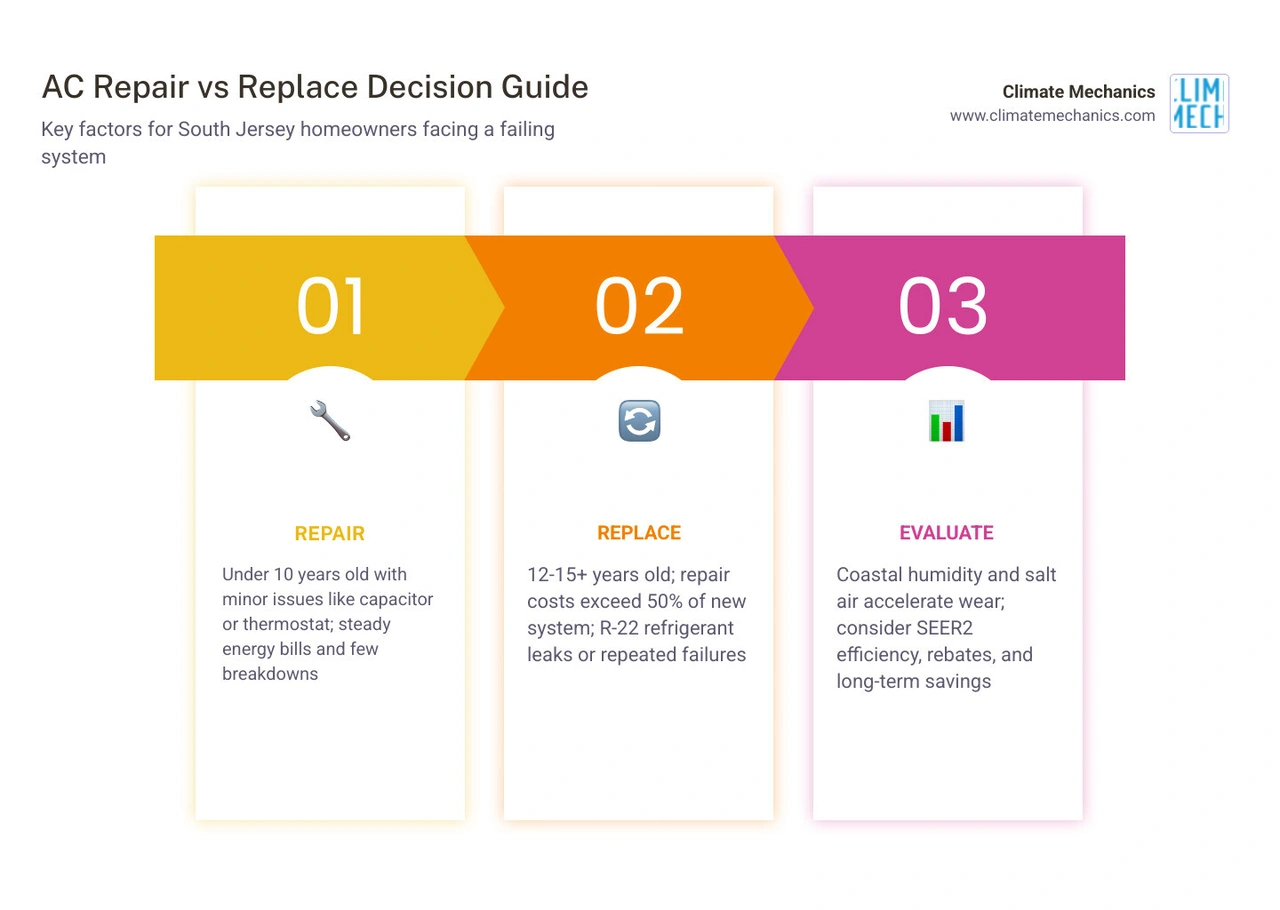
Repair your AC if:
• The system is under 10 years old
• The repair is minor (capacitor, thermostat, contactor)
• Your energy bills have stayed steady
• You haven't had repeated breakdowns
Replace your AC if:
• The system is 12–15+ years old
• Repair costs exceed 50% of what a new system would cost
• You're seeing repeated failures, rising utility bills, or uneven cooling
• The system uses R-22 refrigerant and has a refrigerant leak
When your AC breaks down in the middle of a South Jersey summer, the pressure to make a fast decision is real. But choosing between repair and replacement without the right information can cost you hundreds — or thousands — of dollars in the wrong direction.
South Jersey homeowners face a unique set of challenges. The region's coastal humidity, salt air exposure, and long cooling seasons put extra strain on AC systems compared to inland markets. A unit that might last 15 years in a drier climate can show signs of accelerated wear in Atlantic, Cape May, or Camden County much sooner.
This guide walks you through every factor that matters — system age, repair costs, efficiency ratings, refrigerant type, and local rebates — so you can make a confident, informed decision rather than a rushed one.
Quick ac repair vs replace — decision guide for south jersey homeowners terms:
• how energy savings from a new ac offset replacement in south jersey
• how humidity affects how quickly an old ac degrades in new jersey
• is a 12 to 15 year old ac worth fixing in a south jersey home
Key Indicators for AC Repair vs Replace — Decision Guide for South Jersey Homeowners
When your air conditioner begins to struggle during a humid July stretch, it rarely goes quiet without a fight. Instead, it sends subtle (and sometimes very loud) SOS signals. Understanding how to read these signs is the first step in deciding whether to call for a quick fix or prepare for a full system upgrade.
System performance is the ultimate indicator of your equipment's health. If your air conditioner is running constantly but your living room still feels like a sauna, something is fundamentally wrong. Poor airflow, weak cooling capacity, and strange noises like squealing, grinding, or banging are all indicators that your system is under major stress.
Airflow issues can stem from a variety of sources, ranging from a simple clogged air filter to a failing blower motor or collapsing ductwork. When airflow is restricted, your system has to work twice as hard to move conditioned air throughout your home, leading to accelerated wear on vital internal components.
To help you decode these system warnings, we have compiled detailed resources on identifying these problems early. Check out our guide on Signs AC Unit Needs Professional Attention to understand the physical warnings your system is giving you, and read up on the Signs You Need Expert AC Repair to determine if a technician can resolve the issue safely without requiring a full system replacement.
When to Choose AC Repair in Cherry Hill NJ and Surrounding Areas
Not every system breakdown requires a brand-new air conditioner. In fact, if your cooling system is relatively young and has been well-maintained, a targeted repair is almost always the most logical and cost-effective route.
Minor electrical issues are among the most common reasons an air conditioner suddenly stops working, and fortunately, they are also some of the easiest to fix. A classic example is a failed run capacitor. The capacitor acts like a temporary battery that gives your compressor and fan motor the electrical push they need to start up. In the heat of the summer, capacitors are under immense thermal stress and frequently burn out. Replacing a capacitor is a quick, routine procedure that can restore your cooling system in under an hour.
Similarly, thermostat calibration issues, worn-out contactors, or loose electrical connections can cause your system to short-cycle or refuse to turn on. These are isolated component failures that do not reflect the overall health of your entire system. If you are experiencing these types of minor hiccups in Camden County or Burlington County, scheduling a professional repair will get you back up and running without breaking the bank.
If you live in our local service areas, you can easily book a certified technician to diagnose these issues. For fast, reliable help, visit our page on AC Repair Cherry Hill NJ or learn more about our local services by visiting AC Repair Voorhees NJ.
When to Plan for AC Replacement in Cherry Hill NJ
While we always prefer to repair a system when it is safe and practical to do so, there comes a point where continuing to patch up an old unit is simply throwing good money after bad.
The most obvious sign that you need to shift from a repair mindset to a replacement mindset is a pattern of frequent breakdowns. If you find yourself calling an HVAC technician multiple times over consecutive summers to fix different failing parts, your system is telling you that its components are reaching the end of their collective lifespan. When one part fails, it places additional strain on the remaining older parts, triggering a domino effect of breakdown after breakdown.
Uneven cooling and severe comfort issues are also strong indicators that your system can no longer keep up with demand. If you have hot and cold spots throughout your home, or if the indoor humidity levels remain high and sticky even when the system runs continuously, the compressor may be losing its compression capacity.
When you reach this stage, investing in a modern, reliable system is the best path forward for your comfort and peace of mind. To help you evaluate whether your home is ready for an upgrade, review our article on 4 Signs It's Time for a New AC Unit and check out our dedicated installation services at AC Replacement Cherry Hill NJ.
Evaluating System Age and the Outdated $5,000 Rule in 2026
For decades, the HVAC industry relied on a simple rule of thumb called the "$5,000 Rule" to help homeowners choose between repairing and replacing an air conditioner. The math was straightforward: you multiplied the age of your AC unit by the cost of the proposed repair. If the total exceeded $5,000, you replaced the system. If it was under $5,000, you repaired it.
However, as we navigate July 2026, this traditional rule is officially outdated.
Due to inflation, supply chain shifts, and the rising cost of advanced HVAC technology over the last few years, the baseline cost of both parts and equipment has changed dramatically. Under the old formula, almost any standard repair on an 8-year-old system would trigger an automatic replacement recommendation, which is simply not practical or necessary for many homeowners.
Instead of relying on an outdated multiplier, modern decision-making centers around the actual physical lifespan of the equipment and a direct comparison of the repair quote against the cost of a new system.
The typical lifespan of a central air conditioner in South Jersey is 10 to 15 years. If your system is under 10 years old, it is almost always worth repairing unless it has suffered a catastrophic, non-warranty failure (like a burned-out compressor). Once a unit crosses the 12-year mark, however, it enters a "gray zone" where any major repair should be scrutinized heavily.
To dive deeper into the economics of maintaining an older system in our region, read our detailed analysis: Is a 12 to 15 Year Old AC Worth Fixing in a South Jersey Home.
Applying the 50% Rule for an AC Repair vs Replace — Decision Guide for South Jersey Homeowners
In 2026, professional HVAC contractors and financial advisors recommend using the 50% Rule instead of old mathematical shortcuts.
The 50% Rule is simple: If the cost of a single repair exceeds 50% of the cost of a brand-new system, you should replace the unit.
When calculating this, you must also look at the cumulative service costs. If you have spent a significant amount on multiple repairs over the last two seasons, and you are now facing another major fix, those cumulative costs are a clear signal of system decline.
Upgrading to a new system under these circumstances provides far better long-term value. A new system comes with a fresh manufacturer’s warranty (typically 10 years on parts), drastically lower utility bills, and the peace of mind that you won't be left without cooling on a record-breaking summer day. For a complete breakdown of how to weigh these financial factors, check out our guide on When to Consider an AC Replacement.
How South Jersey’s Coastal Climate and Humidity Impact AC Lifespan
Living in South Jersey offers incredible perks, from beautiful summer days to close proximity to the shore. However, our local climate is notoriously harsh on outdoor mechanical equipment.
For homes in areas near Delaware Bay or along the coastal boundaries of our service footprint, salt air corrosion is a silent killer of air conditioning systems. Salt particles suspended in the air settle on the aluminum fins and copper tubing of your outdoor condenser unit. Over time, this salt accelerates galvanic corrosion, eating away at the delicate metal coils. As the coils corrode, they lose their ability to transfer heat efficiently, forcing the compressor to run longer and hotter to cool your home.
Additionally, South Jersey’s high summer humidity levels place an enormous latent load on your air conditioner. An AC unit does not just cool the air; it also acts as a dehumidifier.
When humidity levels soar, your system must work continuously to wring moisture out of the indoor air. This constant operation increases compressor strain and accelerates the degradation of the condenser coil. Because of these intense environmental factors, a system in South Jersey often reaches the end of its reliable operational life several years faster than an identical unit installed in a dry, inland climate.
Environmental Factors and Refrigerant Phase-Outs
Beyond the physical wear of salt and humidity, environmental regulations have completely rewritten the rules of AC repairs in recent years.
If you have an older air conditioning system (typically manufactured before 2010), it likely relies on R-22 refrigerant (commonly known as Freon). R-22 has been phased out entirely due to environmental regulations. Because it is no longer manufactured or imported, the remaining supply is extremely scarce and exceptionally expensive. If your R-22 system develops a refrigerant leak, attempting to locate the leak, repair the copper lines, and recharge the system with reclaimed R-22 can cost almost as much as a modern system upgrade.
Even systems using R-410A (the refrigerant that replaced R-22) are currently undergoing a regulatory phase-down. In 2026, the industry is transitioning to next-generation refrigerants like R-454B and R-32, which have a much lower Global Warming Potential (GWP).
As R-410A production decreases, the cost to service older R-410A systems with refrigerant leaks will steadily rise. If you are facing a major refrigerant leak on an older system, investing in a new, future-proof system that complies with current environmental standards is the smartest financial move. To learn why timing your upgrade strategically can save you stress and money, read our article on Why Replace AC This Fall.
Energy Efficiency, SEER2 Ratings, and Long-Term Savings
When comparing the cost of keeping an old system running versus upgrading to a new one, many homeowners overlook the impact on their monthly electric bills. An older, inefficient system can easily cost twice as much to run during peak summer months compared to a modern, high-efficiency unit.
Air conditioner efficiency is measured by the Seasonal Energy Efficiency Ratio (SEER). In 2023, the Department of Energy implemented new, more rigorous testing standards known as SEER2. Modern systems are engineered to meet these strict requirements, delivering significantly more cooling output per watt of electricity consumed.
• Older Systems (10-15+ years old) — Average SEER/SEER2 Rating: 10 - 13 SEER — Efficiency & Monthly Energy Cost Impact: Low efficiency; high energy consumption; rising utility bills.
• Standard Modern Systems — Average SEER/SEER2 Rating: 14.3 - 16 SEER2 — Efficiency & Monthly Energy Cost Impact: Good efficiency; reliable baseline performance; noticeable bill reduction.
• High-Efficiency Systems — Average SEER/SEER2 Rating: 18 - 22+ SEER2 — Efficiency & Monthly Energy Cost Impact: Maximum efficiency; variable-speed technology; lowest operating costs.
If you are currently running a 12-year-old system with a 10 SEER rating, upgrading to a modern, entry-level SEER2 system can slash your cooling energy consumption by up to 30% to 40%. Over the lifespan of the new unit, those monthly savings can offset a massive portion of your initial investment. To see a detailed breakdown of how these operational savings add up over time, read our guide on How Energy Savings from a New AC Offset Replacement in South Jersey.
Maximizing Utility Rebates and Incentives for South Jersey Homes
To make upgrading even more appealing, South Jersey homeowners have access to excellent financial incentives designed to promote energy efficiency.
Through the New Jersey Clean Energy Program, as well as direct programs run by local utilities like PSE&G and South Jersey Gas, you can qualify for substantial rebates when installing high-efficiency air conditioners or converting to modern heat pump technology.
These programs offer instant savings and mail-in rebates for qualifying high-efficiency SEER2 equipment. Furthermore, many local utility providers offer attractive, interest-free financing options with no down payment for qualifying energy-efficiency upgrades. When our NATE-certified technicians evaluate your home, we always help you identify and maximize every available local rebate and utility incentive to keep your out-of-pocket costs as low as possible.
Frequently Asked Questions
Navigating the ac repair vs replace — decision guide for south jersey homeowners can bring up plenty of questions. Here are some of the most common inquiries we receive from local homeowners in Camden and Burlington counties.
How does system age affect the ac repair vs replace — decision guide for south jersey homeowners?
As an air conditioner ages, its internal components experience natural wear and tear. Over time, electrical windings in the compressor degrade, fan motors lose efficiency, and outdoor coils thin due to environmental exposure. Even if an older system has not suffered a major breakdown, its overall efficiency declines, leading to rising utility bills.
While a system under 10 years old is usually a prime candidate for a repair, any unit older than 12 to 15 years is operating on borrowed time. At that stage, investing in a repair is often a temporary fix before another component fails.
Is it worth replacing a failed compressor or the entire system?
The compressor is the "heart" of your air conditioner. If your system is out of warranty and the compressor burns out, it is rarely worth replacing just the compressor.
Because the compressor is part of a sealed refrigeration system, a burnout often releases acid and debris throughout the copper lines, which can quickly ruin a brand-new compressor. Furthermore, air conditioning systems are engineered as matched sets. Replacing only the outdoor unit while keeping an old, mismatched indoor evaporator coil reduces system efficiency, compromises reliability, and will likely void your new component's warranty.
What local rebates are available for South Jersey homeowners upgrading their AC?
South Jersey homeowners can take advantage of excellent rebates through the New Jersey Clean Energy Program and local utilities like JCP&L, PSE&G, and South Jersey Gas. These incentives apply to high-efficiency central air systems as well as electric heat pump conversions. Our team stays up to date on all active local utility programs to ensure you receive every dollar of savings you are eligible for.
Conclusion
At Climate Mechanics, we believe in providing honest, transparent guidance to our neighbors throughout South Jersey. With over 38 years of NATE and NCI-certified expertise, our team is dedicated to helping you find the most practical, comfortable, and cost-effective solution for your home — whether that means performing a precision repair to extend your current system's life or designing a high-efficiency replacement tailored to your budget.
We proudly serve homeowners throughout our local communities, including Maple Shade, Pennsauken, Audubon, Willingboro, Collingswood, Haddonfield, Burlington, Marlton, and Camden.
Don't sweat out the summer trying to guess which option is best for your home. Let our friendly, certified professionals provide a comprehensive diagnostic evaluation and help you make the right call.
Ready to restore your home's comfort? Schedule Delran NJ AC Service with the trusted experts at Climate Mechanics today!
