



The Hidden Danger of September Leaf Drop on Your Outdoor Unit
September in the Delaware Valley is just around the corner, and clearing fall leaves and debris from your heat pump's outdoor unit is the single most important chore you can tackle this season. Over our years of serving Cinnaminson and the surrounding communities, the team at Climate Mechanics has seen firsthand how early autumn leaf drop presents a unique and immediate threat. While many homeowners wait until late November to break out the yard tools, right now, your system is working overtime, actively switching back and forth between heating and cooling as the days stay warm but the nights grow chilly. If leaves begin to pile up against the exterior cabinet, the system suffocates. The real challenge is knowing exactly when and how to safely remove this debris without causing accidental damage to the delicate internal components.
For professional support, explore our heating services or schedule comprehensive heat pump maintenance today.
Most people associate falling leaves with the deep autumn months. However, our technicians consistently find that the September transition (heating and cooling) is actually the most vulnerable time for your HVAC system. During this window, your heat pump is performing a delicate balancing act. In the afternoon, it extracts heat from inside your home and pushes it outside. By midnight, it reverses the process, pulling ambient heat from the cool night air and bringing it indoors. Both of these processes rely entirely on unrestricted airflow through the outdoor cabinet.
When early leaves fall, they do not just sit harmlessly on the grass. The fan inside your outdoor unit acts like a giant vacuum, pulling loose debris directly against the metal intake vents. Once those leaves stick to the sides of the cabinet, they form a restrictive barrier. The compressor has to work twice as hard to pull in the same amount of air, leading to longer run times, increased energy consumption, and unnecessary wear and tear on the motor.
The decision point for most homeowners comes down to maintenance boundaries. You need to know how to safely clear the perimeter to keep the system breathing, while recognizing when the debris has penetrated too deeply and requires a licensed technician. Proactive, safe clearing prevents efficiency loss and ensures your system is ready for the heavy lifting of winter.
How Wet Debris Impacts Dual-Mode Performance
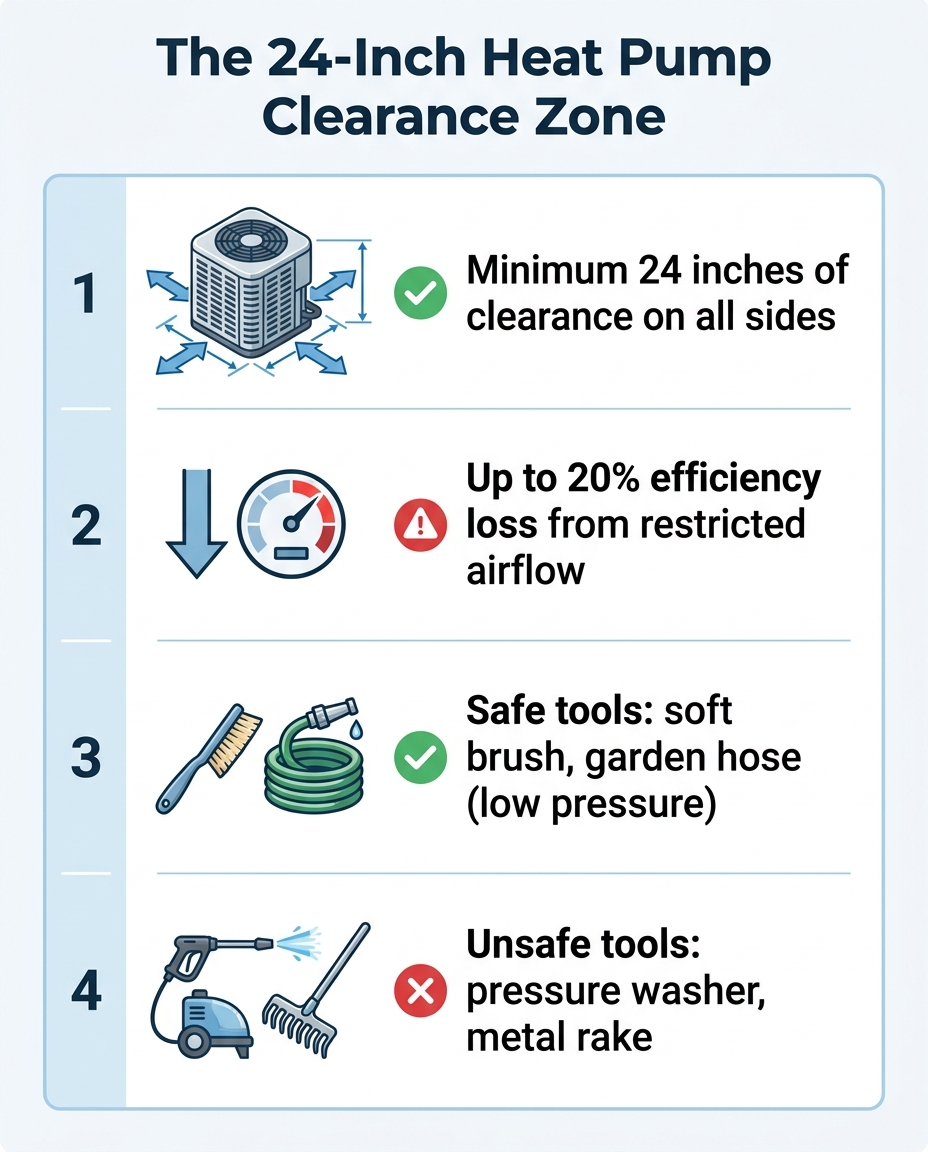
Restricted airflow is the enemy of any HVAC system, but it is particularly devastating to heat pumps. When dirt and wet debris clog the outdoor coil, system efficiency can plummet by up to 20%. This happens because heat pumps do not burn fuel to create heat; they move heat from one place to another. To do this effectively, the refrigerant inside the coils needs a constant, massive volume of air flowing over it. When that airflow is choked off, the system struggles to perform its primary function.
South Jersey's late-summer rain and early autumn leaf fall create the perfect storm for HVAC issues. The combination of heavy rain and shedding trees produces wet debris that easily clings to outdoor units in Cinnaminson, NJ, and the surrounding areas. Unlike dry leaves that might blow away in a strong gust of wind, this wet foliage plasters itself against the metal grilles, drying into a thick, papier-mâché-like crust that blocks the intake completely.
If left unchecked, this restrictive blanket forces the compressor to overheat, which can lead to sudden, total system failure exactly when you need climate control the most. One customer reached out to our Climate Mechanics team when their central air unit went down on a winter holiday weekend. Our owner and a service tech arrived quickly, diagnosed the issue, and repaired the unit within 30 minutes. While that situation was resolved fast, unexpected breakdowns during extreme weather or holidays are stressful and largely preventable with proper airflow management.
Maintaining clear airflow is the easiest way to protect your heat pump cooling efficiency and heating performance as the seasons change.
The 24-Inch Clearance Rule
To prevent debris from suffocating your system, our installation crews at Climate Mechanics always advise following the U.S. Department of Energy (DOE) recommendations for maintaining a strict minimum clearance zone around the outdoor cabinet. Here is how the rule works and why it matters:
• The standard measurement: You must maintain at least 24 inches (two feet) of completely clear space on all sides of the heat pump.
• Overhead clearance: The top of the unit requires even more room. Aim for at least 60 inches (five feet) of vertical clearance so the exhaust air can escape without bouncing back down into the unit.
• Why it prevents suffocation: The 24-inch buffer ensures that the fan can pull in an adequate volume of air without creating a vortex that sucks up nearby loose leaves, dirt, or mulch.
• How to maintain it: Take a tape measure and visually mark a two-foot perimeter around the concrete pad. Trim back any encroaching bushes, tall grass, or low-hanging branches that cross this invisible line.

Your Safe DIY Perimeter Clearing Checklist
Keeping the area around your heat pump clear is a vital homeowner responsibility, but it must be done safely. The exterior cabinet houses high-voltage electrical components and pressurized refrigerant lines. When doing yard work near the unit in Cinnaminson, NJ, our technicians always remind homeowners that a cautious, step-by-step approach is required to protect both yourself and the equipment.
If you are planning on cleaning your outdoor condenser unit this weekend, our team highly recommends following this safe DIY perimeter checklist:
• Step 1: Disconnect the power supply. Never assume the unit is dormant just because the fan isn't spinning. Heat pumps can cycle on without warning. First, turn the system off at your indoor thermostat. Then, locate the outdoor electrical disconnect box (usually mounted on the siding near the unit) and pull the disconnect block or flip the breaker to the "off" position.
• Step 2: Clear the immediate ground area. Put on a pair of heavy gardening gloves. Use your hands to pick up large accumulations of leaves, twigs, and branches from the base of the concrete pad. Do not use a lawnmower or string trimmer right up against the unit, as these can launch rocks and debris directly into the delicate fins.
• Step 3: Gently brush the cabinet exterior. If leaves are stuck to the side grilles, use a soft-bristle brush (like a car-washing brush or a household broom) to gently sweep them away. Always brush in a downward motion, following the direction of the metal slits. Never brush side-to-side.
• Step 4: Trim back summer overgrowth. Shrubs, ornamental grasses, and perennial plants often surge in growth during the late summer. Use hand clippers to prune back any vegetation that has crept into the 24-inch clearance zone. Be sure to bag the clippings immediately so they don't get sucked into the unit later.
• Step 5: Inspect the drainage path. Ensure that water can flow freely away from the concrete pad. If wet leaves have created a dam around the base, clear a path so that rain and condensation can drain away rather than pooling around the bottom of the cabinet.
By keeping the perimeter clean, you drastically reduce the amount of debris that makes its way inside the cabinet, preserving your system's efficiency for the coming winter.
What Not to Do: Avoiding Costly Fin Damage
While clearing the perimeter is highly encouraged, there is a hard line between safe DIY maintenance and actions that cause expensive damage. Our service team has seen too many well-meaning homeowners accidentally ruin their equipment. The most vulnerable parts of your outdoor unit are the aluminum fins. These thin metal strips line the exterior coil and are responsible for transferring heat. They are incredibly fragile—often thinner than a piece of heavy aluminum foil.
During the September transition (heating and cooling), your system is particularly vulnerable to fin damage if you try to forcefully scrape away stubborn, wet debris. If these fins get bent, flattened, or crushed, they block the airflow permanently, creating a localized dead zone on the coil. If enough fins are flattened, the entire system can fail.
Here is what you must avoid when clearing debris:
• Pressure Washers — The Damage It Causes: The high-PSI water stream will instantly fold the aluminum fins flat, completely blocking airflow and ruining the coil.
• Metal Rakes & Shovels — The Damage It Causes: Scraping metal yard tools against the cabinet can puncture the pressurized refrigerant lines hidden just behind the fins.
• Harsh Chemical Cleaners — The Damage It Causes: Household degreasers and bleach can corrode the aluminum fins and strip the protective coating off the copper coils.
• Covering the Unit Completely — The Damage It Causes: Wrapping the heat pump in a tarp traps moisture inside, accelerating rust and inviting rodents to build nests in the wiring.
Never cover a heat pump in the fall or winter. Because a heat pump runs year-round to heat your home, it must remain open to the air. Even if you have a dual-fuel system where a gas furnace takes over in extreme cold, wrapping the outdoor unit traps condensation. If you are concerned about falling ice or heavy debris from a specific tree, you can place a small piece of plywood flat over the top fan grille when the system is completely powered down for an extended period, but the sides must always remain exposed to allow moisture to evaporate.
Recognizing When Restricted Airflow Requires an Expert
Surface clearing is an excellent habit, but it cannot fix debris that has already bypassed the outer grilles. Over time, smaller particles like dirt, pollen, pine needles, and mulched leaves get sucked deep into the interior of the coil. When this happens, brushing the outside of the cabinet will not restore your system's efficiency. You must know when to step back and call a professional.
If your heat pump has suffered from prolonged airflow restriction, it will start showing symptoms. You might notice the system short-cycling, which means it turns on and off rapidly without ever reaching the target temperature on the thermostat. You may also hear strange, strained noises coming from the outdoor compressor as it works harder to pull air through a clogged coil. In Cinnaminson, NJ, a classic sign of internal airflow restriction we frequently diagnose is a heat pump that freezes up entirely during an early fall cold snap. While a light layer of frost is normal during the defrost cycle, a unit encased in solid ice indicates a severe airflow or refrigerant problem.
Opening the cabinet, handling high-voltage electrical components, and performing deep interior coil cleaning must be left to licensed professionals. The inside of the unit contains dangerous capacitors that hold a lethal electrical charge even when the power is turned off. Furthermore, cleaning the interior coil requires specialized, non-corrosive foaming chemicals and a delicate touch to push debris out from the inside without bending the fins.
This is where local expertise matters. Working with our experienced team at Climate Mechanics means you get technicians who know exactly how regional Delaware Valley foliage, from sticky pine sap to wet maple leaves, affects local system wear. We know what to look for and how to safely remove it.
Before the heavy winter weather arrives, the best way to protect your system is to schedule a comprehensive pre-heating-season tune-up. A technician will open the cabinet safely, remove hidden debris, test the electrical components, and ensure the refrigerant charge is exact. To keep your system running smoothly year after year, consider enrolling in a routine maintenance program.
Frequently Asked Questions
How much clearance does a heat pump need?
At Climate Mechanics, we advise that a heat pump requires a minimum of 24 inches of clear space on all sides. This two-foot perimeter ensures the system can pull in enough air to operate efficiently without suffocating. Additionally, you should maintain at least 60 inches of vertical clearance above the unit so exhaust air can escape freely.
How do you safely clean the outside of a heat pump?
Start by turning off the power at the thermostat and the outdoor disconnect box. Use your hands to remove large leaves and twigs, then gently brush the exterior grilles with a soft-bristle broom, moving in a downward motion. You can also use a garden hose on a gentle, low-pressure setting to rinse away loose dirt, but never use a pressure washer.
Should I remove leaves from my AC unit?
Yes, you must remove leaves from the perimeter of your outdoor unit as soon as they accumulate. Leaves block the intake vents, restricting the airflow required for the system to transfer heat. Ignoring leaf buildup forces the compressor to work harder, which drives up energy bills and can cause premature system failure.
Can I cover my heat pump in the fall?
No, you should never completely cover a heat pump with a tarp or plastic wrap. Heat pumps operate year-round to heat your home, and covering them blocks airflow and traps moisture inside the cabinet. Trapped moisture accelerates rust, corrodes electrical connections, and creates an attractive, sheltered environment for winter rodents.
Why is my heat pump freezing up during early fall cold snaps?
A heat pump encasing itself in solid ice is usually a sign of severe airflow restriction or a low refrigerant charge. While a thin layer of frost is normal during cold weather, a thick block of ice means the system cannot draw enough ambient heat from the outside air to complete its defrost cycle. If this happens, turn the system off and call a professional.
Don't let early fall debris compromise your comfort this season. Taking a few minutes to clear the perimeter of your unit protects your equipment, but deep internal cleaning requires an expert touch. Ensure your system is fully prepared for the cold months ahead by scheduling professional heat pump maintenance today, giving you peace of mind all winter long.
