



That First Chilly Evening: Do You Really Need Immediate Help?
Is your furnace blowing cold air, leaving you wondering: Is a 24-Hour Furnace Repair Service Really Necessary for a Mild September Night? In our years keeping South Jersey homes comfortable, we've noticed that the first brisk evening of the season often catches homeowners completely off guard. You walk over to the thermostat, switch the system from cooling to heating, and wait for that familiar, comforting rush of warm air. Instead, nothing happens. Or worse, the vents start circulating a cold, drafty breeze throughout your living space. Panic sets in quickly. Your immediate reaction is to grab your smartphone and start searching for an after-hours technician to fix the problem right this second.
If you are looking for reliable heating services or need furnace repair in Cinnaminson, our team at Climate Mechanics is ready to help you make the right call. The central decision you face is whether you should pay a premium rate for an after-hours emergency dispatch, or if the heating system can safely remain off until standard morning business hours. While a broken heater always feels urgent in the moment, the reality we see in the field is that most mild-weather heating failures are not true emergencies. Professional help is always available around the clock, but understanding the difference between a minor inconvenience and a genuine safety hazard allows you to make an informed choice that saves you both unnecessary stress and premium fees.
What Constitutes a True Heating Emergency?
When our dispatchers field late-night calls, we always emphasize that safety must be the deciding factor, not temporary comfort. A true emergency involves an active threat to your home, your health, or the structural integrity of your property. If those threats are absent, a nighttime repair dispatch is rarely necessary.
Immediate Dangers and Gas Leaks
The most critical emergency our technicians respond to is a potential gas leak. If you notice a sudden, overwhelming smell of rotten eggs or sulfur near your heating equipment, this is an immediate danger. Natural gas is highly combustible, and a leak requires immediate evacuation of the property. Do not turn on lights, do not attempt to shut off the gas valve yourself, and do not wait. Leave the house and call your utility provider and emergency services immediately. Likewise, if your carbon monoxide detectors are sounding their alarms, this is a life-safety issue that demands an urgent response.
Vulnerable Household Members
The presence of vulnerable individuals completely changes the urgency equation. If your household includes newborn infants, elderly family members, or individuals with compromised immune systems, a drop in indoor temperature can quickly become a health hazard. The World Health Organization (WHO) recommends a minimum indoor temperature of 64 degrees Fahrenheit for healthy adults, but that threshold should be higher for vulnerable populations. If you cannot maintain a safe temperature for these family members, you need immediate assistance.
During a recent short-notice evening service call, a local homeowner reached out to us because their system completely failed. Our Climate Mechanics team provided an immediate response, arrived on time, and resolved the heating and AC issue professionally. When safety is genuinely on the line, an urgent dispatch for emergency heating repair in Haddonfield is absolutely the right call.
• Smell of rotten eggs or sulfur — Classification: Severe Emergency — Recommended Action: Evacuate immediately and call 911 / utility company
• Carbon monoxide alarm sounding — Classification: Severe Emergency — Recommended Action: Evacuate immediately and call emergency services
• No heat with vulnerable residents inside — Classification: Emergency — Recommended Action: Call for 24-hour after-hours dispatch
• No heat, healthy adults, 60+ degrees indoors — Classification: Non-Emergency — Recommended Action: Use blankets and schedule morning service
The Reality of Early Fall Weather in South Jersey
From our experience serving Cinnaminson, to understand why you can usually wait until morning, you have to look at our regional climate data. Early fall transition weather in our area is vastly different from the bitter cold of deep winter. South Jersey's 50-degree September nights are fundamentally different from 20-degree January nights, and this distinction is crucial when evaluating the urgency of a broken heater.
Understanding Your Home's Thermal Mass
As our technicians frequently explain to worried homeowners, houses do not lose their heat instantly. Throughout a sunny early autumn day, the exterior of your home absorbs a significant amount of solar radiation. The bricks, siding, insulation, and even the interior furniture absorb this warmth. This concept is known as thermal mass. When the sun goes down and the outside air cools, your home slowly radiates that trapped heat back into the living space. Because the temperature difference between the indoors and outdoors is relatively small during early fall, heat transfer happens very slowly. Even if your heater fails at 8:00 PM, a well-insulated home will likely only drop a few degrees by sunrise.
The Myth of Freezing Pipes in Autumn
One of the primary reasons we see homeowners panic during a heating failure is the fear of frozen, bursting water pipes. However, early fall transition weather rarely poses a freezing risk. Water pipes generally do not freeze until the outdoor temperature drops below 20 degrees Fahrenheit for several consecutive hours. With nighttime outdoor temperatures in the 50s during September, there is absolutely zero risk of your plumbing freezing overnight. Your home will not become dangerously cold, and grabbing an extra blanket from the closet is a perfectly safe, highly effective temporary solution.
4 Signs Your Broken Furnace Can Safely Wait Until Morning
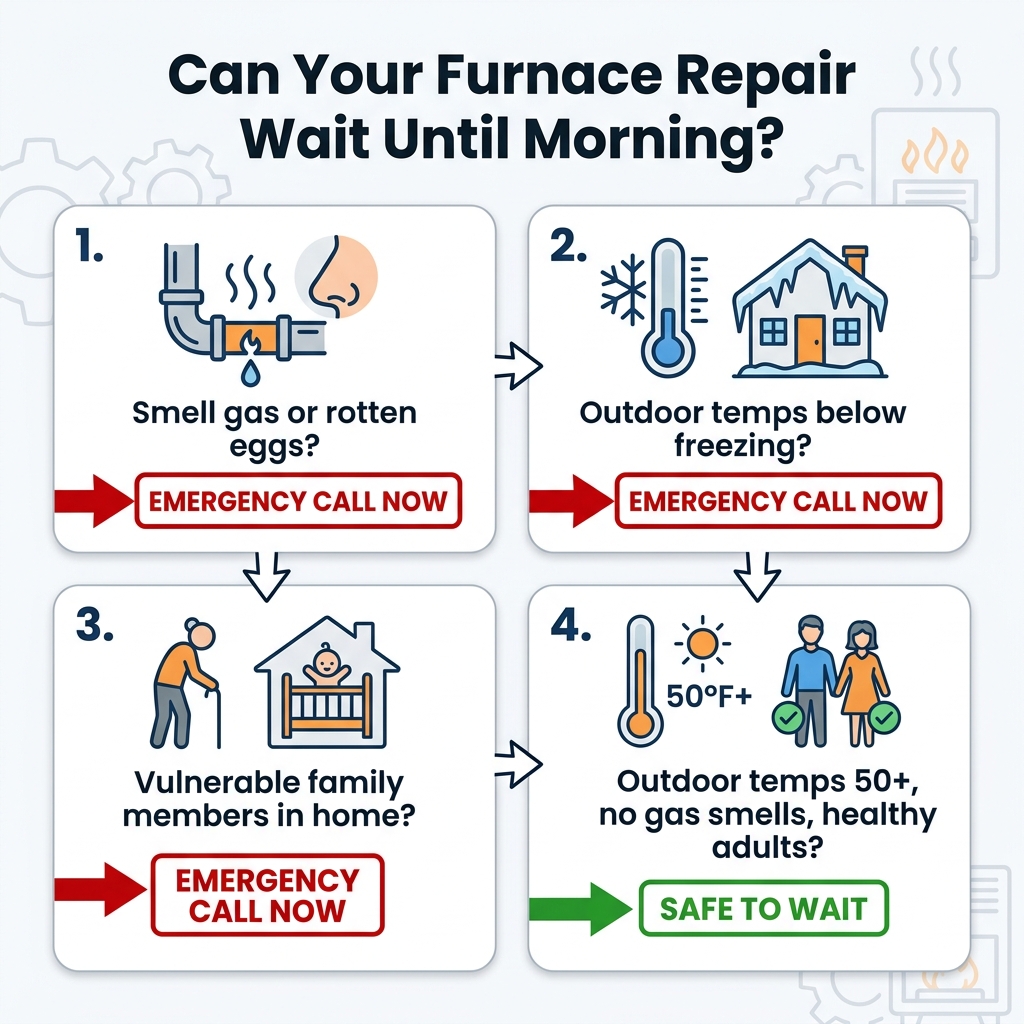
If you are standing in your hallway debating what to do, use this simple checklist our team relies on. If you meet all four of these criteria, you can confidently turn off the system, go to sleep, and handle the repair during normal business hours.
• No gas smells or alarms: The air in your home smells normal. There is no scent of sulfur, burning plastic, or electrical ozone, and your carbon monoxide detectors are silent. This confirms there is no immediate combustion danger.
• Outdoor temperatures remain mild: The local weather forecast shows that nighttime temperatures will stay well above freezing. In early fall, temperatures usually hover in the 50s or 60s, meaning the structural integrity of your home and plumbing is completely safe.
• Indoor temperatures are stable: The thermostat reads 60 degrees Fahrenheit or higher, and based on the mild outdoor weather, you do not expect the indoor temperature to plummet drastically before sunrise.
• Your household is healthy: All residents in the home are healthy adults or older children who can comfortably manage a slight chill by layering clothing or adding an extra quilt to the bed.

Why We Actually Want You to Wait for Regular Business Hours
It might seem unusual for a heating company to actively discourage you from booking an immediate service call, but our approach at Climate Mechanics is built on honesty and transparency. We've built our reputation in Cinnaminson and surrounding South Jersey areas with the goal of establishing long-term trust, not maximizing short-term profits on unnecessary nighttime dispatches.
Transparency Over Premium Fees
The reality of the HVAC industry is that emergency, after-hours dispatch inevitably carries premium fees. Keeping highly trained technicians on standby at 2:00 AM requires additional overhead. If your home is in genuine danger, that premium is entirely justified to restore safety. However, if the situation is simply a matter of temporary discomfort, we prefer to protect your wallet. A reputable local HVAC partner prioritizes customer trust over collecting premium rates for non-emergencies. We want to save our neighbors money whenever a repair can safely wait for standard morning hours.
The Parts Availability Factor
Another practical reason we advise waiting involves the supply chain. In our experience, even if a Climate Mechanics technician arrives at your home at midnight and correctly diagnoses a failed blower motor or a cracked control board, local HVAC supply houses are closed. The technician will likely have to wait until 7:00 AM or 8:00 AM to purchase the specific replacement part required for your exact system model. Paying an after-hours fee just to receive a diagnosis—only to wait until morning for the actual repair anyway—is frustrating and inefficient. By waiting for normal business hours, the diagnostic and the parts acquisition can happen in one seamless, cost-effective process.
Simple Checks Before Scheduling Your Morning Service
While you wait for morning, our technicians recommend a few safe, basic troubleshooting steps you can perform. We often find that what appears to be a major system failure is actually a minor oversight that you can resolve yourself without needing a service visit at all. However, you must always remember never to attempt mechanical or electrical repairs on the equipment itself, as licensed professionals are required for safe resolution.
1. Check the thermostat settings: This sounds overly simple, but it is one of the most common issues we see. Ensure the system is actually switched to the "Heat" position, not "Cool" or "Off." Verify that the temperature setting is actually higher than the current room temperature. If the thermostat screen is blank, try replacing the batteries.
2. Verify the furnace power switch: Most heating systems have a dedicated power switch mounted on the side of the unit or on a nearby wall. It looks exactly like a standard light switch. Because it is often located in a basement, garage, or utility closet, it is very easy to accidentally bump it into the "Off" position while moving boxes or retrieving stored items.
3. Inspect the electrical panel: Locate your home's main electrical panel and check for a tripped breaker. Heating systems require a significant amount of power to start up, and a power surge can occasionally trip the dedicated circuit. If the breaker is tripped, firmly push it all the way to the "Off" position, then snap it back to "On." If it trips again immediately, do not reset it; leave it off and wait for a professional.
4. Examine the air filter: A severely clogged air filter restricts airflow, causing the system's internal safety sensors to overheat and shut the burner down. If the filter looks like a thick blanket of gray dust, replacing it might solve the problem. In fact, skipping the fall furnace inspection and forgetting to change the filter is the leading cause of early season breakdowns we encounter.
Frequently Asked Questions About Early Season Furnace Failures
If you are dealing with a breakdown, scheduling routine furnace maintenance ahead of time can often prevent these early season surprises. To help you navigate a sudden loss of heat, here are detailed answers to the most common questions homeowners ask our team during early fall heating failures.
What qualifies as a furnace emergency?
A true emergency is defined by immediate danger to life or property. This includes smelling gas, detecting rotten egg odors, sparking electrical components, or experiencing a total loss of heat during sub-freezing winter temperatures. If carbon monoxide alarms are sounding, you must evacuate immediately. Situations involving infants, the elderly, or medically vulnerable individuals also escalate a standard breakdown into an emergency.
Is it safe to leave a broken furnace off overnight?
Yes, it is entirely safe to leave the system off overnight as long as the outdoor temperatures are above freezing and no vulnerable individuals reside in the home. Turning the system off at the thermostat prevents it from continuously trying to start and potentially causing further mechanical damage. You can comfortably rely on extra blankets until standard business hours resume in the morning.
Can I wait until morning for furnace repair?
In early fall, waiting until morning is usually the smartest and most cost-effective decision you can make. Because homes retain daytime heat and outdoor temperatures are relatively mild, your indoor environment will remain structurally safe. Waiting allows you to avoid premium after-hours dispatch fees and ensures that supply houses are open if your system requires specialized replacement parts.
At what temperature do pipes freeze?
Water pipes generally do not face a freezing risk until outdoor temperatures drop below 20 degrees Fahrenheit for an extended period of time. During September and early October, nighttime temperatures rarely dip low enough to threaten your plumbing. Therefore, a broken heater in early fall is a comfort issue, not a pipe-freezing crisis.
Is having no heat an emergency in September?
Rarely. Unless the lack of heat is accompanied by a dangerous gas smell, electrical sparking, or the presence of vulnerable residents who require strict temperature control, September heat loss is strictly a comfort issue. The mild weather means your home will not become dangerously cold overnight.
Does a burning smell when first turning on the heater mean an emergency?
We field dozens of calls about this every September: a brief, dusty burning smell is completely normal during the first fall startup. This happens because dust settles on the heat exchanger over the summer, and it burns off during the first few heating cycles. However, if the smell persists for more than twenty minutes, smells like melting plastic, or smells like electrical ozone, shut the system down immediately and call for professional attention.
Make the Smart, Safe Choice for Your Home's Comfort
Navigating an early season heating failure does not have to be a stressful, panicked experience. By understanding the clear safety criteria outlined above, you can make confident, informed decisions about your home's comfort. If you smell gas, hear alarms, or have vulnerable family members, do not hesitate to call our team for immediate help. But if the night is mild and your home is safe, grab an extra blanket, turn off the thermostat, and get a good night's sleep.
When morning arrives, you can schedule a standard service call with our local experts at Climate Mechanics, who will restore your comfort efficiently and professionally, entirely without the premium price tag. Making the smart choice protects your peace of mind, ensures your family's safety, and keeps your household budget intact as you prepare for the colder months ahead.
