



When the Neighborhood Goes Quiet: The Reality of Summer AC Outages
A mere 10% drop in your neighborhood's electrical voltage is enough to cause catastrophic overheating in your HVAC system's most critical components. This hidden electrical strain is exactly why so many Moorestown homes experience mid-August capacitor failures, leaving families sweltering in the peak of summer. Waking up to an air conditioner that has suddenly stopped blowing cold air is incredibly frustrating, especially when the forecast calls for relentless heat. For homeowners, the immediate decision point is determining whether this blown part is a one-off stroke of bad luck or a symptom of broader neighborhood grid stress that requires a more strategic solution.
When the neighborhood grid falters, having a trusted partner for your air conditioning services is essential to restoring your home's comfort safely and efficiently.
The Pattern We See on the Ground
In our first-hand field experience responding to these exact calls, we often find ourselves diagnosing simultaneous neighborhood AC outages on the same Moorestown blocks on the exact same days. This is not a coincidence. Late-summer conditions in New Jersey bring a punishing combination of relentless humidity and high ambient temperatures that prevent systems from cooling down overnight. When mid-August sustained heatwaves settle over the region, the local power infrastructure is pushed to its absolute limits. By tracking these localized clusters, we can confidently identify that many of these part failures are actually the predictable result of grid strain rather than simple equipment age.
The Boiling Point: How Sustained Heat Breaks Down Capacitors
To understand why these components fail so predictably late in the season, you have to look at the thermal limits of the parts themselves. A capacitor acts as a massive, high-voltage battery designed to send a powerful jolt of energy to jump-start your air conditioner's compressor. Inside this small metal cylinder is a specialized dielectric fluid that helps store and discharge this electrical energy. However, this fluid has a strict thermal breaking point.
When ambient temperatures inside the condenser cabinet exceed 150 degrees Fahrenheit, the dielectric fluid begins to break down rapidly. August consistently brings the highest cumulative cooling degree days in New Jersey, meaning your system has likely been working relentlessly for months. Continuous running without adequate thermal recovery time literally bakes the internal electrical components. The heat destroys the fluid's ability to hold a charge, causing the cylinder to swell, leak, and eventually fail completely.
The Impact of Cumulative Cooling Degree Days
The concept of cumulative heat is vital here. A capacitor might survive a three-day heatwave in June without issue. But by the time mid-August sustained heatwaves arrive, the component has endured weeks of extreme thermal cycling. The table below illustrates how standard operating conditions drastically differ from the extreme environment inside your condenser during late summer.
• Ambient Cabinet Temperature — Standard Summer Conditions: 90°F - 110°F — Mid-August Grid Strain Conditions: 140°F - 160°F+
• Component Recovery Time — Standard Summer Conditions: Adequate overnight cooling — Mid-August Grid Strain Conditions: Minimal to no overnight cooling
• Dielectric Fluid State — Standard Summer Conditions: Stable and highly conductive — Mid-August Grid Strain Conditions: Boiling, expanding, and degrading
• Capacitor Physical Condition — Standard Summer Conditions: Normal cylindrical shape — Mid-August Grid Strain Conditions: Swollen, bulging, or leaking fluid
Why Older Electrical Infrastructure Struggles with Modern Cooling Loads
Connecting equipment failure to neighborhood power grids requires looking at the history of our local communities. Moorestown features a beautiful mix of historic and mid-century neighborhoods. While these tree-lined streets offer incredible charm, they often rely on older local electrical transformers that were installed decades ago. There is a fundamental mismatch between this aging electrical infrastructure and the heavy electrical demands of modern, high-efficiency HVAC systems.
When peak afternoon heat strikes, nearly every home on the block kicks on their central air conditioning simultaneously. Modern systems pull significant amperage to start their variable-speed compressors and high-powered blower motors. When fifty houses connected to the same aging transformer all demand maximum power at once, the local grid simply cannot supply the necessary voltage. This results in localized brownouts—temporary drops in voltage that you might only notice as a brief flickering of your living room lights.
The Localized Community Trend
We view this as an observable community trend rather than just generic wear and tear on individual units. When voltage sags across Moorestown neighborhoods with older electrical infrastructure, every air conditioner on that block is forced to work harder to compensate. If your system happens to be the one that absorbs the brunt of that power fluctuation, the capacitor is usually the first component to sacrifice itself. Addressing this requires professional AC repair in Moorestown to ensure the underlying electrical strain hasn't damaged the compressor alongside the capacitor.
The Voltage Drop Domino Effect: A Technical Breakdown
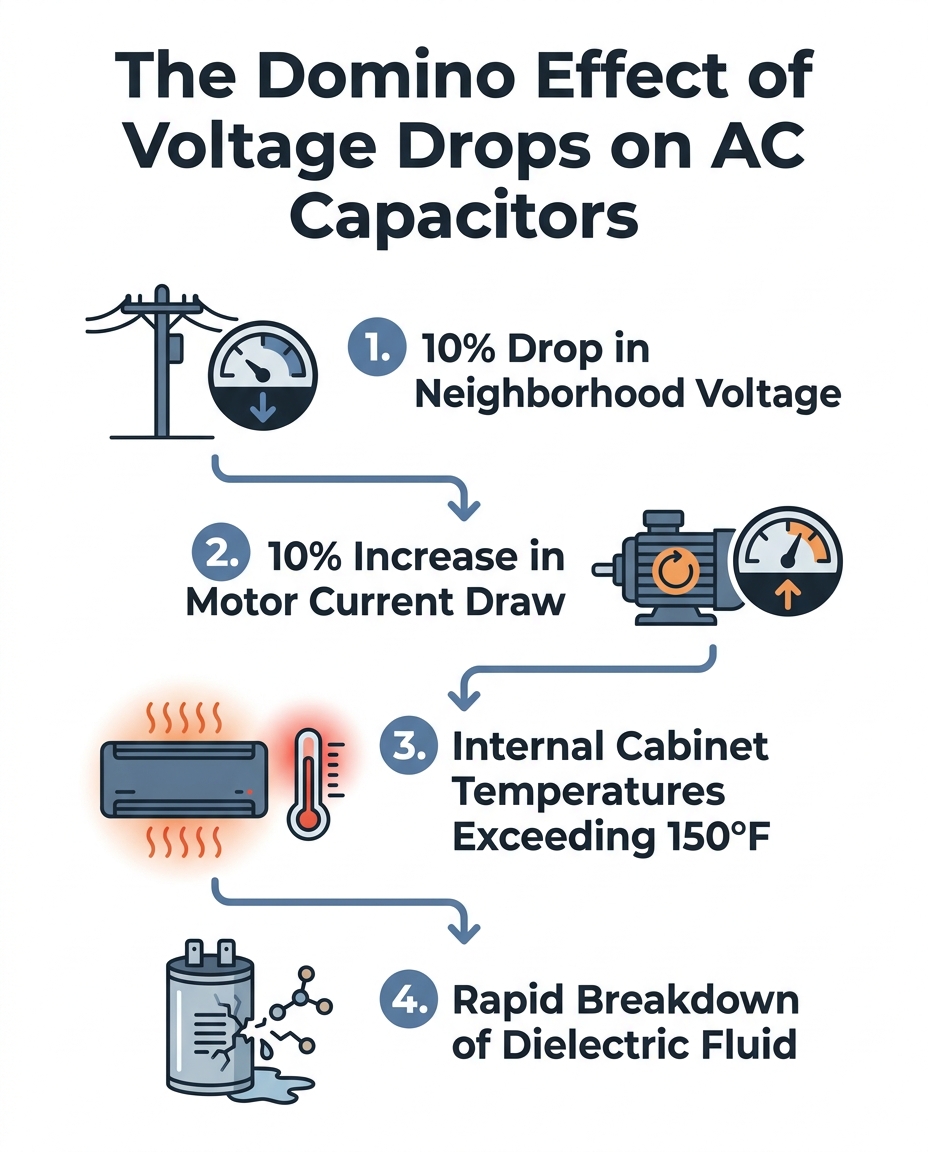
Understanding exactly how a drop in neighborhood voltage physically destroys your AC capacitor requires a brief look at electrical physics. In HVAC motors, there is an inverse relationship between voltage (the electrical pressure) and current (the actual volume of electricity flowing). When voltage drops, the motor must pull more current to perform the exact same amount of work. Here is how that domino effect plays out inside your air conditioning unit:
1. The Grid Sags: As neighborhood demand peaks, the local transformer experiences a brownout, dropping the supply voltage to your home by roughly 10%.
2. The Current Spikes: Because the AC compressor still needs to turn at a specific speed to pump refrigerant, the 10% drop in voltage forces the motor to draw 10% more current to compensate.
3. Massive Heat Generation: This excess current flowing through the system generates massive internal heat, adding to the already extreme ambient temperatures inside the metal condenser cabinet.
4. The Thermal Breaking Point: The capacitor, already thermally stressed by the mid-August heat, is pushed past its limits by the sudden spike in current and internal heat, causing the dielectric fluid to boil and the component to fail.
CRITICAL SAFETY WARNING: Capacitors store lethal amounts of high voltage, even when the power to the air conditioner is completely shut off at the breaker. Because they act like massive batteries, they can deliver a fatal shock if touched improperly. Diagnosis, safe discharging, and replacement must be handled strictly by licensed HVAC professionals. Never attempt to inspect or replace an AC capacitor yourself under any circumstances.

Listening to the Warning Signs of Electrical Stress
Fortunately, an air conditioner will often give you subtle warning signs that it is struggling with electrical stress before the capacitor blows completely. Identifying these symptoms early can mean the difference between a quick component swap and a catastrophic system failure. During mid-August sustained heatwaves, pay close attention to how your system behaves when it cycles on.
• Sluggish Startup Times: If your air conditioner is taking noticeably longer to start pushing cold air after the thermostat clicks on, the capacitor is likely losing its ability to deliver a full charge.
• Humming or Clicking Noises: A distinct humming or rapid clicking sound coming from the outside condenser unit usually indicates the motor is trying to start but isn't receiving enough voltage to turn over.
• Slow-Spinning Fan Blades: If the large fan on top of the outside unit is spinning sluggishly or requires a push from a stick to get going (never use your hands), the capacitor has failed.
The Threat of Compressor Damage
Ignoring these warning signs often leads to severe compressor damage, which is a significantly more extensive and complex repair. Strange mechanical sounds often mask underlying electrical struggles as the motor fights to start without proper voltage. If you notice these symptoms, it is vital to uncover the real reason your AC unit sounds like it's grinding before the electrical strain burns out the compressor windings entirely.
Fast Response When the Heatwave Takes Down Your System
Capacitor failures almost always happen at the worst possible times. They rarely occur on a mild Tuesday morning; they happen during holiday weekends, family gatherings, or at the absolute peak of a mid-August heatwave. When your system goes down during these critical periods, rapid local response is essential to restoring your home's safety and comfort.
One Moorestown homeowner reached out to us when their central air unit failed on a sweltering summer holiday weekend. Recognizing the urgent need, our owner and a service technician arrived quickly, diagnosed the blown capacitor, and safely repaired the unit. Because we understand the local grid dynamics, the system was back up and running within 30 minutes.
The Professional Diagnostic Process
A professional diagnostic visit involves much more than simply swapping out a part. When our technicians arrive, the first step is safely discharging the old capacitor using specialized insulated tools to eliminate the high-voltage risk. Next, we rigorously check the compressor for any signs of heat stress or electrical winding damage caused by the voltage drop. Finally, we verify that the incoming voltage from the neighborhood grid is stable. A quick, professional replacement utilizing reliable AC service restores cooling rapidly and prevents further electrical degradation to your home's HVAC system.
Protecting Your AC Against Future Brownouts and Grid Strain
While you cannot control the power grid in Moorestown neighborhoods with older electrical infrastructure, you can take proactive steps to safeguard your HVAC system against ongoing neighborhood electrical fluctuations. Implementing professional protective measures ensures that your air conditioner is resilient enough to handle late-summer voltage drops without sacrificing critical components.
Another customer contacted us late on a Sunday evening during a brutal summer heatwave when their system abruptly stopped working. A technician arrived within an hour of the call, identified the grid-stress damage, and had the unit operational shortly after. To prevent these recurring emergencies, we recommend several strategic upgrades.
• Install a Hard Start Kit: This device acts as an electrical buffer, reducing the massive demand on the compressor during startup. It stores extra energy to help the system turn on smoothly, even when neighborhood voltage is sagging.
• Add Surge Protection: Whole-home or unit-specific HVAC surge protectors defend your equipment against the sudden voltage spikes that often follow a localized brownout when power is fully restored.
• Schedule Routine Electrical Inspections: Proactive AC maintenance allows technicians to test capacitor microfarad readings. We can catch a swollen, leaking, or weakening capacitor and replace it weeks before it actually fails.
• Clear Condenser Airflow: Ensure the outside unit is completely free of debris, leaves, and overgrown shrubs. Proper airflow helps dissipate the intense internal heat generated during long cooling cycles.
Proactive care is the absolute best defense against the unpredictable nature of late-summer grid stress. By fortifying your system now, you can enjoy uninterrupted comfort no matter how hot the forecast gets.
