




The September Rush to Reclaim Cold South Jersey Sunrooms
Addressing Drafty Sunrooms in Moorestown Before Winter Arrives is a critical priority for local homeowners as September signals a rapid, undeniable shift in our local weather. The stifling humidity of a South Jersey summer finally breaks, replaced by crisp, rapidly cooling nights that warn of the freezing temperatures to come. For many residents, this seasonal transition highlights a frustrating reality: that beautiful, glass-heavy three-season room you enjoyed all summer is about to become a freezing, unusable zone. Without a permanent, highly efficient heating solution in place before the first major freeze, these unique architectural spaces are often abandoned until spring.
By treating the September pre-heating season transition as your deadline, you can evaluate decoupled heating methods that actually work for glass enclosures. If you are exploring ductless heating systems, securing a ductless mini-split installation in Moorestown now ensures your home addition remains comfortable, functional, and energy-efficient long before the emergency winter rush begins.
The Architectural Challenge of Moorestown Additions
Moorestown properties with three-season glass sunrooms feature unique architectural charm, but they also present significant thermal challenges. Unlike the rest of your home, which is wrapped in layers of insulation, drywall, and weather barriers, sunrooms are defined by their high glass-to-wall ratio. This design is perfect for letting in natural light and enjoying the view, but it acts as a massive thermal sieve the moment outdoor temperatures drop.
Our local expertise in retrofitting unique South Jersey architectural features—specifically older sunrooms built without modern winter insulation in mind—reveals that these spaces require specialized attention. Standard building practices for primary living spaces simply do not apply to rooms constructed primarily of glass and aluminum framing.
The Thermal Reality of Glass Walls
To understand why sunrooms lose heat so rapidly, we have to look at the physics of thermal resistance, commonly measured as an R-value. The higher the R-value, the better the material resists heat transfer. According to U.S. Department of Energy (DOE) guidelines regarding window heat loss, even high-quality glass pales in comparison to a standard insulated wall.
• Standard Insulated Exterior Wall — Approximate R-Value: R-13 to R-21 — Heat Loss Potential: Low (Highly stable temperature)
• Double-Pane Window (Argon Filled) — Approximate R-Value: R-3 to R-4 — Heat Loss Potential: Moderate to High
• Single-Pane Glass (Older Sunrooms) — Approximate R-Value: R-1 or less — Heat Loss Potential: Extreme (Rapid heat transfer)
The thermal bridge effect: Because glass has such a low thermal resistance, the heat inside your sunroom is rapidly pulled outside. Cold drafts penetrate aging window seals, creating a localized microclimate that is completely disconnected from the temperature of your main home.
Why Three-Season Rooms Fail in Late Fall
There is a specific temperature threshold where unheated sunrooms transition from feeling a bit "cool" to entirely unusable. Once outdoor temperatures dip below 50°F, the radiant cold coming off large glass surfaces makes the ambient air inside the room feel significantly colder than the thermostat reads. You aren't just losing warm air through tiny gaps; the glass itself is absorbing the heat from your body. This rapid heat loss makes it impossible to maintain comfort without a dedicated, continuous heat source.
Why Extending Central HVAC is a Flawed Strategy
The most common misconception homeowners have when trying to reclaim a cold addition is that they should simply run new ductwork from their existing central HVAC system into the sunroom. On paper, it seems logical. In practice, it is a structural and thermodynamic mistake.
Evaluating different installation approaches is crucial. For instance, one local homeowner recently reached out needing a quote for a complicated full-house HVAC install, trying to decide between extending ducted lines or going with ductless mini-splits for their addition. Our consultative approach helped them evaluate the long-term impacts of both options, revealing exactly why forcing a central system to heat an uninsulated space leads to massive energy waste and uneven temperatures.
The Thermostat Disconnect
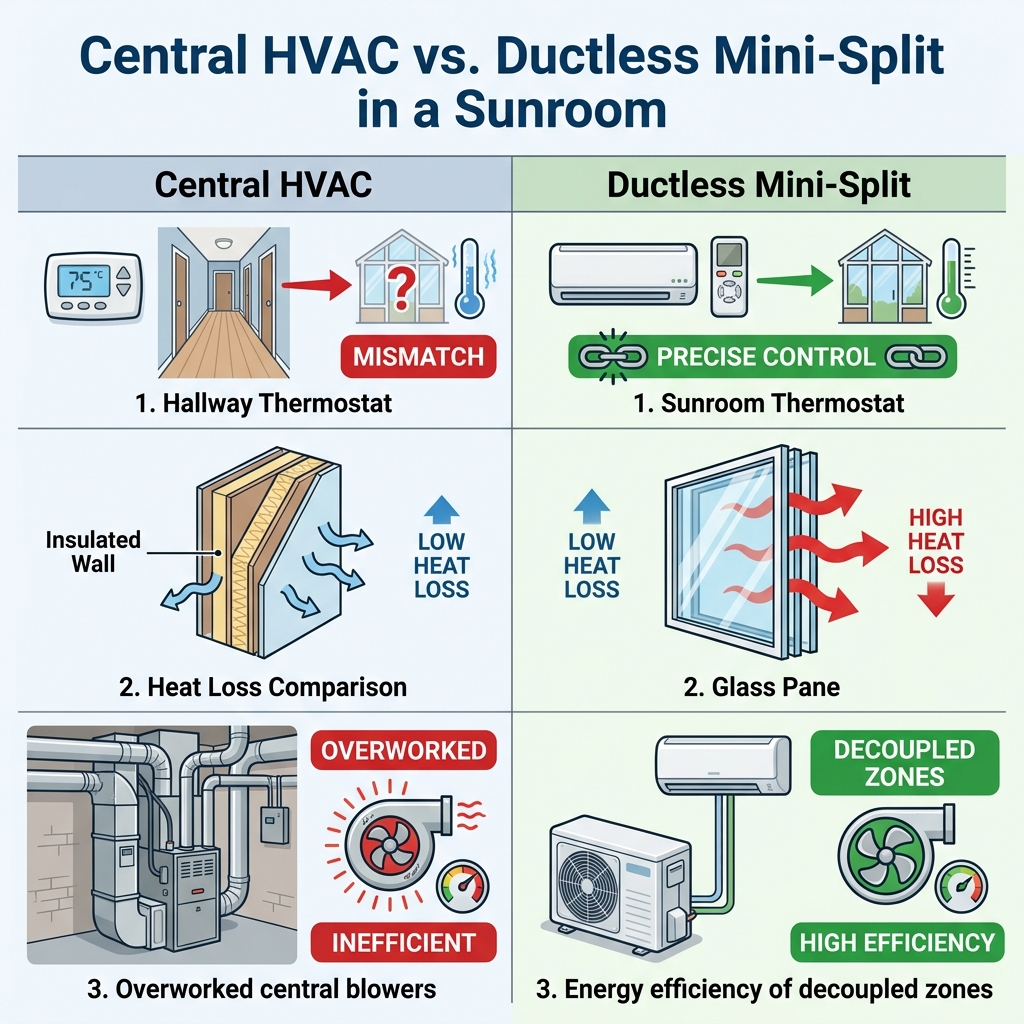
The fundamental flaw of extending ductwork is the "thermostat disconnect." Your home's central thermostat is likely located in an interior hallway, surrounded by insulated walls (R-13 or higher). It reads the temperature of that well-insulated space. If you set the thermostat to 70°F, the system runs until the hallway reaches 70°F, and then it shuts off.
Meanwhile, your sunroom—surrounded by R-1 glass—is losing heat five times faster than the hallway. Because the thermostat cannot "see" the temperature in the sunroom, the system shuts off long before the sunroom is warm. Conversely, if you force the system to run until the sunroom is warm, the rest of your well-insulated house will overheat to an unbearable degree.
Strain on Your Primary Furnace
The hidden cost of duct extensions: Forcing air into a high-loss room overworks your central blower motor and heat exchanger. Central systems are meticulously sized for the original square footage and thermal load of the house. Adding a high-loss glass room alters the static pressure of the entire system.
• Continuous operation: The system struggles to satisfy the uneven temperature demands, running far longer than designed.
• Static pressure imbalances: Poorly planned duct extensions can choke the blower motor, leading to overheating.
• Premature failure: This unnecessary strain often leads to cracked heat exchangers, burned-out motors, and the need for frequent Moorestown furnace maintenance.

The Physics of Decoupled Heating: Enter the Mini-Split
The definitive, scientifically sound solution for localized heat loss is "decoupled heating." This simply means treating the sunroom as its own independent thermal zone, completely separate from the main home's ductwork and thermostat. Ductless mini-split heat pumps are engineered specifically for this purpose. They deliver high-efficiency zonal heating directly to the space without the severe energy loss associated with pushing air through long runs of ductwork.
Furthermore, ductless retrofits offer immense aesthetic and structural benefits for existing additions. Because there is no bulky ductwork required, there is no need to tear down ceilings, open up walls, or sacrifice headroom in your sunroom. A sleek indoor air handler is mounted to the wall or ceiling, connected to a compact outdoor compressor via a small, three-inch conduit.
Mastering Sub-Freezing Temperatures
A common myth is that heat pumps cannot handle true winter weather. While this was true decades ago, modern inverter-driven heat pumps operate efficiently even when outside temperatures drop well below freezing. Unlike traditional single-stage compressors that blast on at 100% capacity and then shut off, inverter technology allows the compressor to variable its speed. It continuously ramps up and down, extracting ambient heat from the freezing outdoor air and transferring it inside to maintain a perfectly stable temperature.
The danger of space heaters: Many homeowners resort to electric space heaters to survive the winter. Not only are these units a leading cause of residential fires, but they rely on resistive heating—a process that consumes massive amounts of electricity to generate a tiny amount of heat. A ductless heat pump, by contrast, transfers heat rather than creating it, making it exponentially more efficient and completely safe to run unattended.
Year-Round Utility for Local Additions
While the current focus is squarely on winter preparation, it is vital to remember that these systems are comprehensive climate control solutions. The same inverter technology that extracts heat from freezing air in January reverses its process in July, pulling humidity and heat out of your sunroom to keep it ice-cold. If you want to understand the full scope of this year-round utility, you can learn more about how a ductless mini split cools a home addition or sunroom in South Jersey during our sweltering summer months.
Protecting Your Home's Primary Heating Infrastructure
While the primary goal of a ductless installation is to make your sunroom comfortable, the secondary benefit is just as important: preserving the lifespan, efficiency, and reliability of your home's main furnace. By taking the massive heating load of the glass sunroom off the central system, your main furnace is allowed to operate exactly as the manufacturer originally designed it.
When you decouple the spaces, you eliminate the pressure imbalances caused by poorly planned duct extensions. When a central blower tries to push air into a distant room without an adequate return vent, it creates positive pressure in the sunroom and negative pressure in the main house. This negative pressure literally sucks freezing outdoor air into your home through cracks, gaps, and window frames, forcing the furnace to work even harder to recover.
Avoiding Unnecessary Wear and Tear
Proper system separation reduces overall wear and tear significantly. A dedicated mini-split prevents the central unit from short-cycling (turning on and off rapidly) or running continuously for hours on end.
• Protects the Heat Exchanger: Eliminates the rapid temperature fluctuations that cause metal fatigue and cracking.
• Saves the Blower Motor: Reduces the static pressure resistance, preventing the motor from overheating and burning out.
• Lowers Emergency Risk: This strategic separation helps you avoid costly heating repair services in Moorestown during the coldest, most demanding months of the year.
Timing Your Retrofit: The Pre-Heating Season Window
The urgency of acting during the September pre-heating season transition cannot be overstated. September is the critical "shoulder season" for HVAC retrofits. The weather is mild enough that your current heating system isn't running constantly, but the suddenness of South Jersey's first frost is looming just weeks away.
Waiting until November to address a freezing sunroom introduces massive logistical hurdles. Once the first major freeze hits, local technicians are instantly booked solid with emergency no-heat calls from residents whose primary furnaces have failed. By scheduling your installation in early fall, you secure prime appointment times, guarantee uninterrupted comfort, and ensure the system is fully operational before the glass walls turn to ice.
Additionally, proactive planning allows you to take advantage of financial incentives. Broad federal tax credits and generic energy rebates may apply to qualifying high-efficiency heat pump installations. Because these programs frequently update and require specific efficiency ratings, early fall is the perfect time to consult with an expert, select the right equipment, and verify current incentives with your utility provider or tax professional without the pressure of a freezing home.
Frequently Asked Questions About Heating Sunrooms
What is the best way to heat a sunroom in the winter?
The best way to heat a sunroom is by using a dedicated, decoupled system like a ductless mini-split heat pump. Because sunrooms have high heat loss due to extensive glass, they require a heat source that operates independently from the main house. Ductless systems provide highly efficient, targeted warmth without overworking your central furnace. They also avoid the safety hazards and high electricity costs associated with portable space heaters.
Can you put a mini split in a 3 season room?
Yes, installing a mini-split is the most effective way to convert a 3-season room into a 4-season room. The indoor air handling unit mounts easily to a wall or ceiling, requiring only a small hole for the refrigerant lines, which preserves the structural integrity of the room. This setup provides powerful heating in the winter and dedicated cooling in the summer, making the space usable year-round.
Why shouldn't I connect my sunroom to my central HVAC?
Connecting a sunroom to central HVAC creates a severe thermostat mismatch. Your central thermostat is located in an insulated part of the house and will shut off the system long before the glass-heavy sunroom gets warm. Furthermore, pushing air into an uninsulated addition alters the static pressure of your ductwork, straining the blower motor and significantly reducing the lifespan of your primary furnace.
How do you keep a sunroom warm in the winter without high electric bills?
To avoid high electric bills, you must move away from resistive electric space heaters and utilize heat transfer technology. Inverter-driven ductless heat pumps use a fraction of the electricity because they absorb ambient heat from the outside air and move it indoors, rather than generating heat from scratch. Combining a high-efficiency heat pump with basic weatherstripping and thermal curtains provides the lowest operating cost possible.
Why is my sunroom so cold even when the door to the house is open?
Your sunroom remains cold because standard glass has an extremely low R-value, meaning it loses heat to the outdoors faster than the warm air from your house can replace it. Leaving the door open simply drains the heat from your main living area, causing your central furnace to run constantly without ever actually warming up the sunroom. The rapid heat loss through the glass creates a permanent thermal deficit.
Do ductless heat pumps work efficiently in freezing South Jersey temperatures?
Yes, modern ductless heat pumps are engineered with advanced inverter technology specifically designed for cold climates. They can extract heat energy from the outdoor air even when temperatures drop well below freezing. Unlike older heat pumps that struggled in the cold, today's hyper-heating models maintain high efficiency and steady heat output throughout the harshest South Jersey winters.
Secure Your Comfort: Addressing Drafty Sunrooms in Moorestown Before Winter Arrives
A drafty sunroom does not have to be abandoned the moment the leaves start to fall. By understanding the unique architectural challenges of glass-heavy additions, you can make an informed decision that protects your home's primary HVAC system while maximizing your usable square footage. Addressing Drafty Sunrooms in Moorestown Before Winter Arrives requires a localized, professional consultation to evaluate your specific layout and thermal needs. Don't wait for the first deep freeze to strike—schedule your ductless mini-split evaluation today and ensure your favorite room remains a warm, inviting retreat all winter long.
