



Don't Panic: Navigating a Sudden 'Dead Compressor' Diagnosis
Your air conditioning system suddenly stops blowing cold air right in the middle of the late-summer August heat, and the technician standing in your yard just delivered the worst possible news. At Climate Mechanics, our team has seen this exact scenario countless times. Knowing exactly what to do when another HVAC contractor tells you your compressor is dead can save you from making a rushed, stressful, and potentially unnecessary financial decision.
Hearing that your system has suffered a catastrophic failure is incredibly overwhelming, especially when it happens during the chaotic back-to-school seasonal transition. A condemned system diagnosis feels final. However, a pattern we see often is that a "dead" compressor is frequently a misdiagnosis of a much simpler, highly fixable electrical issue. The compressor is the heart of your cooling system, but it relies on several smaller components to start and run. When those smaller parts fail, the entire system mimics a total mechanical breakdown.
You have the power to pause, take a breath, and seek a second opinion before committing to a massive expense. Professional Air Conditioning Services are designed to uncover the root cause of a failure, not just treat the most obvious symptom. By scheduling a comprehensive AC repair in Cinnaminson that focuses on deep diagnostics, you can verify whether the compressor has truly failed or if a minor electrical swap will get your home cooling again.
Why Compressors Are Frequently Misdiagnosed in Late Summer
To understand why misdiagnoses happen, it helps to look at the industry landscape during the peak cooling season. The late-summer rush leads to heavily overbooked schedules. Technicians are running from house to house in the late-summer August heat, and fatigue naturally sets in. When schedules are tight, our team notes that a hurried technician might skip comprehensive multimeter testing and rely on visual or auditory assumptions instead.
The Toll of South Jersey Humidity
In our years of servicing local homes, we know firsthand that South Jersey's prolonged hot and humid summers force air conditioning units into extended dehumidification cycles. Your system doesn't just cool the air; it removes thick ambient moisture. This heavy workload increases the thermal load on the equipment. Cumulative heat strain throughout June and July causes smaller, heat-sensitive electrical parts to degrade and fail simultaneously by August. The compressor itself is usually fine, but the parts that deliver its power are completely exhausted.
The Auditory Illusion of a Dead System
When a compressor tries to start without the necessary electrical boost, it often produces a loud, struggling humming sound. It may also trigger a "hard start" condition where the system shudders and trips the circuit breaker. To an untrained or hurried ear, this loud humming sounds exactly like a compressor that has mechanically locked up or seized. A rushed contractor might hear that hum, see the tripped breaker, and immediately condemn the unit.
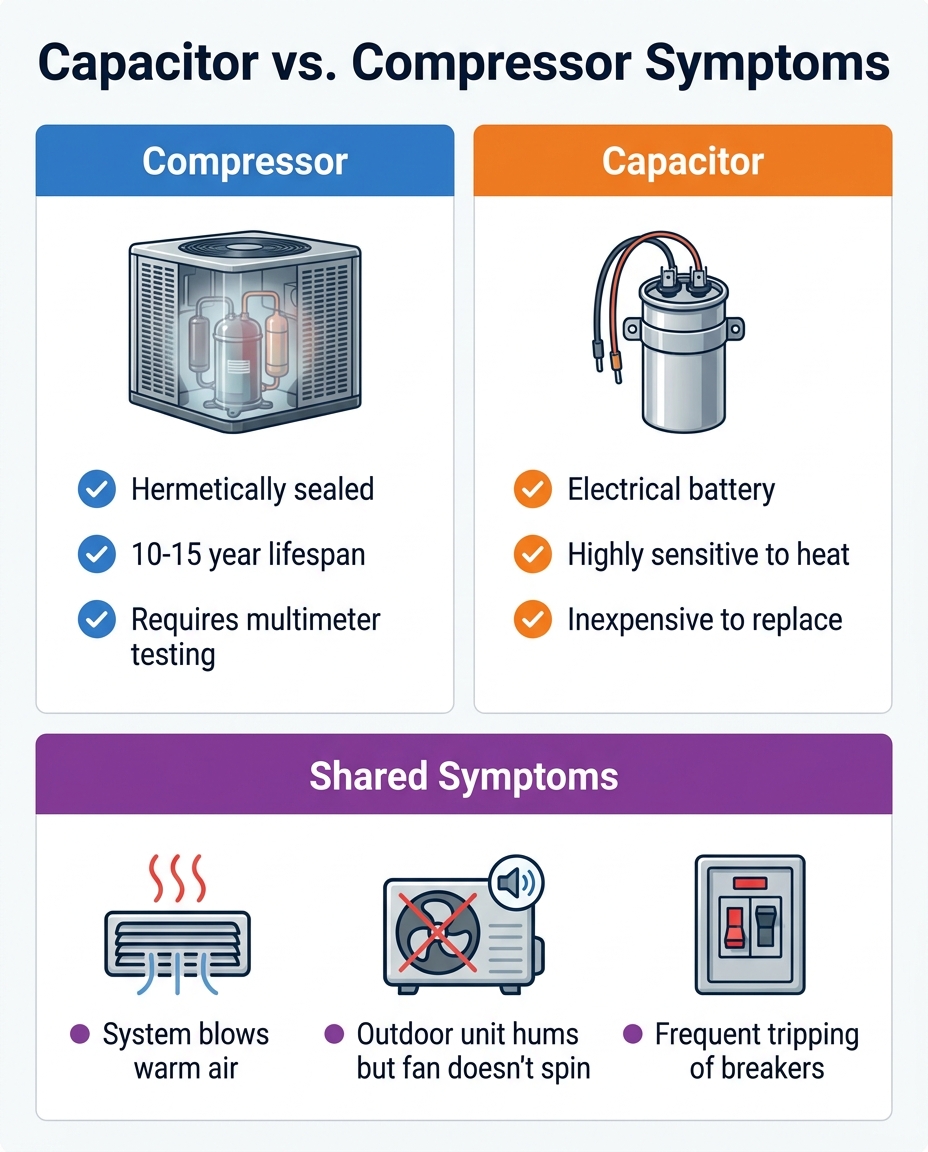
In reality, compressors are hermetically sealed, heavy-duty mechanical components designed to last 10 to 15 years under normal operating conditions. Sudden mechanical death—where the internal rotors physically shatter or seize—is significantly less common than an electrical delivery failure. We always remind our customers that a system refusing to start is a symptom, not a definitive diagnosis.
Capacitor vs. Compressor: The Electrical Issues That Mimic Total Failure
Differentiating between a true mechanical failure and a replaceable electrical failure is the most critical step in saving your air conditioning system. You should never attempt to test these components yourself, as they carry high-voltage electrical charges that remain dangerous even when the power is turned off. However, understanding how they work helps you ask the right questions when our technicians—or any others—arrive at your door.
The Role of the Dual Run Capacitor
The dual run capacitor acts as a powerful battery that provides the initial jolt of energy needed to jump-start the heavy compressor motor. Because the compressor requires a massive amount of torque to begin spinning, it relies entirely on this capacitor. Capacitors are highly susceptible to heat degradation. If the capacitor swells, leaks, or loses its charge, the compressor simply cannot turn on. It will sit there and hum, perfectly healthy but starved of power.
Burnt Contactors and Voltage Drops
The contactor acts as the main switch allowing high-voltage power to flow from your electrical panel to the outdoor unit. Every time your thermostat calls for cooling, the contactor snaps shut. Over thousands of cycles in the Cinnaminson NJ summer, we frequently find that the metal contacts can become pitted, burnt, or covered in carbon buildup. When this happens, the voltage drops or stops entirely. The compressor receives no electricity, mimicking a dead unit completely.
For example, one homeowner reached out in the spring with a severe air conditioner issue that seemed like a total system failure. Our technician assessed the problem, outlined a logical path forward, and ensured the customer understood the actual electrical problem and the plan to fix it—without jumping straight to a compressor replacement. Often, grinding noises during peak afternoon heat or sudden silence point to these exact electrical faults rather than a destroyed compressor.
• Dual Run Capacitor — Function: Provides starting energy to the compressor motor. — Failure Symptoms: Loud humming, fan spins but compressor doesn't, swollen casing. — Repair Scope: Simple, routine part replacement.
• Contactor — Function: Acts as the electrical switch for the outdoor unit. — Failure Symptoms: Unit completely unresponsive, buzzing sound, burnt smell. — Repair Scope: Simple, routine part replacement.
• Compressor — Function: Pumps and pressurizes refrigerant through the system. — Failure Symptoms: Shorted to ground, open windings, physically locked rotor. — Repair Scope: Major mechanical repair or full system replacement.

Understanding Your System's Warranty Status
Before you agree to any major work based on a condemned compressor diagnosis, you must verify your existing coverage. We find that many homeowners are completely unaware that their equipment still carries manufacturer protection. Taking a few minutes to check your warranty status can drastically change the financial reality of the situation.
1. Locate the data plate: Walk outside to your condenser unit and find the manufacturer's sticker or metal data plate. It is usually located on the back or side of the cabinet.
2. Write down the serial number: The serial number and model number contain the manufacturing date and are required to look up your system.
3. Check the manufacturer's website: Most major HVAC brands have a warranty lookup tool on their website. Enter your serial number to see if the unit is still covered.
4. Understand the coverage limits: Many modern compressors carry a 10-year manufacturer's parts warranty if the system was registered properly after installation.
Clarify with your technician that even if the compressor is truly dead after braving the late-summer August heat for years, a valid warranty means you are only responsible for labor and refrigerant costs, not the cost of the compressor part itself. If your system is older and out of warranty, generic energy rebates or local utility incentives may apply to a qualifying high-efficiency heat pump or AC upgrade, helping offset the investment if a replacement is ultimately necessary.
Actionable Steps: Questions to Ask the First Technician
You do not need to be an HVAC expert to hold a technician accountable for their diagnosis. We empower our customers to ask specific, technical questions. A thorough professional will gladly share their diagnostic process and explain their findings. If the answers are vague, dismissive, or rushed, it is a clear sign to pause and evaluate your options.
• "What were the exact microfarad readings on the capacitor?" A technician must use a multimeter to test the capacitor. If they cannot provide the exact microfarad reading compared to the part's rating, they did not test it properly.
• "Did you test the compressor windings for ohms?" A true compressor failure requires testing the internal electrical windings for continuity. Ask if the windings were shorted to ground or if they measured open.
• "Was a hard start kit attempted?" A hard start kit provides an extra surge of starting torque. If a compressor is simply stuck rather than dead, a hard start kit can often break it free and restore function.
• "Did you inspect the contactor for pitting or voltage drops?" Ask if they verified that full voltage is successfully passing through the contactor to the compressor.
If the technician cannot confidently answer these questions, do not sign any paperwork. Send them on their way and schedule a second opinion. Getting the right answers is the most important step before committing to an AC replacement.
The Value of a Diagnostic-First Second Opinion
There is immense value in stepping back from a stressful situation. A second opinion removes the pressure of an immediate, heat-of-the-moment decision. When you are sweating in your Cinnaminson NJ home, the urge to just say "fix it whatever it takes" is strong. However, inviting a fresh set of eyes to inspect the system often changes the outcome entirely.
A fresh technician frequently catches easily fixable ground issues, loose wiring, or minor electrical faults that were entirely missed by the first contractor. For instance, our team recently saw an issue with a mini split air conditioning unit caused by another contractor's rushed work. A diagnostic-first technician came out within two days, identified the actual problem, and fixed the unit quickly and efficiently. The unit was repaired promptly because the focus was on the root cause, not a sales quota.
At Climate Mechanics, we take pride in providing honest, reliable second opinions for Cinnaminson homeowners. We prioritize accurate diagnostics over unnecessary replacements. A proper diagnostic approach systematically rules out every electrical component before declaring a compressor dead. Framing a second opinion as a low-stress, high-clarity step ensures you are making an informed decision based on facts, not panic.
Frequently Asked Questions About AC Diagnostics
Can a bad capacitor mimic a bad compressor?
Yes, a failed capacitor prevents the compressor from starting, often causing a loud humming noise that sounds identical to a seized compressor. Because the capacitor provides the initial electrical jolt required to turn the motor, a dead capacitor leaves a perfectly healthy compressor completely immobilized and unresponsive.
How do you know if your AC compressor is really bad?
A professional must test the electrical windings with a multimeter to confirm an open or shorted circuit, ruling out all other electrical components first. If the capacitor, contactor, and wiring all deliver proper voltage but the internal windings fail the continuity test, the compressor is officially dead.
Should I get a second opinion on AC replacement?
Absolutely. Given the high investment, a second opinion ensures the initial diagnosis wasn't rushed and verifies that a simple electrical repair isn't being overlooked. During the late-summer August heat, rushed technicians frequently misdiagnose minor electrical faults as total system failures, making a second opinion essential.
What causes an AC compressor to stop working?
Causes range from electrical failures like bad capacitors and burnt relays to severe mechanical wear. A lack of routine maintenance can lead to dirty coils, which increases internal pressure and heat, eventually causing the compressor's internal rotors to lock up or the electrical windings to short out entirely.
Is a hard start kit a permanent fix for a failing compressor?
It can extend the life of an aging compressor by providing extra starting torque, but it cannot fix a compressor with internal mechanical damage or shorted windings. A hard start kit is a helpful tool to overcome tight mechanical friction, but it will not reverse permanent internal wear and tear.
Schedule Your Honest AC Diagnostic Today
Receiving a total system failure diagnosis is overwhelming, but you don't have to navigate it alone. Take a deep breath and give yourself the peace of mind that comes with a thorough, honest diagnostic check. We encourage Cinnaminson NJ homeowners to schedule a comprehensive inspection before making any major replacement decisions. Reach out to the Climate Mechanics team today to secure a reliable second opinion and ensure your home stays comfortable without unnecessary expenses.
