



The Late-Summer Dilemma: Should You Fix a Failing AC in August?
Are you wondering if repairing a 10-Year-Old AC in August vs pre-ordering a fall replacement is the smartest move for your home and budget? Here at Climate Mechanics, we see this exact scenario play out every year. When your cooling system breaks down right as the back-to-school transition begins in Cinnaminson, your immediate urge is to find a fast, permanent fix. You are facing a humid late-summer August, and the intense discomfort inside your home can make it difficult to think beyond the next twenty-four hours. However, in our experience, making a rushed, heat-driven decision often leads to long-term regrets and wasted resources.
To explore all your cooling options and make an informed decision, learn more about our comprehensive air conditioning services.
This late-summer dilemma requires a shift in perspective. Instead of reacting emotionally to the uncomfortable temperature, our technicians recommend a logical, financial-focused evaluation of your equipment. Authorizing a major repair on an older unit might restore your comfort today, but we rarely see it extend the realistic lifespan of the system. Weighing the true costs of a late-season patch against the strategic advantages of limping across the finish line to schedule a planned off-season replacement is the best way to protect your long-term comfort.
The Sunk Cost Trap of a Late-Season AC Repair
The sunk cost fallacy is a common trap our team sees homeowners fall into when dealing with aging HVAC systems. Because you have already invested heavily in maintenance and minor fixes over the years, throwing more resources at a dying unit feels like the right way to protect your investment. However, pouring funds into a 10-year-old AC unit at the end of summer rarely yields any real long-term value.
Older units lose significant efficiency over time, and their mechanical components begin to fail in a compounding pattern. Fixing a blower motor today does not prevent the compressor from failing next month. A late-season AC repair is often just a temporary band-aid that masks a systemic decline. While a quick patch might get you through the final hot weeks, it does not reset the clock on your equipment's lifespan.
For example, our emergency crew recently helped a local Cinnaminson homeowner who experienced a sudden breakdown on a Sunday evening during a late-summer heatwave. While our technician was able to arrive and get the system running within an hour, a quick patch on an aging system often just delays the inevitable. The urgency of an immediate summer repair constantly fights against your long-term need for a reliable, energy-efficient system that will not leave you stranded during the next heatwave.
Limping Across the Finish Line: The South Jersey Climate Shift
In our years of serving the area, we know that late August represents the absolute peak of accumulated summer wear-and-tear on your HVAC components. After months of running continuously, a humid late-summer August in South Jersey puts maximum strain on aging compressors, making a breakdown feel like an immediate, terrifying emergency. However, we always remind our customers that the regional climate is about to shift.
The rapid transition to milder autumn weather arrives shortly after the hectic back-to-school rush. Providing yourself with the psychological reassurance that a severe heatwave is temporary allows you to view a strategic delay as a highly valid option. If you can bridge the gap for a few short weeks, you open up a valuable off-season installation window.
Here are a few temporary ways we recommend managing household comfort during the final hot weeks without committing to a massive repair bill:
1. Optimize ceiling fans: Ensure your fans are rotating counterclockwise to create a direct downdraft, which makes the room feel significantly cooler.
2. Utilize strategic ventilation: Open windows during the cooler early morning and late evening hours to flush out stale, hot air, then close blinds and curtains before the sun peaks.
3. Deploy portable units: Using a portable or window air conditioner in your primary bedroom ensures you can sleep comfortably while the rest of the house remains warmer.
4. Reduce internal heat loads: Avoid using the oven or dryer during the hottest parts of the day, as these appliances add unnecessary heat and humidity to your living spaces.
Strategic Advantages of Pre-Ordering a Fall AC Replacement
Waiting for the off-season to install a new system fundamentally changes the experience of upgrading your home. When you pre-order a fall replacement for your 10-year-old AC unit, you move from a reactive emergency state to a proactive, planned strategy.
Our installation team recently worked with a local family who decided to replace their aging central air unit ahead of severe summer weather. By planning their installation strategically, they enjoyed a quick, professional process where we could provide detailed explanations of their new system's features. This level of personalized, low-stress service is much easier to secure when you aren't competing with peak-season emergencies.
Consider these distinct advantages of an off-season upgrade that we highlight for our clients:
• Avoiding emergency stress: Off-season scheduling eliminates the rushed, panicked decisions that happen when your house is sweltering and you just want the air back on immediately.
• Better crew availability: During the fall, installation crews have more flexible schedules, allowing you to choose an installation date that perfectly aligns with your family's routine.
• Time to research incentives: Planning ahead gives you the breathing room to explore generic federal tax credits and local utility rebates that may apply to qualifying high-efficiency upgrades, maximizing your overall value.
• Guaranteed peace of mind: A planned, well-executed AC replacement in Cinnaminson ensures your home is fully prepared long before the next cooling season begins.
Side-by-Side Comparison: August Patch vs. Fall Upgrade
To help you navigate this decision, it helps to look at the short-term and long-term impacts of both options. When dealing with a humid late-summer August breakdown, comparing the outcomes directly clarifies which path aligns with your goals.
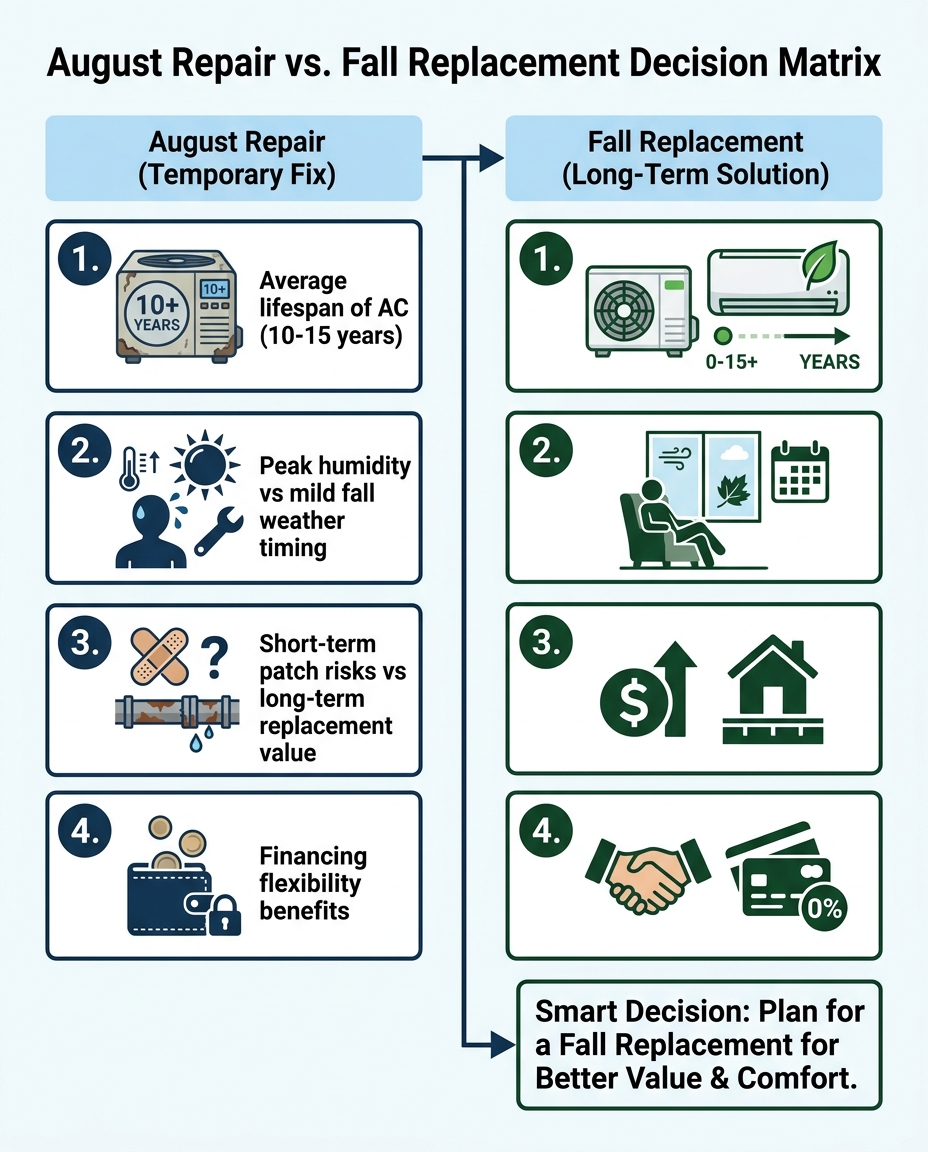
• Short-Term Comfort — August Patch (Repair): Immediate restoration of cooling, but with lingering anxiety about the next potential breakdown. — Fall Upgrade (Replace): Requires temporary cooling strategies for a few weeks until the new system is installed.
• Long-Term Reliability — August Patch (Repair): Low. The aging system remains prone to compounding mechanical failures. — Fall Upgrade (Replace): High. A brand-new system provides a decade or more of dependable, warrantied performance.
• Financial Efficiency — August Patch (Repair): Poor. Funds are sunk into a dying unit with declining energy efficiency. — Fall Upgrade (Replace): Excellent. Investment goes toward high-efficiency equipment that lowers monthly energy usage.
• Stress Level — August Patch (Repair): High. Decisions are rushed, and future breakdowns are highly probable. — Fall Upgrade (Replace): Low. The process is planned, scheduled conveniently, and executed without peak-season pressure.

Evaluating Your Current System: Is It Worth Saving?
Before making your final choice, you must objectively evaluate the condition of your equipment. Central air conditioners generally have a lifespan of ten to fifteen years in our New Jersey climate. If you are operating a 10-year-old AC unit, you are already entering the window where our team typically finds that replacement becomes the statistically smarter choice.
Our technicians often use the "5000 rule" as a conceptual framework for decision-making. You multiply the estimated repair cost by the age of the equipment. If the resulting figure approaches or exceeds the financial threshold of a new installation, repairing the unit is a poor investment. For more detailed insights on this evaluation process, you can read our guide on whether is an older AC worth fixing in South Jersey.
The Age and Efficiency Factor
A decade of heavy wear drastically reduces a system's SEER (Seasonal Energy Efficiency Ratio) rating. Even if your unit was highly efficient when installed, worn coils, struggling motors, and minor duct leaks mean it now consumes significantly more energy to produce the same amount of cooling. Furthermore, mechanical failures in older units are compounding; the strain of a failing capacitor often damages the compressor over time, leading to a cascade of expensive issues.
Refrigerant and Compatibility Concerns
Older systems were often built to utilize R-22 refrigerant, which has been phased out due to environmental regulations. If your aging unit develops a refrigerant leak, sourcing the obsolete R-22 is increasingly difficult and highly impractical. Modern systems utilize environmentally friendly refrigerants that are readily available, making a late-stage repair on an obsolete system a massive logistical headache. Upgrading ensures your home benefits from modern compatibility and superior environmental standards.
Bridging the Gap: How Flexible Financing Removes the Pressure
The biggest hurdle we see to skipping a late-season repair is often the perceived immediate cost of a complete replacement. When faced with a humid late-summer August breakdown, homeowners frequently choose a bad "sunk cost" repair simply because they feel cornered by the sudden expense of a new unit. This is where strategic financial planning changes everything.
Flexible financing serves as the ultimate stress-reliever, empowering you to reject a poor repair investment. By bridging the gap with HVAC financing options, you turn an unexpected emergency into a highly manageable, planned monthly investment. Financing makes pre-ordering a fall replacement completely accessible.
Securing pre-approval is a simple, straightforward process that you can complete well before your fall installation date. Once approved, the pressure of a sudden breakdown evaporates. You no longer have to drain your savings to restore your comfort; instead, you can confidently schedule your off-season upgrade with Climate Mechanics and enjoy the peace of mind that comes with a brand-new, warrantied system.
Make the Smart Move for Your Home's Long-Term Comfort
Navigating an end-of-summer breakdown does not have to be an overwhelming experience. By applying a clear, logical framework, you can confidently decide whether to patch your system or plan for a comprehensive fall upgrade. Surviving the final hot weeks to secure a better long-term solution is almost always the smartest financial move.
If you are struggling with a failing 10-year-old AC unit, do not let the immediate heat force you into a bad investment. Take control of your home's comfort and efficiency by evaluating your system objectively. Reach out to the Climate Mechanics team to schedule a thorough consultation today, and let us help you map out a stress-free replacement strategy that perfectly fits your home and budget.
Frequently Asked Questions
Is it worth fixing a 10-year-old AC in late summer?
In our experience, the short answer is usually no, as pouring funds into an aging system rarely offers long-term value. A 10-year-old unit is nearing the end of its lifespan, and a late-summer patch often just delays an inevitable replacement. Waiting for a fall upgrade is generally a much smarter financial strategy.
When is the best time to schedule an AC replacement?
The best time to schedule a replacement is during the mild off-season months, such as the fall. During this time, installation crews have more availability, and you avoid the stress of an emergency peak-season breakdown. Planning ahead also gives you ample time to research high-efficiency models and generic energy rebates.
Does financing make a fall AC replacement easier?
Yes, flexible financing transforms a sudden, stressful expense into a predictable monthly investment. It empowers you to bypass a bad "sunk cost" repair and instead invest in a reliable new system. Securing pre-approval removes the financial pressure of an unexpected late-summer breakdown.
How long do AC units last in NJ?
Central air conditioners in New Jersey generally have a reliable lifespan of ten to fifteen years. High humidity and intense summer heat put significant strain on the equipment, accelerating wear and tear over time. Regular maintenance can help maximize this lifespan, but efficiency naturally declines after a decade.
Should I replace my AC before it completely breaks down?
Yes, our team highly recommends replacing your system before a catastrophic failure to avoid emergency installation stress. Proactive replacement allows you to schedule the work conveniently, secure financing without pressure, and upgrade your home's efficiency on your own terms. It prevents you from being stranded without cooling during a severe heatwave.
What are the signs my older AC is beyond a simple patch?
If your system requires frequent repairs, struggles to maintain consistent temperatures, or uses obsolete R-22 refrigerant, it is likely beyond a simple patch. Unusually high energy bills and loud, grinding mechanical noises also indicate severe internal wear. When these symptoms appear on a decade-old unit, replacement is the most logical path forward.
