



Why Won't My Air Conditioner Shut Off During the Late Summer Heat?
As the back-to-school transition begins, our team at Climate Mechanics fields countless calls from South Jersey residents staring at their thermostats and wondering, is it normal for my AC to run 18 hours a day during August heat waves? In our experience, it is a common panic point for homeowners when the system hasn't turned off since noon, forcing a sudden decision point: do you need to call for an emergency late-summer repair, or is the equipment simply doing its job?
If you are looking for immediate help with your air conditioning, we can provide AC repair in Cinnaminson to restore your comfort today.
The short answer is yes: during extreme heat waves, our technicians will tell you it is often completely normal for an AC to run 18+ hours a day. If your home feels cool and the indoor humidity is comfortably low, your system is likely functioning exactly as intended. Extreme weather places an extreme load on your home, and residential cooling systems are designed to match that load by running almost continuously when temperatures peak.
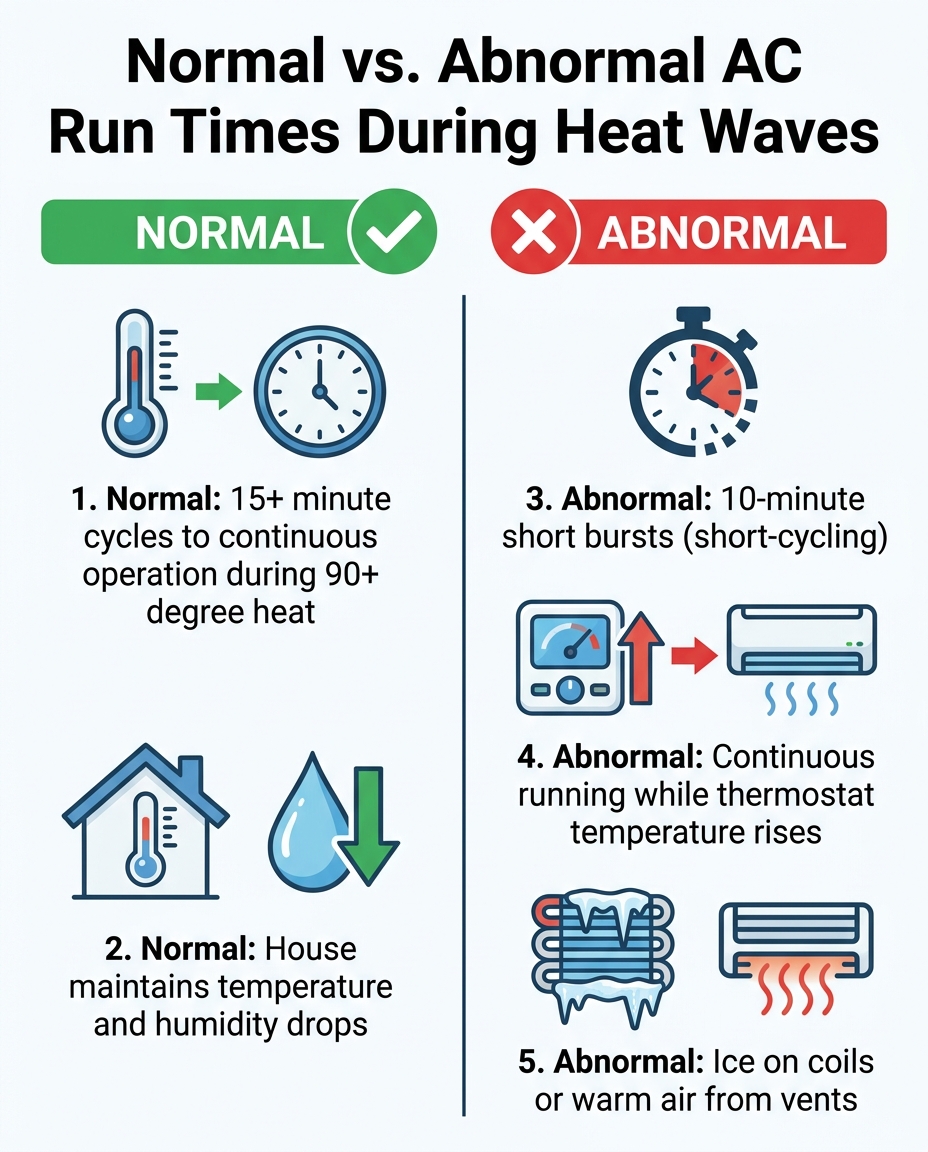
Most homeowners are conditioned to hear their air conditioner cycle on, run for fifteen or twenty minutes, and then cycle off. When that familiar rhythm breaks during late August heat waves, it feels like something must be broken. However, continuous operation is actually a sign that your system is properly sized for your home. As long as the indoor temperature is holding steady—or at least staying within a few degrees of your thermostat setting during the hottest part of the afternoon—your equipment is successfully fighting off the massive amount of heat trying to penetrate your walls, windows, and roof.
Understanding 'Design Temperature' and Your System's Capacity
To understand why your air conditioner seems to be working overtime, you have to look at how these systems are engineered in the first place. When our HVAC professionals size equipment for a home, we use a specific metric called "design temperature." This is not the absolute highest temperature a region might ever see; rather, it is a temperature threshold that covers roughly 99% of the historical weather data for a specific area.
In New Jersey, the summer design temperature typically hovers around 90 to 93 degrees Fahrenheit. When the outdoor temperature stays at or below this mark, your air conditioner will cycle on and off normally. But when the weather pushes past this threshold, the system has to work at its maximum capacity just to maintain the status quo. If you want to know more about the mechanics behind this, you can read about why your AC runs constantly in New Jersey summer heat.
Many people mistakenly believe that an oversized air conditioner would be better because it could cool the house down rapidly and shut off, even on a 95-degree day. In reality, an oversized unit is a poorly designed system. Air conditioners are intentionally sized to run continuously when outdoor temperatures exceed the local design temperature. If a system is so large that it can easily cycle off during the hottest 1% of the year, it will be massively oversized for the other 99% of the cooling season, leading to a host of comfort and efficiency problems.
Residential HVAC systems are built with heavy-duty components specifically designed to handle prolonged operation. The compressor, condenser fan motor, and indoor blower are all rated for continuous duty. Running all day during a severe late-summer heat wave is exactly what they were manufactured to do.
Sensible Cooling vs. Latent Cooling: The Humidity Factor
Dropping the temperature on the thermostat is only half of your air conditioner's job. The other half—which is arguably more important for your comfort—is removing moisture from the air. In the HVAC industry, this is broken down into two distinct categories: sensible cooling and latent cooling.
Sensible cooling is the process of lowering the actual temperature of the air, which is the number you see dropping on your thermostat. Latent cooling is the process of removing humidity. In our years serving the Cinnaminson NJ and surrounding South Jersey area, we know that late-summer weather often brings oppressive humidity levels. This creates a massive "latent heat load" inside your home. Moisture holds onto heat energy, making a humid 75-degree room feel significantly hotter and far more uncomfortable than a dry 75-degree room.
Your air conditioner must run for extended periods just to pull that thick moisture out of the indoor air before it can effectively lower the sensible temperature. The extreme humidity of the Delaware Valley and South Jersey late summers requires significant latent cooling, forcing extended compressor run times. If your system were to cycle off too quickly, it would leave that moisture behind, resulting in a house that feels cold but damp and clammy.
Why Humidity Makes Your AC Work Twice as Hard
When warm, moist air from your home blows across the frigid indoor evaporator coil, condensation forms on the metal fins—much like water droplets forming on the outside of a cold glass of ice water on a summer day. This condensation drips down into a drain pan and is carried away, effectively dehumidifying your home.
However, this process takes time. The evaporator coil needs prolonged, steady exposure to the indoor air to extract meaningful amounts of moisture. If the air conditioner only runs for ten minutes, the coil barely has time to get cold and start condensing water before the system shuts off again. By running for hours at a time during a heat wave, your system is doing the heavy lifting required to wring the humidity out of your living space.
Why Extended Cycles Beat Short-Cycling Every Time
It is completely understandable to worry about the wear and tear on your equipment when you notice an 18+ hours run time vs. short 10-minute bursts. However, from a mechanical standpoint, our team frequently reminds homeowners that long, steady cycles are actually much healthier for your air conditioner.
The most stressful and energy-intensive part of an air conditioner's operation is the startup sequence. When the compressor first kicks on, it requires a massive surge of electricity—often pulling three to five times its normal running current—to overcome mechanical inertia and start pumping refrigerant. This sudden jolt creates heat and stress on the electrical components, particularly the capacitor and the compressor windings.
Once the system is up and running, it settles into a smooth, efficient rhythm. Steady, continuous operation uses less energy overall than a system that constantly starts, stops, and starts again. This rapid on-and-off behavior is known as "short-cycling," and it is one of the most damaging things an air conditioner can do. Short-cycling not only spikes your utility bills due to the constant electrical surges, but it also rapidly accelerates the physical wear on moving parts.
• Cycle Length — Extended Cycles (Normal in Extreme Heat): 45 minutes to continuous operation — Short-Cycling (Abnormal / Harmful): Less than 10 to 15 minutes per cycle
• Humidity Control — Extended Cycles (Normal in Extreme Heat): Excellent; prolonged coil contact removes moisture — Short-Cycling (Abnormal / Harmful): Poor; system shuts off before dehumidifying
• Energy Consumption — Extended Cycles (Normal in Extreme Heat): Efficient; avoids high-amperage startup spikes — Short-Cycling (Abnormal / Harmful): High; constant electrical surges at startup
• Equipment Wear — Extended Cycles (Normal in Extreme Heat): Low; steady operation is what components are built for — Short-Cycling (Abnormal / Harmful): High; rapid starting and stopping degrades parts
When you compare the two, 18+ hours of steady running is far better for the equipment's lifespan than rapid bursts. If your system is running continuously but keeping you comfortable, it is operating at peak efficiency for the given weather conditions.

Red Flags: How to Tell if Your AC is Actually Struggling
While long run times are usually normal during a heat wave, there is a clear line between a system that is working hard and a system that is failing. It is important to know the honest diagnostic criteria so you can self-evaluate whether your continuous running is a sign of actual trouble.
The absolute most important warning sign to watch for is the indoor temperature. If the system is running constantly but the house is steadily getting warmer as the afternoon progresses, your equipment is losing the battle. A degree or two of drift on a 100-degree day might be expected, but a continuous rise means the system is not removing heat effectively.
Other major red flags include:
• Warm air from vents: If the air blowing out of your supply registers feels lukewarm or room-temperature, there is likely a refrigerant issue or a compressor failure.
• Ice formation: Check the copper refrigerant lines outside or the indoor coil. If you see frost or solid ice building up, the system is freezing over and needs to be turned off immediately.
• Strange mechanical noises: Grinding, squealing, or loud buzzing sounds accompanying the long run times indicate a failing motor or electrical component.
• Weak airflow: If the air feels cold but is barely trickling out of the vents, you likely have a severe restriction or a failing blower motor.
If these symptoms accompany the long run times, the system is not just working hard—it is failing to remove heat. This is when getting a logical, step-by-step assessment from a professional becomes essential, rather than immediately assuming the unit is dead. At Climate Mechanics, we pride ourselves on offering expert, honest diagnostics from local technicians who outline a clear path forward without unnecessary upselling. For instance, one customer recently called us out to diagnose a struggling system. Our technician spent 45 minutes thoroughly assessing the problem and explaining the solution, establishing a clear, logical path forward for the repair so the homeowner knew exactly what was happening.
Signs It's Time to Call a Professional
If your thermostat temperature steadily rises throughout the afternoon despite the AC running without pause, it is time to seek professional AC service. Additionally, if the airflow from your vents feels weak or room-temperature, or if you notice unusually high utility bills that completely outpace the expected seasonal increase, a professional diagnostic is the safest next step.
Homeowner Triage: What to Check Before Panicking
Before you make an emergency service call, there are several safe, non-technical steps you can take to ensure your system has the best possible chance of keeping up with the heat. Often, a system that is struggling to cool is simply being choked off by a minor maintenance issue.
1. Check and replace your air filter: A dirty, clogged air filter is the number one cause of cooling issues. Restricted airflow forces the blower motor to work harder, reduces the amount of cold air reaching your rooms, and can easily cause the indoor coil to freeze solid. If the filter looks dark or dusty, replace it immediately.
2. Ensure all vents are open and unblocked: Walk through your home and check both the supply vents (where cold air comes out) and return grilles (where air gets sucked back in). Make sure none are closed, blocked by heavy furniture, or covered by rugs. Your system needs to breathe freely to circulate air efficiently.
3. Verify your thermostat fan setting: Check that your thermostat fan is set to "Auto" rather than "On". If it is set to "On", the blower will run continuously even when the outdoor compressor cycles off, which means it will just be circulating warm, humid air back through your home between cooling cycles.
4. Reduce the solar heat gain: Keep blinds, shades, and curtains closed during the hottest parts of the day, particularly on south- and west-facing windows. The less radiant heat that enters your home, the less work your air conditioner has to do.
If these basics are covered and the system still fails to cool, a prompt service call is warranted, even on a weekend. For example, during a recent Labor Day weekend, a homeowner found their central air unit stopped working right in the middle of a hot weather stretch. They called our dispatch at 6 PM, and one of our technicians arrived quickly to diagnose the issue—getting the unit repaired and running within 30 minutes because the underlying problem was caught before it caused total compressor failure. As we always tell our customers, keeping up with routine AC maintenance is the best way to avoid these late-summer surprises.
Frequently Asked Questions About Summer AC Run Times
How many hours a day should an AC run in summer?
During a typical summer day, an air conditioner will usually run for a total of 9 to 14 hours, broken up into multiple cycles. However, during extreme heat waves, that number can easily climb to 18 hours or more. The exact duration depends entirely on the outdoor temperature, your home's insulation, and the humidity levels. As long as the indoor temperature remains comfortable, extended daily run times are normal.
Is it bad if my AC runs all day?
No, it is not inherently bad for an air conditioner to run all day during severe weather. These systems are engineered for continuous duty and actually experience less mechanical stress when running steadily compared to turning on and off rapidly. The only time continuous operation is "bad" is if the system is running non-stop but the house is still getting uncomfortably warm.
Why is my AC running constantly but not cooling?
If your AC is running constantly but the temperature inside is rising, your system is suffering from a mechanical or airflow failure. The most common culprits are severely clogged air filters, low refrigerant levels due to a leak, a frozen evaporator coil, or a failing compressor. When this happens, turn the system off to prevent further damage and call a professional for diagnostics.
Should I turn my AC off if it runs all day?
You should only turn your AC off if it is blowing warm air, making strange grinding noises, or if you see ice forming on the equipment. If the system is running all day but successfully keeping your home cool and dry, leave it on. Turning it off during a heat wave will allow heat and humidity to build up rapidly, making it incredibly difficult for the system to recover later.
Is it normal for AC to run continuously in 100 degree heat?
Yes, it is entirely normal for an AC to run continuously in 100-degree heat. Residential air conditioners are typically sized for temperatures in the low 90s. When the weather spikes to 100 degrees, the system simply does not have the excess capacity to cool the house down quickly and shut off, so it must run non-stop to hold the line against the extreme heat.
Will running my AC for 18 hours a day damage the compressor?
Running for 18 hours a day will not damage a healthy compressor. Compressors are designed to run continuously and actually prefer steady operation over frequent starting and stopping. The initial startup is what causes the most wear on a compressor. As long as the unit has clean filters and proper airflow, long cycles are perfectly safe for the equipment.
How does high indoor humidity affect my AC's cycle length?
High indoor humidity forces your air conditioner to run much longer cycles because it has to remove the moisture from the air before it can effectively lower the temperature. Moisture holds heat energy, creating a heavy latent heat load. The system must run continuously to allow condensation to form on the indoor coil and drain away, which is why long cycles are crucial for dehumidification.
Get Professional Answers for Your Cooling Concerns
While 18-hour run times can be perfectly normal in August, peace of mind is invaluable when you are relying heavily on your cooling system. Understanding the difference between normal heavy-duty operation and a struggling system can save you from unnecessary panic, but you should never ignore clear red flags like warm air or rising indoor temperatures.
If you notice any warning signs, or if you just want to ensure your system is operating as efficiently as possible before the back-to-school season is in full swing, reaching out for an expert assessment is the smartest move. Our team can provide clear, non-technical diagnostic criteria so you understand exactly what your system needs. Contact us today to schedule your AC repair in Cinnaminson and keep your home comfortable through the worst of the late-summer heat.
