



Facing an After-Hours AC Failure During a Heatwave
Is your air conditioning system actually broken, or is it just struggling to keep up with the intense summer heat? When your AC completely stops cooling late at night, the immediate discomfort is quickly followed by confusion. You might check the thermostat to find the indoor temperature steadily climbing, leaving you to wonder what the right next step is. During a severe July heatwave, losing your primary source of cooling is more than just an annoyance; it is a rapid shift in your home's safety profile.
For immediate assistance with these exact scenarios, learn more about our comprehensive Air Conditioning solutions.
The specific dilemma most homeowners face is deciding whether to request short-notice emergency service or simply endure the night with fans and open windows. However, waiting is often not the safest or most practical option when the outdoor temperatures refuse to drop. Local professionals expect and are fully prepared for these exact situations. The infrastructure of a dedicated service provider is built around the reality that mechanical failures do not respect standard business hours. Recognizing when a situation transitions from a minor hiccup to a legitimate need for an immediate response is the first step in protecting your property and your household.
Overcoming the Hesitation to Call for Late-Night Service
Many homeowners experience a surprising amount of guilt when they consider making a late-evening service call. There is a common psychological barrier where residents feel they are "bothering" a technician or pulling someone away from their family for a problem that might not be severe enough. This hesitation often leads families to suffer through an incredibly uncomfortable and potentially unsafe night, entirely unnecessarily.
The reality is that true 24-hour service providers structure their operations specifically to handle overnight dispatches. At Climate Mechanics, 24-hour emergency service is a standard, welcoming offering, not a premium hassle. Technicians working these shifts are on the clock, fully equipped, and ready to deploy. They understand that AC repair in Haddonfield cannot always be scheduled weeks in advance. When a system fails under the heavy load of a summer heatwave, the priority shifts immediately to restoration and safety.
Shifting your mindset from hesitation to action:
• Protecting your investment: An air conditioner that is struggling or making strange noises can suffer catastrophic compressor damage if left running overnight.
• Prioritizing health: Your family's safety and ability to sleep securely far outweigh any perceived inconvenience to a service company.
• Expected operations: Requesting 24 hour ac service haddonfield is a normal, daily occurrence for dedicated HVAC professionals.
By understanding that after-hours dispatches are a core part of the business, you can confidently make the call without second-guessing your decision.
Clear Criteria: What Constitutes an AC Emergency in Haddonfield?
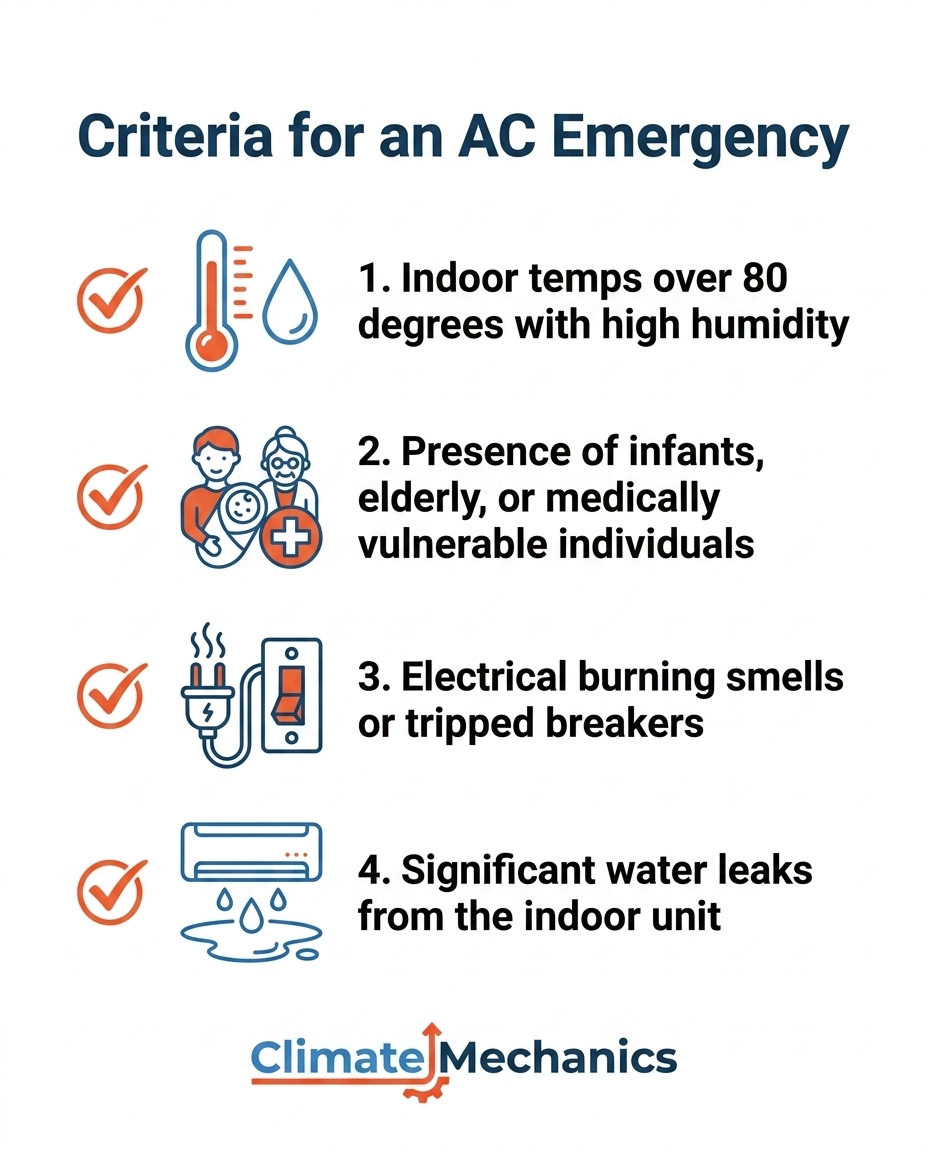
To help you definitively categorize your situation, it helps to have objective, safety-based thresholds. If your system meets any of the following criteria, it is time to stop waiting and start dialing. One Haddonfield homeowner reached out on a Sunday evening when their AC unit completely stopped working. By calling the main line immediately instead of waiting for Monday morning, a technician was dispatched and the system was repaired within an hour.
1. Indoor temperatures exceeding 80 degrees Fahrenheit: If the thermostat reads 80 degrees or higher and the system shows no sign of cooling, the house will continue to trap heat. This is a clear indicator that natural ventilation will not suffice.
2. Presence of vulnerable household members: Homes with infants, elderly residents, or individuals with chronic health conditions cannot safely endure extreme indoor temperatures. Their bodies do not regulate heat as efficiently, making immediate restoration a medical necessity.
3. Signs of electrical failure: If you detect acrid burning smells, notice sparking near the unit, or experience repeatedly tripped circuit breakers, shut the system down immediately at the thermostat. These are severe fire hazards.
4. Significant water leaks: An indoor air handler that is actively leaking large volumes of water threatens to cause immediate property damage to your ceilings, drywall, and flooring.
When these criteria are met, searching for 24 hour emergency ac repair haddonfield is the correct and safest course of action. You are no longer dealing with a simple comfort issue; you are managing a property and health risk.
How South Jersey's Summer Humidity Amplifies Indoor Dangers
Understanding the local climate context is vital when evaluating an evening AC breakdown. South Jersey's subtropical summer climate features intense July humidity that fundamentally changes how a house retains heat. It is not just the ambient air temperature that causes problems; it is the high dew points that trap heat inside Haddonfield homes, preventing them from cooling down naturally overnight.
The science of humidity and heat retention:
When the sun goes down during a standard summer day, you might expect the house to cool off. However, high humidity acts like a heavy blanket over your property. Moisture in the air holds thermal energy far more effectively than dry air. The EPA and CDC provide clear guidelines regarding how high indoor humidity impairs the human body's ability to regulate temperature. Your body cools itself through the evaporation of sweat. When the indoor air is already saturated with moisture, sweat cannot evaporate, leading to rapid overheating and potential heat exhaustion.
Opening windows during a humid heatwave often makes the indoor environment much worse. Instead of letting cool air in, you are inviting thick, moisture-laden air into your living space, which will absorb into your upholstery, bedding, and carpets.
• Opening windows in high humidity — Impact on Indoor Environment: Introduces excessive moisture; traps heat in building materials. — Overall Safety Level: Low Safety
• Leaving a malfunctioning AC running — Impact on Indoor Environment: Risks electrical fires, frozen coils, or compressor burnout. — Overall Safety Level: Low Safety
• Shutting off system and calling for evening service — Impact on Indoor Environment: Prevents further damage; initiates the repair process immediately. — Overall Safety Level: High Safety
A lack of air conditioning in these specific regional conditions is a legitimate health and safety issue. The combination of heat and humidity creates an environment where waiting until morning is simply not a viable option.
Recognizing Dangerous Electrical and Mechanical Failures
Some evening AC breakdowns are not just about a lack of cold air; they are active threats to your home's electrical and mechanical integrity. Recognizing these warning signs requires immediate professional intervention to prevent catastrophic equipment failure or fire hazards.
What does an electrical burning smell indicate?
If you notice an acrid, electrical burning odor coming from your vents or the indoor air handler, this is an immediate red flag. This scent often points to melting wire insulation, a failing blower motor, or a burned-out capacitor. Electrical fires can start quickly within the confined spaces of an HVAC cabinet. If you smell burning plastic or ozone, turn the system off entirely at the thermostat and do not attempt to turn it back on.
Why is a tripping circuit breaker dangerous?
A circuit breaker is designed to protect your home from electrical overloads. If your air conditioner trips the breaker, it is pulling more amperage than the circuit can safely handle. Repeatedly resetting a tripping circuit breaker is highly dangerous. It forces electricity back into a compromised circuit, which can lead to overheating wires and potential electrical fires. A professional must assess why the system is overdrawing power.
When do mechanical noises require immediate shutdown?
Unusual, loud mechanical noises—such as grinding, screeching, or violent rattling—indicate severe internal component failure. A screeching sound often points to a failing fan motor bearing, while a heavy grinding noise could mean the compressor is tearing itself apart internally. If you are wondering why your AC unit is vibrating excessively, it is best to shut the power down and wait for an emergency technician to diagnose the imbalance before the equipment destroys itself.
Protecting Vulnerable Household Members from Extreme Heat
The decision to seek after-hours service often comes down to the human element. While a healthy adult might be able to tolerate a warm night with a floor fan, certain demographics cannot safely wait out an overnight breakdown. Another local homeowner needed short-notice evening repairs to protect their family from rising indoor temperatures. A technician arrived promptly, resolving the issue professionally so the household could sleep safely.
Infants and toddlers: Young children have underdeveloped central nervous systems, making them highly susceptible to rapid temperature changes. They do not sweat as effectively as adults, meaning their core body temperature can spike dangerously fast in a hot, stifling room. A broken AC during a July heatwave is an immediate hazard for a nursery.
Elderly family members: Older adults frequently take medications that alter their ability to stay hydrated or regulate heat. Furthermore, poor circulation and underlying cardiovascular conditions mean that the stress of a hot environment can trigger severe medical events. For elderly residents, a controlled indoor climate is an absolute necessity.
Household pets: Dogs and cats cannot shed layers of clothing, and they rely heavily on panting to release heat. Sudden, severe indoor heat can lead to heatstroke in pets much faster than many owners realize, especially for thick-coated breeds or senior animals.
Protecting family health is the ultimate validation for requesting short-notice evening service. You are not overreacting by prioritizing the physical well-being of the most vulnerable people in your home.
Immediate Steps to Take Before the Technician Arrives
Once you have decided to call for emergency service, there are several actionable, safe steps you can take to mitigate discomfort and protect your equipment while waiting for the dispatch to arrive. Taking control of the environment helps keep everyone calm and prevents further damage to your home AC units.
• Turn the thermostat to the "off" position: This is the single most important step. If the system is malfunctioning, leaving it on "cool" will force it to keep trying to operate. This can freeze the evaporator coil solid or burn out an already struggling compressor.
• Close all blinds, shades, and curtains: Even as the sun goes down, trapping the remaining cool air inside is vital. Heavy curtains provide an extra layer of insulation against the warm glass of your windows.
• Utilize ceiling fans and portable fans: Fans do not lower the temperature of the room, but they do create a wind-chill effect on your skin, which aids in the evaporation of sweat and provides personal comfort.
• Avoid using heat-generating appliances: Do not run the oven, the clothes dryer, or the dishwasher. These appliances release massive amounts of latent heat into the house, compounding the problem.
• Prepare clear access for the technician: Ensure the pathway to your indoor air handler (often in a basement, closet, or attic) is clear of boxes and clutter. Similarly, make sure the outdoor condenser unit is accessible and not blocked by lawn furniture or debris.
Frequently Asked Questions About Evening AC Breakdowns
When a sudden failure happens, homeowners naturally have a lot of questions about safety, system operation, and the importance of AC maintenance to avoid future late-night emergencies. Below are straightforward answers to the most common queries regarding after-hours HVAC failures.
What qualifies as an AC emergency?
An AC emergency is any situation involving extreme indoor temperatures, vulnerable individuals, electrical smells, or severe water leaks. If the indoor temperature climbs above 80 degrees Fahrenheit and high humidity prevents the house from cooling naturally, it is an emergency. Additionally, any signs of an electrical hazard, such as a sparking unit or a burning plastic smell, require immediate professional attention to prevent a fire.
Should I turn off my AC if it's broken?
Yes, leaving a malfunctioning system running can cause further mechanical damage. If the system is blowing warm air, making grinding noises, or rapidly turning on and off (short cycling), switch the thermostat to the "off" position immediately. Forcing a broken system to operate can lead to a frozen evaporator coil or a completely burned-out compressor, turning a minor repair into a major replacement.
Is it safe to sleep in a house without AC during a heatwave?
If indoor temperatures exceed 80 degrees with high humidity, it can be unsafe, particularly for the elderly, infants, or those with medical conditions. The human body needs a cooler environment during sleep to recover and regulate its core temperature. High humidity prevents sweat from evaporating, increasing the risk of heat exhaustion even while you are resting.
Can you call HVAC at night?
Absolutely. Dedicated HVAC contractors offer 24-hour dispatch specifically to handle unexpected overnight failures. Professional service companies staff technicians for evening and overnight shifts because they know mechanical breakdowns do not adhere to a standard daytime schedule. You should never hesitate to call if you feel your home's safety is compromised.
How can I prevent my AC from breaking down at night?
Regular preventative care and seasonal tune-ups are the best ways to catch failing components before they cause an after-hours emergency. A professional technician will inspect electrical connections, measure refrigerant levels, and test motor capacitors during a routine visit. Catching a weak capacitor in the spring prevents it from failing entirely during a hot summer night.
Get Fast, Responsive Help Whenever You Need It
Losing your cooling system during a severe summer night is a highly stressful event, but it is a valid reason to seek immediate assistance. You do not have to endure the stifling heat or worry about the safety of your household while waiting for normal business hours to resume. The criteria are clear: if your home is becoming dangerously hot, or if you suspect an electrical or mechanical hazard, taking action is the right choice.
We encourage you to prioritize your family's safety and comfort over the fear of calling late. Our technicians are standing by to provide the clear, validating service that confirms your situation is a legitimate emergency, giving you the confidence to request short-notice evening service. If you are experiencing an after-hours breakdown in Haddonfield, reach out to our local experts immediately to restore your home's comfort and security.
