


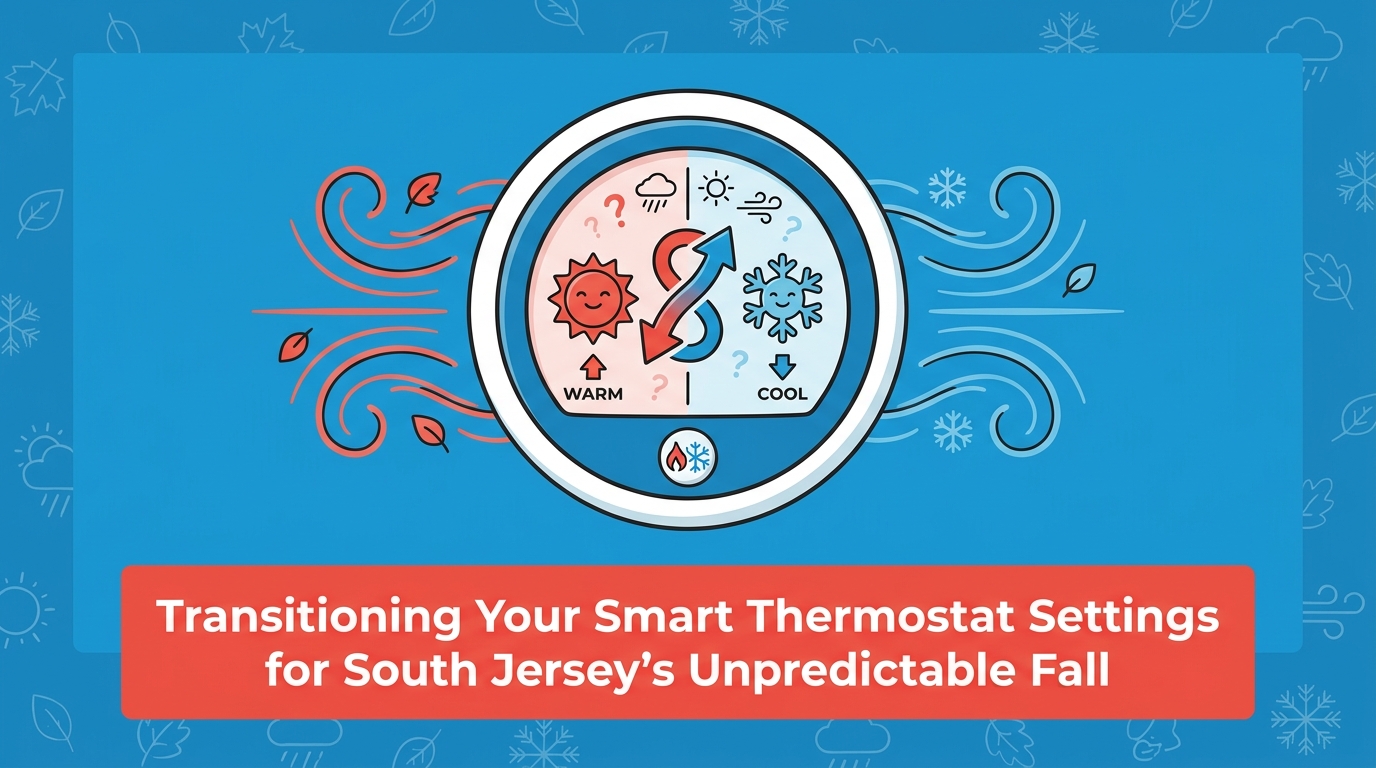

Navigating South Jersey's Extreme Fall Temperature Swings
Transitioning Your Smart Thermostat Settings for South Jersey's Unpredictable Fall is a critical step for homeowner comfort as September arrives. September brings some of the most chaotic weather of the year to the Northeast. You likely know the jarring reality of early fall weather: you need a heavy sweater at 7 AM while walking the dog, but by 3 PM, you are sweating in short sleeves. This extreme fluctuation poses a unique challenge to your home comfort equipment, which often struggles to keep up without constant manual intervention.
Before you rely entirely on automated switching to handle these temperature spikes, a professional inspection ensures your equipment is mechanically sound. To get ahead of the weather, schedule an evaluation for your heating systems, such as comprehensive furnace maintenance in Cinnaminson, to guarantee your home is ready for the transition.
When your equipment is in top shape, properly configuring your auto-changeover settings allows your heating and cooling systems to work in perfect harmony. Our technicians at Climate Mechanics understand these specific Cinnaminson weather patterns and how they uniquely stress residential HVAC equipment. Without the right interface settings, your furnace and air conditioner might end up fighting each other, wasting energy and wearing down critical components. Cinnaminson and the greater South Jersey area demand a smarter approach to climate control, and it all starts with the device on your wall.
The Challenge of the September Climate Shift
The meteorological transition that occurs during early autumn in the Northeast is notoriously difficult to manage. In our years of servicing South Jersey homes, we frequently see 45°F morning to 80°F afternoon temperature swings during this time of year. This rapid temperature increase throughout the day causes homes to trap heat quickly. A house that felt like an icebox at dawn can easily feel like a greenhouse by late afternoon, requiring active cooling even if the morning demanded the furnace.
The manual struggle: For decades, homeowners dealt with the frustration of constantly walking over to the thermostat. You turn the system to "Heat" when you wake up shivering. A few hours later, the sun beats down on the roof, the house gets stuffy, and you have to walk back to flip the switch to "Cool." If you forget to switch it back before bed, you wake up freezing all over again.
This constant manual toggling is inefficient and leaves your indoor climate feeling completely unbalanced. Modern smart thermostats eliminate this daily chore, serving as the ultimate convenience solution for unpredictable weather. By utilizing advanced environmental triggers and automated scheduling, these devices monitor the indoor temperature in real-time and make the necessary adjustments without you ever having to lift a finger. However, to get this seamless experience, you have to tell the thermostat exactly how you want it to behave during these wild seasonal shifts.
Unlocking Your Smart Thermostat's Auto-Changeover Feature
To stop playing thermostat tug-of-war during the September early fall transition, you need to utilize a specific mode built into modern smart devices. "Auto-changeover" is the setting that allows the thermostat to automatically select heating or cooling based on your current indoor temperature. It is a massive upgrade from the traditional "Heat," "Cool," or "Off" modes that older manual thermostats rely on.
Here is how to unlock and configure this essential feature on most modern interfaces:
1. Access the main system menu: Open your smart thermostat's companion app on your phone or tap the physical screen on the wall to open the main settings dashboard.
2. Locate the system modes: Look for the menu labeled "Mode," "System," or "HVAC Settings." You will typically see options for Heat, Cool, Off, and Auto.
3. Select the "Auto" function: Choose "Auto" (sometimes labeled "Heat/Cool" depending on the brand). This gives the thermostat permission to activate either the furnace or the air conditioner as needed.
4. Define your dual setpoints: Once Auto is engaged, the screen will prompt you to enter two different temperatures: a minimum temperature (when the heat should kick on) and a maximum temperature (when the AC should kick on).
5. Save and monitor: Save your preferences. The interface will now handle these transitions smoothly without any further user input.
Understanding how to properly use this mode is one of the most significant smart thermostat installation benefits you can enjoy. It provides year-round comfort, ensuring that no matter what the unpredictable South Jersey weather does outside, your indoor climate remains perfectly stable.
Mastering the Deadband Setting to Prevent System Overlap
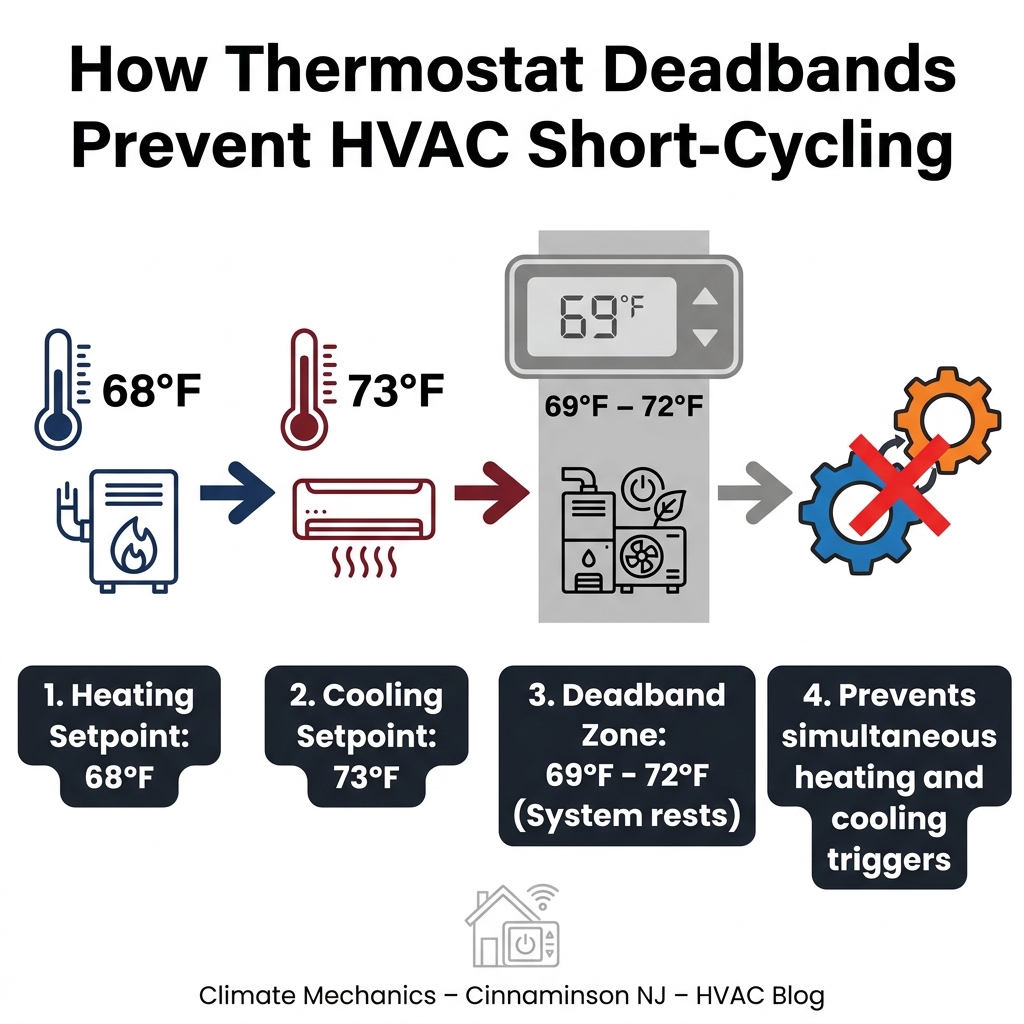
Simply turning on the auto-changeover mode is not enough. You must also master the "deadband" setting. In clear, everyday terms, a deadband is the temperature gap between your heating setpoint and your cooling setpoint. This gap acts as a neutral zone where the HVAC system rests and does absolutely nothing.
A deadband is strictly necessary because it prevents the air conditioner and the furnace from triggering simultaneously or within minutes of each other. During wild afternoon temperature spikes, a wider deadband prevents the AC from kicking on prematurely just because the sun came out for an hour. If you set your heat to turn on at 70°F and your AC to turn on at 71°F, the system will constantly bounce back and forth, wasting massive amounts of energy.
The recommended approach: Energy efficiency guidelines typically recommend a standard deadband range of 3 to 5 degrees.
• Too Narrow — Heating Target: 70°F — Cooling Target: 71°F — Deadband Gap: 1 Degree — Result: System fights itself constantly
• Ideal Range — Heating Target: 68°F — Cooling Target: 73°F — Deadband Gap: 5 Degrees — Result: System rests comfortably
• Maximum Savings — Heating Target: 66°F — Cooling Target: 74°F — Deadband Gap: 8 Degrees — Result: Lowest possible energy usage
For example, setting the heat to 68°F and the cooling to 73°F creates a comfortable 5-degree deadband. When the house is 70°F, the system is completely silent. When Cinnaminson experiences those extreme 45°F morning to 80°F afternoon temperature swings, this 5-degree buffer ensures your equipment only runs when it is truly necessary.

The Hidden Dangers of HVAC Short-Cycling in Early Fall
If your deadband is too narrow, or if your thermostat is placed in a drafty hallway, you run the risk of "short-cycling." Short-cycling occurs when the HVAC system turns on and off rapidly before it can complete a full heating or cooling cycle. During the September early fall transition, an improperly configured auto-changeover mode can cause the system to fight itself, triggering the heat for ten minutes, shutting down, and immediately triggering the AC.
The mechanical toll: This rapid on-and-off behavior is devastating to your equipment. The most intense strain on any HVAC system occurs during startup. Constant starting and stopping takes a severe mechanical toll on both the blower motor and the compressor. Capacitors burn out faster, contactors degrade, and the heat exchanger experiences unnecessary thermal stress from constantly expanding and contracting.
The energy waste: Beyond the physical damage, short-cycling causes massive energy waste. Systems that constantly cycle on and off never reach a stable, comfortable temperature, yet they consume peak electricity every time the motor surges to life. You end up paying higher utility bills for a house that still feels uncomfortable.
Ignoring these incorrect settings usually leads to premature breakdowns. A pattern we see often on early fall service calls is that when the system works this hard just to satisfy conflicting commands, parts fail much faster than they should. This frequently results in the sudden need for unexpected furnace repair services right when the weather starts getting truly cold.
How Conflicting Signals Stress Your Equipment
Several specific factors cause these conflicting signals to stress your machinery during the fall:
• Thermostat sensors reading sudden drafts: If someone leaves the front door open on a chilly morning, a blast of cold air can trick the sensor into triggering the furnace, even if the rest of the house is warm.
• Struggling to satisfy conflicting temperature setpoints: When the heat and cool triggers are set only one degree apart, the residual warmth from the furnace can immediately trigger the air conditioner.
• Increased wear and tear on electrical components: Every sudden start draws a massive surge of amperage, degrading electrical connections and shortening the lifespan of the entire system.
Energy-Saving Scheduling Tips for Unpredictable Autumn Days
While the auto-changeover and deadband settings handle the daily temperature swings, proper scheduling maximizes your energy efficiency. The Department of Energy recommends adjusting your indoor temperatures by 7 to 10 degrees for 8 hours a day to save up to 10% on your annual heating and cooling costs.
Here is a checklist for layering these schedule adjustments on top of your auto-changeover settings for Cinnaminson and the greater South Jersey area:
• Lower the heating setpoint at night: When you are asleep under heavy blankets, you do not need the house kept at 70°F. Program the thermostat to drop the heating target to 62°F or 64°F while you sleep.
• Widen the deadband while away: If the house is empty during the workday, widen the temperature gap significantly. Set the heat to trigger only if the house drops below 60°F, and the AC to trigger only if it exceeds 80°F.
• Pre-condition the home before arrival: Use your smart app to slowly bring the house back to a comfortable 68°F about thirty minutes before you return from work.
• Utilize geofencing features: Many modern thermostats use your smartphone's location to automatically widen the deadband when you leave the neighborhood and restore comfort settings as you drive back.
If you have upgraded your home recently, you will find that modern heat pump systems handle these scheduled transitions highly efficiently compared to older, traditional setups. Heat pumps are designed to maintain steady, consistent temperatures, making them the perfect companion for a well-programmed smart thermostat during the unpredictable autumn months.
Why Pre-Season Maintenance is the Key to Flawless Auto-Changeover
A smart thermostat is ultimately just a control panel. It is only as effective as the mechanical equipment it commands. You can have the most advanced, perfectly scheduled thermostat on the market, but if the furnace is dirty and the AC is struggling, your home will not be comfortable.
Switching rapidly between heating and cooling demands clean sensors, clear air filters, and fully lubricated motors. During the September early fall transition, your system is often doing dual-duty. A comprehensive tune-up ensures both the air conditioning components and the heating elements are prepared for these demanding days. Professional technicians verify that the thermostat is communicating correctly with the control board, ensuring that when the thermostat calls for heat, the furnace ignites safely and efficiently.
Our team at Climate Mechanics understands exactly how hard your equipment works during these specific seasonal transitions. We frequently see the benefits of proactive care in our community. For example, we recently performed a comprehensive pre-fall tune-up for a local homeowner's AC and furnace units. Our technician performed the maintenance, cleaned the vital components, and explained all the work done, ensuring the entire HVAC system was functioning perfectly for the demanding months ahead. That same level of thorough, dual-system preparation is exactly what your equipment needs before tackling the wild temperature swings of early autumn.
Frequently Asked Questions About Fall Thermostat Settings
What is a good temperature to set your thermostat in the fall?
The ideal temperature balances comfort and energy efficiency. Most experts recommend setting your heating target around 68°F while you are awake and at home. You can lower this target by 7 to 10 degrees while you are sleeping or away at work to maximize your energy savings without sacrificing comfort.
How does auto changeover work on a thermostat?
Auto changeover allows the thermostat to automatically switch between your heating and cooling systems based on the indoor temperature. Instead of manually flipping a switch from "Heat" to "Cool," you program a heating minimum and a cooling maximum. The thermostat monitors the room and activates whichever system is needed to keep the house within that specific temperature range.
What is a deadband setting on a thermostat?
A deadband is the required temperature gap between your heating setpoint and your cooling setpoint. It acts as a neutral zone where the HVAC system rests. For instance, if your heat is set to 68°F and your AC is set to 73°F, the 5-degree difference is the deadband, preventing the two systems from running at the same time.
Should I set my thermostat to auto in the fall?
Yes, setting your thermostat to auto in the fall is highly recommended in regions with unpredictable weather. It prevents your home from becoming too hot during sunny afternoons or too cold during chilly mornings. Just ensure you have a wide enough deadband programmed so the system does not short-cycle.
How wide should the temperature gap be between heating and cooling?
A gap of at least 3 to 5 degrees is the standard recommendation. A narrower gap forces the system to fight itself, rapidly switching between heating and cooling. A wider gap of 5 degrees or more provides better energy efficiency and reduces the mechanical wear and tear on your equipment.
Can fluctuating fall weather damage my HVAC system?
The weather itself does not cause damage, but improper thermostat settings during fluctuating weather certainly can. If the system constantly turns on and off to chase wild temperature swings (short-cycling), it puts immense strain on the motors, capacitors, and compressors, leading to premature wear and unexpected breakdowns.
Ensure Your System is Ready for South Jersey's Fall Weather
Mastering your smart thermostat settings is the best way to keep your home comfortable while saving energy. However, auto-changeover features and proper deadband settings rely entirely on healthy, well-maintained mechanical equipment. Before the deep winter freeze sets in across Cinnaminson and the greater South Jersey area, ensure your machinery is up to the task. Schedule your seasonal tune-up today so your system transitions flawlessly through every unpredictable autumn day.
