


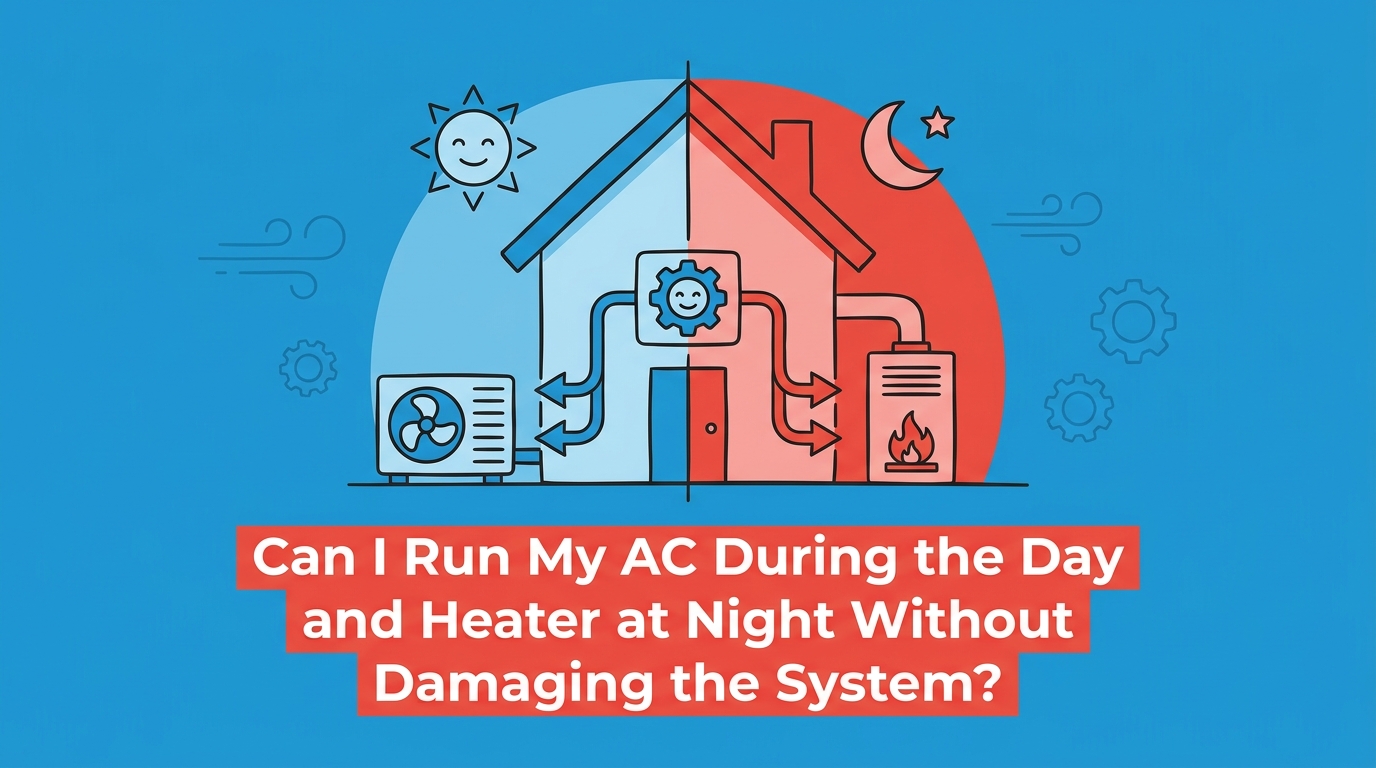

The Big Question: Is Daily Mode Switching Safe for Your HVAC System?
Are you staring at your thermostat during a wild weather swing and wondering, can I run my AC during the day and heater at night without damaging the system? It is a very common dilemma for homeowners facing unpredictable early fall weather. You wake up to a freezing house that requires the furnace, but by 3:00 PM, the indoor temperature climbs so high that you are sweating in your own living room. The fear of breaking an expensive piece of equipment by flipping the switch back and forth keeps many people suffering through uncomfortable temperatures.
For those needing professional help assessing their current equipment, you can explore our air conditioning solutions or schedule an AC repair today.
The short answer is: Yes, you can safely run your AC during the day and your heater at night.
Modern thermostats and HVAC systems are explicitly designed to handle daily mode switching without causing damage. The technology inside your digital thermostat acts as a safeguard between your commands and the physical equipment outside. When you switch from heating to cooling, the system does not instantly slam the brakes on the furnace and aggressively kickstart the air conditioner. Instead, built-in protections manage the transition smoothly. These automated safeguards prevent the equipment from short-cycling, ensuring that the heavy mechanical components have time to rest, equalize, and restart safely, no matter how many times the weather changes in a single day.
The Science of Switching: Understanding the 5-Minute Compressor Time Delay
To understand why daily mode switching is safe, you have to understand what happens inside the equipment. Historically, the biggest threat to an HVAC compressor was a phenomenon called "short-cycling." A compressor is essentially a heavy-duty pump that moves refrigerant gas under extremely high pressure. If you turn off an air conditioner and immediately try to turn it back on, the compressor has to start up against a massive wall of built-up pressure. This draws a dangerous amount of electrical current, which can overheat the motor, blow a fuse, or permanently damage the compressor valves.
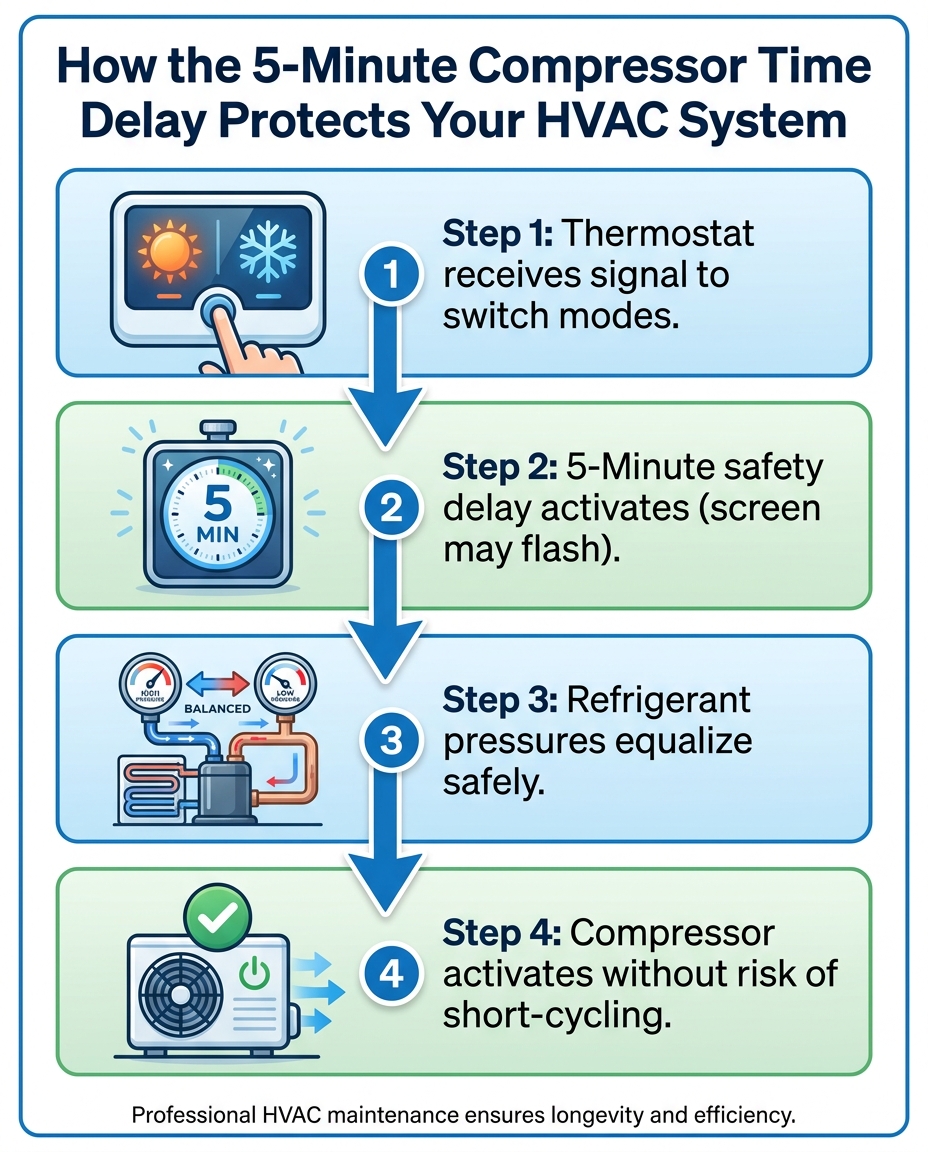
Today's digital thermostats eliminate this risk by incorporating a mandatory 5-minute compressor time delay. This feature is hard-coded into the thermostat's programming to protect your investment.
Here is the mechanical process that happens during a mode switch:
1. The Signal is Sent: You switch the thermostat from "Heat" to "Cool" (or the auto-changeover triggers the switch).
2. The Furnace Powers Down: The heating cycle completes, the gas valve closes, and the indoor blower fan runs for a short period to push the remaining warm air into your home.
3. The Safety Delay Engages: The thermostat intentionally blocks the cooling signal for a full five minutes. During this time, your thermostat screen might flash "Cool On" or display a blinking hourglass icon.
4. Pressures Equalize: Outside, the high and low-pressure sides of the refrigerant lines slowly equalize, removing the resistance against the compressor pump.
5. Safe Startup: Once the 5-minute compressor time delay finishes, the thermostat releases the signal, and the AC compressor starts up smoothly without fighting excess pressure.
Many homeowners panic when they see a blinking screen and feel no cold air blowing immediately. Reassure yourself that a flashing screen during this transition is a protective feature, not a malfunction. It means the thermostat is doing exactly what it was designed to do.

Navigating South Jersey's Unpredictable Shoulder Seasons
The need to switch between heating and cooling is not just an edge case; it is a daily reality during the September fall transition in Cinnaminson NJ. The shoulder seasons—those transitional weeks between the deep heat of summer and the freezing chill of winter—bring extreme daily temperature swings. It is entirely common to experience 80-degree afternoons that rapidly plummet into 40- or 50-degree nights.
Because of our deep understanding of South Jersey weather patterns, we know that dual-mode operation is a necessity for indoor comfort. You cannot simply turn your AC off in September and wait until May to turn it back on.
When the outdoor temperature spikes in the afternoon, it is not just the heat that causes discomfort; it is the trapped indoor humidity. Running the air conditioner during these warm afternoon hours serves a dual purpose. First, it cools the ambient air. Second, and more importantly, it pulls excess moisture out of the house. If you refuse to turn on the AC during a humid 80-degree afternoon out of fear of damaging the system, your home will feel sticky, stagnant, and uncomfortable.
• 6:00 AM — Typical Outdoor Temp: 45°F - 55°F — System Mode: Heating — Primary Benefit: Removes morning chill and warms floors
• 3:00 PM — Typical Outdoor Temp: 75°F - 85°F — System Mode: Cooling — Primary Benefit: Reduces indoor humidity and heat buildup
• 10:00 PM — Typical Outdoor Temp: 50°F - 60°F — System Mode: Off / Heating — Primary Benefit: Maintains comfortable sleeping temperatures
Local HVAC systems are sized, installed, and calibrated with these exact weather patterns in mind. The equipment sitting outside your home was engineered to handle the rigorous demands of a Cinnaminson NJ autumn. Utilizing both the furnace and the air conditioner in the same 24-hour period is exactly what the system was built to do.
Auto-Changeover Thermostats and the Importance of the Deadband
If you find yourself constantly walking over to the wall to flip the switch from "Heat" to "Cool," you might be underutilizing your smart thermostat. Most modern thermostats feature an "Auto-Changeover" mode. In this mode, you do not have to manually select the system function. The thermostat monitors the indoor temperature and automatically activates the furnace or the air conditioner based on what the room needs.
However, setting up auto-changeover requires understanding a critical concept known as the "deadband." The deadband is the temperature buffer between your heating setpoint and your cooling setpoint. If you are transitioning your smart thermostat settings for the fall, configuring this buffer correctly is essential.
If you set your heat to 70°F and your cool to 70°F, the system has a zero-degree deadband. As soon as the furnace warms the house to 71°F, the AC will immediately kick on to cool it back down. Once it hits 69°F, the furnace fires up again. The system will fight itself in a continuous, expensive loop. A 2 to 3-degree deadband is critical to prevent this endless cycling.
Setting Your Ideal Transition Temperatures
To keep your home comfortable without wasting energy during unpredictable weather weeks, follow these best practices for setting your deadband:
• Create a 3-degree gap: Set your heating setpoint to 68°F and your cooling setpoint to 71°F. This gives the house room to naturally drift in temperature without triggering either system.
• Adjust for the season: Keep the cooling setpoint slightly higher than your peak summer preference, and keep the heating setpoint slightly lower than your deep winter preference.
• Check thermostat placement: Ensure your thermostat is located away from direct sunlight, drafts, or heat-generating appliances (like ovens or lamps) to prevent false readings that trigger unnecessary mode switches.
• Trust the automation: Once the deadband is set, let the 5-minute compressor time delay manage the transitions. Resist the urge to constantly adjust the numbers.
What Happens If You Force a Rapid Switch Manually?
While modern digital thermostats handle the transition safely, user behavior can still cause problems, especially if you are dealing with legacy equipment. When a house feels uncomfortably hot or cold, it is human nature to become impatient. The temptation is to walk over to the thermostat, rapidly flip the switch from "Cool" to "Off" to "Heat" and back again, hoping the system will respond faster.
If you have an older, non-digital mechanical thermostat (the kind with a sliding lever or a mercury dial), rapid switching is highly discouraged. These legacy devices do not have a built-in 5-minute compressor time delay. If you bypass the natural resting period and force a rapid switch manually, the compressor will attempt to start against high refrigerant pressure.
The consequences of forcing a legacy system include:
• Tripped electrical breakers: The massive surge of electrical current required to start a locked compressor will often trip the breaker at the electrical panel.
• Blown fuses: The disconnect box outside near the AC unit contains fuses that will blow to protect the wiring from melting during a high-amp draw.
• Overheated motors: Repeatedly forcing the compressor to stall generates intense heat, which degrades the internal motor windings over time.
If you operate a legacy mechanical thermostat in Cinnaminson NJ, you must enforce the manual "wait rule." If you turn the AC off, look at your watch and wait a full five minutes before turning the heat on, and vice versa. If you accidentally flip the switch too fast and notice the lights in your house dimming, or hear a loud, angry buzzing sound coming from the outdoor unit, turn the system off immediately. That is the sound of a compressor struggling to start against unequalized pressure.
Equipment Considerations: Heat Pumps vs. Traditional Split Systems
How your HVAC system handles rapid mode switching also depends heavily on the type of equipment you own. The architecture of your system dictates the mechanical steps required to shift from heating to cooling.
In a traditional split system, heating and cooling are handled by two completely independent pieces of equipment. You typically have a gas furnace located in the basement or attic, and an air conditioning condenser sitting outside. When you switch modes, the thermostat simply stops sending a 24-volt signal to the furnace and starts sending it to the outdoor AC unit. Because the furnace and the AC do not share primary mechanical components (other than the blower fan and ductwork), the transition is quite simple. The 5-minute compressor time delay still applies to protect the outdoor AC, but the furnace is unaffected.
Conversely, heat pumps operate differently. A heat pump is a single piece of equipment that handles both heating and cooling. It achieves this by using a specialized component called a reversing valve. During the summer, the reversing valve directs the flow of refrigerant to pull heat out of your home. During the September fall transition, the valve shifts, reversing the flow of refrigerant to pull ambient heat from the outside air and bring it indoors.
Heat pumps are specifically engineered for seamless transitions, making them ideal for shoulder seasons. However, homeowners are sometimes startled by the sounds a heat pump makes during a mode switch. When the reversing valve shifts position, it equalizes the pressure instantly, which often results in a loud "whoosh" or a brief hissing sound. This noise is completely normal and indicates that the valve has successfully changed the direction of the refrigerant flow. It is not a sign of damage.
Why Routine Maintenance Matters Most During Shoulder Seasons
While daily mode switching is safe by design, that safety assumes your HVAC equipment is in good working order. The stress of transitioning between heating and cooling multiple times a week exposes underlying vulnerabilities in neglected systems.
A dirty air filter, for example, restricts airflow, causing the system to run hotter and longer than necessary. When a system is already working hard to adapt to a 30-degree temperature swing outside, restricted airflow can cause the indoor evaporator coil to freeze during the cooling cycle or the furnace heat exchanger to overheat during the heating cycle. Similarly, failing sensors or a sticking reversing valve can turn a normal transition into a complete system breakdown.
Early fall is the critical window to ensure both the AC and the furnace are operating efficiently. Keeping up with routine HVAC maintenance verifies that the safety delays, contactors, and reversing valves are functioning correctly before the deep winter cold sets in.
Transition seasons are notorious for stressing unmaintained systems. One local homeowner reached out on a Sunday evening just before the Labor Day weekend when their central air unit went down unexpectedly during a late-summer heat wave. Because the system was heavily strained, a component failed. A technician arrived quickly, diagnosed the issue, and had the system repaired within 30 minutes, saving their holiday weekend. Proactive tune-ups help catch these exact types of electrical and mechanical weaknesses before they result in a weekend emergency.
Frequently Asked Questions About Dual-Mode HVAC Operation
Is it bad to switch from AC to heat in the same day?
No, it is not bad to switch from AC to heat in the same day. Modern systems are designed to accommodate daily temperature fluctuations safely. As long as your thermostat is functioning correctly, it will manage the transition without putting undue stress on the HVAC components.
How long should I wait before switching from AC to heat?
If you have a modern digital thermostat, you do not need to wait; the thermostat enforces a 5-minute delay automatically. The screen may flash or show a timer while it protects the equipment. For older manual thermostats with mercury dials or mechanical sliders, you must wait at least 5 minutes manually before switching modes to allow refrigerant pressures to equalize.
Can you use auto mode on a thermostat for heat and cool?
Yes, using auto-changeover is highly recommended for maintaining consistent comfort. Provided you set a proper deadband (the temperature gap between heating and cooling), auto mode is the most efficient way to manage unpredictable transition weather. It prevents you from having to manually adjust the system multiple times a day.
Does switching from heat to AC damage the compressor?
Switching from heat to AC does not damage the compressor, provided the system is allowed to rest for 5 minutes between cycles. This resting period allows the high and low refrigerant pressures to equalize. Without this delay, the compressor would struggle to start against high pressure, which can cause electrical failures or mechanical damage.
What is the ideal thermostat deadband for South Jersey fall transitions?
A 3-degree buffer is ideal for preventing the system from constantly cycling back and forth. For example, setting your heat to kick on at 68°F and your cool to kick on at 71°F gives your home enough natural temperature drift. This keeps you comfortable while preventing the furnace and AC from fighting each other.
Ensure Your System is Ready for the Fall Transition
Daily mode switching is a safe, normal part of living through the unpredictable weather swings in Cinnaminson NJ. Your digital thermostat's built-in delays are designed to protect your equipment, allowing you to stay comfortable without fear of breaking your system. However, if your system struggles to switch modes, makes unusual grinding noises, or trips the circuit breaker during a transition, it may indicate a failing electrical component or a stuck reversing valve rather than user error. Do not ignore these warning signs. If you suspect your equipment is struggling to keep up with the changing seasons, reach out to schedule an AC repair or a comprehensive system inspection today.
