


The Hidden Costs of the September Shift in South Jersey
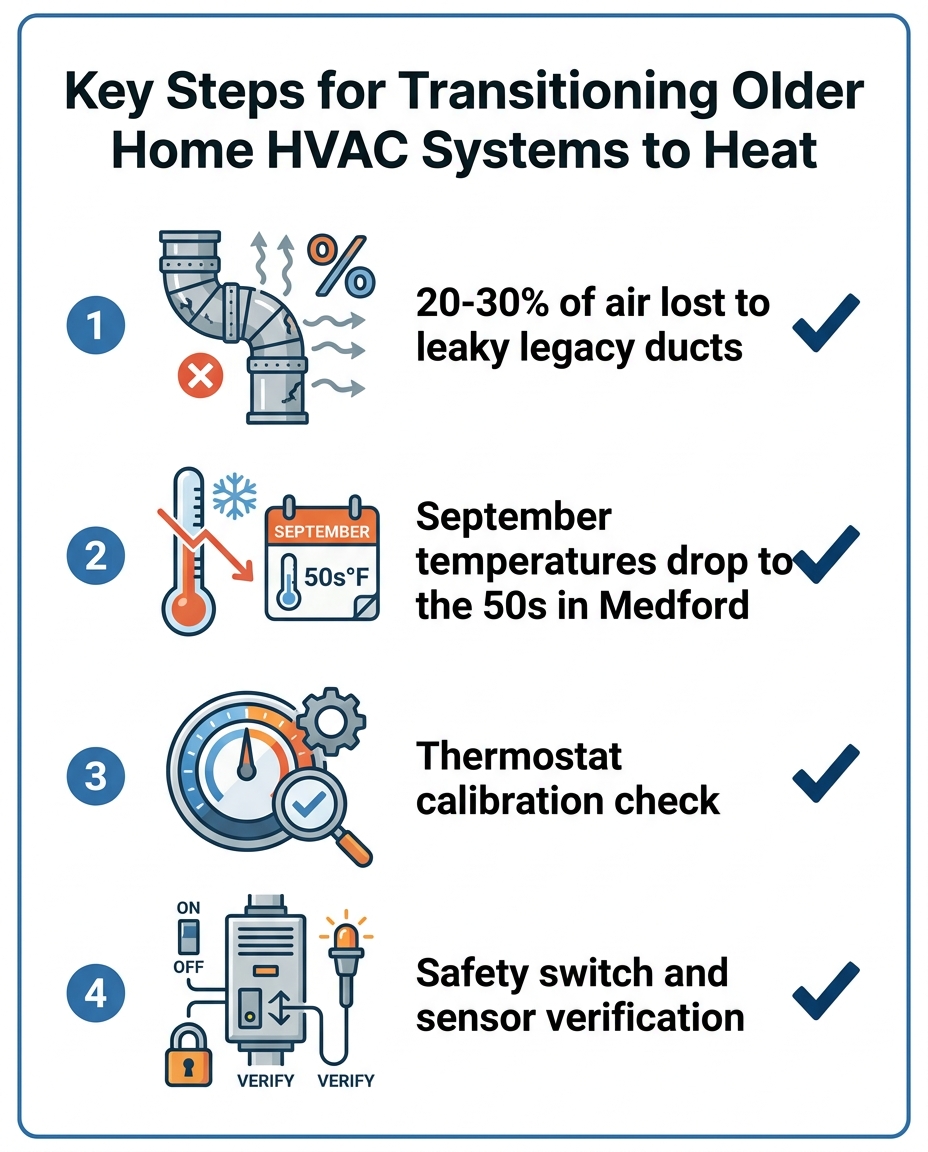
Up to 30 percent of the conditioned air your HVAC system produces can be lost through leaks, gaps, and poor connections in legacy ductwork. If you are focused on Preparing Older Medford Homes for the Transition from AC to Heating, that single statistic should completely change how you view the upcoming season. At Climate Mechanics, we know that flipping a switch on the wall might turn the furnace on, but it does not guarantee that the warm air will actually reach your living spaces. In our experience managing the September pre-heating-season transition, older properties require a much more thorough mechanical evaluation than newer builds.
To ensure your home stays comfortable and efficient, it is highly recommended to have your heating systems professionally evaluated by our team, ideally as part of a comprehensive maintenance plan before the cold weather sets in.
Simply moving the thermostat from "cool" to "heat" is insufficient for aging infrastructure that has just endured a long, grueling cooling season. Over the summer, your system's blower motor, ductwork, and electrical components have been under constant strain. Assuming they are ready for immediate, heavy-duty heating duty is a common mistake that we see lead to early winter breakdowns. There is a critical three-to-four week window in early fall where proactive homeowners can secure their systems. By taking action during this brief period, our technicians can help you identify hidden air leaks, calibrate sensitive components, and resolve minor wear and tear before it escalates into an emergency repair on a freezing night.
How Summer Humidity Degrades Legacy Ductwork
The underlying problem: South Jersey's distinct shift from high-humidity summers to brisk autumns creates a brutal environment for the unconditioned spaces in your home. In attics and crawlspaces, hot, moisture-laden summer air constantly interacts with the cooler metal of your ductwork. This temperature differential triggers a relentless condensation cycle.
The root cause: In our years of servicing Older Medford, NJ residential neighborhoods, our team consistently finds many properties still relying on original galvanized ductwork sealed with outdated mastic or traditional cloth-backed duct tape. As condensation forms and evaporates repeatedly over the summer, these legacy sealing materials degrade. The mastic becomes brittle and cracks, while the adhesive on older tapes simply gives out. By the time September arrives, the seams and joints that were airtight in May are often compromised, leaving significant gaps in your distribution system.
The mechanical solution: When the furnace finally activates in the fall, it pushes pressurized warm air into these compromised ducts. Instead of reaching your bedrooms or living room, a large percentage of that expensive heat is blown directly into your attic or crawlspace. This direct correlation between degraded duct seals and uneven heating is why certain rooms in older homes always feel drafty. Addressing duct integrity is a foundational step for overall home health and efficiency. Beyond just keeping you warm, sealing these gaps prevents dusty, unconditioned air from being pulled back into your living spaces, which is why we frequently pair duct maintenance with indoor air quality solutions to keep older homes breathing safely.
Why Analog Thermostats Struggle with the Seasonal Switch
The mechanics behind older thermostats make them particularly vulnerable to the changing seasons. Analog models and early-generation digital units rely on physical components—like bimetallic strips or aging thermistors—to read the ambient room temperature. Over years of use, we often see these components accumulate microscopic layers of dust and lose their factory calibration. During the September pre-heating-season transition, this calibration drift becomes painfully obvious. The thermostat might read 72 degrees, but the actual temperature in the room could be 68 degrees, leaving your family shivering while the system sits idle.
The danger of temperature swings: An uncalibrated thermostat causes significant temperature swings and forces the heating system to overwork. If the sensor is misreading the room, the furnace may run far longer than necessary, wasting energy and putting excessive strain on the heat exchanger. Conversely, the system might suffer from short-cycling, where the furnace turns on and off in rapid, inefficient bursts because the degraded thermostat cannot accurately gauge the temperature changes it is creating.
Professional calibration over DIY fixes: Attempting DIY electrical adjustments on an older thermostat is never recommended. The wiring in older homes can be brittle, and sending the wrong voltage signal to your furnace's control board can cause catastrophic electrical failure. Professional calibration by our experts ensures that the thermostat is communicating perfectly with the heating equipment, reading the room accurately, and cycling the furnace at the optimal intervals for your specific square footage.
Navigating the Vulnerabilities of Mid-Century Architecture
Older Medford, NJ residential neighborhoods feature beautiful mid-century and historic architecture, but these homes were built long before modern energy codes existed. The reality of drafty wall insulation, balloon framing, and legacy duct routing means that these houses handle airflow very differently than a modern subdivision build. We routinely see standard big-box HVAC solutions fail to account for the unique airflow dynamics of historic layouts, resulting in aggressive, oversized equipment that overwhelms the existing ductwork and creates loud, rushing air noises.
• Evaluate existing airflow: We determine if the legacy ductwork can handle the CFM (cubic feet per minute) output of a modern blower motor without creating excessive static pressure.
• Consider supplementary options: We evaluate alternative or supplementary heating methods that respect the home's original construction, such as boiler systems, rather than forcing a standard forced-air solution where it doesn't belong.
• Avoid the big-box approach: Rely on our deep local expertise in servicing historical Burlington County homes. Our consultative approach ensures safe transitions and optimal comfort without the aggressive upselling typical of big box competitors.
• Check for structural shifts: We inspect how decades of natural house settling have impacted the rigid ductwork hidden behind plaster walls.
Assessing Legacy Heating Infrastructure
Identifying common wear patterns in older distribution systems requires a trained eye. Over decades, the structural settling of a historic home impacts ductwork joints, slowly pulling seams apart as floor joists shift. Our professional assessment looks beyond the furnace itself, evaluating the entire distribution network to ensure that the heat generated in the basement actually makes it to the second-floor bedrooms safely and efficiently.
Professional Calibration vs. The Simple Switch
There are hidden dangers to firing up a dormant heating system without verifying that safety switches and sensors are clean and functional. Over the summer, dust, pet dander, and occasional moisture can coat the flame sensor, limit switches, and burners. If a homeowner simply switches the thermostat to heat, the system might ignite, but a dirty sensor can cause it to shut down immediately, or worse, allow it to run unsafely.
• Turning on the heat and hoping for the best. — Professional Fall Transition Service: Comprehensive inspection of the heat exchanger for hairline cracks.
• Ignoring strange smells after the first cycle. — Professional Fall Transition Service: Cleaning burners and verifying proper ignition sequences.
• Assuming the thermostat is reading accurately. — Professional Fall Transition Service: Testing and calibrating the thermostat to prevent short-cycling.
• Waiting for a breakdown to call for help. — Professional Fall Transition Service: Securing fast, reliable service before the peak winter rush begins.
A comprehensive fall transition service actually entails a deep mechanical review tailored to an older property. This includes interpreting strange noises or smells during the first heating cycle of the year. If you are wondering what to do when your heater makes knocking sounds, the answer is always to have a professional investigate the blower assembly and duct expansion immediately. One local homeowner reached out to our team last fall when they needed general HVAC service to prepare their older system. By scheduling early with Climate Mechanics, they received fast, on-time service, and a minor ignition issue was fixed correctly before it could cause a mid-winter failure.

Timing Your Fall HVAC Transition
Tracking Medford's average September low temperatures reveals a clear pattern: as the month progresses, evening temperatures rapidly drop into the 50s. This creates a closing window of opportunity. The cascading effects of waiting until the first major cold snap to test an older furnace are entirely predictable. HVAC companies become inundated with emergency no-heat calls, and older systems that were forced to turn on without preparation are the first to fail.
1. Early September: The ideal time to schedule a transition service, clean sensors, and seal accessible ductwork.
2. Late October: The system should be fully calibrated and running short cycles to maintain ambient comfort without strain.
3. The First Freeze: The furnace operates flawlessly because the safety switches, blower motor, and duct seals were prepped in advance.
Preventing severe mid-winter breakdowns through early intervention and consistent upkeep is a strategy we heavily emphasize to our customers. One local homeowner learned this the hard way when their furnace failed on a snowy winter day. Fortunately, a Climate Mechanics technician arrived within four hours, identified a dirty sensor that had been ignored during the fall, and resolved the issue while explaining how proactive maintenance prevents recurrences. Handling these tasks during the September pre-heating-season transition eliminates that winter panic entirely.
Protecting Your Historic Home's Comfort Before the Cold Snaps
Addressing ductwork and thermostats together is the only way to ensure your heating system operates efficiently in an aging property. The vulnerabilities of Older Medford, NJ residential neighborhoods require specialized care, which is why our team brings a deep understanding of historic architecture and a commitment to preserving your home's unique characteristics without forcing oversized, incompatible equipment into the space.
Securing your system's reliability for the upcoming winter starts with proactive preparation. Do not wait for the first freezing night to discover that your ductwork is leaking or your thermostat is failing. By enrolling in our routine HVAC maintenance program, you can ensure that your older home remains perfectly comfortable, energy-efficient, and fully protected throughout the coldest months of the year.
Frequently Asked Questions
Why is my older home so drafty when the heat turns on?
Drafts in older homes are often caused by compromised ductwork that leaks warm air into unconditioned spaces like attics or crawlspaces. When the heated air escapes before reaching your vents, it creates pressure imbalances that pull cold outside air into your living areas. Sealing these legacy ducts is the most effective way to eliminate the drafty feeling and restore even heating.
How do I know if my older thermostat is calibrated correctly?
You can check calibration by taping a highly accurate digital room thermometer to the wall next to your thermostat and waiting 15 minutes. If the reading on the thermometer differs from the thermostat by more than a degree or two, the unit has lost calibration. Because older units rely on aging mechanical parts, a professional should recalibrate or replace the thermostat to prevent the furnace from overworking.
Does an older home need duct sealing?
Yes, older homes benefit immensely from professional duct sealing. The original mastic and cloth tape used decades ago naturally degrade, become brittle, and fail over time, especially after enduring humid summers. Sealing these gaps can recover up to 30 percent of the conditioned air that is currently being lost, drastically improving both comfort and energy efficiency.
When should I switch from AC to heat in NJ?
The best time to prepare for the switch is in early to mid-September, just before the evening temperatures consistently drop into the 50s. This gives you a three-to-four week window to have the system professionally inspected and calibrated. Testing the heat during this mild period ensures everything is functional before a sudden cold snap forces you to rely on the furnace.
Why is my heating uneven in my old house?
Uneven heating in historic homes is typically the result of structural settling pulling duct joints apart, combined with a lack of modern wall insulation. The rooms furthest from the furnace receive the least amount of warm air because the pressure is lost through leaks along the way. A professional airflow assessment can identify these specific bottlenecks and recommend targeted sealing or supplementary heating solutions.
What are the risks of turning on an older furnace without an inspection?
Starting a dormant furnace without an inspection risks igniting the system with dirty flame sensors or a cracked heat exchanger. Over the summer, dust and debris settle on critical safety components, which can cause the furnace to short-cycle or fail to shut off safely. A pre-season inspection verifies that all electrical switches, sensors, and exhaust flues are clear and operating securely.
