



That Harmless July Puddle Is a Warning Sign
When you notice a tiny puddle forming near the base of your indoor air conditioning unit, you need to understand the hidden costs of ignoring minor AC drips until the end of summer. The house still feels perfectly cool, and the thermostat is holding steady. Because the system seems to be working fine, it is incredibly tempting to just grab a towel, wipe up the moisture, and assume the equipment is simply working hard in the late August heat.
However, that seemingly harmless moisture is actually a glaring red flag. If you are currently debating whether to call for a professional inspection now or wait it out as the kids head back to school, understanding what is happening inside that equipment is critical. What looks like a tiny drip today is often the first visible symptom of a failing drainage system.
When it comes to air conditioning services, catching these warning signs early is the absolute best way to avoid a sudden, messy breakdown that requires emergency AC repair in Cinnaminson.
The false sense of security: Air conditioners are designed to blow cold air, even when their internal drainage systems are failing. The blower motor and the compressor will keep running, masking the underlying issue. But in humid climates, this minor drip is actually a critical warning sign that the condensate line is beginning to back up.
Setting the stakes is simple: ignoring the issue guarantees escalation. Water always finds the path of least resistance. If it cannot flow outside, it will flow into your home. A slow drip in July will inevitably escalate into severe secondary structural damage by late August (end of cooling season), ruining floors, drywall, and insulation long before the weather finally cools down.
The Mechanics of Condensation in High Humidity
To understand why a simple drip is so dangerous, you have to look at how your air conditioning system actually cools your home. Central air conditioners do not just lower the temperature; they extract massive amounts of moisture from the indoor air. This dehumidification process is what makes your home feel crisp and comfortable rather than clammy.
When warm, humid indoor air blows over the freezing cold evaporator coil, the moisture in the air condenses into liquid water. It is the exact same process that causes water droplets to form on the outside of a cold glass of iced tea on a hot day. In a controlled environment, this water drips safely off the coil, lands in a specialized drain pan, and flows outside through a PVC condensate pipe.
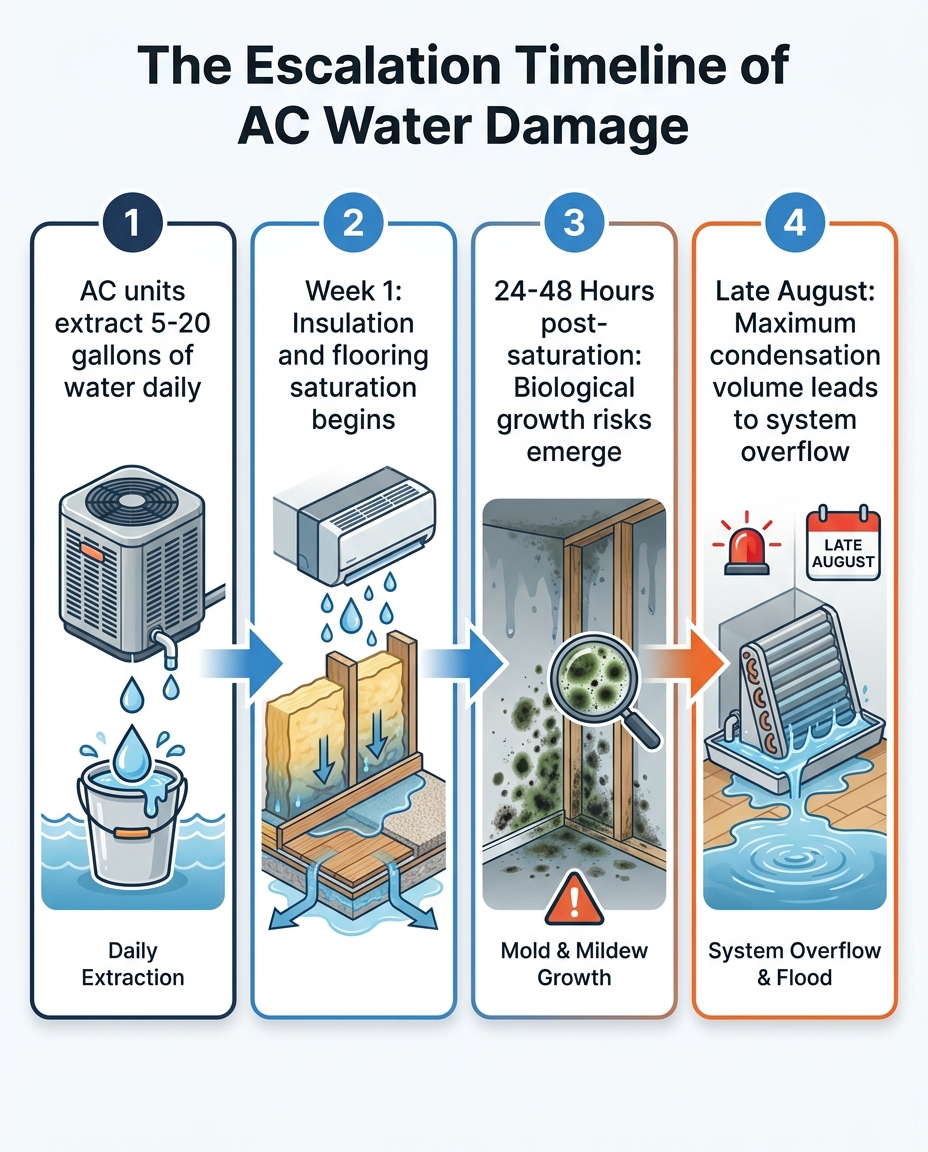
The sheer volume of water produced is staggering. In our years of providing cooling solutions, our team at Climate Mechanics has seen hard-working central air conditioners in Cinnaminson NJ area homes easily extract 5 to 20 gallons of moisture per day during peak humid weather.
The climate impact: South Jersey's humid subtropical climate means that summer relative humidity frequently exceeds 70%. This creates a massive latent heat load—meaning your system has to work incredibly hard just to remove the moisture before it can even begin to lower the actual temperature.
• Low (Below 40%) — AC Workload: Light moisture extraction — Estimated Daily Condensation: 1 to 3 gallons
• Moderate (40% - 55%) — AC Workload: Standard cooling cycles — Estimated Daily Condensation: 3 to 8 gallons
• High (Over 60%) — AC Workload: Continuous run-times — Estimated Daily Condensation: 10 to 20+ gallons
Your system's drain pan and condensate line are specifically designed to manage this massive volume of water safely. However, continuous run-times due to high dew points push the entire drainage system to its maximum capacity. When the system is draining 20 gallons of water a day, even a partial restriction in the pipe will cause the water to back up and spill over the edges of the pan.
When a Normal Drip Becomes a Backed-Up Line
Telling the difference between normal system operation and a failing drainage line is the key to preventing water damage. Under normal conditions, you should never see water pooling indoors. The only place you should see a steady drip of water is outside your home, where the primary condensate pipe terminates near your outdoor condenser unit or into a designated utility drain.
The Problem: Indoor Pooling
When water begins pooling around the base of your indoor air handler, furnace, or dripping from a ceiling vent, the normal flow has been interrupted. This is not condensation "sweating" off the ductwork; this is a physical backup. The water is actively seeking an escape route because its primary path is blocked.
The Cause: A Dark, Damp Environment
Condensate lines do not clog with traditional household debris. Instead, the blockages are biological. The inside of a condensate pipe is dark, constantly damp, and slightly cool—the perfect breeding ground for algae, mold, and biological slime. Over the course of the spring and early summer, airborne dust and dirt mix with this biological growth to form a thick, jelly-like sludge.
In early summer, this sludge might only partially block the pipe, creating a sluggish line. The water drains, but slowly. However, as the condensation volume peaks in the late summer heat, that sluggish line becomes fully clogged. The pipe simply cannot drain the water fast enough to keep up with the 20 gallons of daily moisture the system is pulling from the air.
The Solution: Early Recognition
Recognizing the transition from a slow, sluggish drain to a full backup requires vigilance. If you notice a musty smell near your vents, hear a gurgling sound coming from the indoor unit, or see a tiny watermark on the floor, the line is already compromised. Taking proactive steps and addressing AC leaking water at the first sign of trouble will save your home from a catastrophic overflow.
The Escalation Timeline: July Puddles to August Emergencies
When a homeowner decides to place a towel under a dripping AC unit and ignore the root cause, the resulting damage follows a very predictable, and very destructive, timeline. The financial and structural impacts compound rapidly when water is allowed to flow continuously into building materials.
1. Week 1 to 2: Immediate Saturation. The water overflowing from the drain pan first attacks the immediate area around the indoor unit. If your unit is in an attic, the water begins soaking into the fiberglass or cellulose insulation, rendering it useless and heavy. If the unit is in a basement or utility closet, the water seeps under nearby flooring, causing laminate to warp and wood to cup.
2. Week 3 to 4: Structural Degradation and Biological Growth. Continuous moisture exposure moves beyond the surface. The water wicks up into the surrounding drywall and saturates the wooden framing of the house. According to data from the EPA and ASHRAE, biological growth can begin on damp drywall or organic materials within 24 to 48 hours of continuous moisture exposure. By week four, dark spots will likely appear on walls or ceilings, accompanied by a strong, persistent musty odor.
3. End of Season: Complete System Failure. What started as a minor drip turns into a catastrophic overflow. By late August (end of cooling season), the sheer volume of water overwhelms the surrounding area. Often, this results in sudden system failure during a hot holiday weekend when the internal safety switches finally trigger, or the electrical components short out from the moisture.
Our technicians recently helped a local family who faced this exact hot and humid summer reality when their older central air unit finally went down after prolonged strain. The system had been struggling with drainage and performance issues for weeks, and the resulting failure meant the unit had to be entirely replaced to restore cooling. While our installation team was able to get the new unit up and running quickly and professionally, the situation highlights how rapidly an aging, struggling system can turn a minor symptom into a major replacement project.

The Hidden Threat of Micro-Cracks and Drain Pan Failures
While biological clogs in the condensate line are the most common culprit for indoor leaks, they are not the only threat. Sometimes, the pipe is perfectly clear, but the water is still pooling on your floor. In these cases, the hardware itself has failed.
Aging drain pans: The drain pan sits directly underneath the evaporator coil to catch every drop of moisture. Over years of service, these pans are subjected to constant temperature fluctuations—freezing cold when the system runs, and warm when it shuts off. This constant expansion and contraction causes older plastic or metal drain pans to become brittle. Eventually, microscopic cracks develop along the seams or near the drain port.
These micro-cracks are incredibly deceptive. They may only leak when the pan is at maximum capacity during peak humidity. When the system is running light cycles, the water drains before it reaches the crack. But on a sweltering afternoon, the water level rises, hits the crack, and bypasses the drain line entirely.
Frozen evaporator coils: Another major cause of sudden water overflow is a frozen evaporator coil. When a system suffers from severe airflow issues—usually due to a filthy air filter or failing blower motor—the condensation on the coil physically freezes into a solid block of ice. When the system turns off, that massive block of ice melts rapidly, sending a tidal wave of water into the drain pan that instantly overwhelms the capacity and spills over the sides.
These hardware failures require professional assessment. A technician can identify a cracked pan or a freezing coil during routine AC maintenance for Cinnaminson NJ area homes, catching the issue before water begins bypassing the internal safety switches and ruining your floors.
Why Professional Diagnostics Matter Before the Season Ends
Simply wiping up the water, changing the air filter, and hoping the leak stops is not a viable long-term strategy. When water is pooling indoors, the system is actively failing to manage its own latent heat load. Guessing at the cause can lead to disastrous consequences.
A professional diagnostic goes far beyond just looking at the puddle. It is a comprehensive assessment of the entire moisture management system. Here is what a thorough evaluation actually entails:
• Checking pan integrity: Inspecting the primary and secondary drain pans for micro-cracks, rust, or structural failure.
• Clearing the lines: Using specialized, high-suction equipment to remove biological sludge from both the primary and secondary condensate lines without damaging the PVC joints.
• Testing safety switches: Ensuring that the float switches and moisture sensors are functioning correctly so they will automatically shut the system down if a backup occurs in the future.
• Evaluating airflow: Measuring static pressure and checking the evaporator coil to ensure the system isn't freezing over during long run-times.
The true value of a professional visit lies in the explanation. A recent customer called our team about a persistent air conditioner issue that had them incredibly frustrated. After a thorough 45-minute diagnostic process, our technician was able to provide a clear, logical path forward so the homeowner understood exactly what was wrong, why the system was failing, and how to fix it permanently.
This thorough diagnostic approach is designed to catch hidden condensation line clogs and pan leaks before they turn into costly late-summer emergencies. Addressing the issue proactively with professional Cherry Hill AC repair avoids the severe costs of structural repairs, drywall replacement, and biological growth remediation as you push toward late August (end of cooling season).
Commonly Asked Questions About AC Water Leaks
What happens if you ignore a leaking AC unit?
Ignoring a leak leads to continuous water accumulation, which rapidly saturates surrounding building materials like drywall, flooring, and structural framing. Over time, this constant moisture exposure causes severe structural degradation and expensive secondary property damage. In our experience serving Cinnaminson NJ area homes, a leak left unchecked for even a few weeks can ruin ceilings and require extensive professional remediation.
Can an AC leak cause mold?
Yes, biological growth can begin on damp organic materials within 24 to 48 hours of continuous moisture exposure from an unchecked AC leak. The dark, warm environments where indoor air handlers are usually located provide the perfect conditions for spores to multiply. Once established in saturated drywall or insulation, it spreads quickly and requires specialized removal.
Is it safe to run my AC if it's leaking water indoors?
Running a leaking AC risks further property damage and potential electrical hazards, as water can easily short out the system's internal control boards or wiring. It is highly recommended to turn the unit off immediately at the thermostat and schedule a professional inspection. Continuing to run the system will only force it to produce more condensation, worsening the indoor flooding.
What happens if the AC drain line is completely clogged?
A complete clog causes the drain pan to overflow, spilling water directly into the home unless a functioning safety float switch successfully shuts the system down. Without that safety switch, the system will continue pulling gallons of moisture from the air and dumping it onto your floors or through your ceiling. Clearing a complete clog requires professional vacuum equipment to remove the biological sludge safely.
How quickly does water damage occur from a leaking AC?
During peak summer humidity, an AC can produce up to 20 gallons of water a day, meaning visible water damage and saturation can occur in just a matter of hours. Drywall acts like a sponge, wicking the moisture upward and outward rapidly. The longer the system runs while leaking, the faster the surrounding materials will degrade.
Protect Your Home Before the Fall Transition
A small drip near your air conditioning unit is never just a minor inconvenience; it is a direct symptom of a larger drainage failure. Whether it is a biological clog forming in the condensate line, a micro-crack in an aging drain pan, or a system freezing over due to poor airflow, the water has to go somewhere.
Acting now prevents extensive secondary damage as the cooling season wraps up. By late August (end of cooling season), your system has endured months of heavy, humid workloads, and any existing vulnerabilities are poised to fail completely. Do not wait for a small puddle to become a collapsed ceiling or a ruined hardwood floor. If you notice any signs of moisture, musty odors, or sluggish draining around your indoor unit, explore your professional diagnostic options immediately to protect your home and ensure your system finishes the summer strong.
