



The Myth of the 'Too Good to Be True' HVAC Estimate
The old saying insists that you always get exactly what you pay for, but when evaluating HVAC quotes: why the lowest price isn't always a red flag is a lesson many homeowners learn the hard way. During the peak of the August late-summer cooling season, a sudden system failure can send anyone into a panic. When the house is uncomfortably hot and the air conditioner absolutely refuses to turn on, it is easy to assume that the highest bid you receive guarantees the best equipment and the most reliable installation. In reality, a massive price tag often reflects a company's bloated operating costs rather than superior technical skill or better machinery.
If you are exploring options for AC replacement in Cinnaminson, it helps to understand what you are actually funding when you sign a contract. Evaluating these estimates requires looking closely at the business model behind the bid, not just the final number at the bottom of the page. Many homeowners unknowingly overpay for a contractor's overhead—such as massive advertising campaigns and large vehicle fleets—rather than investing that money into a higher-efficiency unit for their home. A lower bid from a dedicated local expert can actually mean you are receiving higher efficiency equipment, more personalized service, and significantly better overall value.
Breaking Down the Business Economics of HVAC Pricing
To understand why estimates vary so wildly, you have to pull back the curtain on how different heating and cooling businesses operate. Large regional companies and national franchises carry immense financial burdens just to keep their doors open. They pay for prime-time radio spots, highway billboards, heavy print advertising, and massive administrative offices. These high-overhead operations also maintain huge fleets of vehicles that require constant maintenance, fuel, and insurance. Every single one of those expenses is baked directly into the quote a homeowner receives.
In contrast, lean local businesses focus their resources on technician training, high-quality tools, and efficient installation processes. By skipping the massive marketing budgets and franchise fees, these local contractors can pass substantial operational savings directly to the customer. A higher price tag does not automatically guarantee a higher SEER2 efficiency rating, better indoor air quality, or superior installation craftsmanship. It often just means you are paying for the company's marketing department.
• Marketing Budget — High-Overhead Contractors: Extensive (billboards, radio, TV ads baked into your price) — Low-Overhead Local Experts: Minimal (relies on community reputation and word-of-mouth)
• Operating Costs — High-Overhead Contractors: High (franchise fees, large administrative staff, massive fleets) — Low-Overhead Local Experts: Low (lean teams, focused purely on technical service)
• Pricing Structure — High-Overhead Contractors: Inflated to cover non-installation business expenses — Low-Overhead Local Experts: Transparent, reflecting actual equipment and labor costs
• Customer Focus — High-Overhead Contractors: High-volume sales quotas and rapid turnover — Low-Overhead Local Experts: Precision installation and long-term community relationships
Where Your Money Actually Goes
When you look at an inflated estimate for Cinnaminson NJ area homes, a significant percentage of that total is siphoned away before a single wrench is turned. Instead of paying for a premium compressor or advanced humidity control features, a large portion of the funds goes toward administrative bloat and corporate overhead. Local companies that keep their overhead low are able to focus your investment purely on the tangible things that matter: premium equipment, durable materials, and meticulous installation quality. They do not need to charge a massive premium because their business model is built on efficiency, not volume.
Equipment Quality vs. Operational Overhead
Distinguishing between a quote that is cheap because it uses inferior equipment and a quote that is lower due to business efficiency is the most important step in your decision process. The secret lies in the equipment specifications. A legitimate, high-value quote will always list the exact brand, the specific model numbers, the SEER2 efficiency rating, and the tonnage of the proposed system. If two companies quote the exact same premium equipment, but one estimate is drastically lower, you are witnessing the direct benefit of low operational overhead.
Highly efficient local installation teams also reduce labor waste without cutting corners. Because these technicians specialize in specific regional architectures and work together seamlessly, they can complete complex installations with fewer wasted hours. This proficiency naturally lowers the total cost of the project. You are not getting a rushed job; you are getting a streamlined, expert process.
Real-World Proof: The difference overhead makes is substantial. In one recent spring project involving the installation of new mini-split air conditioning units, a local quote came in significantly less than the estimate provided by a major regional competitor for the exact same scope of work. The homeowner received the precise premium units they wanted, the installation was completed flawlessly, and when a minor follow-up adjustment was needed later, the local team handled it quickly and efficiently. The homeowner saved a massive amount simply by choosing an efficient business model over a heavily advertised brand name.
Why Precise Sizing Matters More Than a Premium Price Tag
Connecting the importance of accurate system sizing to quote evaluation is critical, especially when dealing with demanding regional weather. Any legitimate quote must include an ACCA Manual J load calculation. This calculation measures your home's square footage, insulation levels, window quality, and sun exposure to determine the exact heating and cooling capacity required. High-overhead companies, driven by sales quotas, might push expensive, oversized units to inflate the total ticket size, convincing homeowners that "bigger is better."
The problem with oversized units: In our specific climate, New Jersey's high summer humidity and freezing winters require precise system sizing. An oversized air conditioner cools the house too quickly and shuts off before it has time to pull the humidity out of the air. This leads to a cold but clammy indoor environment, known as short-cycling. Short-cycling also causes excessive wear and tear on the compressor, leading to early breakdowns and spiked energy bills.
The solution: A lower-priced, properly sized unit will always outperform an expensive, oversized one. Whether you are installing central air or looking into a furnace replacement, precise sizing ensures the system runs in long, steady cycles. This maximizes energy efficiency, provides superior moisture control during humid summers, and extends the lifespan of the equipment. Paying a premium for an oversized unit is not an upgrade; it is a fast track to comfort issues and premature system failure.
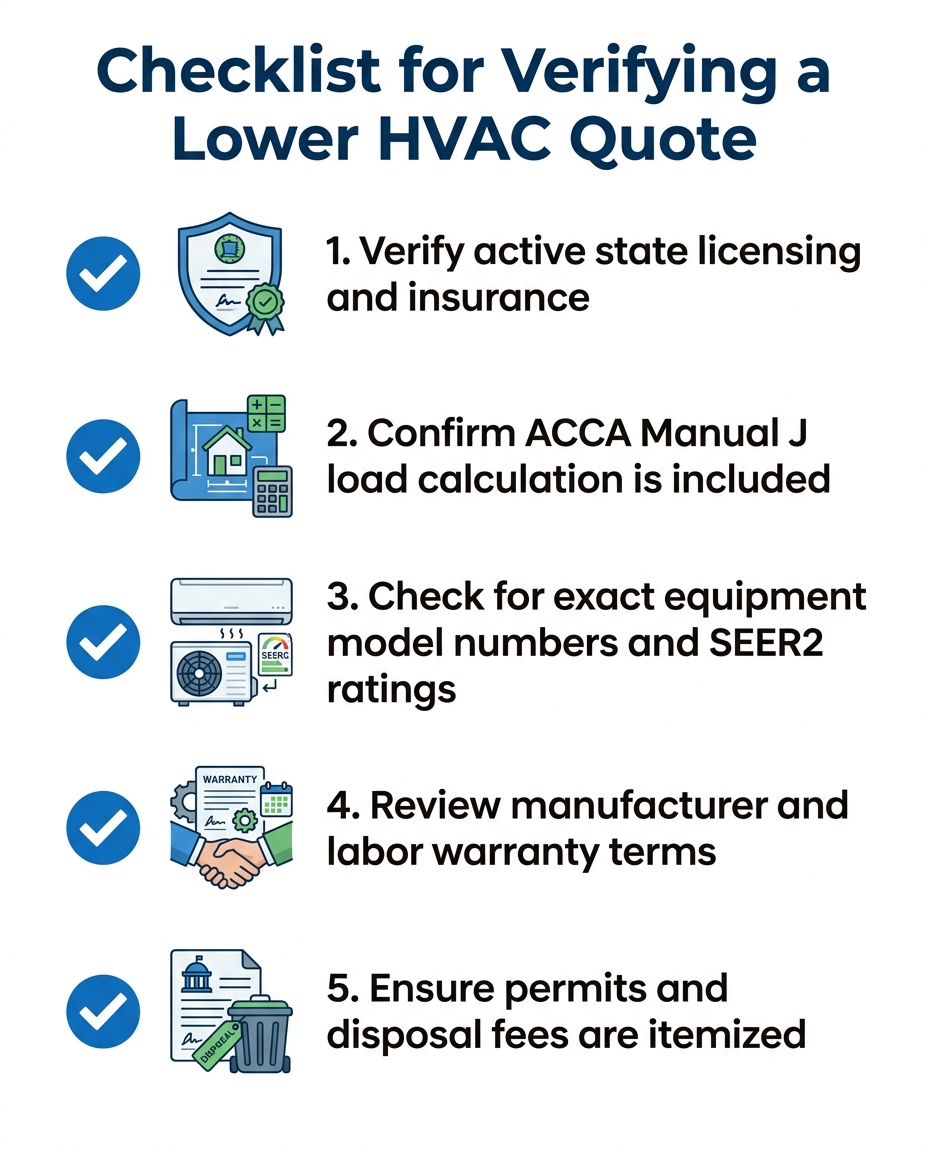
Checklist: Verifying a Lower HVAC Quote is Legitimate
You do not have to guess whether a lower bid is a smart choice or a risky gamble. By verifying a few specific details, you can confidently accept a lower estimate knowing you are getting premium service. Use this checklist to validate any estimate you receive:
• Verify state licensing and full insurance coverage: A legitimate contractor will gladly provide their license number and proof of liability insurance. This protects you and your property during the installation process.
• Confirm a Manual J load calculation was performed: If the contractor simply looked at your old unit and guessed the size, the quote is invalid. Proper sizing requires mathematical calculation.
• Check for exact equipment specifications: The written estimate must include the manufacturer brand, the exact model numbers for both the indoor and outdoor units, the SEER2 rating, and the system capacity (tonnage).
• Review manufacturer warranty details and labor guarantees: Ensure the quote clearly states the length of the manufacturer's parts warranty and the contractor's specific guarantee on their installation labor.
• Ensure all necessary permits and disposal fees are included: A trustworthy quote will itemize the cost of pulling local municipal permits and the fees associated with safely removing and disposing of your old equipment.

Red Flags: When a Low Price Actually is a Problem
While low overhead can yield fantastic savings, it is equally important to recognize the actual warning signs of a bad quote. Differentiating a lean, efficient business from a shady, cut-rate operation protects your home and your wallet. If you encounter any of the following behaviors, the low price is likely masking serious risks.
Estimates given over the phone: No professional can accurately quote a system replacement without a thorough physical inspection of your home's ductwork, electrical panel, and spatial constraints. Phone quotes are almost always bait-and-switch tactics.
Vague line items: If the contract simply says "1 AC unit" or "New Furnace" without specifying the brand and model number, the contractor plans to install the cheapest builder-grade equipment they can find at the supply house that morning.
Refusal to pull local permits: Municipal permits exist to ensure the installation meets strict safety and building codes. A contractor who suggests skipping the permit to save money is actively avoiding third-party safety inspections.
High-pressure sales tactics: If a salesperson demands an immediate signature to lock in a "today only" price, walk away. Legitimate quotes are based on stable equipment and labor costs, not artificial urgency. For more context on navigating these tactics, comparing big box HVAC estimates vs local contractors often reveals how high-pressure environments operate.
How Efficient Local Teams Pass Savings to You
The best contractors in the industry do not compete by cutting corners; they compete by running smarter businesses. Climate Mechanics leverages low overhead and highly efficient local installation teams to provide dramatically lower, honest quotes without compromising the premium quality required to withstand demanding local weather. By maintaining a sharp focus on technical excellence rather than sprawling marketing campaigns, these savings are passed directly to the homeowner.
Specialized, local teams work more efficiently because they know the regional housing stock inside and out. This familiarity reduces labor waste and prevents the unexpected delays that often plague less experienced crews. Skipping massive marketing campaigns allows for honest, transparent pricing from the very first conversation.
Real-World Proof: During a recent brutal summer heatwave, a local family needed a new central air unit installed immediately. The local team not only provided a highly competitive quote but also took the time to offer helpful explanations about the new unit's features and maintenance needs. The family received quick, professional service that restored their comfort without the inflated costs typical of high-overhead competitors. Furthermore, flexible HVAC financing options are often available, making legitimate, high-quality installations even more accessible for homeowners who want premium efficiency without the premium markup.
Frequently Asked Questions About HVAC Estimates
Why do HVAC quotes vary so much?
HVAC quotes vary significantly because you are paying for the company's business model, not just the equipment. Large companies with massive advertising budgets, fleets of vehicles, and heavy administrative overhead must charge more to cover those expenses. Smaller, highly efficient local contractors have lower operating costs, allowing them to offer the exact same equipment at a much better price. Always look at the equipment specifications to ensure you are comparing apples to apples.
What should be included in an HVAC estimate?
A comprehensive HVAC estimate should act as a detailed blueprint for your project. It must include the specific brand, exact model numbers, SEER2 or AFUE ratings, and the tonnage of the proposed equipment. Additionally, it should itemize labor costs, note that a Manual J load calculation was performed, detail all warranty terms, and include the cost of municipal permits and old equipment disposal.
How do I know if an HVAC contractor is legitimate?
You can verify a contractor's legitimacy by checking their credentials and their process. A legitimate contractor will hold an active state license, carry full liability and workers' compensation insurance, and insist on pulling the required local permits for the installation. They will also perform a physical inspection of your home and ductwork rather than giving blind estimates over the phone.
Are cheap HVAC units worth it?
There is a major difference between a cheap, off-brand unit and a premium unit offered at a lower price due to low business overhead. Off-brand, builder-grade units often suffer from lower efficiency, shorter lifespans, and frequent breakdowns, making them more expensive in the long run. However, getting a premium, name-brand unit at a highly competitive price from a lean local contractor is an excellent investment.
Does a higher price mean a better HVAC installation?
No, a higher price does not guarantee a better installation. In many cases, a higher price simply means the company has higher marketing and franchise costs to cover. Installation quality depends entirely on the skill, training, and dedication of the technicians performing the work, which is why researching a local contractor's reputation is far more important than assuming their high price tag equals high quality.
Get an Honest, Low-Overhead Quote for Your Home
The best value for your home comfort always comes from efficient, local experts who prioritize craftsmanship over corporate expansion. If you have received an estimate that feels bloated, or if a high-pressure salesperson is demanding an immediate decision, it is always worth getting a second opinion. You deserve to know exactly what you are paying for, without funding someone else's billboard campaign. If you are ready for a transparent, properly sized, and expertly installed system, reach out to discuss your air conditioning services today and experience the difference that honest, low-overhead pricing can make.
