


Navigating Your September Heating Upgrade
Are you truly prepared for the deep freezes that sweep through South Jersey every winter? As the September pre-heating season arrives, it is the perfect time to evaluate your home's readiness before the bitter cold sets in. If your current heating system is aging, struggling to keep up, or failing entirely, you are likely weighing Standard 80% AFUE Furnaces vs High-Efficiency Models for Cinnaminson Winters. This is a major decision that directly impacts your daily comfort and long-term energy utilization for years to come. Making this choice early in the fall gives you the breathing room to evaluate your home's unique infrastructure without the pressure of an emergency breakdown in the middle of January.
If you are exploring furnace heating systems, our team at Climate Mechanics is ready to help you plan a seamless furnace replacement in Cinnaminson. Over our years of serving South Jersey, we have guided countless homeowners through this exact transition.
The proactive advantage: Upgrading your heating system in early fall allows you to carefully consider the technical differences between standard and high-efficiency units. A furnace is not a one-size-fits-all appliance. The architecture of your home, your long-term living plans, and the severity of local weather all play a crucial role in determining which system makes the most sense. By understanding the specific demands of our regional climate, the choice between an 80% AFUE model and a 90%+ AFUE model becomes much clearer.
What 80% vs 90%+ AFUE Ratings Actually Mean
Before diving into the mechanical differences, it helps to understand exactly how efficiency is measured. Annual Fuel Utilization Efficiency (AFUE) is a measurement of how much fuel your heating system converts directly into usable heat for your home over the course of a typical year. You can think of it as the miles-per-gallon rating for your furnace. The higher the percentage, the less fuel is wasted during the combustion process.
The baseline standard: When you look at 80% vs 90%+ AFUE ratings, the standard 80% AFUE furnace turns 80% of the natural gas or propane it consumes into warm air that circulates through your vents. The remaining 20% escapes as exhaust gas up the chimney or flue. While this might sound like a significant loss, our technicians routinely note that modern 80% units are still far more efficient than the outdated systems installed a few decades ago, which often operated at 60% to 70% efficiency.
The high-efficiency alternative: High-efficiency models, rated at 90% AFUE or higher, are designed to capture almost all the heat generated during combustion, minimizing waste. A 95% AFUE furnace, for example, converts 95% of its fuel into usable heat, allowing only 5% to escape. These percentages dictate your long-term gas efficiency. During periods of heavy usage—like a prolonged South Jersey cold snap—that difference in fuel utilization can have a massive impact on how much energy your home consumes to stay warm.
Infrastructure Realities: Metal Flues vs. PVC Venting
The difference between an 80% and a 90%+ AFUE furnace goes far beyond a simple sticker rating. These two types of systems rely on fundamentally different technologies to generate and exhaust heat. High-efficiency models achieve their impressive ratings by utilizing a secondary heat exchanger. This component extracts additional thermal energy from the combustion gases before they leave the system. However, this advanced process changes the physical requirements for a new furnace installation.
Because the secondary heat exchanger pulls so much heat out of the exhaust, the remaining gases cool down significantly and form an acidic condensation. Traditional metal flues cannot handle this moisture—they would quickly rust and degrade. Therefore, high-efficiency systems require specialized PVC venting that can safely transport the acidic exhaust outside. Furthermore, the system needs a nearby floor drain or a dedicated condensate pump to manage the continuous flow of moisture.
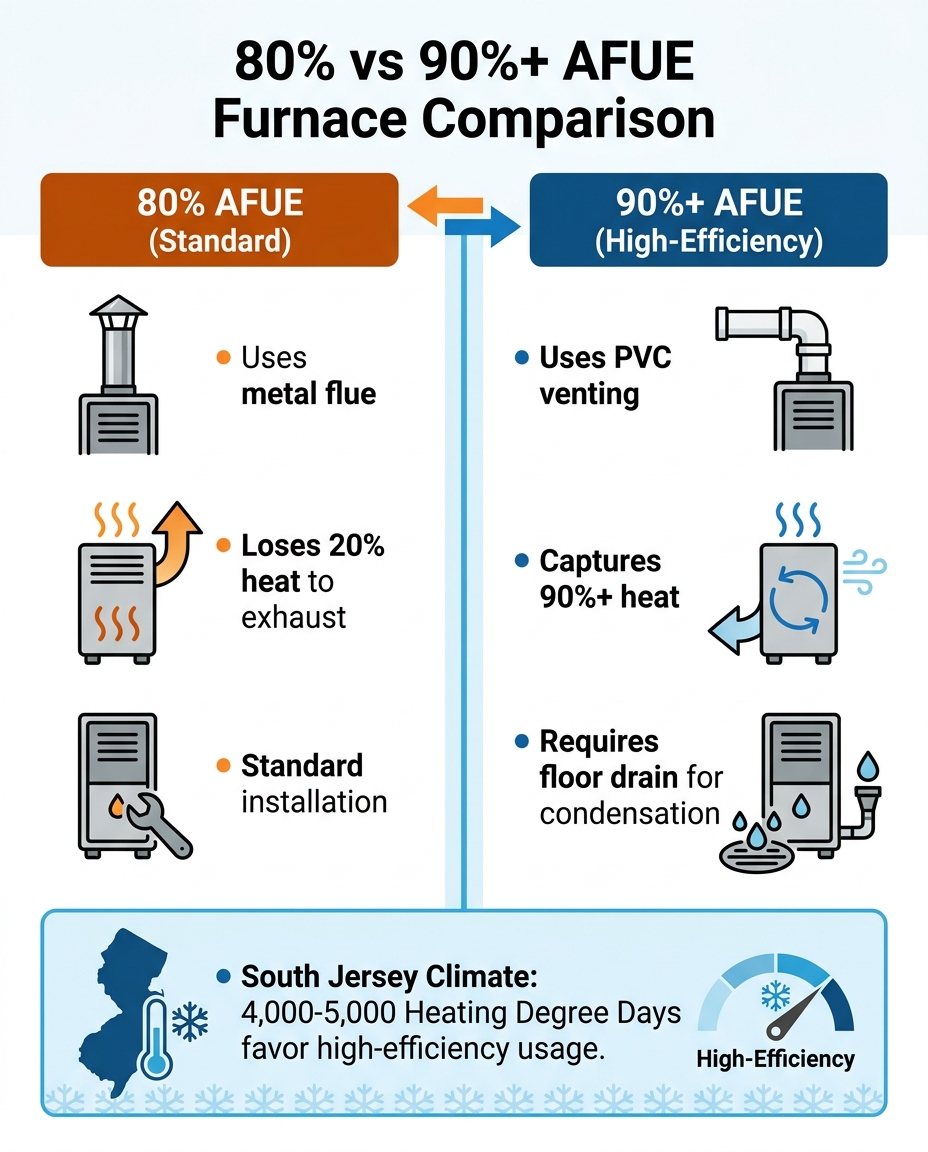
Retrofitting older homes in Cinnaminson, NJ for these requirements adds to the initial complexity of the installation process. At Climate Mechanics, we routinely evaluate Cinnaminson's classic bi-levels and colonials to determine the most practical retrofitting path. To help you visualize the differences, here is a breakdown of the structural requirements:
• Venting Material — Standard 80% AFUE Furnace: Traditional metal flue (often shared with water heater) — High-Efficiency 90%+ AFUE Furnace: Specialized PVC piping (direct vent to the outside)
• Heat Exchangers — Standard 80% AFUE Furnace: Single primary heat exchanger — High-Efficiency 90%+ AFUE Furnace: Primary and secondary heat exchangers
• Moisture Management — Standard 80% AFUE Furnace: Minimal condensation; gases exit hot — High-Efficiency 90%+ AFUE Furnace: Produces acidic condensation; requires floor drain or pump
• Installation Complexity — Standard 80% AFUE Furnace: Generally straightforward swap for older standard units — High-Efficiency 90%+ AFUE Furnace: Often requires structural retrofitting for new vents and drains

How Prolonged Freezing Temperatures Impact Your ROI
When evaluating the return on investment for a heating upgrade, regional climate data is just as important as the equipment's specifications. South Jersey experiences approximately 4,000 to 5,000 Heating Degree Days (HDD) annually. A Heating Degree Day is a measurement designed to quantify the demand for energy needed to heat a building. In areas with high HDD numbers, furnaces run frequently and for extended periods.
Prolonged freezing weather means your heating system is working overtime. This heavy, continuous usage maximizes the percentage of gas saved by a 90%+ AFUE unit compared to milder regions. If you lived in a coastal southern state where the furnace only kicks on a few weeks out of the year, the extra installation effort for a high-efficiency unit might not make sense. But in Cinnaminson, NJ, the severe winter severity and prolonged cold snaps make efficiency ratings much more impactful.
The local expertise advantage: Working with a team like ours at Climate Mechanics that has deep local expertise in South Jersey climates ensures you get an accurate, honest framework for payback periods based on real regional usage patterns, rather than generic national averages. Additionally, generic energy rebates, federal tax credits, and utility incentive programs are frequently available for high-efficiency upgrades. These generic incentives can often help offset the higher initial setup requirements, making the long-term gas efficiency even more appealing.
When a Standard 80% Furnace Makes Sense
Despite the impressive energy utilization of condensing technology, a standard 80% AFUE furnace remains the most practical and logical choice for many homeowners. The decision often comes down to the physical layout of your property and your future plans.
Just recently, a local homeowner seeking a quote for a complex whole-house HVAC installation—including both ducted systems and ductless mini-splits—consulted with our Climate Mechanics team. While exploring their options, they found that our experienced assessment helped clarify their home's unique structural limits, ultimately guiding them toward the most practical equipment choice for their specific architecture.
Based on our field experience, here are the most common scenarios where sticking with an 80% vs 90%+ AFUE rating makes the most sense:
• Structurally prohibitive retrofitting: If your home has a finished basement with drywall ceilings, routing new PVC venting to the exterior and tapping into a floor drain can require significant demolition. In these cases, the structural modifications may outweigh the benefits.
• Short-term homeownership: If you plan to sell your home and move within the next three to five years, you likely will not reside there long enough to see the long-term gas efficiency balance out the initial setup efforts.
• Significant baseline improvements: If you are replacing a furnace from 15 to 20 years ago, upgrading to a modern 80% AFUE unit is still a massive leap in operational efficiency and reliability.
• Faster, simpler installations: Standard furnaces utilize the existing metal flues and do not require complex drainage solutions, resulting in a much faster installation process with fewer disruptions to your home.
When to Invest in High-Efficiency Condensing Technology
On the other side of the equation, upgrading to a 90%+ AFUE model is often the best long-term decision for homeowners looking to maximize their energy utilization and future-proof their property. High-efficiency condensing technology is engineered for peak performance during the harshest winter months.
During a recent busy season, another local customer needed a complete system overhaul, requiring a new central air unit, a heater, and a water heater. Our Climate Mechanics installers provided a highly competitive estimate and completed the extensive installation sooner than expected. Upgrading multiple systems simultaneously often provides the perfect opportunity to implement high-efficiency technology, as the necessary infrastructure changes can be handled all at once.
Consider upgrading to a 90%+ AFUE model if you relate to the following situations:
• Long-term residency: If you plan to stay in your current residence for a decade or more, the continuous gas efficiency will provide compounding value over the lifespan of the equipment.
• Straightforward infrastructure access: Homes with unfinished basements, easily accessible exterior walls, and existing floor drains make running new PVC venting and managing condensation incredibly straightforward.
• Environmental consciousness: Homeowners looking to actively reduce their carbon footprint benefit greatly from condensing technology, as it extracts the maximum amount of usable heat from every unit of fuel consumed.
• Access to generic utility programs: When local utility programs or federal energy initiatives offer generic incentives for high-efficiency upgrades, it can make the advanced technology highly accessible.
Why Early Fall is the Ideal Time for Furnace Decisions
Timing is everything when it comes to major home upgrades. The September pre-heating season is the optimal window to evaluate and replace your heating system. Complex installations, such as retrofitting PVC venting for a high-efficiency unit, are much easier to schedule and execute before the first freeze hits and local technicians are overwhelmed with no-heat emergencies.
Waiting for an aging system to fail entirely almost always leads to rushed decisions. When your house is freezing, you do not have the luxury of carefully weighing 80% vs 90%+ AFUE ratings or calculating long-term efficiency—you simply need heat immediately. If your heater makes knocking sounds, struggles to reach the set temperature, or requires frequent repairs, those are strong indicators that the unit needs professional evaluation now, not in December.
To ensure your home is ready, follow this early fall checklist we recommend to all our customers:
1. Assess system age: If your furnace is over 15 years old, begin researching replacement options now.
2. Monitor for unusual noises: Grinding, banging, or rattling sounds indicate mechanical wear and tear that will likely fail under heavy winter strain.
3. Review recent energy bills: Unexplained spikes in your gas utilization often point to a system that is losing its efficiency.
4. Schedule a professional tune-up: Booking routine furnace maintenance allows a technician to give you an honest assessment of the unit's remaining lifespan.
Proactive Replacement vs. Emergency Swaps
The difference between a proactive replacement and an emergency swap is significant. Emergency replacements often limit you to whatever inventory is immediately available on the truck or in the local warehouse. You may be forced to settle for a standard unit when you really wanted high-efficiency technology, simply because the complex retrofitting cannot be accommodated during an emergency freeze response. Proactive planning in the fall allows ample time to calculate whether the high-efficiency upgrade fits your specific home architecture and to schedule the work at your convenience.
Make a Confident Choice for Your Winter Comfort: Standard 80% AFUE Furnaces vs High-Efficiency Models for Cinnaminson Winters
Ultimately, the choice between an 80% and a 90%+ AFUE furnace comes down to balancing installation complexity with your goals for long-term gas efficiency. Standard 80% models offer a straightforward, highly reliable upgrade path for homes where complex retrofitting is impractical. High-efficiency 90%+ models, on the other hand, provide superior fuel utilization that pays dividends during the prolonged, freezing temperatures we experience in South Jersey.
The most important step is making this decision before the harsh winter weather arrives. Getting a professional, localized assessment of your home's infrastructure will provide the clarity you need. If you are ready to explore your options, reach out to our team at Climate Mechanics to discuss a furnace replacement in Cinnaminson, and ensure your home remains safe, warm, and efficient all season long.
Frequently Asked Questions
What is the difference between 80% and 90% AFUE?
The primary difference lies in how much fuel is converted into usable heat versus how much is lost as exhaust. An 80% AFUE furnace converts 80% of its fuel into heat and loses 20% through the flue. A 90%+ AFUE furnace uses a secondary heat exchanger to capture almost all the thermal energy, losing less than 10% to exhaust, which makes it far more efficient for long-term gas utilization.
Can I replace an 80 furnace with a 90?
Yes, you can replace an 80% AFUE furnace with a 90%+ model, but it is not a simple swap. High-efficiency models require structural retrofitting, including the installation of specialized PVC venting to handle acidic exhaust and a drainage system for the resulting condensation. A professional assessment is required to determine if your home's layout can accommodate these changes.
What are the venting requirements for a high-efficiency furnace?
High-efficiency condensing furnaces require dedicated PVC piping for venting, rather than traditional metal flues. Because the secondary heat exchanger pulls so much heat from the exhaust, the remaining gases are cool and acidic, which would quickly corrode metal. The PVC pipes typically vent directly through a sidewall or the roof to safely expel the exhaust outside.
Is a 95% efficient furnace worth it in New Jersey?
For many homeowners in New Jersey, a 95% efficient furnace is highly beneficial due to the region's severe winter climate. The area experiences thousands of Heating Degree Days annually, meaning the system runs continuously for months. This heavy, prolonged usage maximizes the fuel utilization benefits of condensing technology, making the initial installation efforts highly worthwhile for long-term residents.
How does a secondary heat exchanger work in a condensing furnace?
A secondary heat exchanger captures the combustion gases after they pass through the primary heat exchanger. It cools these gases down further to extract the last remaining bits of thermal energy, transferring that heat into your home's airflow. This process causes the gases to condense into a liquid state, which is why these systems require a floor drain or condensate pump to manage the moisture.
